
If you are the widow of a wartime veteran, you may qualify for up to $18,697 a year in tax-free care support. Many surviving spouses never apply because they assume benefits ended when their husband passed away.
That assumption can cost your household over $1,550 every month in lost help. VA Aid and Attendance helps cover in-home caregivers, assisted living, or nursing home bills on a fixed income.
Your spouse did not need combat service or a disability rating for you to qualify. Learning how these veterans widow benefits work puts vital cash back into your monthly budget.
In this guide7 sections
- What VA Aid and Attendance Really Is—and Why Widows Miss It
- Who Qualifies: Service, Marriage, and Medical Rules
- 2026 Payment Rates and How Medical Bills Unlock the Benefit
- Net Worth Limits and the 36-Month Look-Back Trap
- How to Apply Without Delaying Your Effective Date
- Avoiding “Pension Poaching” Scams and Bad Advice
- Frequently Asked Questions

What VA Aid and Attendance Really Is—and Why Widows Miss It
Many families treat VA Aid and Attendance as a standalone program, but it is an enhanced payment tier added to the VA Survivors Pension. This tax-free, needs-based benefit helps unremarried surviving spouses pay for everyday living and long-term care.
A smaller Housebound tier exists for survivors who rarely leave home, though you cannot collect both additions together. If your spouse died from a service-connected condition, you may qualify for Dependency and Indemnity Compensation (DIC) instead.
You cannot receive DIC and a Survivors Pension at the same time, so the U.S. Department of Veterans Affairs (VA) pays whichever benefit is higher. Unlike DIC, Survivors Pension requires no link between military service and cause of death.
In fiscal year 2025, 87,853 survivors received a VA pension nationwide, with 77% over age 75 and 63.2% receiving the Aid and Attendance tier. Total pension enrollment, counting veterans and survivors, dropped roughly 10.5% from the prior year.
Many widows overlook this support because they believe combat duty is mandatory or think benefits only go to veterans who applied while alive. Neither rule applies to surviving spouses seeking help today.
Who Qualifies: Service, Marriage, and Medical Rules
To qualify for veterans benefits as a surviving spouse, your late husband or wife needed a discharge other than dishonorable. Required active-duty length depends on when the veteran entered military service.
Veterans who entered active duty on or before September 7, 1980, needed at least 90 active days. Those entering after September 7, 1980, generally needed 24 months of active duty or the full period called to service.
At least one active-duty day must fall during World War II (Dec. 7, 1941–Dec.
31, 1946), the Korean Conflict (June 27, 1950–Jan. 31, 1955), or the Gulf War (Aug.
2, 1990–present). Overseas combat deployment is not required.
For the Vietnam War era, service inside Vietnam counts from November 1, 1955, through May 7, 1975. Service outside Vietnam qualifies from August 5, 1964, through May 7, 1975.
There is no minimum age limit for surviving spouses, though you must not have remarried after the veteran’s death. You also must have lived together continuously until death, barring separations for health, work, or the veteran’s misconduct.
In addition, you must have been married to the veteran for at least one year prior to death, had a child together, or married during active duty. You did not need to be married during wartime service itself.
To receive the Aid and Attendance tier, a physician, nurse practitioner, or physician assistant must certify that you meet at least one clinical requirement:
- You need regular help from another person with daily tasks such as bathing, dressing, feeding, toileting, or staying safe from daily hazards.
- Your health condition leaves you largely bedridden.
- You reside in a nursing home because of mental or physical incapacity.
- Your corrected vision is 5/200 or worse in both eyes, or your visual field is contracted to 5 degrees or less.

2026 Payment Rates and How Medical Bills Unlock the Benefit
The VA sets a Maximum Annual Pension Rate (MAPR) each year, which acts as a ceiling rather than an automatic flat check. Your actual payment equals the gap between your applicable cap and your countable annual income.
Through November 30, 2026, a single surviving spouse qualifying for Aid and Attendance can receive up to $18,697 per year, or about $1,558 monthly. The 2026 annual maximums across survivor tiers appear below.
| Benefit Tier (Through Nov. 30, 2026) | Surviving Spouse (No Dependent Child) | Surviving Spouse (1 Dependent Child) |
|---|---|---|
| Basic Survivors Pension | $11,699 / year (~$975 / month) | $15,311 / year |
| Housebound Tier | $14,298 / year (~$1,192 / month) | $17,902 / year |
| Aid and Attendance Tier | $18,697 / year (~$1,558 / month) | $22,304 / year |
If you care for more than one dependent child, each additional child adds $2,984 per year to your annual cap. Working dependent children can also exclude up to $16,100 in annual wages.
Pension caps adjust every December 1 to match the Social Security cost-of-living adjustment (COLA). On October 14, 2026, the Social Security Administration (SSA) announced a 3.6% COLA for 2027, lifting the projected single-survivor Aid and Attendance cap to roughly $19,370.
Many widows assume their Social Security check exceeds the $18,697 ceiling, so they skip applying. However, recurring out-of-pocket medical bills can lower your countable income down to zero.
The VA lets you deduct Unreimbursed Medical Expenses (UMEs) that exceed 5% of your base pension rate. In 2026, that deductible floor is $584 for a single surviving spouse or $765 with one dependent child.
Qualifying deductions include assisted living, nursing home care, paid in-home caregivers, prescriptions, and Medicare Part B premiums. Per the Centers for Medicare & Medicaid Services (CMS), standard Part B premiums rise from $202.90 monthly in 2026 to $209.40 in 2027.
Suppose your Social Security and pension total $28,000 a year, and you pay $32,400 annually for assisted living and Part B premiums. Subtracting the $584 medical floor yields $31,816 in deductions, reducing your countable VA income to zero.
Because your countable income drops to zero, you qualify for the full $18,697 Aid and Attendance payment. That tax-free check covers well over half of your annual care bills.
Net Worth Limits and the 36-Month Look-Back Trap
Income is only half of the financial test because the VA also caps your total wealth. Through November 30, 2026, applicants face a $163,699 net worth cap, projected to rise by 3.6% to roughly $169,591 in December 2026.
The VA calculates net worth by adding your countable savings, investments, and property to your annual countable income. Only your own assets and any dependent child’s assets count toward this threshold.
Several major belongings stay off the balance sheet completely. Your primary residence on a lot up to two acres, one personal vehicle, and typical household furnishings are excluded from net worth.
Before submitting a claim, pay close attention to the VA’s 36-month look-back period. If you gave away money or shifted assets into certain trusts below fair market value within three years of filing, the VA may impose a penalty.
This penalty applies only when keeping those transferred assets would have pushed your net worth over the limit. The VA divides the excess transferred amount by the 2026 monthly divisor of $2,874 to block benefits for up to 60 months.
For example, gifting $57,480 that pushed you over the cap creates a 20-month denial period. Returning gifted assets before filing—or within a 60-day cure window after a penalty notice—can reduce or eliminate that penalty.
How to Apply Without Delaying Your Effective Date
Waiting until every discharge paper and invoice sits on your kitchen table can cost you months of retroactive payments. Follow these five steps to protect your start date and file an accurate application:
- Submit VA Form 21-0966 (Intent to File) online at VA.gov or by mail before gathering records. This step locks in your effective start date and gives you one full year to complete your claim.
- Gather your spouse’s DD-214 discharge papers, death certificate, your marriage certificate, bank statements, and recurring care contracts or receipts.
- Ask your physician, nurse practitioner, or physician assistant to sign VA Form 21-2680 documenting your daily care needs. If you reside in a nursing home, have the facility complete VA Form 21-0779.
- Submit VA Form 21P-534EZ online through VA.gov or mail your packet to the VA Pension Intake Center, P.O. Box 5365, Janesville, WI 53547-5365.
- Have a VA-accredited Veterans Service Officer (VSO) or your county veterans office review your entire application for free before sending it.
While your claim is pending, check Benefits.gov to screen for food, utility, or state property tax relief programs. Pairing local aid with veterans benefits stretches a fixed retirement budget much further.
Avoiding “Pension Poaching” Scams and Bad Advice
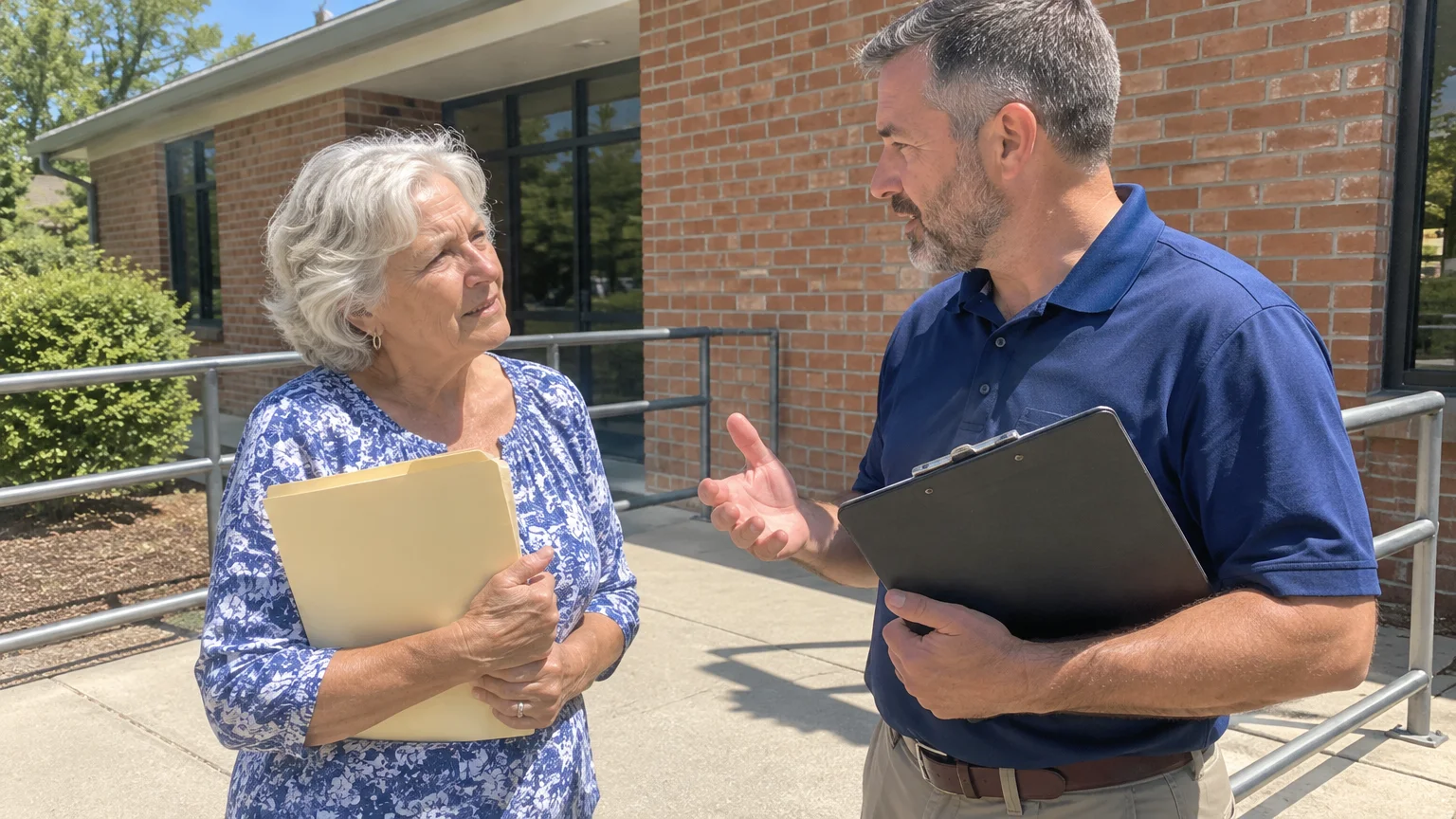
Complex eligibility rules attract aggressive marketers who target older widows through schemes known as pension poaching. Unaccredited consultants frequently charge steep consultation fees or push unsuitable financial products disguised as claim help.
Under federal law, no one—not even a VA-accredited attorney or claims agent—may charge a fee to prepare or file an initial VA pension claim. Paid representation is lawful only after an initial VA decision during an appeal.
Be wary of advisers urging you to lock savings into irrevocable trusts or deferred annuities just to pass the net worth cap. Those moves often trigger three-year look-back penalties, trap funds needed for care, and complicate future Medicaid eligibility.
Always verify VA accreditation on VA.gov and rely on a free VSO or state veterans office. You can also learn common elder financial scam tactics from the Consumer Financial Protection Bureau (CFPB).
Frequently Asked Questions
Can I qualify if my husband never served in combat or filed a VA claim?
Yes, your late spouse only needed to meet the active-duty wartime service requirement and receive an other-than-dishonorable discharge. Combat deployment and prior VA disability ratings are not required for a Survivors Pension.
Is VA Aid and Attendance considered taxable income?
No, VA Survivors Pension and Aid and Attendance payments are completely tax-free at the federal level. You do not report these monthly deposits as taxable income on your tax return.
Can I pay a family member for in-home care and deduct it?
Yes, the VA allows you to deduct out-of-pocket payments to family members or friends providing in-home care, alongside agency bills. Keep signed caregiver agreements, detailed invoices, and canceled checks or bank records to verify expenses.
What happens if my spouse died from a service-connected condition?
You should apply for Dependency and Indemnity Compensation (DIC), which pays monthly benefits regardless of your income or net worth. If you qualify for both programs, the VA automatically pays whichever benefit is higher.
Should I give money to my children so I meet the net worth limit?
Do not transfer assets without checking the 36-month look-back rule first. Giving away savings below fair market value can trigger up to five years of VA ineligibility when you need care most.
For official financial guidance for seniors, visit National Institute on Aging (NIA), Administration for Community Living (ACL) and Eldercare Locator.
Disclaimer: This article is for informational purposes and is not a substitute for professional financial or tax advice. Consult with a certified financial planner or tax professional for guidance on your specific situation.