
Year-end retirement deadlines can trigger costly tax surprises if you overlook them. Taking the right steps with your traditional IRA and 401(k) accounts safeguards your hard-earned savings from steep IRS penalties.
If you must take a 2026 Required Minimum Distribution (RMD), you have critical choices to make before December 31. Understanding withdrawal rules, charitable giving tools, and conversion limits keeps more money in your pocket.
Planning your year-end retirement moves now ensures you satisfy distribution rules while avoiding unnecessary income taxes. Let us walk through the essential deadlines and strategies you need to know.
In this guide8 sections
- Know Your 2026 RMD Deadlines and Starting Ages
- Crucial Differences Between IRA and 401(k) Withdrawals
- Lower Your Taxable Income with Qualified Charitable Distributions
- Navigating Roth Conversions and the First-Dollar Rule
- Managing 2026 Tax Brackets and Medicare IRMAA Surcharges
- Common Year-End RMD Pitfalls to Avoid
- Step-by-Step Year-End Retirement Checklist
- Frequently Asked Questions
Know Your 2026 RMD Deadlines and Starting Ages
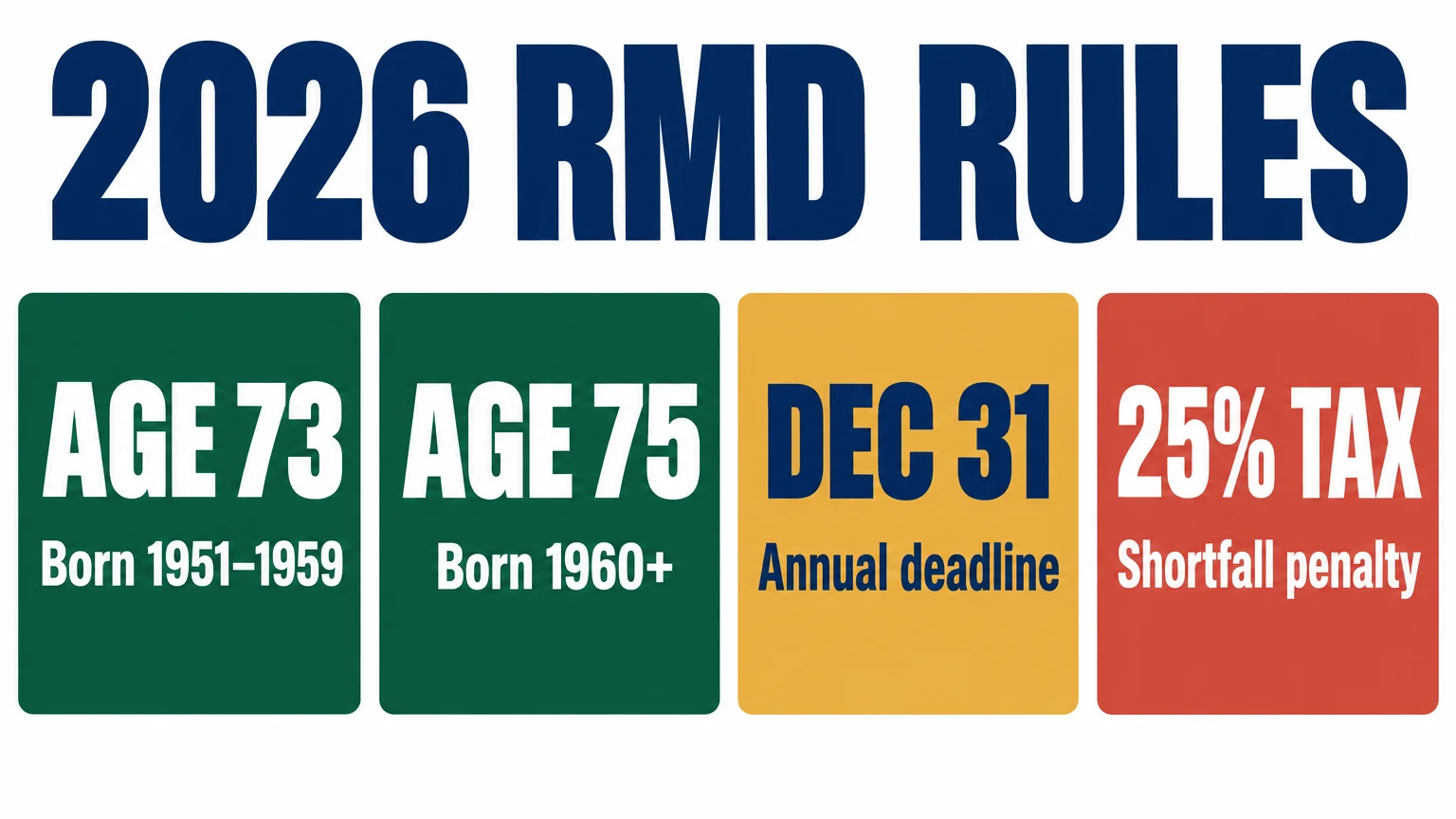
Under current law, seniors born between 1951 and 1959 must begin taking distributions at age 73. If you were born in 1960 or later, your required starting age increases to 75.
Most retirees must complete their annual withdrawals by December 31, 2026. Failing to withdraw the full amount triggers a 25% IRS excise tax on the shortfall.
You can reduce that penalty to 10% if you correct the error quickly and submit IRS Form 5329. Meeting the rmd deadline prevents this avoidable cost.
If you reach age 73 during 2026, you can delay your initial distribution until April 1, 2027. However, delaying means you must take two full taxable distributions during 2027.
Crucial Differences Between IRA and 401(k) Withdrawals
Traditional IRAs and employer plans follow distinct distribution guidelines. You can calculate the total required amount for all your traditional IRAs and withdraw it from a single account.
Workplace accounts operate under stricter aggregation restrictions. You must calculate and withdraw the required distribution from each individual 401(k) plan separately.
Roth IRAs require zero distributions during your lifetime. Designated workplace Roth 401(k) accounts are also exempt from lifetime distribution mandates under current ira rules.
If you remain employed past age 73, your company plan may allow you to delay distributions until retirement. This still-working exception applies only if you own 5% or less of the business.
As noted by consumer advocates at the Consumer Financial Protection Bureau (CFPB), understanding your account types protects you from unexpected withdrawal fees and penalties.
Lower Your Taxable Income with Qualified Charitable Distributions
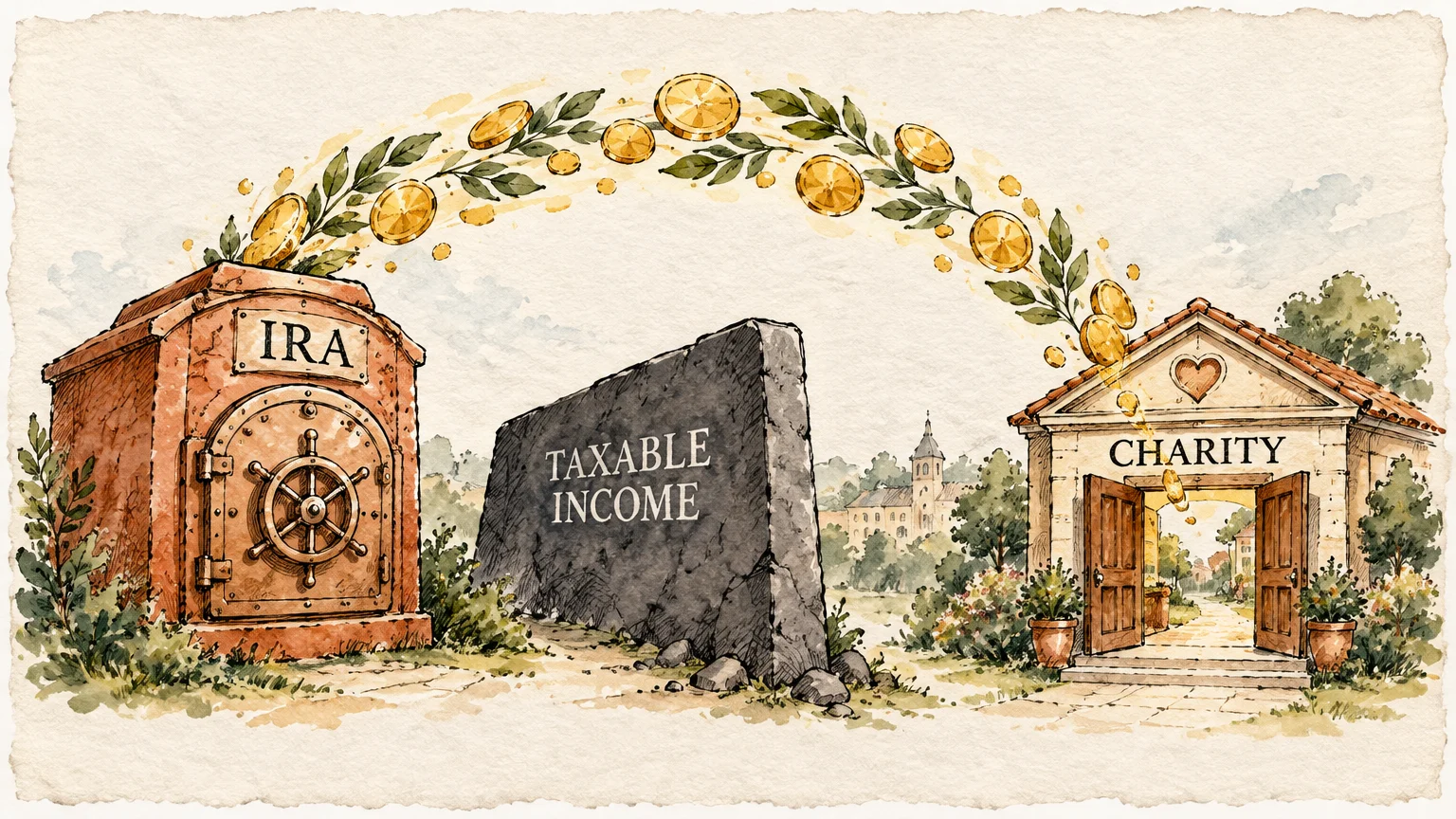
If you are age 70½ or older, you can utilize a Qualified Charitable Distribution (QCD). This strategy allows you to send funds directly from an IRA to a qualified non-profit organization.
In 2026, you can donate up to $111,000 directly from your IRA without counting the withdrawal as taxable income. Married couples filing jointly can donate up to $222,000 from separate IRAs.
A QCD satisfies your distribution obligation dollar-for-dollar up to the legal cap. It lowers your adjusted gross income, which helps preserve valuable deductions.
Remember that QCDs are optional and apply exclusively to traditional IRAs. You cannot make a charitable distribution directly from an employer 401(k) plan.
The IRS ordering rule dictates that your earliest distributions count toward your annual withdrawal requirement first. Complete charitable transfers before taking regular withdrawals to maximize your tax benefits.
Navigating Roth Conversions and the First-Dollar Rule
Converting pre-tax balances into a Roth account creates future tax-free growth. You must finish any conversion by December 31, 2026, to count for the current tax year.
If you owe an annual distribution, you must withdraw that full amount before converting any remaining funds. The IRS strictly prohibits converting required distribution dollars into a Roth account.
Because conversions generate ordinary taxable income, evaluate your current tax bracket carefully. Converting too much balance at once can push you into a higher federal tax tier.
Guidance from the Social Security Administration (SSA) highlights that higher taxable income can also cause a larger portion of your Social Security benefits to be taxed.
Managing 2026 Tax Brackets and Medicare IRMAA Surcharges
Your year-end retirement moves directly affect your modified adjusted gross income. In 2026, the 12% federal income tax bracket tops out at $50,400 for singles and $100,800 for married couples.
The 22% bracket reaches $105,700 for single filers and $211,400 for joint returns. Keeping your taxable withdrawals within these boundaries controls your annual tax bill.
Taxpayers age 65 and older can claim an extra $6,000 deduction under the One Big Beautiful Bill Act. This deduction phases out when income exceeds $75,000 for singles or $150,000 for couples.
Additionally, your 2026 income determines your 2028 Medicare Part B and Part D premiums under Income-Related Monthly Adjustment Amount (IRMAA) rules.
According to the Centers for Medicare & Medicaid Services (CMS), exceeding specific income tiers triggers higher monthly surcharges two years later.
Reviewing your expected gross income before December 31 prevents you from crossing an IRMAA cliff. You can consult Medicare.gov to track how premium surcharges apply across different income thresholds.
Common Year-End RMD Pitfalls to Avoid
Waiting until the final week of December creates unnecessary risk. Many financial institutions enforce internal cutoffs days before December 31 to process paperwork.
Another frequent mistake involves liquidating investments when you prefer to stay invested. You can satisfy your distribution by transferring securities in-kind directly into a taxable brokerage account.
Failing to review inherited accounts also leads to unexpected penalties. Beneficiaries subject to recent rules must often take annual distributions during the mandatory 10-year payout window.
Finally, never withdraw funds from a single employer plan to satisfy another 401k year end obligation. Each workplace account requires separate management to remain compliant.

Step-by-Step Year-End Retirement Checklist
Use this reference table to organize your final account steps before the year ends:
| Account Action | Applicable Accounts | Year-End Deadline | Key Rule to Remember |
|---|---|---|---|
| Annual RMD Withdrawal | Traditional IRA, 401(k) | December 31, 2026 | 401(k) plans cannot be combined to satisfy distributions. |
| Qualified Charitable Distribution | Traditional IRAs only | December 31, 2026 | Cap is $111,000; funds must transfer directly to charity. |
| Roth Conversion | Traditional IRA, 401(k) | December 31, 2026 | Satisfy your full distribution before converting balances. |
| First-Year RMD Grace Period | First distribution at age 73 | April 1, 2027 | Delaying requires taking two distributions during 2027. |
Review each retirement account statement today to confirm your total withdrawals. Starting early gives you ample time to complete transfers without stressful processing delays.
Frequently Asked Questions
Do Roth accounts require minimum distributions in 2026?
No. Original owners of Roth IRAs and designated Roth 401(k) plans do not have to take required minimum distributions during their lifetimes.
Can I donate my 401(k) distribution directly to charity using a QCD?
No. Qualified Charitable Distributions apply only to traditional IRAs. Workplace plans like 401(k)s do not qualify for direct charitable transfers.
What happens if I miss the December 31 RMD deadline?
The IRS imposes a 25% excise tax on the shortfall. You can reduce this penalty to 10% by taking the distribution promptly and filing Form 5329.
Can I transfer stock shares instead of cash to satisfy my RMD?
Yes. You can complete an in-kind transfer of shares from your retirement account to a taxable brokerage account using the market value on the transfer date.
If I turned 73 in 2026, should I wait until April 1, 2027 to take my first RMD?
While legally permitted, waiting means taking two separate distributions during 2027. This double withdrawal could push your income into a significantly higher tax bracket.
For additional senior resources, visit
Eldercare Locator, AARP, Alzheimer’s Association, American Heart Association and Benefits.gov.
Disclaimer: The information in this article is for educational purposes only and is not intended to be a substitute for professional financial, legal, or medical advice. Always consult with a qualified expert for advice tailored to your personal situation.