

You can eliminate federal income taxes on your retirement benefits by building your financial reserves inside a Roth IRA. This strategic account creates tax-free cash flow that federal tax formulas completely ignore.
Many retirees discover too late that standard investment withdrawals directly trigger surprise taxes on their monthly benefits. Taking control of your accounts today shields your fixed income for life.
With proper planning, you can legally maintain your provisional income below federal taxation thresholds. Here is your comprehensive guide to protecting your hard-earned benefits from the tax collector.
In this guide9 sections
- The Social Security Tax Trap: How Benefits Become Taxable
- The IRS Formula: Calculating Your Provisional Income
- The Secret Weapon: Why Roth IRAs Shield Your Benefits
- Real-World Numbers: Traditional IRA vs. Roth IRA in Action
- Protecting the New Enhanced Senior Deduction
- The Retirement Gap Strategy: Timing Your Roth Conversions
- The Multi-Bucket Withdrawal Blueprint for Retirees
- Common Pitfalls, IRMAA Traps, and Financial Scams
- Frequently Asked Questions
The Social Security Tax Trap: How Benefits Become Taxable
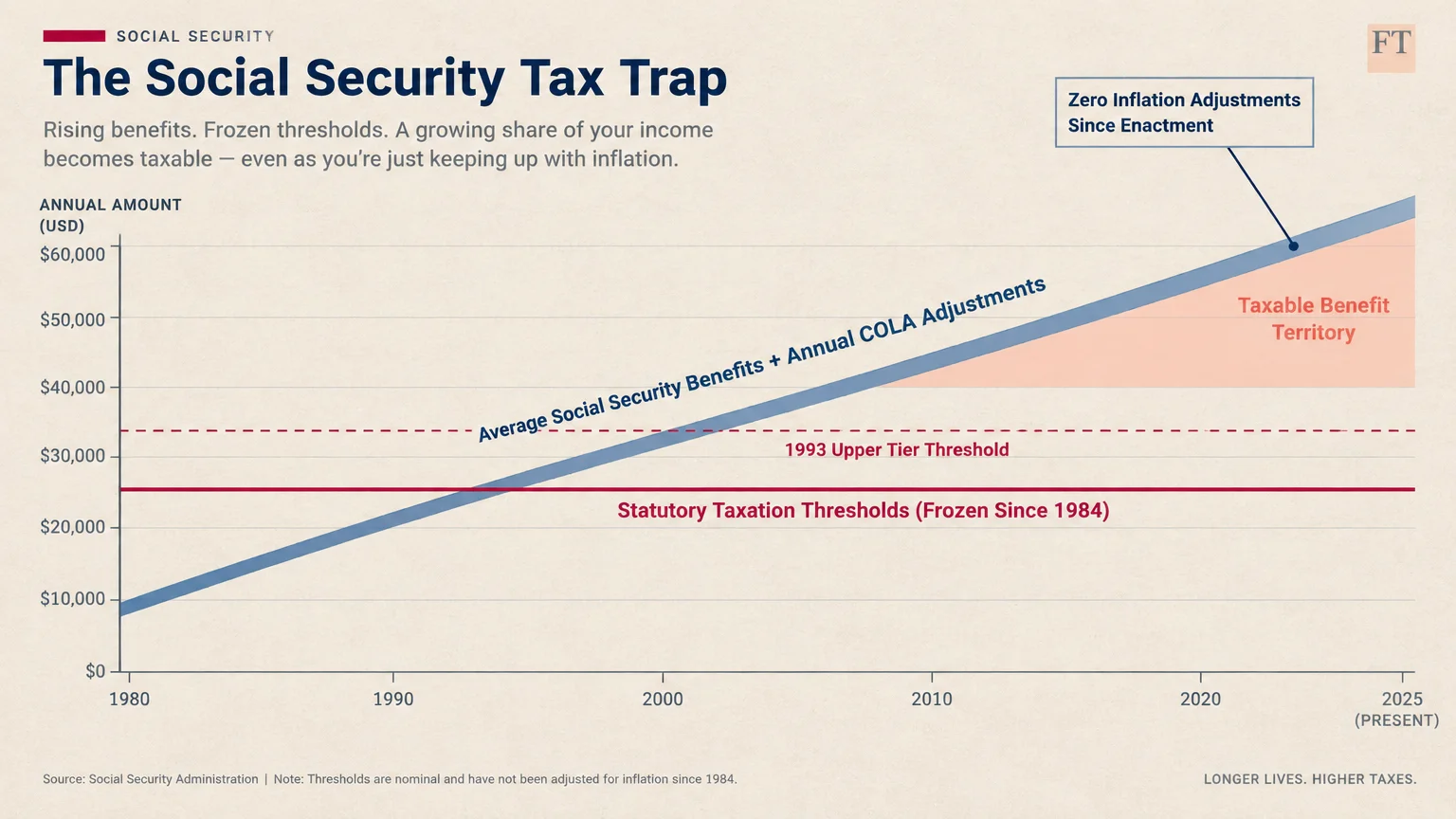
For nearly fifty years after its inception in 1935, Social Security was entirely exempt from federal income taxation. That fundamental promise changed dramatically in 1983 when lawmakers enacted significant bipartisan tax reforms.
According to the Social Security Administration (SSA), millions of seniors now surrender a meaningful portion of their monthly checks to federal taxes. This unexpected liability catches many retirees completely unprepared.
The primary driver behind this growing tax burden is the complete absence of inflation adjustments. Lawmakers established static taxation thresholds in 1984 and 1993, and those limits have never shifted upward with economic inflation.
Because cost-of-living adjustments steadily increase monthly benefit amounts, seniors naturally drift into higher tax brackets over time. What Congress originally designed as a levy on affluent retirees now impacts middle-income seniors on modest fixed budgets.
Every time you receive an annual cost-of-living increase, your nominal income rises. Unfortunately, those higher payments frequently push your overall income beyond the frozen thresholds, eroding your purchasing power.
Drawing supplementary living expenses from traditional retirement accounts compounds this fiscal problem. Distributions from pre-tax plans function as taxable fuel that accelerates the taxation of your benefits.
You spent decades paying FICA payroll taxes out of every paycheck you earned. Watching the federal government tax those same dollars during retirement feels deeply unfair and disrupts financial stability.
Understanding how the federal government evaluates your household earnings is the essential first step toward reclaiming your independence. You do not have to accept benefit taxation as an unavoidable reality.
The IRS Formula: Calculating Your Provisional Income
The Internal Revenue Service does not evaluate your tax liability using standard gross income alone. Instead, the agency uses a specialized calculation known as provisional income or combined income.
According to IRS.gov guidelines, this specific calculation determines whether zero, 50 percent, or up to 85 percent of your benefits face taxation. The formula contains three distinct components.
To compute your provisional income, begin with your Adjusted Gross Income, which includes wages, pensions, and taxable investment distributions. Next, add all tax-exempt interest payments, such as municipal bond yields.
Finally, add exactly 50 percent of your total annual Social Security benefit to that preliminary sum. The final number represents your provisional income for that specific tax year.
Many seniors falsely assume that investing in municipal bonds protects their monthly benefits from taxation. While municipal bond interest avoids regular federal tax, the IRS explicitly includes it in the provisional income formula.
The statutory thresholds remain frozen at levels established decades ago. For individual filers, keeping your provisional income below $25,000 ensures that zero percent of your benefits face federal taxation.
If your provisional income falls between $25,000 and $34,000 as a single filer, up to 50 percent of your benefits become taxable. Provisional income exceeding $34,000 exposes up to 85 percent of your benefits to taxes.
Married couples filing jointly receive a baseline threshold of $32,000 for total tax exemption. Combined income between $32,000 and $44,000 makes up to 50 percent of your joint benefits taxable.
Once a married couple generates provisional income exceeding $44,000, up to 85 percent of their benefits face federal taxation. Crossing this boundary even by a single dollar increases your tax bill.
| Filing Status | 0% Benefits Taxed | Up to 50% Benefits Taxed | Up to 85% Benefits Taxed |
|---|---|---|---|
| Single, Head of Household, or Surviving Spouse | Under $25,000 | $25,000 to $34,000 | Over $34,000 |
| Married Filing Jointly | Under $32,000 | $32,000 to $44,000 | Over $44,000 |
These compressed thresholds mean that even small distributions from traditional retirement savings can trigger substantial tax spikes. Managing your reported provisional income requires precision and disciplined planning.

The Secret Weapon: Why Roth IRAs Shield Your Benefits
The Roth IRA provides an ironclad defense against the taxation of your Social Security benefits. Qualified distributions from a Roth IRA are completely tax-free and do not register inside the provisional income formula.
Because you funded the account with money that was already taxed, you owe zero income tax upon withdrawal. The IRS excludes qualified Roth distributions entirely from your Adjusted Gross Income.
Because Roth withdrawals never enter your AGI, they produce zero impact on your provisional income calculation. You can withdraw thousands of dollars for living expenses without increasing the taxable portion of your benefits.
Traditional retirement vehicles like 401(k) plans and traditional IRAs work against you during retirement. Every dollar you withdraw from a traditional account inflates your AGI and pushes your benefits into higher tax tiers.
Furthermore, Roth IRAs do not mandate Required Minimum Distributions during your lifetime. Traditional accounts force you to take taxable distributions starting at age 73, whether you need the money or not.
These mandatory traditional withdrawals often push seniors directly into the 85 percent taxation bracket. A Roth IRA preserves your autonomy, allowing you to withdraw funds only when personal circumstances dictate.
To guarantee that your distributions qualify as completely tax-free, you must observe two simple conditions. You must reach age 59½, and your account must satisfy the statutory five-year rule.
You can withdraw your original cash contributions at any time and at any age without taxes or penalties. The five-year clock applies strictly to accumulated investment growth and converted balances.
By establishing a well-funded Roth IRA, you construct a dependable financial firewall around your monthly benefits. You preserve your spendable income without paying tribute to outdated tax formulas.
Real-World Numbers: Traditional IRA vs. Roth IRA in Action
Reviewing concrete figures clarifies the remarkable tax savings that a Roth IRA generates. Consider two hypothetical married couples who require identical annual household income during retirement.
Both couples receive $36,000 each year in joint Social Security benefits, which equals $3,000 per month. Both households require an additional $30,000 in personal savings withdrawals to cover their basic living expenses.
Couple A relies on a traditional IRA to supply their supplemental income. When they withdraw $30,000 from their traditional account, that full sum counts as Adjusted Gross Income on their federal return.
To calculate their provisional income, Couple A adds half their benefit ($18,000) to their $30,000 AGI. Their total provisional income reaches $48,000, easily exceeding the $44,000 married filing jointly threshold.
Because their provisional income surpasses $44,000, up to 85 percent of their Social Security benefits become subject to income taxes. That creates up to $30,600 of extra taxable income on their annual tax return.
Couple B covers their living expenses by withdrawing the identical $30,000 from an established Roth IRA. Because qualified Roth distributions carry zero tax liability, their reported Adjusted Gross Income is $0.
Couple B calculates their provisional income using only half of their Social Security benefits, which totals $18,000. That figure falls well below the $32,000 tax-free ceiling for married couples.
Because their provisional income remains below $32,000, exactly zero percent of Couple B’s Social Security benefits face federal taxes. They enjoy the exact same total spending power while keeping their tax bill at zero.
| Financial Factor | Scenario A: Traditional IRA | Scenario B: Roth IRA |
|---|---|---|
| Annual Social Security Benefits | $36,000 | $36,000 |
| Personal Retirement Withdrawal | $30,000 (Traditional) | $30,000 (Roth) |
| Adjusted Gross Income (AGI) | $30,000 | $0 |
| Provisional Income Calculation | $30,000 + $18,000 = $48,000 | $0 + $18,000 = $18,000 |
| Federal Threshold Triggered | Over $44,000 (85% Tier) | Under $32,000 (0% Tier) |
| Taxable Social Security Amount | Up to $30,600 | $0 |
| Total Taxable Income Reported | $60,600 | $0 |
This direct comparison demonstrates that account structure matters just as much as your overall net worth. Selecting the right withdrawal source preserves thousands of dollars every year.
Protecting the New Enhanced Senior Deduction
Recent federal legislation introduces another compelling incentive to manage your taxable income through a Roth IRA. The One Big Beautiful Bill Act of 2025 created a temporary Enhanced Senior Deduction for tax years 2025 through 2028.
Despite widespread media rumors, this law did not repeal federal taxes on Social Security benefits directly. Instead, it provides taxpayers age 65 and older with an extra $6,000 above-the-line deduction beyond existing deductions.
When both spouses in a married household reach age 65, they can claim a combined $12,000 additional deduction. This temporary relief helps older Americans offset the biting impact of cumulative inflation.
However, Congress paired this generous deduction with a strict income-based phaseout mechanism. The deduction phases out at six cents per dollar once Modified Adjusted Gross Income exceeds $75,000 for single filers.
For married couples filing jointly, the phaseout begins immediately once Modified Adjusted Gross Income surpasses $150,000. Traditional IRA distributions add directly to your MAGI, which can rapidly erode this valuable benefit.
Analysis published by AARP emphasizes that maintaining low taxable income preserves critical tax deductions for older Americans. Relying on a Roth IRA protects your eligibility by keeping your reported MAGI low.
When you require extra funds for major home repairs or dental procedures, withdrawing from a Roth IRA leaves your MAGI untouched. You protect your Enhanced Senior Deduction while keeping your benefits tax-free.
Aligning your withdrawals with these phaseout thresholds maximizes your overall tax savings during these temporary legislative years. Smart account management pays compound dividends across multiple federal programs.
The Retirement Gap Strategy: Timing Your Roth Conversions
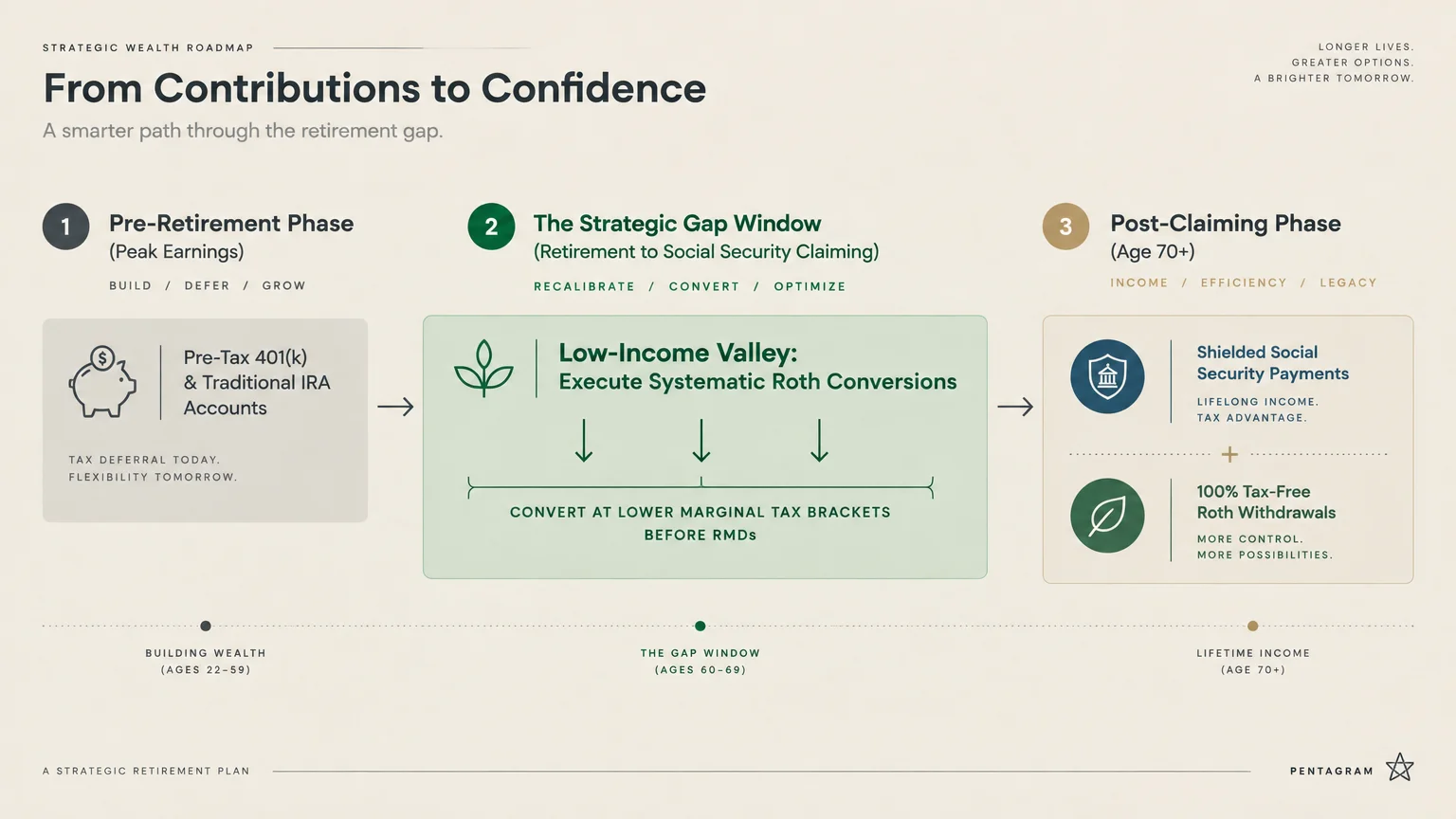
If your retirement savings currently reside in traditional pre-tax accounts, you can still transition those funds into a Roth structure. Executing deliberate Roth conversions allows you to create tax-free income before benefit taxation begins.
The most advantageous window for converting pre-tax assets is the retirement gap period. This valuable window spans the years between your retirement date and the day you claim Social Security benefits.
During this gap period, your earned income drops to zero, and your monthly benefit checks have not yet started. Your temporary low-income status allows you to convert traditional funds at favorable tax rates.
By executing conversions in your early or mid-sixties, you shift money into a Roth shelter before claiming benefits at age 70. This prevents conversion income from interfering with your Social Security payments later.
Rather than converting your entire retirement portfolio in a single transaction, spread conversions across multiple tax years. This measured approach keeps you from crossing into higher federal income tax brackets.
Remember that every dollar you convert from a traditional account counts as taxable income in that calendar year. You must pay income taxes on the converted balance using outside cash whenever possible.
Depleting your converted balance to pay the immediate tax bill reduces the compounding growth inside your Roth account. Always fund your conversion tax bill with independent liquid cash reserves.
Planning conversions methodically transforms your future tax landscape. When your Social Security checks finally begin, your Roth account stands ready to supply supplemental income without triggering taxes.
The Multi-Bucket Withdrawal Blueprint for Retirees
Sustaining a tax-free retirement requires a coordinated withdrawal strategy that blends multiple account types effectively. Relying on a multi-bucket framework gives you complete control over your annual reported income.
A successful retirement blueprint organizes your financial resources into three distinct categories. These categories comprise taxable bank accounts, tax-deferred traditional accounts, and tax-exempt Roth reserves.
- Maximize Direct Roth Contributions When Eligible: If you or your spouse work part-time in retirement, contribute earned dollars directly. In 2026 and 2027, the contribution ceiling is $7,500, plus an $1,100 catch-up for savers 50 and older.
- Observe Annual Income Phaseout Ceilings: Direct Roth contributions phase out between $153,000 and $168,000 for singles in 2026, rising to $158,000 to $173,000 in 2027. For joint filers, limits span $242,000 to $252,000 in 2026, and $250,000 to $260,000 in 2027.
- Draw Traditional Funds Up to Base Thresholds: Withdraw just enough money from traditional accounts to utilize your standard deduction and lower tax brackets without breaching provisional income limits.
- Tap Your Roth IRA for Discretionary Spending: Fund extra travel, unexpected emergencies, or large home renovations exclusively from your Roth account to keep your provisional income entirely flat.
- Maintain a Liquid Cash Buffer: Keep one to two years of baseline living expenses inside insured checking or high-yield savings accounts to avoid forced withdrawals during market downturns.
This disciplined sequence ensures that you extract maximum value from every dollar you saved over your working career. You draw sufficient income while keeping your Social Security safely below tax triggers.
Review your withdrawal sequence every autumn before the tax year closes. Minor mid-course adjustments prevent accidental bracket creep and keep your benefits secure.

Common Pitfalls, IRMAA Traps, and Financial Scams
While building a Roth reserve provides immense advantages, careless execution can generate severe financial setbacks. Navigating these obstacles requires caution and a thorough understanding of federal rules.
Converting too much pre-tax savings in a single year represents the most widespread mistake among retirees. A large conversion spike can push you into punishing income tax brackets and trigger unexpected consequences.
In addition to regular income taxes, high conversion income can trigger Medicare Income-Related Monthly Adjustment Amounts, known as IRMAA. Medicare calculates Part B and Part D surcharges based on tax returns from two years prior.
An oversized conversion executed at age 65 will dramatically inflate your Medicare healthcare premiums when you turn 67. You must weigh the combined cost of income taxes and Medicare surcharges before completing conversions.
Seniors must also remain vigilant against aggressive financial advisers promoting questionable conversion products. Many unscrupulous salespeople push high-commission annuities or risky private placements by exaggerating the benefits of tax avoidance.
Warnings from the Consumer Financial Protection Bureau (CFPB) caution older adults against aggressive promoters pushing questionable conversion schemes or high-fee annuities. Always verify credentials through official regulatory databases.
Beware of deceptive solicitations promising complete tax elimination through complex offshore trusts or unregulated financial instruments. Legitimate tax reduction relies entirely on established federal statutes like the Roth IRA.
Always partner with an independent, fee-only fiduciary planner who holds no commercial incentives to sell proprietary products. A trustworthy adviser protects your hard-earned assets while engineering a compliant tax strategy.
Frequently Asked Questions
Can Roth IRA distributions ever cause my Social Security benefits to be taxed?
No, qualified Roth IRA distributions do not trigger federal income taxes on your Social Security benefits. The IRS completely excludes qualified Roth withdrawals from your Adjusted Gross Income and your provisional income calculation.
Because these distributions never enter the federal formula, you can withdraw substantial amounts without increasing the taxable portion of your monthly benefit checks.
What happens if I convert a Traditional IRA to a Roth IRA after claiming Social Security?
The converted sum counts as ordinary taxable income in the calendar year the transaction occurs. This temporary income spike will likely push your provisional income over the thresholds, subjecting your benefits to taxation for that year.
To minimize damage, execute smaller conversions across multiple tax years or finish your conversions during the gap years before claiming monthly benefits.
Do municipal bonds protect my Social Security benefits the same way as a Roth IRA?
No, municipal bonds do not protect your Social Security benefits from taxation. Although municipal bond interest avoids standard federal income tax, the IRS requires you to add that interest into your provisional income calculation.
Unlike municipal bond interest, qualified distributions from a Roth IRA remain totally excluded from the provisional income formula.
What is the five-year rule for Roth IRAs, and does it apply to retirees over age 65?
Yes, the five-year aging rule applies to all Roth IRA owners regardless of their age. To withdraw accumulated investment earnings tax-free, at least five calendar years must elapse after your first Roth contribution.
However, you can withdraw your original contribution dollars at any time without taxes or penalties, even before meeting the five-year requirement.
How does the temporary Enhanced Senior Deduction interact with my Roth IRA withdrawals?
The Enhanced Senior Deduction offers an extra $6,000 deduction for seniors age 65 and older, but it phases out as income rises. Because Roth distributions do not increase your MAGI, they protect this deduction.
Relying on a Roth IRA allows you to fund your lifestyle without triggering the phaseout or exposing your Social Security benefits to federal taxation.
For official financial guidance for seniors, visit Medicare.gov, Centers for Medicare & Medicaid Services (CMS), Consumer Financial Protection Bureau (CFPB), IRS.gov and Benefits.gov.
Disclaimer: This article is for informational purposes and is not a substitute for professional financial or tax advice. Consult with a certified financial planner or tax professional for guidance on your specific situation.