

Evaluating your 401(k) balance at age 78 requires looking beyond simple averages to see how your savings match your daily living costs. By this stage of retirement, mandatory withdrawals and medical expenses have naturally reshaped your portfolio.
While major plan providers report average balances in the six figures, median savings figures tell a very different story. Knowing where you stand helps you protect your remaining capital and prevent costly tax mistakes.
Whether your balance is above or below national benchmarks, practical strategies can help stretch your money throughout your late 70s and beyond.
In this guide9 sections
- Average 401(k) Balances in Your Late 70s
- The Gap Between Average and Median Retirement Savings
- IRS Required Minimum Distributions: Calculating Your Age-78 Drawdown
- Integrating Social Security with Your 401(k) Withdrawals
- Budgeting for Healthcare and Long-Term Care Costs
- Financial Pitfalls and Senior Scams to Avoid
- Practical Strategies to Stretch Your 401(k) Savings
- Decision Framework: Determining If Your Savings Are Sufficient
- Frequently Asked Questions
Average 401(k) Balances in Your Late 70s
Major financial institutions track retirement data by broad age cohorts rather than single years. When evaluating age 78, researchers examine data for participants aged 65 and older, individuals in their 70s, and households aged 75 and older.
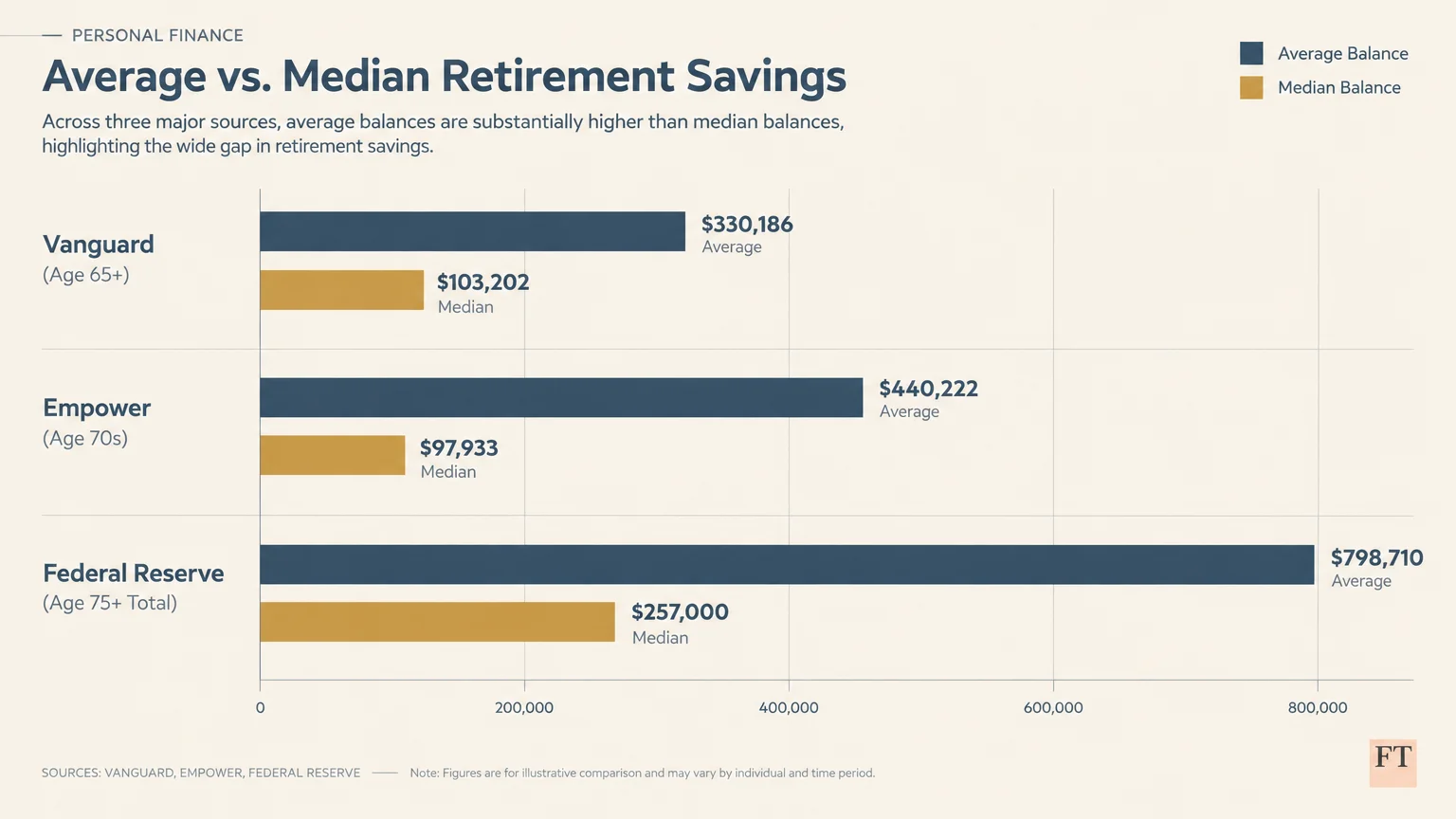
According to Vanguard’s report reflecting year-end 2025 data, the average 401(k) balance for participants aged 65 and older is $330,186. However, the median balance for that same group is just $103,202.
Data from Fidelity’s retirement analysis shows that savers in their 70s hold an average 401(k) balance of $286,900. That figure stands significantly higher than the overall participant average across all ages, which sits at $155,800.
Empower Personal Dashboard data reveals that individuals in their 70s hold an average 401(k) balance of $440,222. The median 401(k) balance for that same age demographic is $97,933.
When you evaluate total retirement savings, including IRAs and pension accounts, the numbers shift upward. Empower participants in their 70s maintain an average total retirement balance of $1,068,677 and a median balance of $460,644.
Federal Reserve data from the Survey of Consumer Finances shows households headed by someone aged 75 or older hold an average total retirement balance of $798,710. The median total retirement balance for this group is $257,000.
The Federal Reserve also reports that households aged 75 and older hold a median net worth of $504,900. This makes Americans aged 75 and older the wealthiest demographic group in the nation by median net worth.
| Data Source | Age Group Tracked | Average Balance | Median Balance |
|---|---|---|---|
| Vanguard | Age 65+ (401k Only) | $330,186 | $103,202 |
| Fidelity | Age 70s (401k Only) | $286,900 | Not Reported |
| Empower | Age 70s (401k Only) | $440,222 | $97,933 |
| Empower | Age 70s (Total Savings) | $1,068,677 | $460,644 |
| Federal Reserve | Age 75+ (Total Accounts) | $798,710 | $257,000 |
These numbers highlight a clear truth about retirement in your late 70s. While a small fraction of retirees maintain large balances, half of all older Americans hold balances below the reported medians.
The Gap Between Average and Median Retirement Savings
Understanding the gap between the average and the median balance is essential when comparing your savings. Averages are mathematically skewed by a tiny percentage of exceptionally wealthy savers.
If nine retirees hold $50,000 each and one retiree holds $5,000,000, the statistical average for the group becomes $545,000. However, nine out of ten individuals hold only a fraction of that average sum.
The median represents the exact middle point of the population. Half of all retirees hold more than the median amount, and half hold less.
When assessing whether you are ahead or behind at age 78, comparing yourself to the median provides a much more accurate benchmark. For standalone 401(k) accounts, that median sits near $100,000.
Many seniors also mistakenly believe their 401(k) balance should peak in their late 70s. In reality, balances naturally decline as retirees progress through their 70s due to steady spending and mandatory withdrawals.
Furthermore, many retirees roll their employer 401(k) plans into traditional IRAs shortly after leaving the workforce. A low 401(k) balance at 78 often means the money now lives in an IRA rather than disappearing.
Home equity also represents a significant portion of wealth for individuals in this age bracket. The Federal Reserve’s median net worth figure of $504,900 reflects substantial paid-off home values alongside financial accounts.
If your total retirement savings hover near the Federal Reserve median of $257,000, you are performing on par with most peers. If your combined accounts exceed that figure, you are statistically ahead of the majority.
IRS Required Minimum Distributions: Calculating Your Age-78 Drawdown
At age 78, managing your 401(k) requires strict attention to federal distribution laws. Under the SECURE 2.0 Act, mandatory annual withdrawals from traditional retirement plans begin at age 73.
Because mandatory withdrawals began at age 73, an individual at age 78 is now in their sixth year of required distributions. This multi-year drawdown schedule directly causes account balances to contract over time.
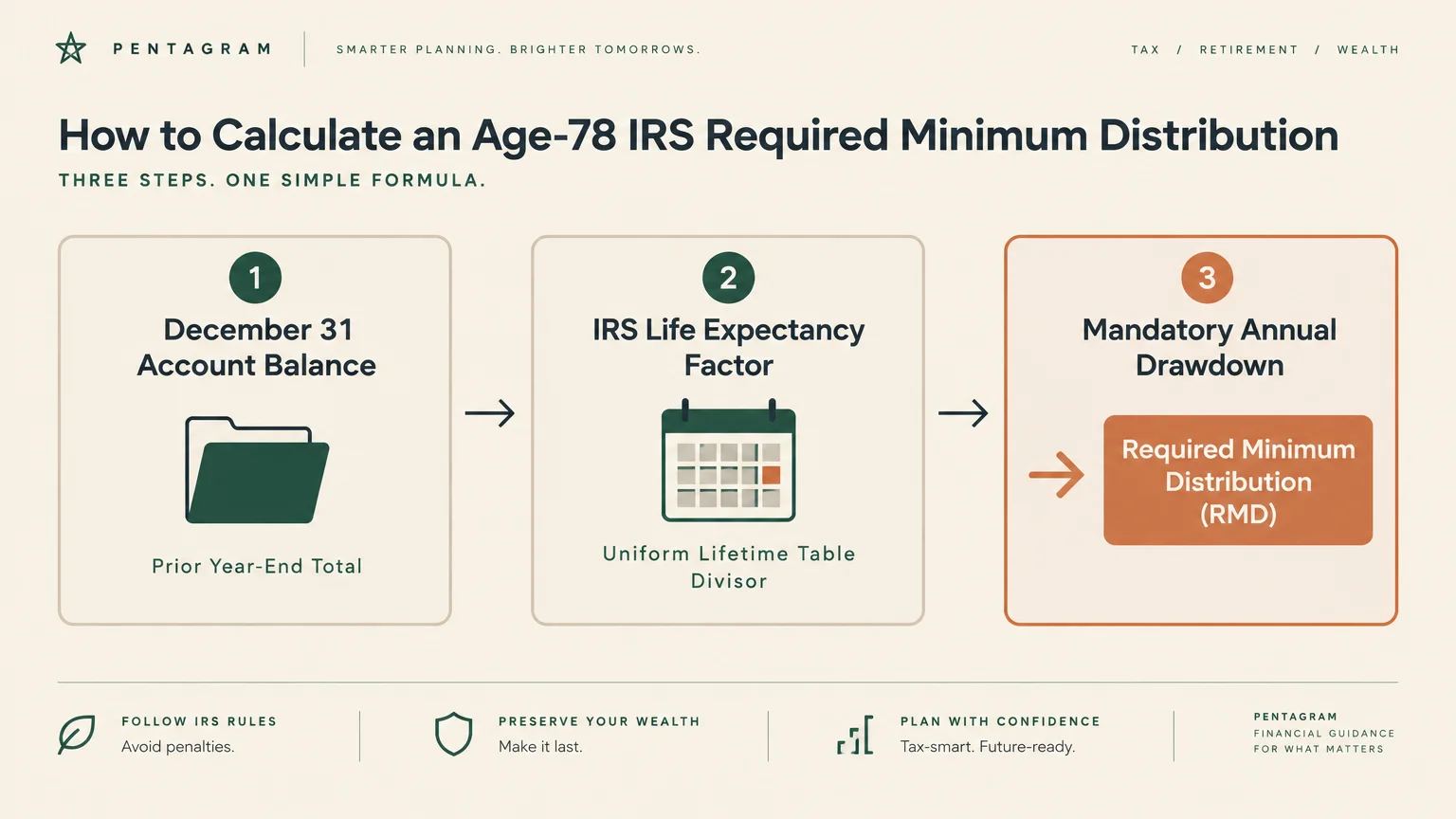
According to IRS.gov, you must calculate your Required Minimum Distribution (RMD) each year using the IRS Uniform Lifetime Table. This table determines the exact percentage of your savings you must withdraw based on your age.
For an individual who turns 78, the IRS Uniform Lifetime Table assigns a life expectancy distribution factor of 22.0. You divide your account balance from December 31 of the previous year by this distribution factor.
Dividing your balance by 22.0 results in a mandatory withdrawal rate of approximately 4.55% of your total balance. You must complete this withdrawal by December 31 of the tax year to remain compliant.
Consider a practical example using real dollar amounts. If your 401(k) balance was $100,000 on December 31 of last year, you must withdraw $4,545.45 during your age-78 tax year.
If your prior year-end balance stood at $250,000, your annual distribution requirement equals $11,363.64. If your balance totaled $500,000, your mandatory withdrawal rises to $22,727.27.
| Prior Year-End Account Balance | Age 78 Distribution Factor | Mandatory Withdrawal Rate | Required Minimum Distribution |
|---|---|---|---|
| $50,000 | 22.0 | 4.55% | $2,272.73 |
| $100,000 | 22.0 | 4.55% | $4,545.45 |
| $200,000 | 22.0 | 4.55% | $9,090.91 |
| $300,000 | 22.0 | 4.55% | $13,636.36 |
| $500,000 | 22.0 | 4.55% | $22,727.27 |
Failing to withdraw your full distribution brings harsh financial penalties from the federal government. The IRS levies a 25% excise tax on any distribution amount you fail to take on time.
If you correct the missed distribution within two years and submit IRS Form 5329, the penalty drops to 10%. Even at 10%, missing a distribution creates an unnecessary financial loss that fixed-income seniors cannot afford.
One notable exception applies to designated Roth 401(k) accounts and Roth IRAs. Under current federal tax laws, original owners do not have to take mandatory distributions from Roth accounts during their lifetime.
Integrating Social Security with Your 401(k) Withdrawals
Your 401(k) balance does not operate in isolation from your other income streams. At age 78, Social Security serves as the foundational financial pillar that prevents you from depleting your investment accounts too quickly.
Data from the Social Security Administration (SSA) shows the average monthly benefit for a retired worker was $2,071 at the start of 2026. That monthly benefit reached $2,092.17 by late 2026.
Retirees in their 70s receive higher monthly checks than younger beneficiaries due to delayed retirement credits. SSA records confirm the weighted average benefit for retirees aged 70 to 79 is $2,194.02 per month, or roughly $26,328 annually.
Cost-of-living adjustments help preserve your purchasing power against inflation. A 3.6% adjustment raises average monthly retirement benefits by approximately $75 starting in January 2027.
For a married couple where both partners receive typical benefits, combined Social Security payments often deliver $45,000 to $52,000 annually. This guaranteed cash flow dramatically reduces the amount you must pull from savings.
If your annual household baseline living expenses total $40,000, Social Security may cover the majority of your obligations. In that scenario, a $100,000 401(k) balance provides adequate security for discretionary needs and emergency costs.
Conversely, if your monthly living expenses reach $6,000, Social Security leaves a substantial monthly shortfall. You must withdraw around $3,800 monthly from savings, which can rapidly exhaust a $150,000 portfolio.
You must also monitor how withdrawals affect the taxation of your Social Security benefits. When your combined income exceeds federal thresholds, up to 85% of your Social Security benefits become subject to federal income tax.
Budgeting for Healthcare and Long-Term Care Costs
At age 78, healthcare and personal assistance represent the largest financial threats to your savings. Medical expenses accelerate in your late 70s, making cost anticipation a critical part of portfolio preservation.
According to the 2025 CareScout and Genworth Cost of Care survey released in early 2026, long-term care rates continue to climb. The national median cost for an assisted living community stands at $74,400 annually, or $6,200 monthly.
If you prefer to age in your home, professional non-medical caregivers charge a national median of $35 per hour. Securing 44 hours of weekly home care totals approximately $80,080 annually.
For seniors requiring specialized medical oversight at home, private duty skilled nursing costs a median of $90 per hour. Adult day health care offers a lower-cost daytime option, averaging $95 daily, or $24,700 per year.
Skilled nursing facility care represents the most expensive tier of eldercare support. A semi-private room in a nursing home costs a national median of $114,975 per year, while a private room reaches $129,575 annually.
| Care Setting or Service Type | Median Hourly or Daily Cost | Median Monthly Cost | Median Annual Cost |
|---|---|---|---|
| Adult Day Health Care | $95 per day | $2,058 | $24,700 |
| Assisted Living Facility | Not Applicable | $6,200 | $74,400 |
| In-Home Caregiver (44 hrs/wk) | $35 per hour | $6,673 | $80,080 |
| Nursing Home (Semi-Private) | Not Applicable | $9,581 | $114,975 |
| Nursing Home (Private Room) | Not Applicable | $10,798 | $129,575 |
| In-Home Skilled Nursing | $90 per hour | Varies by Hours | Varies by Hours |
Traditional Medicare does not pay for custodial non-medical care or long-term nursing home residency. Seniors must pay these costs using personal savings, long-term care insurance policies, or Medicaid once assets are depleted.
If you need assistance locating localized support programs, you can consult the Eldercare Locator to find community services. Accessing local non-profit support can protect your savings from rapid depletion.
A 78-year-old with a $200,000 balance can comfortably cover routine expenses, but an extended nursing stay creates financial strain. Factoring potential care costs into your spending plan prevents sudden crises.

Financial Pitfalls and Senior Scams to Avoid
Seniors in their late 70s are prime targets for predatory financial practices and fraudulent schemes. Protecting the savings you have built requires remaining vigilant against deceptive sales tactics and outright fraud.
According to guidance from the Consumer Financial Protection Bureau (CFPB), older adults lose billions annually to financial exploitation. Imposter scams, fraudulent tech support calls, and sweepstakes deception remain widespread across the country.
Criminals frequently pose as government officials from the IRS or Social Security Administration. Remember that legitimate federal agencies will never call demanding immediate payment through wire transfers, gift cards, or cryptocurrency.
Another common pitfall involves aggressive sales pitches for high-fee financial products. Unscrupulous brokers sometimes pressure seniors to liquidate 401(k) accounts to purchase complex annuities with steep surrender charges.
At age 78, locking your liquid funds into an annuity with a ten-year surrender penalty is rarely appropriate. You need convenient access to liquid capital to handle unexpected medical and home maintenance expenses.
Be cautious of unsolicited pitches urging you to buy physical gold or speculative investments to hedge against inflation. These promotions often feature hidden markups that strip away 20% to 30% of your capital instantly.
Tax mismanagement represents another frequent self-inflicted mistake for retirees. Taking large, unplanned lump-sum distributions from traditional 401(k) plans can push you into higher tax brackets and trigger higher Medicare premiums.
Finally, never share your account passwords or grant remote access to your computer to unsolicited callers. Always consult a trusted family member or an independent fiduciary professional before transferring money.
Practical Strategies to Stretch Your 401(k) Savings
Regardless of whether your balance sits above or below national medians, tactical money management helps preserve capital. Implementing proven financial strategies shields your wealth from taxes and unnecessary market exposure.
- Utilize Qualified Charitable Distributions (QCDs): If you support charities, you can transfer up to statutory limits directly from an IRA to a qualified non-profit. This satisfies your distribution requirements while excluding the funds entirely from your adjusted gross income.
- Maintain a Dedicated Cash Buffer: Keep one to two years of anticipated living expenses in liquid, high-yield cash vehicles. This cash buffer prevents you from being forced to sell depressed investments during an unexpected market decline.
- Consolidate Stranded Retirement Plans: If you still maintain 401(k) plans with former employers, roll them into a single account. Managing one account eliminates multiple distribution calculations and reduces administrative fees.
- Rebalance to Protect Capital: Ensure your portfolio reflects your late-70s timeline rather than growth-heavy allocations. A conservative mix of high-grade bonds, cash equivalents, and dividend-paying equities limits severe downside drops.
- Conduct Annual Beneficiary Audits: Verify that your primary and contingent beneficiary designations remain up to date. Beneficiary designations override instructions written in your will, making accuracy vital for your heirs.
A Qualified Charitable Distribution is particularly powerful for philanthropic seniors at age 78. Because standard 401(k) plans cannot execute direct charitable rollovers, moving funds to a traditional IRA first enables this maneuver.
By lowering your adjusted gross income through charitable transfers, you keep your overall tax footprint small. This move can also protect you from surcharges on your Medicare Part B and Part D premiums.
Automating your mandatory distributions is another reliable step to avoid IRS penalties. Most brokerage platforms allow you to schedule systematic annual or monthly payments sent directly to your checking account.
Decision Framework: Determining If Your Savings Are Sufficient
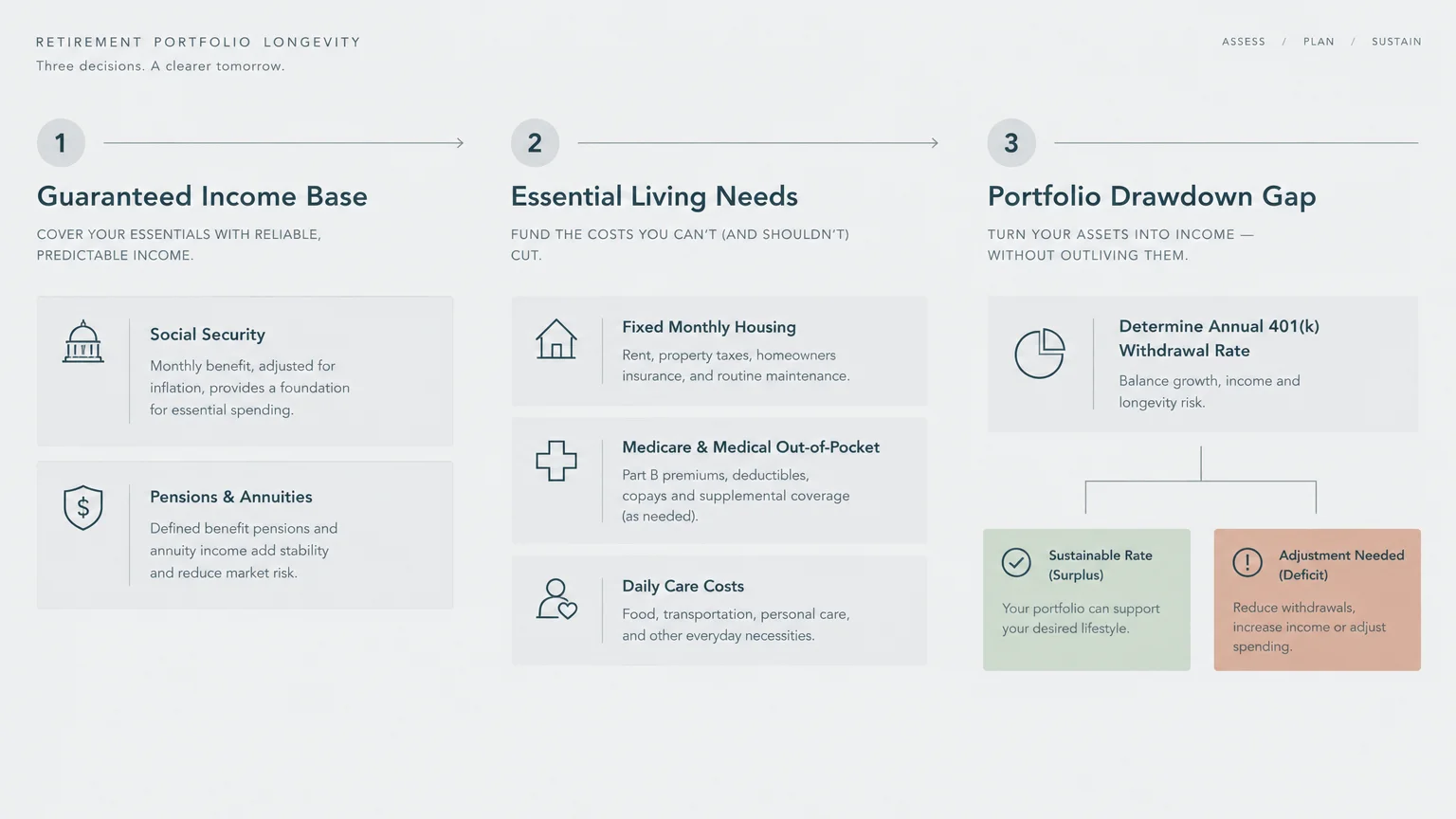
Deciding if your 401(k) balance is sufficient requires measuring your personal expenses against guaranteed income. National statistics provide helpful perspective, but your personal balance sheet matters most.
Review the three financial tiers below to identify where your savings place you at age 78.
Tier 1: Ahead of the Benchmark
You fall into this category if your total retirement savings exceed $350,000 and your housing debt is completely eliminated. With this balance, your mandatory distributions provide comfortable discretionary spending on top of Social Security.
Your primary goal at this tier is tax efficiency, estate planning, and shielding assets from unnecessary administrative waste. Consider working with a certified tax planner to coordinate wealth transfers and charitable giving.
Tier 2: On Track with the Benchmark
You occupy this tier if your savings range between $100,000 and $350,000 and you maintain manageable living overhead. Your savings align closely with national medians, providing adequate resources to supplement your monthly Social Security checks.
Focus on maintaining your cash reserve and keeping your debt levels at zero. Avoid high-risk investments, and review your home equity as a potential safety net should intensive long-term care become necessary.
Tier 3: Behind the Benchmark
You fit this tier if your total savings sit below $100,000 and you struggle to cover recurring expenses on Social Security alone. Many seniors in this bracket face financial pressure due to rising rent, utility costs, or outstanding medical debt.
If you are in this situation, prioritize eliminating high-interest consumer debt immediately. Look into local property tax relief programs and utility assistance initiatives designed to assist fixed-income seniors.
Remember that having less than the national average does not mean you have failed. By aligning your lifestyle with guaranteed income streams, you can achieve financial stability throughout your retirement.
Frequently Asked Questions
How much does the average 78-year-old have in a 401(k)?
Major plan providers report that savers in their 70s hold an average 401(k) balance between $286,900 and $440,222. However, the median balance sits around $98,000 to $103,000, which better reflects typical retiree balances.
What percentage of my 401(k) must I withdraw at age 78?
Under the IRS Uniform Lifetime Table, a 78-year-old has a distribution factor of 22.0. This requires you to withdraw approximately 4.55% of your previous year-end account balance before December 31.
What happens if I miss my required distribution deadline at 78?
Failing to take your required distribution triggers an IRS excise tax penalty equal to 25% of the amount not withdrawn. If you correct the mistake within two years using Form 5329, the penalty drops to 10%.
Can I roll my 401(k) into an IRA at age 78?
Yes, you can roll your employer 401(k) into a traditional IRA at age 78. However, you must satisfy your required distribution for that specific tax year before transferring the remaining funds into the IRA.
Do I have to pay income taxes on my 401(k) withdrawals?
Withdrawals from traditional 401(k) accounts are taxed as ordinary income at your regular federal and state income tax rates. Qualified distributions from designated Roth accounts, however, are completely tax-free.
For official financial guidance for seniors, visit
IRS.gov, Benefits.gov and AARP.
Disclaimer: This article is for informational purposes and is not a substitute for professional financial or tax advice. Consult with a certified financial planner or tax professional for guidance on your specific situation.