

Securing reliable long-term care insurance shields your hard-earned retirement savings from unpredictable medical expenses. The right policy grants you direct control over where and how you receive personal assistance as you age.
Long-term care planning requires balancing financial strength, monthly premiums, and flexible benefit options. Preparing now protects your spouse and adult children from overwhelming emotional and caregiving burdens later in life.
Here is an in-depth review of five top long-term care insurance companies worth considering today, along with current cost data to guide your retirement strategy.
In this guide9 sections
- Understanding Long-Term Care Costs and Risks
- Evaluating Traditional Versus Hybrid LTC Policies
- Top 5 Long-Term Care Insurance Companies
- Comparing the Top LTC Insurance Providers
- Tax Deductions and Financial Rules for Seniors
- Common Pitfalls and Mistakes to Avoid
- How to Choose the Right Policy for Your Budget
- Frequently Asked Questions
- Protecting Your Independence and Family Legacy
Understanding Long-Term Care Costs and Risks
Long-term care refers to the custodial assistance you may need when daily living activities become challenging. This assistance includes help with dressing, bathing, eating, using the restroom, transferring from bed, and managing personal hygiene.
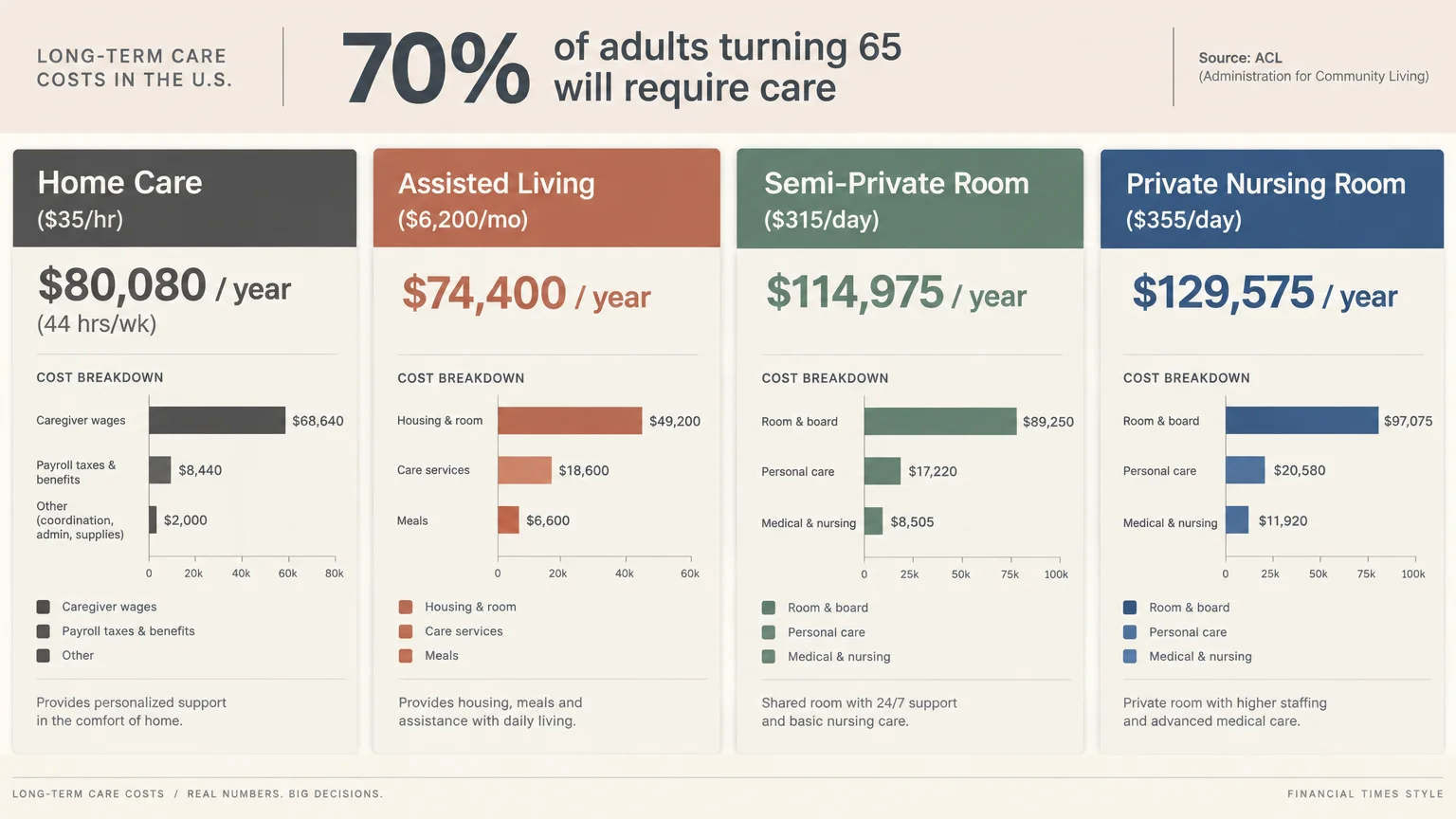
According to the Administration for Community Living (ACL), nearly 70% of adults turning age 65 will require some form of long-term care support during their lifetime.
Many seniors mistakenly assume government programs cover these everyday personal services. As clearly explained on Medicare.gov, traditional Medicare does not pay for non-skilled custodial care when that is the only type of care you need.
Without private coverage or personal savings, long-term care costs can rapidly deplete a lifetime of investments. Current data reveals that professional assistance carries a substantial price tag across every setting.
A non-medical in-home caregiver costs a national median of $35 per hour. If you require 44 hours of weekly assistance to remain safely at home, annual expenses reach approximately $80,080.
If you require specialized clinical support at home, skilled in-home nursing averages $90 per hour. Meanwhile, adult day health care programs provide community-based socialization and supervision for a median cost of $95 per day.
Residential facilities demand even larger financial commitments. A private, one-bedroom apartment in an assisted living community averages $6,200 per month, totaling $74,400 per year.
Skilled nursing facilities represent the most intensive and costly care tier. A semi-private nursing home room costs $315 per day, which equates to $114,975 every year.
A private room in a nursing home reaches $355 per day, creating an annual financial obligation of $129,575. Recent actuarial data indicates an average 65-year-old needs roughly $135,000 set aside solely for projected out-of-pocket care expenses.
Selecting the best long-term care insurance establishes a financial safety net against these surging figures. It preserves your independence, preserves your family assets, and guarantees quality care on your own terms.

Evaluating Traditional Versus Hybrid LTC Policies
The insurance marketplace has evolved dramatically over the last two decades. Today, you will encounter two primary coverage structures: traditional standalone policies and asset-based hybrid policies.
Traditional standalone policies operate like automobile or homeowner insurance. You pay an annual or monthly premium to maintain a pool of long-term care benefits.
If you need care, the insurer pays your qualified expenses up to your policy limits. However, if you never need care, the company retains your premiums—a scenario known as the use-it-or-lose-it model.
Standalone policies usually feature the lowest initial premium rates for older adults. The main risk involves rate stability; insurers can raise premiums on entire policy classes if claims exceed actuarial projections.
Hybrid policies combine long-term care coverage with permanent whole life insurance or an annuity. If you require chronic care, the policy accelerates the death benefit to pay for your assistance.
If you pass away without utilizing your care benefits, the insurer delivers a tax-free life insurance death benefit directly to your named beneficiaries. This dual-purpose structure eliminates the risk of paying premiums for coverage you never use.
Hybrid policies typically provide guaranteed premiums that can never increase. You can fund them through a single lump sum or spread payments over five, ten, or twenty years.
You must also distinguish between reimbursement models and cash indemnity models. Understanding how benefits disburse impacts your day-to-day flexibility when receiving care.
Research from the National Institute on Aging (NIA) emphasizes that receiving support in familiar home surroundings improves physical and emotional well-being for aging adults.
A reimbursement policy requires you to submit detailed monthly receipts from state-licensed agencies before reimbursing your care costs. Any unused monthly benefit remains inside your total pool for future needs.
Conversely, a cash indemnity policy pays you your full monthly benefit amount regardless of your actual care receipts. This approach gives you absolute freedom to hire trusted friends, private aides, or family members without bureaucratic hurdles.
Top 5 Long-Term Care Insurance Companies
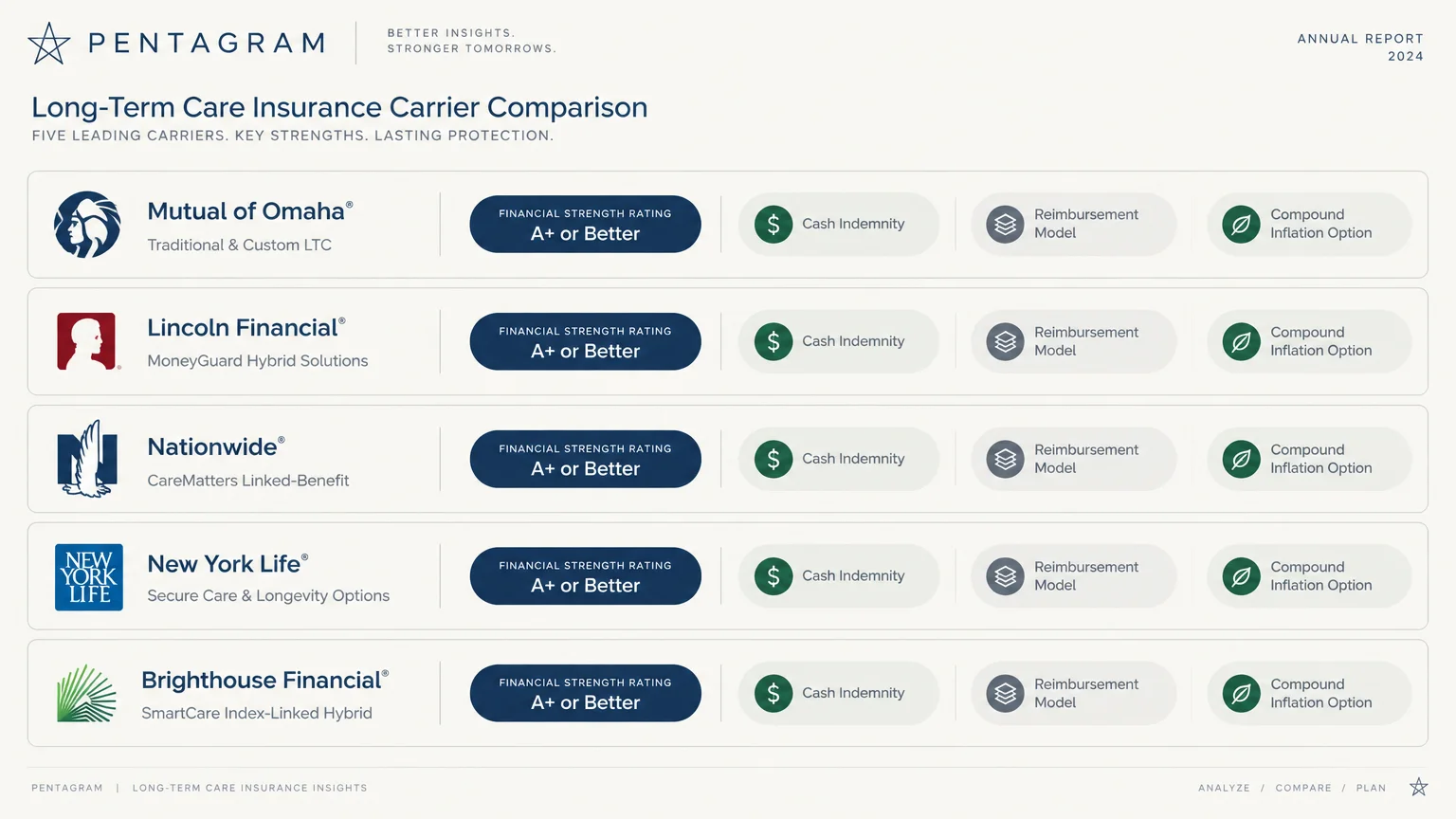
Finding dependable long-term care insurance companies requires examining financial strength, customer service reputations, and policy flexibility. The following five carriers stand out as industry leaders worth considering for your retirement plan.
1. Mutual of Omaha
Mutual of Omaha remains a pillar in the traditional long-term care insurance sector. AM Best awards the carrier an A+ (Superior) financial strength rating, demonstrating outstanding claims-paying capability.
While many competitors exited the standalone market, Mutual of Omaha continues offering customizable standalone coverage for applicants aged 30 through 79. Their signature policies provide robust daily or monthly benefit allowances designed around your budget.
The company offers attractive optional riders, such as return-of-premium features and shared benefits for married couples. A shared benefit rider lets spouses tap into each other’s benefit pools if one exhausts their initial allocation.
Mutual of Omaha also includes a valuable cash benefit provision on select policies. This rider delivers a percentage of your monthly benefit in direct cash, bypassing standard agency billing rules.
Policyholders can choose elimination periods ranging from zero to 365 days. Selecting a 90-day elimination period offers a sweet spot between affordable ongoing premiums and manageable out-of-pocket risk.
2. New York Life
New York Life stands among the most financially sound institutions in the world. The company carries an exceptional A++ (Superior) rating from AM Best and holds a perfect 100 COMDEX ranking.
New York Life offers both traditional standalone policies and linked-benefit hybrid solutions. Flagship products like NYL Secure Care and NYL My Care give you varied avenues to fund your future care needs.
Because New York Life operates as a mutual insurance company, policyholders are eligible to receive annual dividends. While never guaranteed, these dividends can offset premium costs or purchase additional paid-up long-term care benefits.
The company provides strong inflation protection options, including 3% and 5% compound annual growth riders. These riders allow your monthly benefit pool to double over time, insulating your plan against inflation.
Underwriting standards at New York Life remain thorough and conservative. If you maintain good health in your late 50s or early 60s, you can secure preferred rates that offer exceptional lifetime value.
3. Northwestern Mutual
Northwestern Mutual is another mutual insurance powerhouse boasting an A++ (Superior) rating from AM Best. Like New York Life, it maintains a top-tier 100 COMDEX ranking based on balance-sheet strength and immense cash reserves.
The insurer delivers both standalone policies through its QuietCare line and modern hybrid options linked to whole life coverage. Their policies cater particularly well to high-net-worth retirees who require high monthly benefit maximums.
Northwestern Mutual has an exemplary history of paying policyholder dividends across its life and disability portfolios. These dividends help cushion the long-term carrying costs of holding coverage across multiple decades.
Their contracts feature generous definitions of qualified care facilities, covering adult day centers, assisted living communities, memory care units, and private home care. They also provide dedicated care coordinators to guide families during the initial claims process.
Applying for Northwestern Mutual coverage requires working alongside a dedicated financial representative. This collaborative model ensures your long-term care plan coordinates smoothly with your broader investment portfolio and estate plans.
4. Nationwide
Nationwide has established itself as an industry leader in hybrid linked-benefit policies. Backed by an A+ (Superior) rating from AM Best, Nationwide offers the highly acclaimed CareMatters series.
The standout advantage of Nationwide CareMatters is its 100% cash indemnity benefit model. Once your medical claim is approved, the company sends you a predetermined monthly check with no monthly receipts required.
This indemnity structure allows you to compensate informal caregivers, including your adult children or close personal friends. Many traditional reimbursement policies refuse to pay non-certified or related family members.
Nationwide allows policyholders to select benefit periods ranging from two to seven years. You can fund policies using existing cash, qualified retirement assets, or 1035 tax-free exchanges from dormant life insurance contracts.
The policy guarantees that a death benefit will pass to your loved ones if you do not exhaust the care fund. This guarantee provides unmatched peace of mind for seniors concerned about paying for unused benefits.
5. Thrivent
Thrivent is a top-performing fraternal benefit society holding an A++ (Superior) rating from AM Best, reaffirmed in late 2026. The organization serves members with conservative financial management and generous community dividends.
Thrivent offers both standalone long-term care insurance and versatile hybrid coverage solutions. Their policies feature some of the highest maximum benefit caps available, extending up to $15,000 per month for qualified care.
Their contracts incorporate flexible inflation protection choices, helping your daily benefit keep pace with local medical cost increases. You can choose from simple, compound, or CPI-linked inflation growth riders.
Thrivent also provides international coverage allowances, which reimburse eligible expenses incurred while traveling abroad. This feature benefits active retirees who plan to spend their early retirement traveling the globe.
As a fraternal organization, Thrivent directs profits back to member services, financial education, and charitable causes. Joining requires a simple membership affiliation, opening the door to highly competitive pricing on essential coverage.

Comparing the Top LTC Insurance Providers
Comparing LTC insurance providers side-by-side clarifies which company matches your personal priorities. Reviewing financial strength ratings, policy formats, and payout methods ensures you make an informed decision.
The table below summarizes key metrics for the five leading long-term care insurance companies reviewed in this guide.
| Insurance Carrier | AM Best Rating | Primary Products Offered | Benefit Payout Model | Standout Advantage |
|---|---|---|---|---|
| Mutual of Omaha | A+ (Superior) | Traditional Standalone | Reimbursement & Cash Option | Customizable standalone plans with cash benefit riders |
| New York Life | A++ (Superior) | Standalone & Hybrid | Reimbursement | Unmatched financial stability and annual dividend potential |
| Northwestern Mutual | A++ (Superior) | Standalone & Hybrid | Reimbursement | High monthly benefit limits and top-tier dividend history |
| Nationwide | A+ (Superior) | Hybrid Life + LTC | 100% Cash Indemnity | Pays cash benefits directly to cover family caregivers |
| Thrivent | A++ (Superior) | Standalone & Hybrid | Reimbursement | Monthly benefit limits up to $15,000 and fraternal benefits |
Financial strength ratings from AM Best serve as an indicator of an insurer’s reliability. Choosing an A+ or A++ carrier ensures the company possesses the reserves to honor claims decades into the future.
Pay close attention to whether the carrier utilizes a reimbursement or indemnity structure. If you intend to stay at home under the care of relatives, an indemnity provider like Nationwide offers unmatched administrative freedom.
Tax Deductions and Financial Rules for Seniors
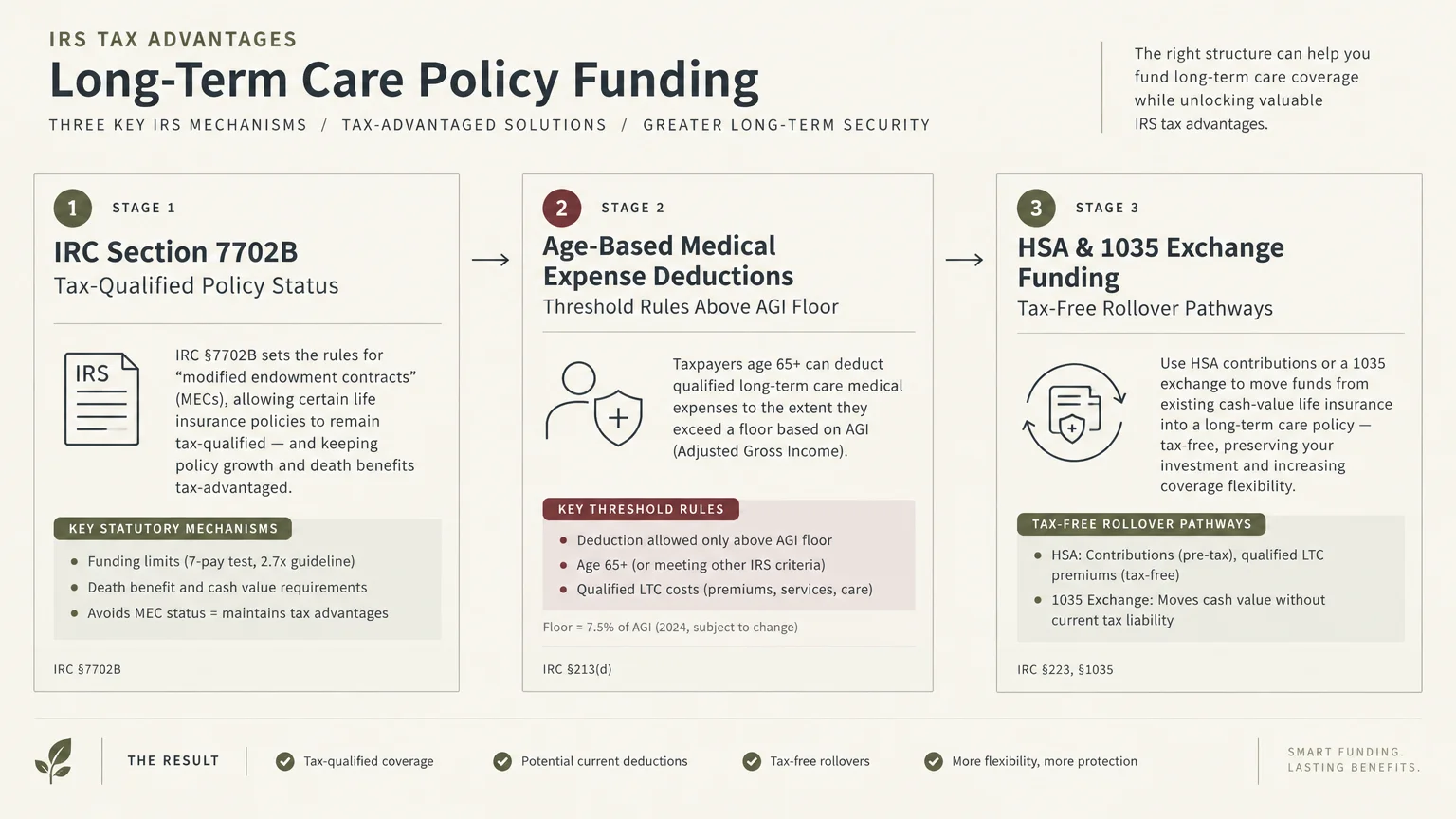
Federal tax laws provide meaningful financial incentives to encourage private long-term care planning. Under Internal Revenue Code Section 213(d)(10), premiums paid for tax-qualified long-term care policies count as deductible medical expenses.
If you itemize your tax deductions, you can deduct eligible premiums to the extent that total medical expenses exceed 7.5% of your adjusted gross income (AGI). The IRS limits the deductible premium amount per person based on age.
The deductible limits reflect substantial tax relief for older taxpayers:
- Age 40 or younger: $500 per individual
- Age 41 to 50: $930 per individual
- Age 51 to 60: $1,860 per individual
- Age 61 to 70: $4,960 per individual
- Age 71 and older: $6,200 per individual
Self-employed seniors gain an even larger tax advantage. If you own a small business or work as an independent contractor, you can deduct eligible premiums above-the-line without meeting the 7.5% AGI threshold.
Tax rules also treat the benefits you receive favorably. Benefits collected under a qualified long-term care policy are generally received completely income-tax-free up to actual care costs.
For policies operating on a per-diem or cash indemnity model, the tax-free limit is capped at $430 per day. You can receive this amount without submitting daily receipts or proving actual expenses.
Many states also participate in the Long-Term Care Partnership Program. These public-private partnerships grant asset protection against Medicaid spend-down rules on a dollar-for-dollar basis.
For example, if your partnership policy pays out $300,000 in benefits, you can protect $300,000 of your personal assets above standard Medicaid limits should you ever need state aid. This provision secures your family legacy while preventing complete financial exhaustion.

Common Pitfalls and Mistakes to Avoid
Purchasing long-term care insurance requires navigating complex contract terms and underwriting guidelines. Avoiding common missteps protects you from paying excessive premiums or experiencing denied claims.
The most expensive mistake is waiting too long to purchase coverage. As you age, annual premium costs escalate dramatically while your likelihood of developing disqualifying medical conditions rises.
According to price index data from the American Association for Long-Term Care Insurance, a healthy 55-year-old couple pays roughly $2,500 to $3,500 per year combined. That same couple purchasing coverage at age 65 will pay $3,900 to $5,500 annually.
Delaying coverage from age 55 to age 65 increases ongoing premiums by 60% to 80%—an average cost increase of 8% to 10% for every year of delay. Securing coverage in your mid-50s to early 60s locks in favorable rates while your health remains intact.
Another frequent error is omitting compound inflation protection to save on initial premium costs. Healthcare costs rise rapidly, and a fixed $150 daily benefit purchased today will lose significant purchasing power over twenty years.
Adding a 3% compound inflation rider ensures your benefit pool expands automatically each year. A policy with compound growth will double its daily care benefit in 24 years, keeping pace with real-world care expenses.
Guidance from the Consumer Financial Protection Bureau (CFPB) advises seniors to budget carefully so future premium obligations remain affordable during fixed-income retirement years.
Always verify whether your traditional standalone policy has a history of major rate revisions. Opting for a top-rated carrier with strong capital reserves reduces your exposure to unexpected premium shocks.
Finally, avoid planning in isolation without informing your immediate family. Ensure your adult children or designated healthcare proxy know where your policy documents are stored and understand how to initiate a claim.

How to Choose the Right Policy for Your Budget
Selecting the best policy involves calculating your personal coverage gap rather than buying arbitrary maximums. Follow these practical steps to design an insurance plan tailored to your household budget.
- Evaluate Local Care Costs: Examine median care prices in the state where you plan to retire. Account for regional variations between urban and rural care centers.
- Assess Your Retirement Income: Calculate how much monthly cash flow your Social Security, pension, and retirement distributions generate. You only need insurance to cover the difference between your guaranteed income and projected care costs.
- Determine Your Preferred Setting: Decide whether your primary objective is aging in place at home or securing residence in a premier assisted living community. This preference dictates whether you need an indemnity or reimbursement policy.
- Select a Realistic Benefit Period: The average long-term care claim lasts approximately three years. Choosing a three-to-four-year benefit duration offers strong protection while keeping premium costs manageable.
- Engage an Independent Broker: Work with an independent specialist who represents multiple top-rated insurers. An independent broker compares rates across carriers like Mutual of Omaha, Nationwide, and New York Life to find the best match for your health profile.
Single women must pay close attention to carrier pricing. Because women live longer and file more claims, single 60-year-old females pay an average of $4,450 annually for standalone coverage—roughly 30% to 50% more than single men.
Couples should explore shared care riders and spousal discounts to maximize savings. Applying together frequently qualifies both partners for discounts of up to 15% to 30% on combined policy premiums.
A policy that covers 60% to 80% of projected care expenses provides immense financial relief. Designing a sensible plan preserves your core retirement assets without overstretching your current monthly budget.
Frequently Asked Questions
What is the ideal age to apply for long-term care insurance?
The optimal age to purchase long-term care coverage is between age 53 and 62. Applying during this window allows you to lock in favorable rates before age-based price spikes occur and before unexpected chronic health conditions disqualify you from preferred underwriting tiers.
What triggers long-term care insurance benefits to pay out?
Benefits typically activate when a licensed physician certifies that you cannot perform at least two of the six Activities of Daily Living (ADLs) without substantial human assistance for at least 90 days.
Benefits also trigger immediately if you suffer from severe cognitive impairment, such as Alzheimer’s disease or dementia.
Can traditional long-term care insurance rates increase after purchase?
Yes, premiums on traditional standalone policies can increase if state regulators approve rate hike requests submitted for entire actuarial classes. However, hybrid life and long-term care policies feature fully guaranteed premiums that can never increase once the contract is issued.
How does the elimination period work on a long-term care policy?
The elimination period acts as a deductible measured in days rather than dollars. You are responsible for paying your care costs out-of-pocket for a set period—typically 30, 60, or 90 days—before your insurance company begins disbursing benefit payments.
Can I pay family members to care for me using long-term care insurance?
You can pay family members directly if you purchase a cash indemnity policy, such as the Nationwide CareMatters plan. Traditional reimbursement policies generally prohibit payments to relatives or require caregivers to hold state licenses and work through accredited home care agencies.
Protecting Your Independence and Family Legacy
Long-term care planning is about maintaining dignity and personal autonomy during your golden years. It ensures you dictate where you receive assistance while protecting your family from distressing caregiving challenges.
Take proactive steps today to evaluate your financial readiness against local healthcare figures. Request comparative illustrations from several top-rated carriers to compare costs and policy structures.
Taking action early guarantees the widest selection of policy options at the most affordable rates. A well-constructed plan delivers enduring security, preserving both your retirement nest egg and your family relationships.
For additional senior resources, visit
Eldercare Locator, AARP, Alzheimer’s Association, American Heart Association and Benefits.gov.
Disclaimer: The information in this article is for educational purposes only and is not intended to be a substitute for professional financial, legal, or medical advice. Always consult with a qualified expert for advice tailored to your personal situation.