

A single missing year on your Social Security earnings record can shrink your monthly retirement check for life. Spotting and fixing an error early protects the fixed income you rely on.
Millions of wage reports sit unmatched in government suspense files because of typos, name changes, or employer reporting mistakes. Even one understated year can noticeably lower your monthly benefit calculation.
You can review your lifetime earnings record in minutes, gather simple tax documents, and submit a correction request. Taking action before deadlines pass preserves every dollar you earned.
In this guide8 sections
- Why Your Earnings Record Controls Your Retirement Check
- Why Benefit Errors Happen More Often Than You Think
- How to Check Your SSA Earnings Statement Online and by Mail
- The Three-Year Deadline—and Exceptions That Keep Your Case Alive
- Step-by-Step Guide to Fix Your Earnings Record
- What Proof You Need for Wages, Self-Employment, and Lost Records
- Scams, Identity Theft, and Costly Mistakes to Avoid
- Frequently Asked Questions
Why Your Earnings Record Controls Your Retirement Check
Your monthly retirement benefit does not come from guesswork; it comes directly from the numbers on your Social Security earnings record. When that record drops a paycheck or deletes an entire year, your future benefits drop with it.
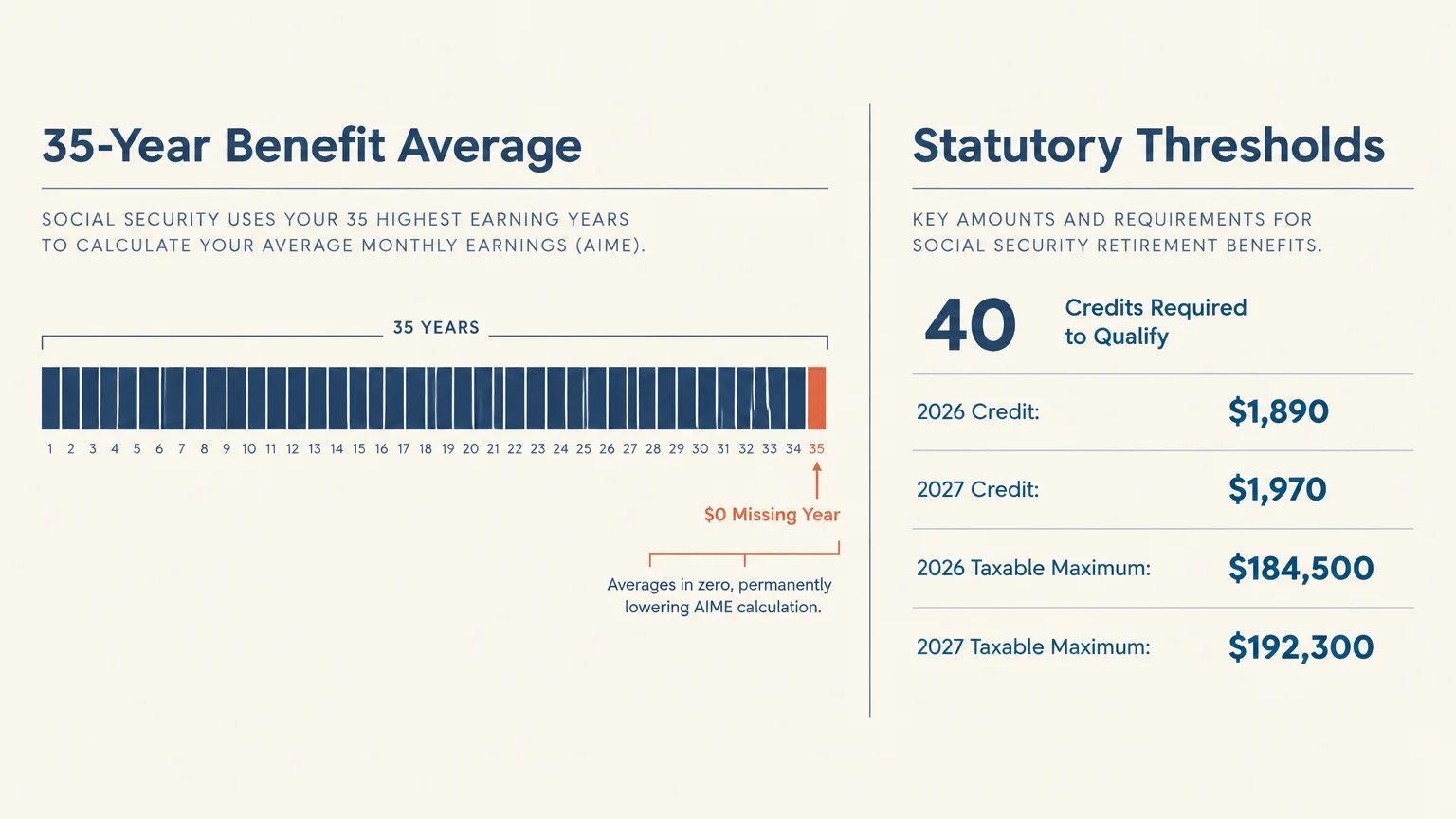
The Social Security Administration (SSA) calculates retirement benefits using your highest 35 years of covered earnings. The agency adjusts earlier wages for inflation—generally indexing them to average wage levels in the year you turn age 60—to determine your Average Indexed Monthly Earnings (AIME).
If your record shows fewer than 35 years of earnings, SSA averages in zeros for every missing year. Replacing a single $0 year with a real working year can boost your permanent monthly payment, especially when you live on a fixed budget.
Your earnings history also determines whether you qualify for benefits at all. Anyone born in 1929 or later needs 40 Social Security credits—roughly 10 years of covered work—to collect retirement benefits.
You can earn up to four credits per calendar year based on your covered wages or self-employment income. In 2026, you earn one credit for every $1,890 in covered earnings, meaning $7,560 secures the maximum four credits for the year.
In 2027, that credit threshold rises to $1,970 per credit. Missing wages near retirement could leave someone with 38 or 39 credits on paper instead of the 40 credits needed to unlock monthly checks.
Keep in mind that Social Security only records wages up to an annual taxable maximum, known as the contribution and benefit base. Since 1994, however, Medicare payroll taxes have applied to all covered earnings with no upper cap.
| Benefit Measure | 2025 Figure | 2026 Figure | 2027 Figure |
|---|---|---|---|
| Maximum Taxable Earnings Cap | $176,100 | $184,500 | $192,300 |
| Earnings Required for 1 Credit | Prior-year rate applies | $1,890 | $1,970 |
| Maximum Monthly Benefit at Full Retirement Age | Prior-year rate applies | $4,152 | $4,188 (reflecting 3.6% COLA) |
On average, Social Security replaces about 40% of pre-retirement annual earnings for an average earner. Because that check forms the backbone of retirement cash flow for millions of older adults, benefit errors carry real long-term costs.
Consider a simple numerical example. Suppose you worked 35 years, and one year where you earned $45,000 shows up as $0 on your statement.
Instead of dividing 35 full earning years to find your average, SSA averages in that $0 alongside your other 34 years. That single missing line lowers your AIME every month for life—and reduces future cost-of-living adjustments (COLAs) that build on top of your base benefit.
Even if you have already claimed benefits, correcting an understated year triggers a recalculation. Fixing the record raises your monthly payment going forward and can bring back pay for months already missed.
Why Benefit Errors Happen More Often Than You Think
Many retirees assume payroll computers automatically send every dollar to the right federal file. In reality, mismatched wage reports pile up by the millions every year.
According to a September 2026 report from the SSA Office of the Inspector General (OIG), the agency’s Earnings Suspense File held over $2.4 trillion in unmatched wages as of fiscal year 2025. That backlog represented more than 424 million separate wage items spanning tax years 1937 through 2024.
When a wage report cannot match your name and Social Security Number (SSN), SSA sets the money aside in that suspense file. You receive zero credit toward your retirement check until the mismatch gets resolved.
According to SSA guidance, missing or incorrect earnings usually stem from a handful of everyday problems:
- Employer reporting mistakes: A payroll clerk or tax preparer transposed digits in your SSN, misspelled your last name, or failed to submit annual W-2 totals properly.
- Unreported name changes: You changed your name after marriage or divorce, gave the new name to your employer, and forgot to update your card with SSA.
- Wrong SSN usage: A former employer filed wages under an old temporary number, or someone else worked using an SSN that did not belong to them.
- Self-employment filing gaps: You paid income taxes on freelance or small-business earnings, yet Schedule SE was omitted or improperly matched to your SSN.
Before you panic over a blank line at the bottom of your chart, check the date of the missing income. SSA notes that earnings from the current year and the prior year often do not appear right away.
Employers file W-2 forms early in the following year, and self-employed workers file returns in the spring. It takes several months for IRS and SSA computers to process those reports and post them to your history.
If an older year—two or more years back—shows $0 or looks far lower than what you actually earned, treat it as a red flag.
Waiting until you apply for retirement at age 62 or Full Retirement Age (FRA) can make tracking down old employers much harder.

How to Check Your SSA Earnings Statement Online and by Mail
Reviewing your SSA earnings statement once a year takes less than ten minutes and costs nothing. Checking annually lets you spot clerical mistakes while your pay stubs and W-2 forms are still easy to find.
Anyone age 18 or older with a Social Security Number and a valid email address can view their complete lifetime earnings online through a personal my Social Security account.
You can access the portal directly through the Social Security Administration (SSA) homepage or by typing ssa.gov/myaccount into your browser.
If you created an online account before September 18, 2021, you must sign in using a Login.gov or ID.me credential to keep your access active.
New users must also verify their identity through Login.gov—recommended for most U.S. residents—or ID.me, which is required for people living outside the United States.
Setting up a Login.gov profile protects your sensitive tax and benefit data from unauthorized access. To create your credential, prepare the following items before you sit down at your computer or tablet:
- A personal email address that only you check regularly.
- A strong password containing at least 12 characters.
- A working phone number or authenticator app for multi-factor authentication (MFA).
- Front-and-back photos of a valid U.S. government-issued ID, such as a driver’s license or passport.
- A smartphone or webcam to take a quick verification selfie during enrollment.
Once signed in, navigate to the Eligibility and Earnings section and select the option to review your full earnings record. Compare every year on the screen against your old W-2 forms, tax returns, or personal income logs.
Notice that your statement lists two separate columns for taxed earnings: taxed Social Security earnings and taxed Medicare earnings. Because Medicare taxes have no annual wage cap, your Medicare column may show a higher figure in high-earning years—that is normal, not an error.
Prefer paper over screens? If you are age 60 or older, do not yet receive Social Security benefits, and do not have a my Social Security account, SSA automatically mails a paper Social Security Statement three months before your birthday.
If you are under age 60 or want an extra copy right away, you can mail Form SSA-7004 to request a printed statement. SSA typically delivers mailed statements within four to six weeks.
Compare the figures carefully for sudden dips, missing side jobs, or years where you know you worked full-time but see minimal wages. Flag every discrepancy on a sheet of paper before starting your correction request.
The Three-Year Deadline—and Exceptions That Keep Your Case Alive
Federal law puts a strict clock on how long you have to fix earnings record mistakes cleanly.
Under federal regulation 20 CFR Section 404.802 and Section 205(c) of the Social Security Act, you generally have 3 years, 3 months, and 15 days after the taxable year ends to correct your record.
For example, if you earned wages during calendar year 2023, that taxable year ended on December 31, 2023. Counting forward 3 years, 3 months, and 15 days puts your standard correction deadline at April 15, 2027.
If that deadline falls on a weekend or federal holiday, it shifts forward to the next federal business day. Active military service can also pause or extend the deadline under the Soldiers and Sailors Relief Act.
What happens if you discover a missing year from the 1990s or 2000s—long after the three-year window closed? Do not assume your earned benefits are lost forever.
Federal rules carve out specific exceptions that allow SSA to update older earnings records even decades later. SSA can still revise a closed year under these conditions:
- Matching IRS tax filings: SSA can align its records with tax returns you previously filed with the IRS, though self-employment returns must have been timely filed within the 3-year, 3-month, and 15-day window.
- Employee omissions from employer reports: Your employer filed a valid wage report for that period, yet your individual name or earnings line was accidentally left off.
- Missing employer reports: Your employer never submitted the required wage reports at all, and you hold credible proof of the wages paid to you.
- Errors on the face of the record: SSA reviewers can spot an obvious mathematical or clerical mistake simply by examining their own processed wage files.
- Reported wages not posted: Your employer reported paying wages to you, yet those figures never transferred onto your personal earnings chart.
Understanding these exceptions matters enormously for seniors reviewing 35 or 40 years of career history. As long as you have reliable documentation—such as old W-2 forms or filed tax transcripts from IRS.gov—you often have a clear legal path to restore missing wage years.
Self-employment errors carry stricter rules than regular W-2 employment. Because independent contractors file their own earnings reports directly with the IRS, failing to file Schedule SE within the three-year, three-month, and 15-day limit usually prevents SSA from adding self-employment income later.
Step-by-Step Guide to Fix Your Earnings Record
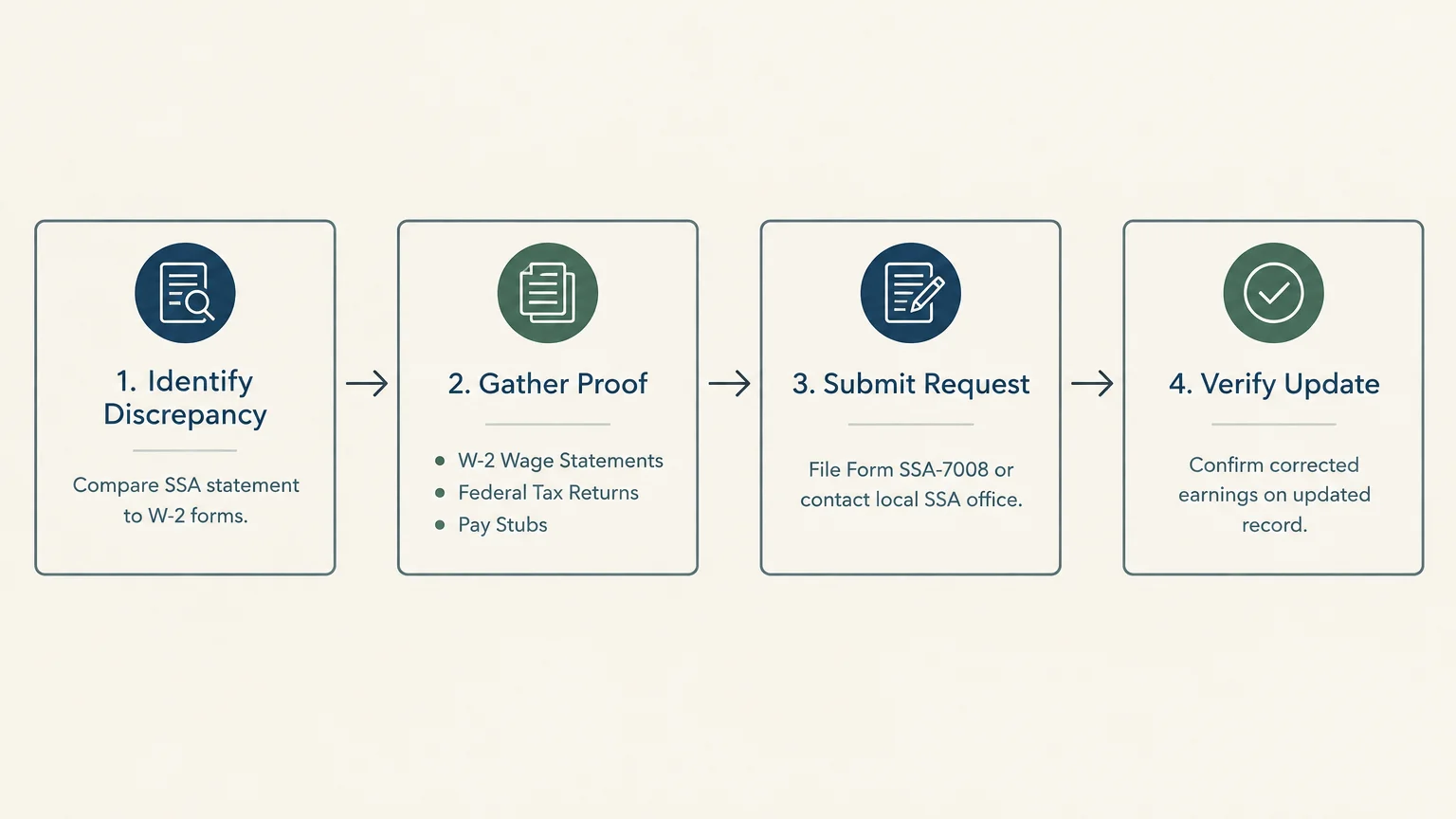
Once you confirm a discrepancy—and verify it is not simply last year’s payroll still in processing—you can begin fixing it. Follow these steps in order to save time and avoid rejected paperwork.
- Check whether you qualify to file online: Sign in to your my Social Security account, open your full earnings record, and look for the link to request a correction online. Online filing works best for straightforward missing W-2 wages from recent years.
- Understand when online filing is blocked: SSA states that not everyone is eligible for online corrections. If you need to remove wages that do not belong to you, or fix complex multi-year records, you will likely need to submit paper forms or visit a local office.
- Complete Form SSA-7008 for paper or in-person requests: Download or request Form SSA-7008, titled Request for Correction of Earnings Record. Fill out your name, SSN, the specific years in dispute, the employer’s name and address, and the exact dollar amounts you earned.
- Attach photocopies of your proof: Never mail your original W-2 forms or original tax returns unless an agent specifically asks to inspect them in person. Send clear photocopies alongside Form SSA-7008 and keep your originals in a locked file at home.
- Schedule an office appointment if needed: Effective January 6, 2025, SSA expanded appointment-based services nationwide for local field office visits. Book your slot online at ssa.gov/manage-benefits/make-an-appointment or call ahead before driving down.
You can reach SSA toll-free at 1-800-772-1213 (or TTY 1-800-325-0778) Monday through Friday, from 8:00 a.m. to 7:00 p.m. local time. Automated phone services run 24 hours a day, and free interpreter services are available whenever you need them.
To avoid long phone holds, call during off-peak windows. SSA advises that wait times are shortest between 8:00 a.m. and 10:00 a.m. or between 4:00 p.m. and 7:00 p.m., Wednesday through Friday, and later in the month.
If you are vulnerable, have an urgent benefit issue, or struggle with phone systems, SSA confirms that local offices will not turn away urgent walk-in visitors. Still, booking an appointment first spares you from waiting in a crowded lobby.
After you submit Form SSA-7008 and supporting documents, be patient while SSA verifies your records against employer archives and IRS files. Under SSA’s Program Operations Manual System (POMS RM 03803.020), the agency aims to issue an initial determination within six months.
Under court-ordered rules known as the Rivera standard, SSA must issue an initial determination within three years of receiving Form SSA-7008 or a written correction inquiry.
That legal clock only extends to 3 years, 3 months, and 15 days if the agency is actively waiting for evidence you promised to send.
What Proof You Need for Wages, Self-Employment, and Lost Records
Strong documentation turns a slow investigation into a fast approval. Gathering the right papers before contacting SSA saves weeks of back-and-forth letters.
The exact evidence you need depends on whether you worked as a W-2 employee, earned self-employment income, or lost your paperwork decades ago. Use the table below to match your situation to SSA’s accepted proof.
| Type of Missing Income | Primary Documents SSA Accepts | Backup Details If Originals Are Missing |
|---|---|---|
| Regular Wages (W-2 Employment) | Photocopy of Form W-2 (any copy except Copy A), original signed employer statement, tax returns, or pay stubs | Employer name, work location, dates worked, total pay, and the exact name and SSN used on payroll |
| Self-Employment Income | Form 1040, Schedule SE, and Schedule C or Schedule F, plus proof of timely filing | IRS date-stamped copy or cancelled check or money order payable to the IRS |
| Unmatched Name-Change Wages | Form W-2 or pay stubs plus marriage certificate or divorce decree linking your old and new names | Certified vital records showing the exact legal name change date |
Notice one subtle detail on W-2 forms: SSA accepts photocopies of your employee copies, but not Copy A, which employers send directly to the government.
If your former company shut down years ago, check whether you still have old federal tax returns showing those same W-2 totals.
For self-employed workers, filing the return on time matters as much as the numbers on the page. Include clear proof that you filed within the 3-year, 3-month, and 15-day window—such as an IRS receipt stamp, electronic filing confirmation, or cancelled tax payment check.
What if a basement flood, house fire, or cross-country move wiped out your records from thirty years ago? SSA still lets you submit Form SSA-7008 without paper receipts.
Write down every factual clue you remember: the company’s legal name, the city and state where you worked, your start and end dates, your approximate pay, and the exact name and SSN printed on your paychecks.
SSA staff can search internal employer filings and the Earnings Suspense File using those clues.
Before mailing any package, make a full copy of your completed Form SSA-7008 and every attached receipt for your own files. Send paper submissions via certified mail with return receipt requested so you have dated proof that SSA received your request.

Scams, Identity Theft, and Costly Mistakes to Avoid
Sometimes an error on your Social Security earnings record goes in the opposite direction: you spot high wages from an unfamiliar employer in a state you never visited. Never ignore extra earnings—they will not boost your check safely, and they often signal SSN misuse.
If someone else used your Social Security Number to work, those phantom wages can trigger unexpected IRS tax bills for unreported income. Worse, they can expose you to broader financial identity theft across bank accounts and credit cards.
Removing earnings that do not belong to you usually cannot be completed online. You may need to visit a local SSA office in person and sign a formal declaration under penalty of perjury confirming the wages are not yours.
While SSA can strip fraudulent wages off your earnings record, the agency does not investigate identity theft crimes. If you suspect someone misused your SSN, report it promptly to the Federal Trade Commission (FTC) at identitytheft.gov/steps or by calling 1-877-438-4338.
Reviewing consumer protection guides from the Consumer Financial Protection Bureau (CFPB) can also help you freeze your credit files and monitor bank statements for suspicious activity.
Freezing your credit with all three major bureaus is free and stops thieves from opening new loans in your name.
At the same time, watch out for third-party scams pretending to offer earnings record fixes. Fraudsters frequently target older adults with terrifying phone calls, emails, or text messages claiming your Social Security record has been suspended or frozen due to an error.
Follow these basic safety rules whenever anyone contacts you about your earnings record:
- Never pay a fee to fix your record: Checking your statement and filing Form SSA-7008 with SSA is 100% free. Any private company demanding money to repair your earnings chart is either unnecessary or an outright scam.
- Guard your login codes: Real SSA employees will never call out of the blue asking for your Login.gov password, one-time MFA text codes, gift cards, or wire transfers.
- Hang up and verify directly: If a caller claims there is an urgent error on your record, hang up immediately and dial 1-800-772-1213 yourself.
- Avoid clicking email links: Never sign in to your account through a link inside an unexpected text or email; always type ssa.gov/myaccount directly into your browser.
You can also find plain-language fraud alerts and retirement checklists through organizations like AARP, which regularly tracks emerging senior financial scams. Staying skeptical of unsolicited calls keeps both your benefit record and your savings safe.
Finally, avoid the most common mistake of all: assuming small errors do not matter. Even a modest discrepancy—or a single missing year caused by a name change—can reduce your monthly check and follow your spouse’s survivor benefits for decades.
Frequently Asked Questions
Can I fix my Social Security earnings record after I start collecting benefits?
Yes, you can submit Form SSA-7008 and supporting proof even if you are already retired and receiving monthly checks. Once SSA confirms the missing or understated wages, it recalculates your benefit amount and adjusts your future monthly payments.
How long does SSA take to process an earnings record correction?
Under SSA policy guidelines, the agency aims to issue an initial decision within six months of receiving your request. Complex cases requiring older employer archives can take longer, though court-ordered rules generally require an initial decision within three years.
Why is my most recent year of work showing zero dollars on my statement?
Wages from the current year and the prior year often appear blank while annual employer W-2 filings and self-employment tax returns are still being processed. Check back after the following autumn before assuming an error occurred.
What if my former employer went out of business and I lost my W-2?
You can still file Form SSA-7008 using old federal tax returns, pay stubs, or a detailed written statement listing the employer’s name, location, dates worked, and approximate pay. You can also request past wage and income transcripts directly from the IRS.
Will fixing a name change automatically pull my missing wages out of the Earnings Suspense File?
Updating your legal name with SSA prevents future mismatches, yet older unposted wages may still need a manual review. After updating your name, check your full earnings history and submit Form SSA-7008 with your W-2s if any past years remain blank.
For official financial guidance for seniors, visit
Administration for Community Living (ACL), Eldercare Locator, Social Security Administration (SSA), Medicare.gov and Centers for Medicare & Medicaid Services (CMS).
Disclaimer: This article is for informational purposes and is not a substitute for professional financial or tax advice. Consult with a certified financial planner or tax professional for guidance on your specific situation.