

Home equity held by Americans age 62 and older reached a record $15.34 trillion in mid-2026, making housing wealth your largest potential retirement cushion. Yet reverse mortgage rules, lending caps, and lender options are shifting rapidly as 2027 begins.
Federal regulators kept core borrower protections intact while reviewing sweeping program updates behind the scenes. Meanwhile, private jumbo reverse mortgages surged while government-backed volume hit near-decade lows.
This guide breaks down the 2027 lending outlook, fee structures, and recent rule changes in plain English. You will see exact dollar examples and a clear checklist to decide whether tapping home equity fits your budget.
In this guide8 sections
- What Has Changed for Reverse Mortgages Heading Into 2027
- Federal Policy Updates and Pending HECM Reforms
- Core Reverse Mortgage Rules That Have Not Changed
- Reverse Mortgage Rates, Fees, and Real Cost Examples
- Reverse Mortgage Pros and Cons for Home Equity Retirement
- Step-by-Step Checklist Before Applying in 2027
- Common Reverse Mortgage Mistakes and Scams to Avoid
- Frequently Asked Questions
What Has Changed for Reverse Mortgages Heading Into 2027
The biggest shift heading into 2027 is not a single new law, but a sharp split between government-backed loans and private alternatives. Understanding both sides helps you shop from a position of strength.
HECM Limits and the 2027 Lending Cap Outlook
Most reverse mortgages in the United States are Home Equity Conversion Mortgages, or HECMs, insured by the Federal Housing Administration (FHA). Each year, the U.S. Department of Housing and Urban Development (HUD) sets a nationwide Maximum Claim Amount (MCA) for these loans.
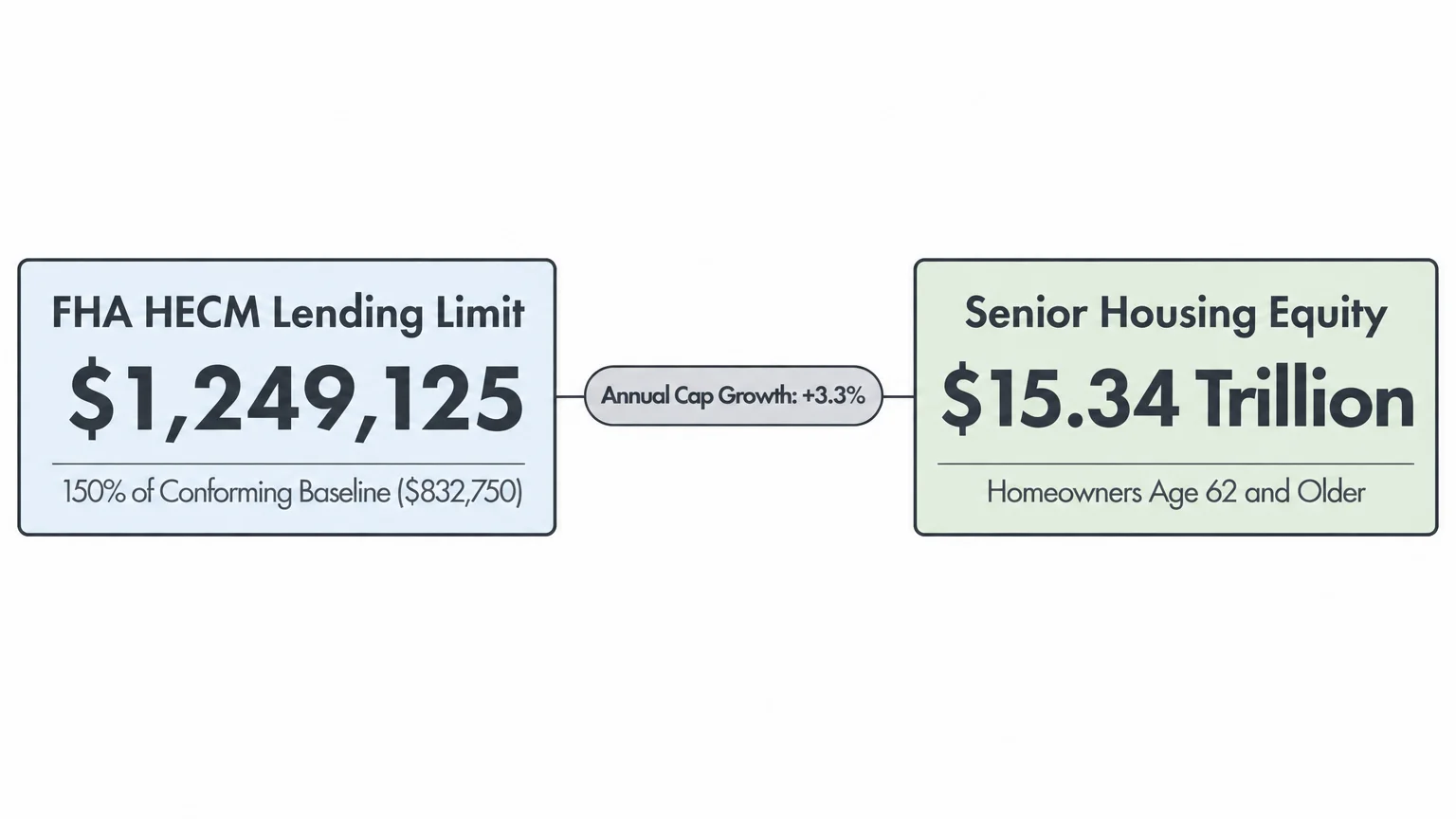
For case numbers assigned between January 1 and December 31, 2026, HUD set the HECM limit at $1,249,125 nationwide under Mortgagee Letter 2025-22. That cap applies everywhere, including Alaska, Hawaii, Guam, and the U.S. Virgin Islands.
This $1,249,125 ceiling marked a 3.3% ($39,375) jump from the 2025 limit of $1,209,750 and the tenth consecutive annual increase. By statute, HUD calculates this cap at 150% of Freddie Mac’s $832,750 baseline conforming loan limit for 2026.
Do not confuse the lending limit with your cash payout. The MCA only caps the home value FHA uses when calculating how much you can borrow based on your age and interest rates.
As of mid-November 2026, HUD had not yet announced the official 2027 HECM limits. HUD normally publishes the next year’s ceiling in late November or December after the Federal Housing Finance Agency (FHFA) releases updated conforming loan limits.
Record Senior Home Equity vs. Falling HECM Volume
According to the NRMLA/RiskSpan Reverse Mortgage Market Index released in October 2026, homeowners age 62 and older held $15.34 trillion in home equity during the second quarter of 2026. That marked the first time senior housing wealth crossed $15 trillion.
A $430 billion (+2.5%) gain in home values drove that milestone, offset only slightly by a $30 billion (+1.2%) rise in senior mortgage debt. Despite that wealth, fewer seniors chose traditional government-backed reverse mortgages.
HUD data compiled by the National Reverse Mortgage Lenders Association (NRMLA) shows annual HECM endorsements fell to 24,182 in fiscal year 2026. That compares with 28,172 in fiscal year 2025, 32,991 in 2023, and 64,489 in 2022.
Fiscal year 2027 began slowly as well, with 1,995 endorsements recorded in October 2026. Since the program began, cumulative HECM endorsements reached 1,403,171 through October 2026.
The Surge in Proprietary Reverse Mortgages
Many retirees are turning to private, proprietary reverse mortgages—often called jumbo reverse mortgages. These loans serve homeowners whose property values exceed the HECM cap or who want to avoid federal mortgage insurance premiums.
A July 2026 New View Advisors and NRMLA analysis of Consumer Financial Protection Bureau (CFPB) Home Mortgage Disclosure Act data highlights this rapid shift. Total reverse mortgage dollar volume grew 54%, rising from $6.25 billion in 2023 to $9.65 billion in 2025.
Proprietary reverse mortgages fueled most of that expansion, jumping 245% in dollar volume from $1.1 billion in 2023 to $3.8 billion in 2025. Unit originations nearly quadrupled from 1,774 in 2023 to 3,212 in 2024 and 6,979 in 2025.
Over that same span, traditional HECM unit volume grew by only about 6%. If your home is worth well over $1.25 million, comparing private jumbo options against HECM limits is now essential.
A Closer Look at the FHA Insurance Fund
FHA’s fiscal year 2026 annual report, released in November 2026, showed mixed health for the fund backing HECMs. As of September 30, 2026, FHA’s overall Mutual Mortgage Insurance Fund held a 10.29% capital ratio, comfortably above the 2% statutory minimum.
More than 250,000 active HECMs accounted for $63.5 billion in outstanding obligations, representing under 4% of the broader fund. However, the standalone HECM capital ratio dropped sharply from 24.06% in fiscal year 2025 to 5.43% in fiscal year 2026.
HUD attributed that decline to substantial capital spent on assignment claims alongside lower actual and projected loan payoffs. A weaker standalone cushion makes federal officials cautious about cutting insurance premiums anytime soon.

Federal Policy Updates and Pending HECM Reforms
Washington took an active look at reverse mortgage rules across 2025 and 2026, though major structural overhauls remain on hold. Knowing which policies changed—and which stayed the same—prevents unpleasant surprises during closing.
No Cuts Planned to FHA Mortgage Insurance Premiums
Lender trade groups, led by NRMLA, have lobbied HUD to reduce the 2% upfront HECM mortgage insurance premium or bring back risk-based pricing as low as 0.50%. Lowering that fee would save borrowers thousands at closing.
In September 2026, however, Ginnie Mae President Joe Gormley stated that the administration is comfortable with the current FHA mortgage insurance structure and has no plans to change it. You should budget for the full 2% upfront premium in 2027.
Pending HUD and Ginnie Mae Program Review
In October 2025, HUD—working through FHA and Ginnie Mae—issued a formal Request for Information on the future of the HECM program and secondary-market securities. Public comments closed in December 2025, though HUD has not announced a timeline for final changes.
Regulators asked industry experts and consumer advocates for ideas on several fronts that could eventually reshape how you qualify or refinance:
- Declining demand and lender barriers: Officials want to understand why fewer seniors and lenders participate in the HECM program.
- Refinance net-benefit tests: HUD is reviewing rules that govern when an existing HECM borrower can refinance into a new reverse mortgage.
- Life Expectancy Set-Asides (LESAs): Regulators are examining how funds are reserved to pay future property taxes and homeowners insurance for borrowers with tighter credit histories.
- Servicing tools and liquidity: Ginnie Mae is studying how to keep secondary-market investors willing to fund reverse mortgage pools.
Recent 2025 and 2026 FHA Operational Updates
While sweeping HECM legislation stalled, HUD issued several targeted Mortgagee Letters that streamline underwriting, appraisals, and servicing heading into 2027. Most focus on cutting lender red tape rather than changing your payout formula.
- Underwriting and appraisal changes (June 2025): HUD rescinded the full-time employment mandate for Direct Endorsement underwriters, removed the 2024 federal flood elevation mandate for newly built homes in 100-year floodplains, and dropped several procedural appraiser steps.
- Appraisal dispute updates (March 2025): HUD rescinded borrower-initiated Reconsideration of Value disclosure mandates under Mortgagee Letter 2025-08, though underwriter-initiated valuation reviews remain active.
- Servicing and counseling revisions (2025–2026): HUD updated servicing, hazard insurance, and loss-mitigation standards in January 2025 and revised its Housing Counseling Handbook in March 2026.
Counseling funding also survived a budget scare in 2026. Although the White House’s proposed fiscal year 2027 budget sought to eliminate $57.5 million in housing counseling funds, NRMLA reported in June 2026 that the House appropriations package preserved HECM operations and restored counseling money.

Core Reverse Mortgage Rules That Have Not Changed
Despite headlines about shifting markets and Washington reviews, the foundational reverse mortgage rules remain firmly intact for 2027. Every borrower must satisfy these core requirements.
Age, Occupancy, and Existing Mortgage Rules
To qualify for a standard HECM, every borrower on the loan must be at least 62 years old and live in the home as a primary residence. Vacation homes and rental properties do not qualify.
You must also pay off any existing traditional mortgage, home equity line of credit, or tax lien at closing. Most seniors use proceeds from the new reverse mortgage to wipe out that old monthly payment.
You can also use a HECM for Purchase if you want to downsize or move closer to family. Under that program, you combine a cash down payment with reverse mortgage proceeds to buy a new primary residence with no ongoing monthly principal-and-interest bill.
Private proprietary reverse mortgages follow looser eligibility thresholds because FHA does not insure them. Depending on your state and lender, minimum borrowing ages start as low as 55—or 60 in Massachusetts, New York, and Washington, and 62 in North Carolina and Texas for certain HomeSafe loans.
Proprietary programs also allow much larger balances, with some lenders offering up to $4 million on homes valued up to $10 million. That makes them useful if your equity far exceeds federal HECM limits.
Mandatory Independent Housing Counseling
Before a lender can process your HECM application or charge upfront application fees, you must complete a session with a HUD-approved housing counselor. You can locate an approved counselor nationwide by calling 800-569-4287.
During this session, an independent counselor reviews your budget, explains loan costs, and discusses alternatives such as downsizing or property tax deferral programs. Treat this meeting as your personal safety check, not a formality.
The 60% First-Year Withdrawal Limit
FHA limits how much of your available credit you can draw during the first 12 months after closing. In most cases, you cannot withdraw more than 60% of your initial principal limit in year one.
An exception applies if your mandatory obligations—such as paying off an existing mortgage and covering closing costs—exceed 50% of your principal limit. In that situation, you may draw enough to pay those obligations plus an extra 10% of the principal limit.
Your payout structure also depends on the rate type you pick.
Fixed-rate HECMs require taking your eligible proceeds as a single lump sum at closing, whereas adjustable-rate HECMs let you choose a line of credit, monthly term or tenure payments, a lump sum, or a blend.
Ongoing Homeowner Duties and Maturity Triggers
With a reverse mortgage, your name stays on the deed and you make zero monthly principal-and-interest payments. However, you do not get a free pass on homeownership expenses.
You must stay current on property taxes, homeowners insurance, and any homeowners association (HOA) dues, while keeping the home maintained to FHA standards. Falling behind on taxes or insurance can put your loan into default and risk foreclosure.
Your loan becomes due and payable when the last borrower passes away, sells the house, or permanently moves out. Moving into a nursing home or assisted living facility counts as a permanent move after 12 consecutive months if no co-borrower remains in the house.
Non-Recourse and Non-Borrowing Spouse Safeguards
Every HECM is a non-recourse loan, meaning neither you nor your heirs will ever owe more than the home is worth when sold to settle the debt. If the loan balance exceeds the sale price, FHA insurance absorbs the shortfall.
Qualifying spouses who are under 62 or left off the loan also keep vital protections under HUD Mortgagee Letter 2021-11. An Eligible Non-Borrowing Spouse may remain in the home and defer loan repayment after the borrowing spouse dies, provided they continue paying taxes, insurance, and maintenance.
Reverse Mortgage Rates, Fees, and Real Cost Examples
Reverse mortgages carry higher upfront costs than traditional forward mortgages, so understanding the exact math before you apply is critical. Let’s look at late-2026 market rates and how federal fee caps work on real home values.
Late-2026 Interest Rates and Borrowing Options
Market quotes in mid-November 2026 show fixed-rate HECMs averaging around 7.680% to 7.810%, with estimated annual percentage rates (APRs) near 9.19% to 9.34%. Fixed rates protect you from rising rates, but force you into a one-time lump-sum payout.
Adjustable-rate HECMs carry lower starting rates near 6.250% to 6.500%, calculated from a 1.750% to 2.000% lender margin added to the 12-month Constant Maturity Treasury (CMT) index. These rates adjust monthly and feature a 5% lifetime cap above your starting rate.
Adjustable-rate HECMs also include a valuable line-of-credit growth feature. Any unused credit in your HECM line grows automatically each month at your loan’s interest rate plus the 0.50% annual mortgage insurance premium rate, expanding your emergency reserve over time.
| Feature | HECM Fixed-Rate | HECM Adjustable-Rate | Proprietary (Jumbo) |
|---|---|---|---|
| Minimum Age | 62 | 62 | 55 to 62 (varies by state and lender) |
| Lending Value Cap | $1,249,125 (2026 limit) | $1,249,125 (2026 limit) | No FHA cap (loans up to $4 million) |
| FHA Mortgage Insurance | 2.00% upfront; 0.50% annual | 2.00% upfront; 0.50% annual | None |
| Payout Choices | Single lump sum only | Credit line, monthly payouts, lump sum, or mix | Usually lump sum; some offer credit lines |
| Best Fit For | Paying off a large existing mortgage | Building a growing retirement reserve | High-value homes or borrowers age 55 to 61 |
HECM Fee Caps Explained
Federal rules strictly cap two major HECM charges: mortgage insurance premiums and lender origination fees. Third-party closing costs—such as appraisals, title insurance, and recording fees—still vary by county and lender.
- Upfront Mortgage Insurance Premium: 2.00% of your home’s appraised value or the $1,249,125 Maximum Claim Amount, whichever is less.
- Annual Mortgage Insurance Premium: 0.50% per year charged on your outstanding loan balance, added to the balance rather than paid monthly out of pocket.
- Origination Fee Cap (24 CFR § 206.31): Lenders may charge the greater of $2,500, or 2% of the first $200,000 of your home’s value plus 1% of the value above $200,000, strictly capped at $6,000.
- Monthly Servicing Fees: Although HUD permits monthly servicing charges, most reverse mortgage lenders no longer charge them.
Two Real-Dollar Cost Examples
Suppose your home is appraised at $400,000 and you choose a HECM in late 2026. Your 2.00% upfront FHA mortgage insurance premium equals $8,000.
Under HUD’s origination formula, the lender can charge 2% on the first $200,000 ($4,000) plus 1% on the remaining $200,000 ($2,000). That puts your maximum origination fee right at the $6,000 federal cap, totaling $14,000 before third-party title and appraisal charges.
Now suppose your home is worth $1,500,000. Because FHA caps the Maximum Claim Amount at $1,249,125 under 2026 HECM limits, your 2.00% upfront mortgage insurance premium is calculated on $1,249,125—costing $24,982.50—while the origination fee remains capped at $6,000.
On a $1,500,000 home, you leave $250,875 of equity completely uncounted under a standard HECM. Comparing a private jumbo reverse mortgage—which charges no FHA mortgage insurance—often saves money or unlocks higher proceeds on luxury properties.
Reverse Mortgage Pros and Cons for Home Equity Retirement
Tapping home equity in retirement solves real cash-flow problems for seniors on fixed incomes, yet it carries lasting trade-offs. Reviewing reverse mortgage pros and cons side by side helps you avoid regret five or ten years later.
Key Advantages for Retirees
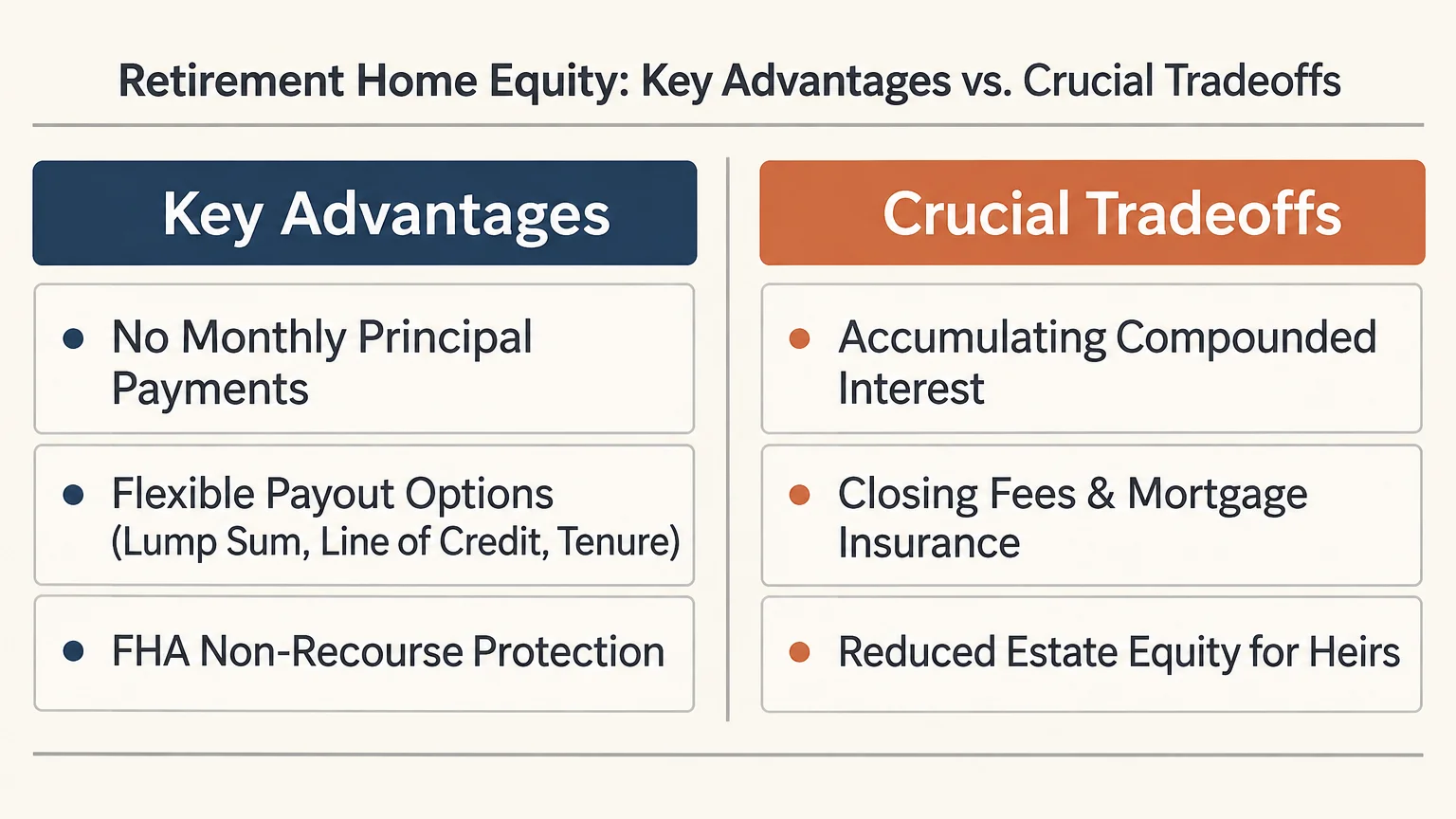
- Eliminates monthly mortgage payments: Paying off an existing mortgage at closing frees up hundreds or thousands of dollars in monthly cash flow immediately.
- Tax-free cash proceeds: Reverse mortgage payouts are loan advances, not taxable income, so they do not trigger higher income tax brackets; you can verify official interest and loan tax rules on IRS.gov.
- No impact on Social Security retirement or Medicare: Loan funds do not count toward the earnings test or Medicare Part B income-related surcharges.
- Growing emergency line of credit: On an adjustable HECM, leaving credit untouched grows your available borrowing power every month regardless of future home price swings.
- Non-recourse safety net: You and your estate never owe more than the home’s market value when sold to pay off the loan.
Major Drawbacks to Weigh Carefully
- High upfront closing costs: Paying a 2% upfront insurance fee plus origination and title costs makes reverse mortgages expensive if you plan to move within three to five years.
- Compounding loan balance: Because you make no monthly payments, interest and annual insurance premiums compound over time, steadily shrinking the equity left for your heirs.
- Risk of tax or insurance default: If medical bills or inflation strain your budget and you miss property tax or homeowners insurance payments, the lender can start foreclosure.
- Means-tested benefit traps: While regular Social Security retirement is unaffected, Supplemental Security Income (SSI) and Medicaid apply strict monthly asset caps; confirm asset rules with the Social Security Administration (SSA) before taking large payouts.
- Healthcare move-out rule: Spending more than 12 consecutive months in a nursing home or rehabilitation facility without a co-borrower living at home triggers loan repayment.
Step-by-Step Checklist Before Applying in 2027
A reverse mortgage should fit smoothly into a long-term retirement plan rather than act as a quick band-aid. Follow these six steps before signing any lender paperwork.
- Stress-test your property tax and insurance budget: Add up annual property taxes, homeowners insurance, HOA dues, and routine home repairs, and confirm your pension or Social Security reliably covers them for the next decade.
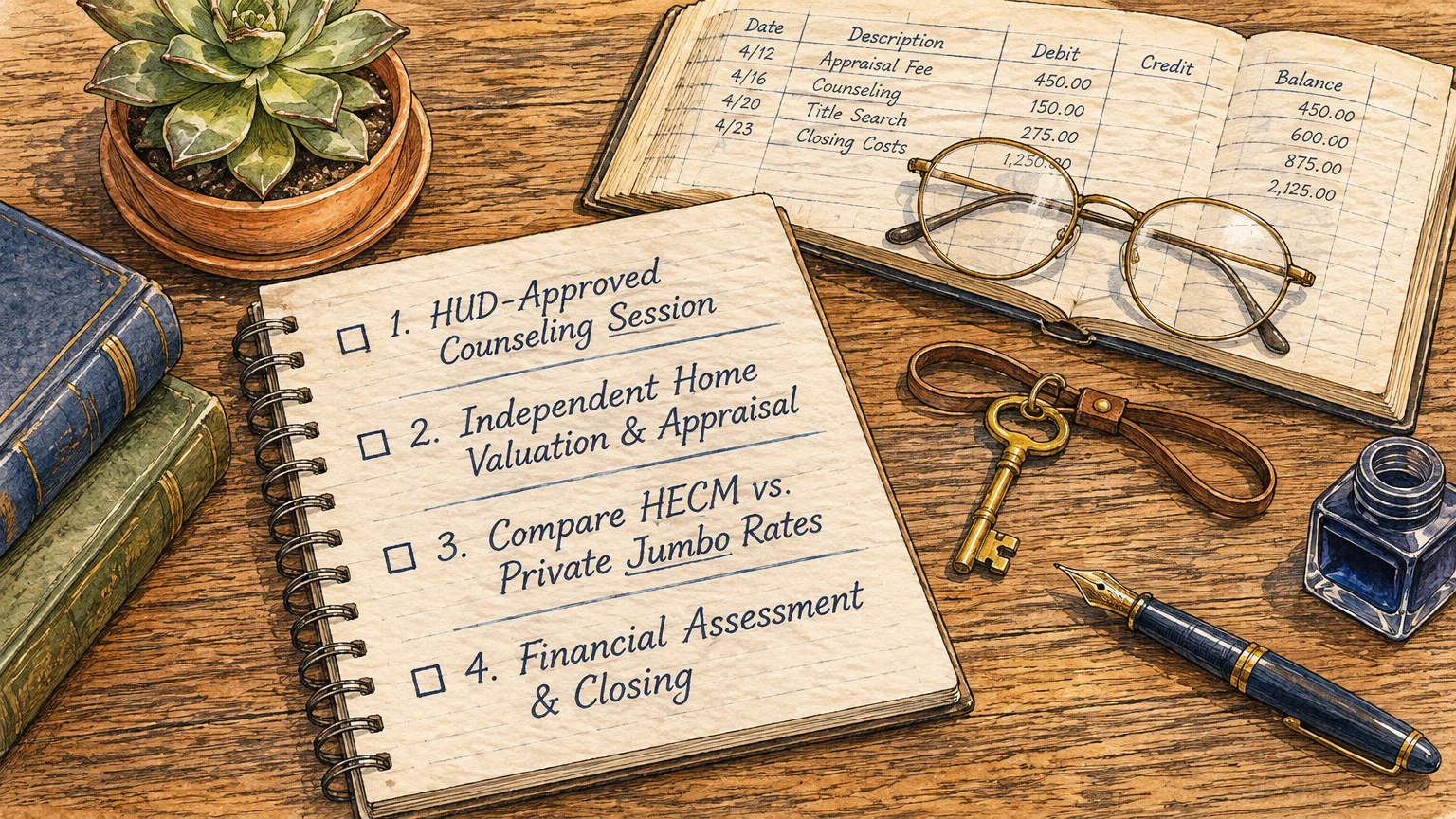
- Compare HECM limits against your home value: If your property sits near or above the $1,249,125 federal cap, request side-by-side quotes for both an FHA HECM and a proprietary jumbo reverse mortgage.
- Complete HUD-approved counseling first: Call 800-569-4287 to schedule your mandatory independent counseling session, and ask the counselor whether a Life Expectancy Set-Aside might shrink your cash payout.
- Shop at least three lenders on margins and origination fees: Lender margins on adjustable HECMs and origination charges below the $6,000 cap vary meaningfully, so compare written Loan Estimates using shopping guides from the Consumer Financial Protection Bureau (CFPB).
- Check benefit and estate interactions: If you rely on Medicaid, SSI, or state property-tax relief programs, verify how holding loan cash past month-end could affect your eligibility.
- Talk openly with your spouse and heirs: Confirm whether your spouse qualifies as a co-borrower or Eligible Non-Borrowing Spouse, and make sure adult children understand how they will sell or refinance the home later.

Common Reverse Mortgage Mistakes and Scams to Avoid
Because reverse mortgages unlock large sums of equity at once, bad actors frequently target older homeowners with high-pressure sales tactics. Recognizing these traps protects both your house and your savings.
Never Use Loan Proceeds to Buy Investments or Annuities
One of the most dangerous pitches involves an advisor urging you to pull equity from your home to buy a high-commission annuity, life insurance policy, or risky investment. Legitimate reverse mortgage lenders cannot require you to buy another financial product as a condition of approval.
Remember that HECM fixed rates currently sit near 7.68% to 7.81%, plus 0.50% in annual insurance fees. Few safe investments earn enough after fees and taxes to beat borrowing against your house at over 8% combined cost.
Watch Out for Contractor and Home-Repair Schemes
Some roofing, solar, or remodeling contractors promise a free home upgrade paid through a reverse mortgage they help arrange. Once the work finishes, you are left with a hefty loan balance and steep upfront fees for repairs you might have financed far more cheaply.
Always hire licensed contractors separately from your mortgage search, and get three independent repair bids before borrowing against your equity. If you need help paying for essential home modifications, check local aging grants through the Eldercare Locator first.
Avoid Leaving Lump Sums Idle in Checking Accounts
If you receive Medicaid long-term care assistance or Supplemental Security Income, taking a large lump sum and letting it sit in your checking account can disqualify you the very next month.
Both programs count unspent cash left past the end of the calendar month toward strict asset limits.
Choosing a HECM line of credit instead lets you draw only the exact amount you need for bills during the month you spend it. Always confirm your state’s asset rules before choosing a payout option.
Do Not Leave a Younger Spouse Off the Deed Without Planning
Some couples remove a younger spouse under 62 from the home’s title just to qualify for a slightly higher payout. That shortcut can create devastating legal headaches if the older spouse passes away or enters long-term care.
Although Eligible Non-Borrowing Spouses can remain in the home under HUD rules, they cannot draw any remaining funds from a reverse mortgage line of credit after the borrowing spouse dies.
Waiting until both spouses turn 62—or budgeting separately for the surviving spouse—is often much safer.
Frequently Asked Questions
Can I lose my home if I take out a reverse mortgage in 2027?
You keep the title to your home and cannot lose it simply for living a long life or owing more than the property’s value.
However, the lender can foreclose if you move out permanently, fail to maintain the property, or miss property tax, homeowners insurance, or HOA payments.
Will a reverse mortgage affect my Social Security or Medicare benefits?
No, reverse mortgage loan advances do not reduce regular Social Security retirement checks or change your Medicare coverage because borrowed funds are not taxable income.
Needs-based programs such as Medicaid and Supplemental Security Income (SSI) have strict asset limits, so unspent cash kept past month-end can affect eligibility.
What happens to my reverse mortgage if I move into a nursing home?
If you are the sole borrower and stay in a hospital, rehabilitation center, or nursing home for more than 12 consecutive months, the loan becomes due and payable. If a co-borrower still lives in the home as their primary residence, repayment remains deferred.
Should I wait for the 2027 HECM limits before applying?
Waiting only makes sense if your home’s value is higher than the 2026 limit of $1,249,125 and you expect a meaningful federal increase for 2027. If your property is worth less than $1,249,125, a higher national ceiling will not increase your personal borrowing limit.
How do my heirs pay off a reverse mortgage if the home drops in value?
Because HECMs are non-recourse loans, your heirs never owe more than the home’s appraised value or sale price when settling the debt.
They can sell the house and let FHA insurance cover any shortfall, hand the deed back to the lender, or keep the home by paying 95% of its current appraised value or the loan balance, whichever is less.
For official financial guidance for seniors, visit
Medicare.gov, Centers for Medicare & Medicaid Services (CMS) and Consumer Financial Protection Bureau (CFPB).
Disclaimer: This article is for informational purposes and is not a substitute for professional financial or tax advice. Consult with a certified financial planner or tax professional for guidance on your specific situation.