

Veterans often assume their VA health care exempts them from signing up for Medicare at age 65. Relying solely on VA benefits can trigger severe, lifelong financial penalties when you finally enroll in Medicare Part B.
Medicare does not consider VA health care to be creditable coverage for Part B purposes. Failing to enroll during your initial window means facing delayed access and a permanent monthly surcharge.
Understanding the rules today helps you protect your hard-earned benefits, secure outside medical access, and avoid expensive surprises.
In this guide7 sections
- The Core Rule: Why VA Health Care Is Not Creditable for Part B
- How the Medicare Part B Late Enrollment Penalty Works
- Initial Enrollment Period: Key Deadlines You Must Meet
- TRICARE For Life and CHAMPVA: Why Part B Is Mandatory
- Comparing VA Health Care and Medicare Coverage
- Best Enrollment Strategies for Veterans Turning 65
- Frequently Asked Questions
The Core Rule: Why VA Health Care Is Not Creditable for Part B
Medicare requires you to have medical insurance based on active, current employment to delay Part B without penalty. Because VA benefits stem from past military service rather than current job-based group coverage, Medicare does not grant an exemption.
According to Medicare.gov, VA health care does not qualify you for a Part B Special Enrollment Period. If you drop or delay Part B without active job insurance, your late penalty clock starts ticking immediately.
VA health care and Medicare operate as completely separate systems funded by different congressional appropriations. The VA will not bill Medicare for treatment you receive in its clinics, nor does Medicare reimburse VA facilities.
How the Medicare Part B Late Enrollment Penalty Works
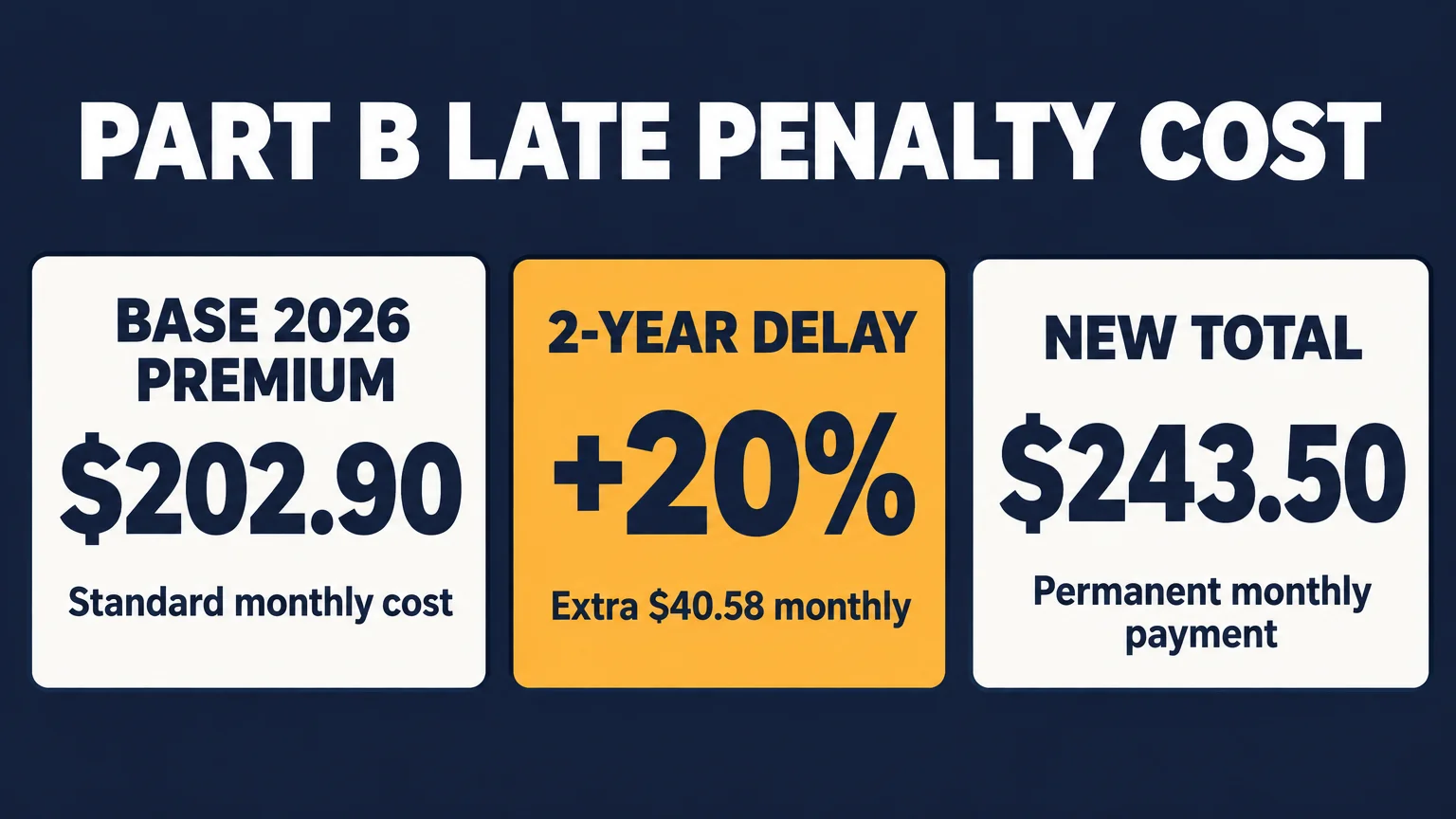
The Part B late enrollment penalty adds an extra 10% to your monthly premium for every full 12-month period you lacked coverage. You must pay this surcharge every month for as long as you keep Medicare Part B.
For 2026, the standard monthly Part B premium is $202.90. If you wait two full years to sign up, a 20% penalty adds $40.58 each month, bringing your total to $243.50 monthly.
In 2027, the standard Part B premium increases to $209.40 per month. Because the penalty is a percentage, the dollar amount you owe rises every time the federal government adjusts baseline Medicare rates.
Initial Enrollment Period: Key Deadlines You Must Meet
Your Initial Enrollment Period is a 7-month window that opens three months before your 65th birthday month. It includes your birthday month and ends three months later.
If you miss this window, you must wait for the General Enrollment Period, which runs annually from January 1 through March 31. Your coverage then begins the first day of the month after you submit your application.
Official guidelines from Centers for Medicare & Medicaid Services (CMS) highlight that waiting for the General Enrollment Period leaves you vulnerable to gaps in outside care and cumulative penalties.
TRICARE For Life and CHAMPVA: Why Part B Is Mandatory
While general VA health care makes Part B voluntary, military retiree benefits carry much stricter rules. Military retirees must enroll in both Medicare Part A and Part B to keep their earned TRICARE coverage.
At age 65, your TRICARE coverage automatically converts to TRICARE For Life, which acts as a secondary payer to Medicare. If you decline Part B, you lose TRICARE coverage entirely until you re-enroll during an authorized window.
Family members receiving coverage through CHAMPVA face the exact same requirement upon reaching age 65. If a CHAMPVA beneficiary drops Part B, the program terminates their health benefits on that same day.

Comparing VA Health Care and Medicare Coverage
Understanding how VA coverage interacts with Medicare parts helps you choose the right protection. The rules for doctor visits differ fundamentally from the rules governing prescription drugs.
| Coverage Type | Is VA Considered Creditable? | Penalty If Delayed |
|---|---|---|
| Medicare Part B (Outpatient & Doctors) | No (Requires active employment coverage) | 10% per full 12-month period for life |
| Medicare Part D (Prescription Drugs) | Yes (For the veteran only) | None, if enrolled within 63 days of losing VA care |
| TRICARE For Life (Military Retirees) | Not applicable (Part B is mandatory) | Immediate loss of TRICARE health benefits |
Unlike Part B, VA health care counts as creditable coverage for Medicare Part D prescription plans. You can safely skip Part D while relying on the VA pharmacy, provided you enroll within 63 days if you ever lose VA care.

Best Enrollment Strategies for Veterans Turning 65
Enrolling in Part B provides valuable flexibility by letting you see civilian specialists and visit local emergency rooms without pre-authorization. VA health care generally covers non-VA providers only under strict Community Care guidelines.
Federal funding for VA priority groups can change over time based on congressional budget decisions. Holding Medicare Part B acts as a dependable safety net if future policy changes ever restrict your access to VA care.
As highlighted on Benefits.gov, combining federal programs allows you to maximize your health protection while keeping your out-of-pocket costs predictable.
Frequently Asked Questions
Does enrolling in Medicare Part B affect my VA health care benefits?
No, enrolling in Medicare has no negative impact on your VA eligibility or priority group. You can use both systems independently to access medical treatments.
Can I use Medicare at a VA hospital?
No, VA facilities do not bill Medicare for medical services. Medicare only pays for covered health care received from participating civilian doctors and hospitals.
What if I have health insurance through my current employer at age 65?
If you or your spouse actively work for an employer with 20 or more employees, you can safely delay Part B. You will receive an 8-month Special Enrollment Period when that employment ends.
Do high-income military retirees face extra Medicare costs?
Yes, higher earners pay an Income-Related Monthly Adjustment Amount on top of the standard premium. For 2026, single filers earning over $109,000 pay an additional monthly surcharge.
Is Medicare Part D necessary if I already get VA prescriptions?
Part D is optional because VA drug coverage is creditable. However, adding Part D lets you fill prescriptions written by non-VA doctors at your neighborhood pharmacy without VA approval.
For additional senior resources, visit
Social Security Administration (SSA), Consumer Financial Protection Bureau (CFPB), Administration for Community Living (ACL), Eldercare Locator and AARP.
Disclaimer: The information in this article is for educational purposes only and is not intended to be a substitute for professional financial, legal, or medical advice. Always consult with a qualified expert for advice tailored to your personal situation.