

Working a part-time job while receiving Supplemental Security Income provides financial freedom, but requires strict monthly wage reporting. Reporting earnings on time protects your monthly benefits and avoids surprise overpayments.
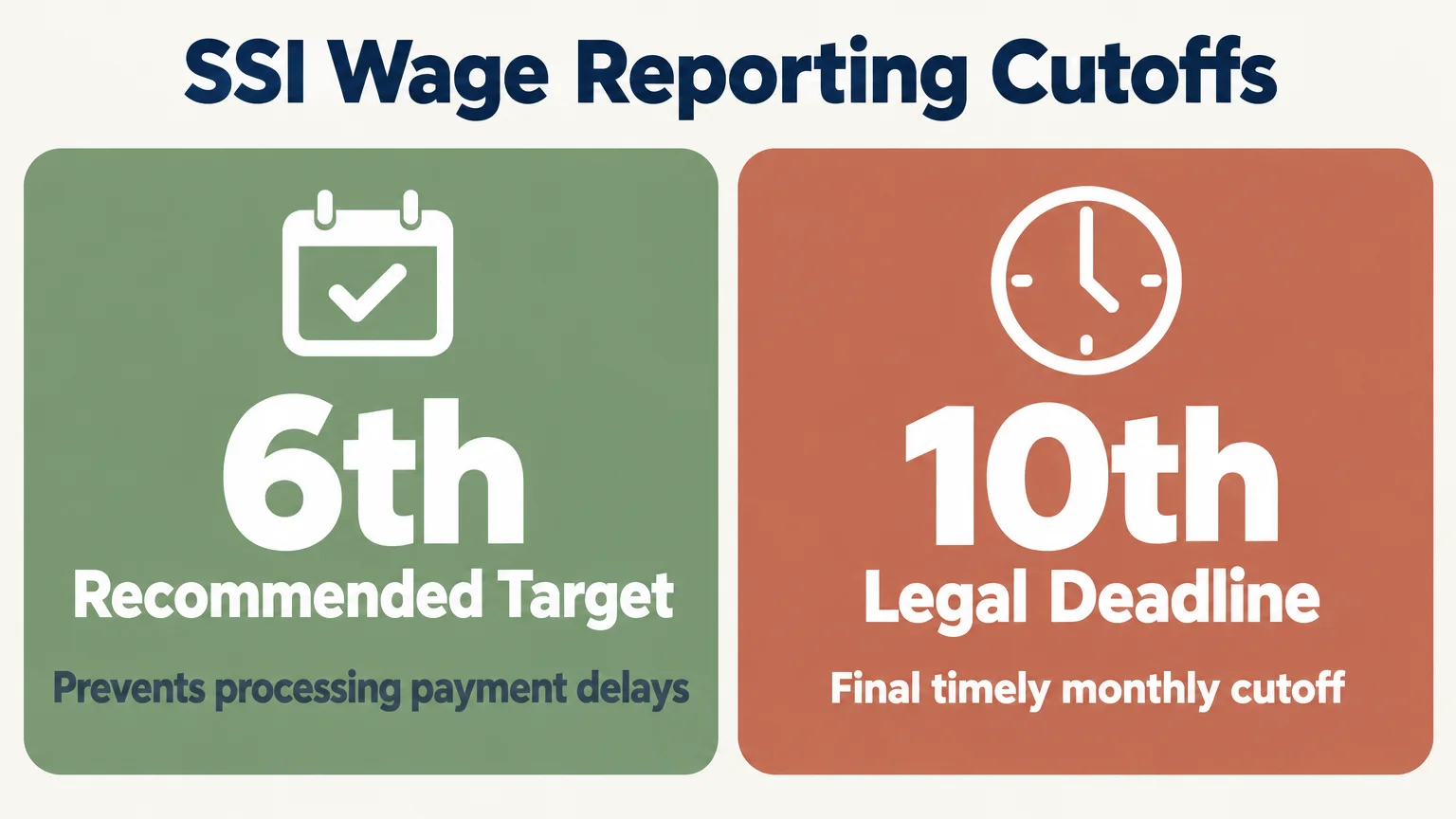
Federal rules give you until the 10th of each month, but reporting by the 6th creates a vital safety cushion. This guide outlines reporting deadlines, submission options, and safeguards for working seniors.
In this guide9 sections
- Understanding SSI Monthly Wage Reporting Deadlines
- How Work Earnings Affect Your Monthly SSI Payment
- Five Approved Ways to Report Your Wages
- The Payroll Information Exchange Explained
- Step-by-Step Checklist for Reporting Wages
- Consequences of Late or Missed Wage Reports
- Handling Overpayment Notices, Appeals, and Waivers
- Common Wage Reporting Mistakes to Avoid
- Frequently Asked Questions
Understanding SSI Monthly Wage Reporting Deadlines
Supplemental Security Income (SSI) is a needs-based program where job earnings directly influence your monthly federal benefit. You must submit your monthly gross wages no later than the 10th day of the month after you receive them.
Although the legal deadline is the 10th, the agency strongly urges you to report by the 6th day of the month. Submitting pay details by the 6th gives administrative systems time to adjust your next scheduled check smoothly and accurately.
Reporting between the 7th and the 10th is lawful and timely, but processing delays can trigger temporary overpayments. If you miss both windows, submit your report later in the month rather than skipping it entirely.
You must notify the agency within 10 days after the end of the month if you start a new job, stop working, or receive a raise. Self-employed seniors must submit an annual report of net earnings by January 10 while reporting major profit estimates as they occur.
How Work Earnings Affect Your Monthly SSI Payment
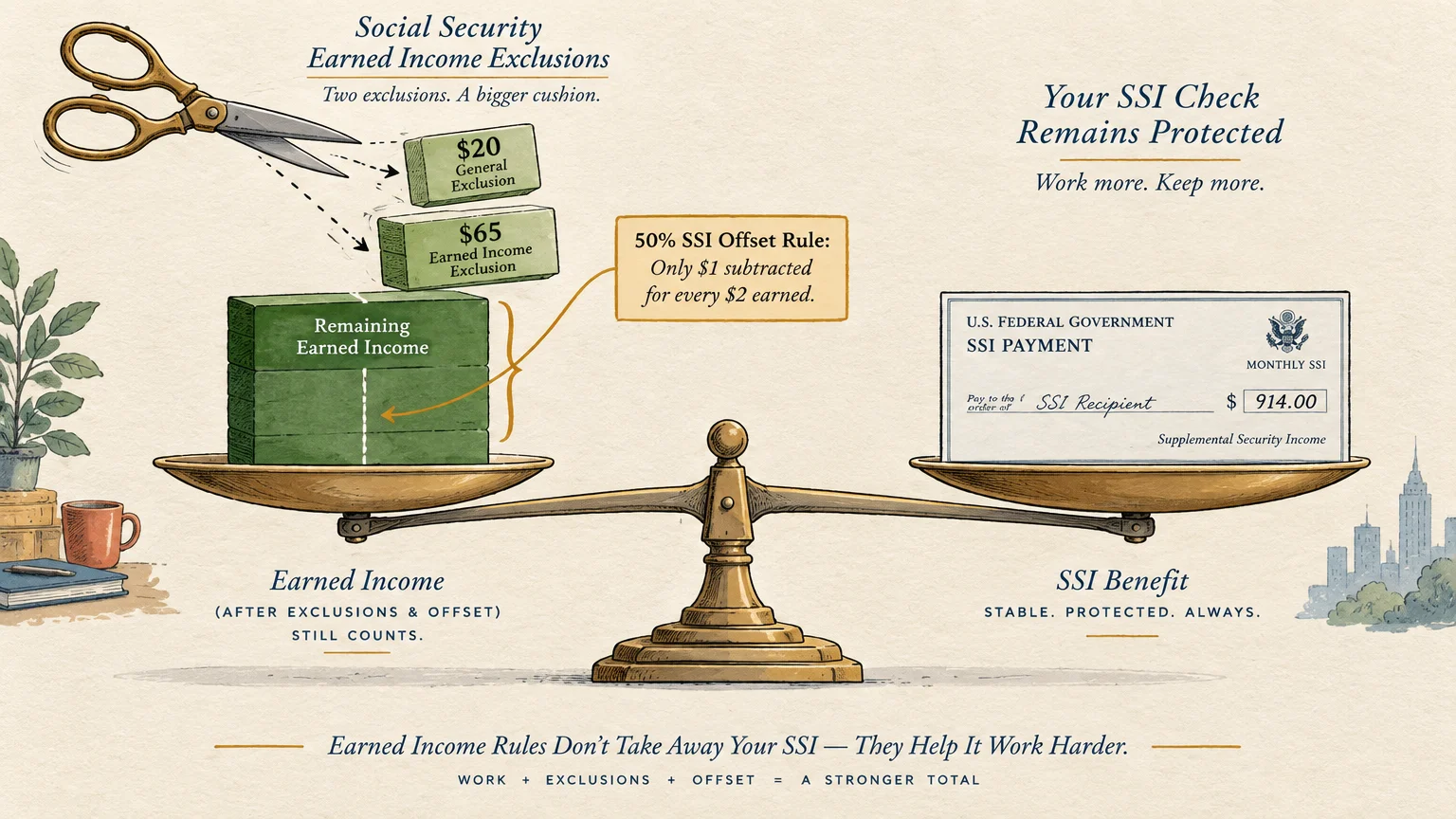
Federal work incentives ensure that working almost always increases your total monthly income. Earned income exclusions shield a significant portion of your paycheck from reducing your SSI check.
First, the agency applies a standard $20 monthly general income exclusion to your earnings. Next, a dedicated $65 monthly earned income exclusion protects an additional $65 of your gross earnings.
Finally, the agency excludes half of any remaining wages, reducing your SSI payment by only $1 for every $2 earned above $85. For example, earning $585 in gross wages leaves just $250 in countable earned income after exclusions are applied.
According to the Social Security Administration (SSA), maximum federal rates rise by 3.6% for 2027. However, countable resource limits remain fixed at $2,000 for individuals and $3,000 for couples.
| Benefit Category | 2026 Calendar Year | 2027 Calendar Year |
|---|---|---|
| Individual Maximum Federal Rate | $994 per month | $1,029 per month |
| Couple Maximum Federal Rate | $1,491 per month | $1,544 per month |
| Individual Zero-Benefit Gross Wage Cap | $2,073 per month | $2,143 per month |
| Individual Countable Resource Limit | $2,000 | $2,000 |
| Couple Countable Resource Limit | $3,000 | $3,000 |
When gross wages exceed the zero-benefit threshold, your cash SSI payment drops to zero, though special Medicaid rules often preserve healthcare coverage.
Five Approved Ways to Report Your Wages
Beneficiaries can report monthly wages online through their personal portal or by using the official mobile reporting app. You can also call the automated telephone reporting system at 1-866-772-0953 to enter wage figures 24 hours a day.
Before using the app or phone system, you must contact your local office to register your employer and their Employer Identification Number (EIN). When submitting, provide your legal name, Social Security number, wage earner’s number, and total gross monthly pay.
Alternatively, you can mail or hand-deliver pay stubs to your local field office, or speak with an agent at 1-800-772-1213 (TTY 1-800-325-0778). You can also sign up for free monthly text or email reminders to help track reporting deadlines.
The Payroll Information Exchange Explained
The Payroll Information Exchange (PIE) allows participating payroll providers, primarily Equifax, to share wage data securely with the agency. You must authorize data access by submitting Form SSA-8240 online through your personal account.
You must continue manual wage reporting until you receive an official notice confirming your employer is actively connected. Furthermore, you must manually report starting a new job, leaving a position, secondary gig work, and all self-employment income.
Step-by-Step Checklist for Reporting Wages
Gather all physical or digital pay stubs received in the prior calendar month, based on check payment dates rather than dates worked. Identify and total your gross pre-tax earnings across all paychecks received during that month.
Submit your total wage data between the 1st and the 6th day of the month to ensure timely adjustments. Secure confirmation immediately by saving your confirmation number or requesting a stamped receipt from your local office.
Retain pay stubs and confirmation receipts for at least two years in your home records. Finally, review your monthly benefit deposits to confirm calculations match expectations, contacting your local office if discrepancies appear.
Consequences of Late or Missed Wage Reports
Failing to report wages does not immediately terminate benefits, but delayed reports lead to overpayments that must be repaid. Administrative penalties for unexcused delays deduct $25 for a first failure, $50 for a second, and $100 for subsequent failures.
According to information from USA.gov, honest reporting errors rarely trigger administrative fraud sanctions. Benefit suspensions of 6, 12, or 24 months and civil fines up to $5,000 are reserved for individuals who knowingly conceal earnings.
Demonstrating good cause, such as hospitalization, illness, or postal delays, can excuse missed deadlines and eliminate late-reporting penalties.

Handling Overpayment Notices, Appeals, and Waivers
Under federal regulation 20 CFR § 416.571, the agency caps standard SSI overpayment withholding at 10% of your total monthly income. This limits monthly deductions to $99.40 in 2026 and $102.90 in 2027, unlike Title II programs with default 50% withholding rates.
Automatic benefit deductions generally begin about 60 days after notice, but you have 30 days to respond and preserve your rights. Experts at the Consumer Financial Protection Bureau (CFPB) emphasize responding promptly to official debt notices.
If 10% withholding strains your budget, submit Form SSA-634 to request payments as low as $10 per month. If you believe the agency made an error, file Form SSA-561 (Request for Reconsideration) within 60 days of receiving your notice.
If the overpayment was not your fault and you cannot afford repayment, submit Form SSA-632-BK to request a debt waiver. The agency examines household expenses and assets to confirm whether repayment would deprive you of ordinary living necessities.
Common Wage Reporting Mistakes to Avoid
A frequent error is reporting net take-home pay instead of gross earnings before taxes and insurance deductions. Another common mistake is recording earnings by work shifts rather than the calendar month you actually received the check.
Beneficiaries paid biweekly must remember to report all three paychecks during five-paycheck months. Always retain confirmation receipts as proof of compliance, and remember to report a working spouse’s gross income under federal deeming rules.
Frequently Asked Questions
What happens if I miss the reporting deadline on the 10th?
Submit your report immediately online or at your local office to prevent overpayments from compounding over time. The agency may assess a $25 penalty, but will waive it if you establish good cause.
Can I deduct impairment-related work expenses from my reported wages?
Yes, Impairment-Related Work Expenses (IRWE) such as specialized transportation, medical devices, or attendant care can be deducted from gross wages. Deducting approved out-of-pocket costs lowers your countable earned income and increases your monthly SSI payment.
How does working affect my Medicaid coverage while receiving SSI?
Under Section 1619(b) of the Social Security Act, you can keep Medicaid coverage even if wages reduce your SSI cash benefit to zero. You must continue meeting disability criteria and remain under standard countable resource limits.
Do I need to report wages if my income is below the $65 exclusion?
Yes, federal regulations require full reporting of all earnings, even if you earn only $20 or $50 in a month. The agency must apply exclusions officially to prevent automated discrepancies when IRS records are cross-checked.
What should I do if my employer changes payroll companies?
Notify your local field office immediately to verify the new company name and Employer Identification Number. Resume manual monthly reporting until you receive formal confirmation that automated data exchange is active.
For additional senior resources, visit Consumer Financial Protection Bureau (CFPB), Administration for Community Living (ACL), Eldercare Locator and AARP.
Disclaimer: The information in this article is for educational purposes only and is not intended to be a substitute for professional financial, legal, or medical advice. Always consult with a qualified expert for advice tailored to your personal situation.