

Retiring abroad promises lower living costs, vibrant cultures, and sunny climates, but unexpected visa hurdles can disrupt your golden years if you prepare without complete information. Many foreign governments enforce strict solvency rules, tax regulations, and healthcare mandates that catch retirees off guard. Understanding these hidden visa requirements ensures a smooth transition, allowing you to secure your residence permit without financial delays or legal complications. From proven passive income thresholds to strict limits on work, navigating the official process requires careful attention to detail. By mastering international retirement rules today, you protect your nest egg and build a stress-free retirement overseas.
The Hidden Realities of Retiring Abroad
Moving to another country during retirement sounds like a dream come true; however, establishing legal residency involves far more than simply purchasing an airline ticket and finding a cozy coastal home. Foreign immigration departments design retirement visas specifically to ensure that foreign nationals do not become financial burdens on local social infrastructure. Consequently, immigration officers review your financial statements, criminal background history, and health status with extreme scrutiny before granting long-term residency permits.
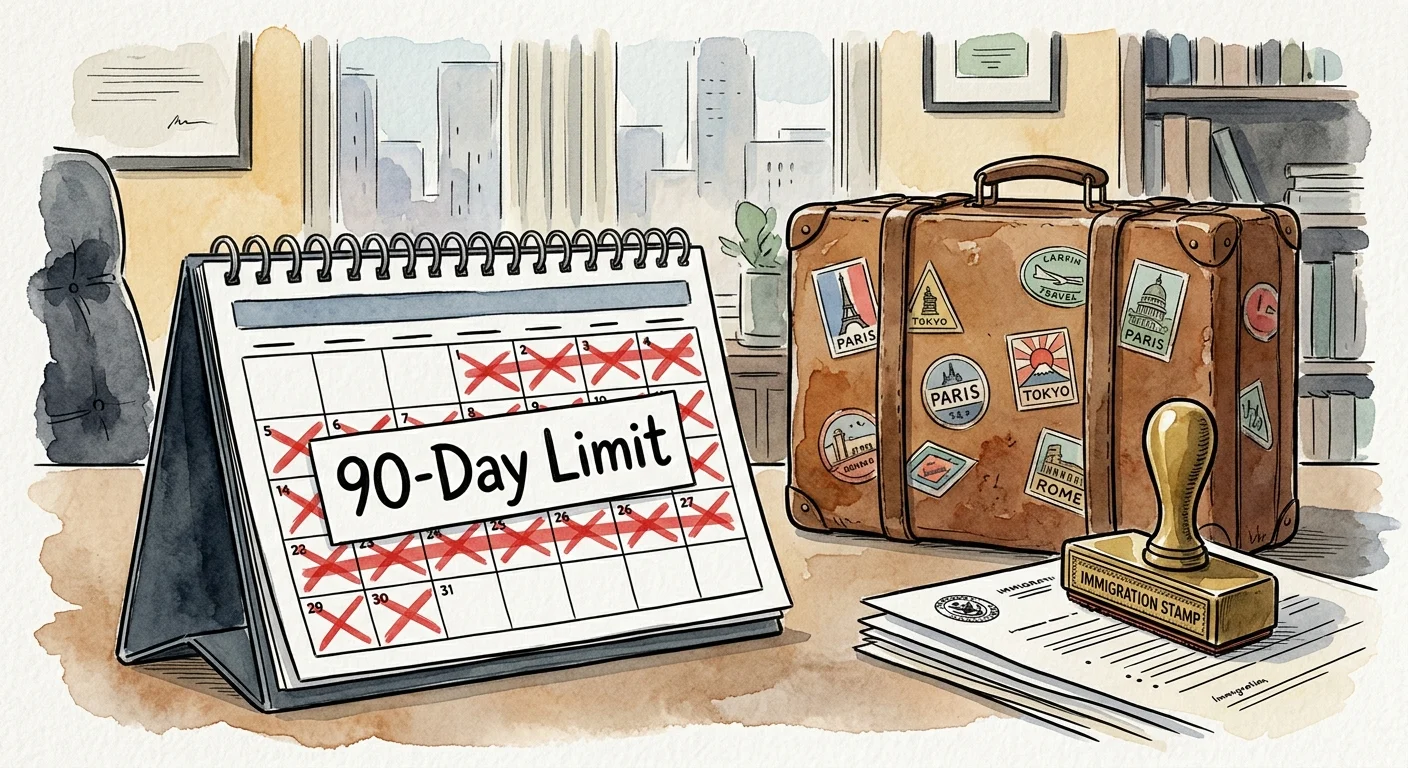
Many seniors assume that holding a valid U.S. passport allows them to live abroad indefinitely. In reality, standard tourist stamps only grant temporary stays—typically ranging between 30 and 90 days—and do not permit you to lease long-term housing, open local bank accounts, or register for local healthcare programs. Overstaying a tourist visa triggers severe penalties, including substantial fines, mandatory deportation, and long-term re-entry bans that could permanently block your retirement plans.
According to guidance from the Social Security Administration (SSA), U.S. citizens can continue receiving monthly retirement benefits while living in most foreign countries, but maintaining compliance with host-country residency laws remains entirely your responsibility. Securing a proper retirement visa requires months of methodical preparation, official document collection, and strict adherence to localized bureaucratic procedures. Understanding these rules early saves you money and prevents unnecessary stress.
Strict Passive Income and Financial Solvency Thresholds
The single most critical requirement for any retirement visa is proving continuous, guaranteed financial solvency. Foreign governments do not want retirees seeking local employment, so they mandate that applicants prove a steady stream of passive income generated from sources outside the destination country. Passive income includes government or corporate pensions, Social Security payments, military retirement pay, fixed annuity disbursements, and regular dividends from established investment portfolios.
Consulates carefully differentiate between liquid cash reserves and guaranteed monthly distributions. While possessing substantial savings in a traditional bank account helps your application, many nations insist on predictable, lifelong monthly income. Furthermore, immigration agencies index these income thresholds directly to national economic indicators, meaning mandatory financial minimums frequently rise to match domestic inflation rates.
Research from the Consumer Financial Protection Bureau (CFPB) emphasizes that foreign financial institutions and foreign consulates require verified official documentation—such as bank statements, certified tax returns, and official pension benefit letters—to validate your solvency claims. Presenting informal letters or unverified account summaries results in immediate visa rejections. You must ensure that your passive income comfortably exceeds official baselines to account for currency exchange fluctuations.

The Remote Work Trap and Active Income Bans
A widespread misconception among modern retirees is that they can supplement their foreign living expenses by conducting light freelance work, remote consulting, or online business management from their foreign living room. However, standard non-lucrative and retirement visas strictly prohibit all forms of employment within the host country, regardless of where your employer or client base operates.
For example, Spain enforced Royal Decree 1155/2024 (effective May 20, 2025), which explicitly forbids non-lucrative visa holders from engaging in any active employment or self-employment activities. Spanish consulates rigorously verify that your income stems solely from passive assets; working remotely for a U.S. client while living in Spain under a traditional Non-Lucrative Visa violates immigration law. Violating these active work bans can lead to the immediate revocation of your residence permit and formal deportation orders.
If you plan to earn active income through consulting or digital freelance work during your retirement years, you must apply for a specialized Digital Nomad Visa or an active work permit rather than a standard retirement visa. Retirement visas are reserved exclusively for individuals who have completely stepped away from active commercial labor. Always verify the precise legal definitions of earned income with a qualified immigration attorney in your destination country.
Country-by-Country Breakdown of Retirement Visa Requirements
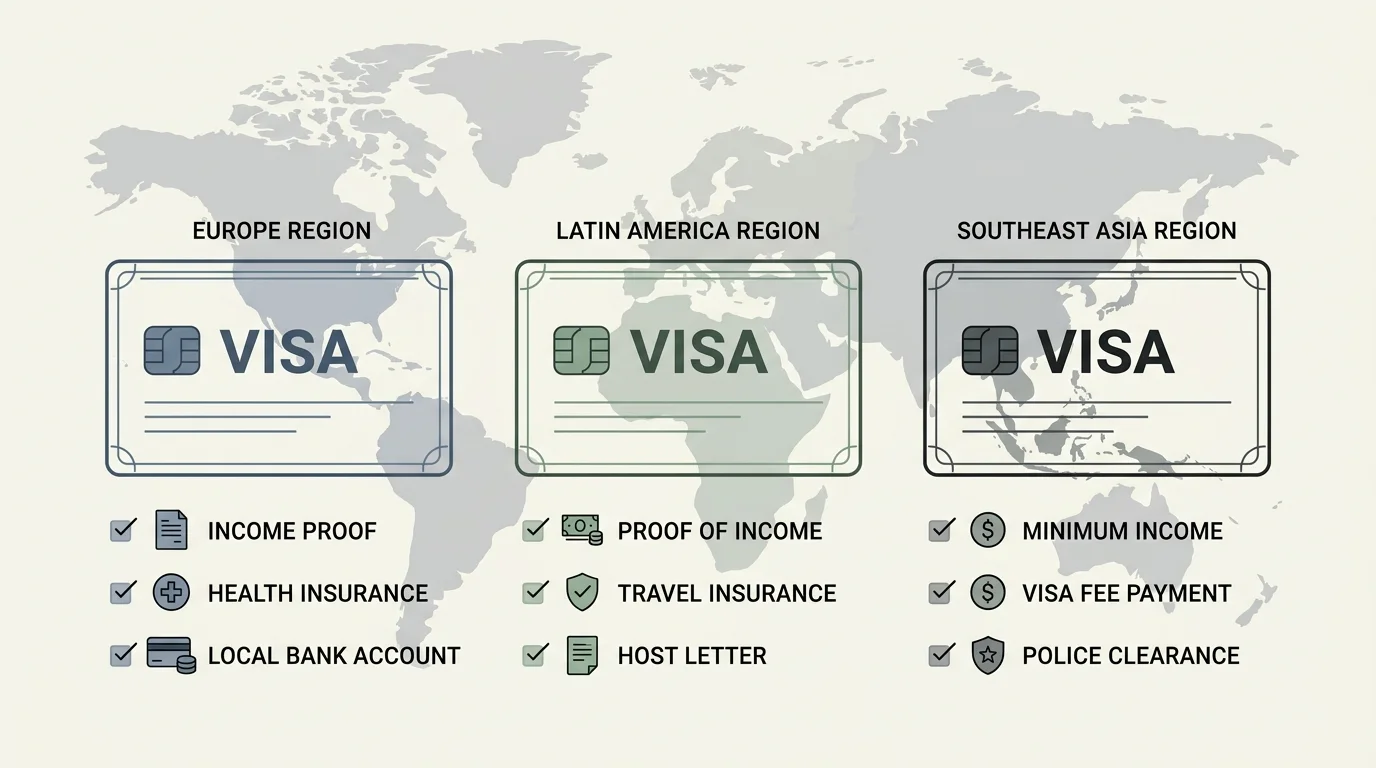
Each country establishes unique financial standards, paperwork regulations, and age minimums for foreign retirees. Reviewing these requirements side-by-side helps you determine which destination fits your current pension structure and financial profile.
Spain (Non-Lucrative Visa)
Spain calculates financial eligibility using the Public Income Indicator for Multiple Effects (IPREM), which stands at €600 per month (€7,200 annually). Primary applicants must demonstrate foreign passive income equal to 400% of the IPREM threshold, which totals €2,400 per month (€28,800 annually). Adding a dependent spouse requires an additional 100% of the IPREM (€600 per month or €7,200 annually). Under Royal Decree 1155/2024, Spain strictly prohibits any active foreign or domestic employment under this visa category.
Portugal (D7 Passive Income Visa)
Portugal ties its D7 visa financial requirements directly to its national minimum wage, which sits at €920 per month (€11,040 annually). To qualify, a primary applicant must prove regular, lifetime passive income meeting 100% of this threshold (€920 per month). Adding a spouse increases the financial requirement by 50% (€460 per month), while dependent children add 30% (€276 per month per child). Applicants must also open a Portuguese bank account and deposit a funded safety-net balance before submitting their application.
Mexico (Temporary Resident Visa)
Mexico updates its financial solvency metrics annually based on the Unit of Measurement and Update (UMA) published in the Diario Oficial de la Federación. Under current guidelines, retirees must demonstrate either a monthly tax-free pension or investment distribution of 680 days of UMA (approximately $4,200 to $4,500 USD per month maintained over the past 6 months) OR an average investment balance of 11,460 days of UMA (approximately $70,000 to $73,000 USD maintained over the past 12 months).
Thailand (Non-Immigrant O-A Retirement Visa)
Thailand requires retirement visa applicants to be at least 50 years old. You must prove financial solvency by showing a deposit of at least 800,000 THB (approximately $22,000 USD) in a seasoned Thai bank account OR a verified monthly pension income of at least 65,000 THB (approximately $1,800 USD). Furthermore, Thai immigration mandates specialized, government-compliant local health insurance policies and requires retirees to file a physical address confirmation (Form TM47) every 90 days.
Panama (Pensionado Visa)
Panama offers one of the world’s most attractive retirement programs. The Pensionado Visa requires proof of a lifetime monthly pension or annuity payout of at least $1,000 USD. If you purchase Panamanian real estate valued at $100,000 or more, the minimum monthly pension requirement drops to $750 USD. Under Panama’s Law 6, visa holders gain statutory consumer discounts, including 20% off prescription medications, 25% off domestic and international airfare, and 25% off restaurant dining.
Costa Rica (Pensionado Visa)
Costa Rica requires applicants to present proof of a permanent, lifetime pension—such as U.S. Social Security, military benefits, or a corporate annuity—of at least $1,000 USD per month. This baseline income amount covers both the main applicant and an accompanying spouse. While visa holders cannot work as local employees, Costa Rica exempts foreign pension income from domestic income taxes, making it an economically appealing retirement haven.
| Country | Visa Name | Min. Monthly Income (USD / Local) | Work Allowed? | Key Mandatory Requirement |
|---|---|---|---|---|
| Spain | Non-Lucrative Visa | €2,400/mo ($28,800/yr) + dependents | No (Strict Ban) | Zero-deductible private Spanish health insurance |
| Portugal | D7 Visa | €920/mo (€11,040/yr) + dependents | No local employment | Funded Portuguese bank account deposit |
| Mexico | Temporary Resident | ~$4,200–$4,500/mo (or $70k+ savings) | No local work | 6 to 12 months of official bank statements |
| Thailand | Non-Immigrant O-A | 65,000 THB/mo (or 800k THB deposit) | No | 90-day address reports (Form TM47) & local policy |
| Panama | Pensionado Visa | $1,000/mo ($750/mo with real estate) | No | Guaranteed lifetime annuity or pension proof |
| Costa Rica | Pensionado Visa | $1,000/mo (covers spouse) | No local work | Lifetime pension documentation; zero local pension tax |

Health Insurance, Medicare Limitations, and Medical Clearance
One of the most dangerous traps for U.S. seniors moving abroad is assuming that their domestic health insurance coverage follows them across international borders. According to official regulations outlined by Medicare.gov, original Medicare (Part A and Part B) does not cover health services, prescription drugs, or hospital stays received outside the United States. While select Medicare Advantage plans offer limited emergency coverage during foreign travel, they never satisfy foreign visa requirements for long-term residency.
To secure a retirement visa, foreign consulates typically mandate comprehensive private health insurance policies issued by insurers licensed to operate within their jurisdiction. Countries like Spain insist that your private policy feature zero deductibles, zero copays, and full coverage for hospitalization and repatriation of remains. Selecting an unapproved international travel plan instead of a foreign-recognized residence policy leads to immediate consular rejection.
Furthermore, many nations require a formal medical clearance certificate signed by a licensed physician within 30 days of your visa application. As noted by health experts at the Centers for Disease Control and Prevention (CDC), managing pre-existing medical conditions and maintaining vaccination documentation remain vital steps when transitioning to overseas health systems. Foreign medical checks verify that applicants do not carry communicable diseases that pose public health threats under International Health Regulations.

Background Checks, Legalization, and the Apostille Process
Foreign governments demand strict legal proof that incoming retirees hold clean criminal records and present authentic civil documents. Obtaining a standard local police department report rarely suffices for international visa applications. Instead, most consulates require an official Federal Bureau of Investigation (FBI) Identity History Summary check, which involves submitting digital fingerprints through an approved FBI channel.
Once federal or state agencies issue your official records—such as background checks, marriage certificates, or pension verification letters—you must authenticate them for international legal recognition. For countries participating in the 1961 Hague Convention, this validation process requires obtaining an official Apostille certificate from the U.S. Department of State or state authority. Without an Apostille, foreign immigration officers view U.S. public documents as legally invalid.
Finally, you must hire officially accredited sworn translators to translate your legal paperwork into the destination country’s native language. Keep in mind that background checks and official medical certificates come with strict expiration windows—typically lasting between 90 and 180 days from their issuance date. If your consular appointment gets delayed, you may have to repeat the entire background check and legal authentication process from scratch.

Tax Implications, Reporting, and Social Security Benefits
Retiring to a tropical paradise does not eliminate your tax filing obligations with the United States government. The United States levies income taxes based on citizenship rather than physical residency. Therefore, as long as you retain your U.S. passport, you must file annual tax returns with the Internal Revenue Service (IRS), declaring your global income regardless of where you reside.
In addition to standard tax returns, holding foreign bank accounts brings strict federal reporting rules. If your aggregate foreign financial accounts exceed $10,000 USD at any point during the calendar year, you must submit a Report of Foreign Bank and Financial Accounts (FBAR) electronically via FinCEN Form 114. Failing to declare foreign accounts can result in massive financial penalties and civil sanctions.
Educational resources published by AARP remind retirees that many destination countries enforce bilateral Double Taxation Agreements (DTAs) with the United States to prevent tax duplication. However, establishing fiscal residence in countries like Portugal or Spain could subject your U.S. pensions, 401(k) withdrawals, and investment gains to local foreign income taxes. Working with an international certified public accountant ensures you remain fully compliant while taking advantage of tax credits.

Common Pitfalls and Bureaucratic Mistakes to Avoid
Navigating foreign retirement visas requires precision, patience, and meticulous organization. Even minor administrative oversight can result in rejected applications, wasted processing fees, and missed relocation deadlines. Avoid these common operational traps when preparing your visa paperwork:
- Relying on Outdated Online Advice: Expat forums and social media groups frequently publish obsolete rules. Financial thresholds change annually, and administrative decrees update regularly. Always verify rules directly through official consulate websites.
- Miscalculating Document Timelines: FBI background checks and state-issued Apostilles can take eight to twelve weeks to process. Collecting documents out of sequence risks their expiration before your official consular interview.
- Underestimating Local Currency Fluctuations: If your income barely meets the destination country’s baseline, a drop in the value of the U.S. dollar against foreign currencies could disqualify you during annual visa renewals.
- Ignoring In-Country Registration Mandates: Arriving in your foreign destination is not the final step. Most nations require you to register your physical address at the local town hall and apply for a physical residence card within 30 days of arrival.
- Failing to Notify U.S. Financial Institutions: Moving abroad without informing your U.S. banks can trigger fraud alerts, locking your accounts and blocking foreign ATM withdrawals when you need cash most.
Frequently Asked Questions
Can I use my U.S. Medicare coverage while living in another country?
No, original U.S. Medicare (Part A and Part B) does not cover healthcare services rendered outside the United States. You must secure private health insurance that meets the legal mandates of your host country. Many seniors choose to retain Medicare Part A (which is typically free) so they have hospital coverage when visiting the U.S., while pausing or dropping Part B to avoid unnecessary premiums.
Will I lose my U.S. citizenship if I obtain permanent residence abroad?
Obtaining a foreign retirement visa or permanent residence permit does not affect your U.S. citizenship status. You remain a full citizen of the United States with full passport privileges. You only lose U.S. citizenship if you formally renounce it through an official administrative process at a U.S. embassy or consulate.
How does buying foreign property affect my retirement visa application?
Purchasing real estate can strengthen your application by demonstrating long-term integration into the community. In countries like Panama, buying qualified real estate reduces your mandatory monthly passive income threshold. However, owning property rarely replaces the need to prove regular passive income, as governments still require evidence that you can afford ongoing living expenses.
What happens to my Social Security checks if I move abroad permanently?
The U.S. Social Security Administration can deposit your monthly retirement benefits directly into foreign bank accounts in many countries worldwide. Alternatively, you can maintain a domestic U.S. bank account and transfer funds abroad using low-cost international transfer services. A small list of restricted countries exists where payments cannot be sent, so check official SSA rules before moving.
Can my spouse accompany me under a single retirement visa application?
Most foreign retirement visas allow main applicants to include a lawful spouse under a joint application. However, bringing a dependent spouse increases the total passive income or bank balance requirements required by consular officials. You must present an Apostilled and officially translated marriage certificate to prove your marital status.
For additional senior resources, visit
Administration for Community Living (ACL), Eldercare Locator, AARP and Alzheimer’s Association.
Disclaimer: The information in this article is for educational purposes only and is not intended to be a substitute for professional financial, legal, or medical advice. Always consult with a qualified expert for advice tailored to your personal situation.









Leave a Reply