

Healthcare expenses can quickly drain your hard-earned retirement nest egg. Claiming legitimate medical expense tax deductions helps you keep more cash in your pocket every tax season.
Many older adults leave substantial money on the table simply because IRS filing guidelines seem confusing. Understanding which out-of-pocket healthcare costs qualify empowers you to make smarter financial moves.
When medical bills accumulate, tracking these eligible deductions provides vital relief on your annual tax return. Learn how these nine overlooked healthcare tax breaks can reduce your tax bill this year.
In this guide13 sections
- Understanding the IRS Medical Deduction Threshold
- 1. Medicare Premiums and Supplemental Coverage
- 2. Age-Based Long-Term Care Insurance Premiums
- 3. Home Modifications for Aging in Place
- 4. Medical Travel, Mileage, and Transportation
- 5. Specialized Dental, Vision, and Hearing Care
- 6. In-Home Care and Assisted Living Services
- 7. Prescription Drugs and Specialized Medical Devices
- 8. Diagnostic Tests and Preventive Screenings
- 9. Qualified Dependent and Spousal Medical Expenses
- Smart Strategies to Maximize Your Healthcare Tax Savings
- Common Medical Tax Pitfalls Retirees Must Avoid
- Frequently Asked Questions
Understanding the IRS Medical Deduction Threshold
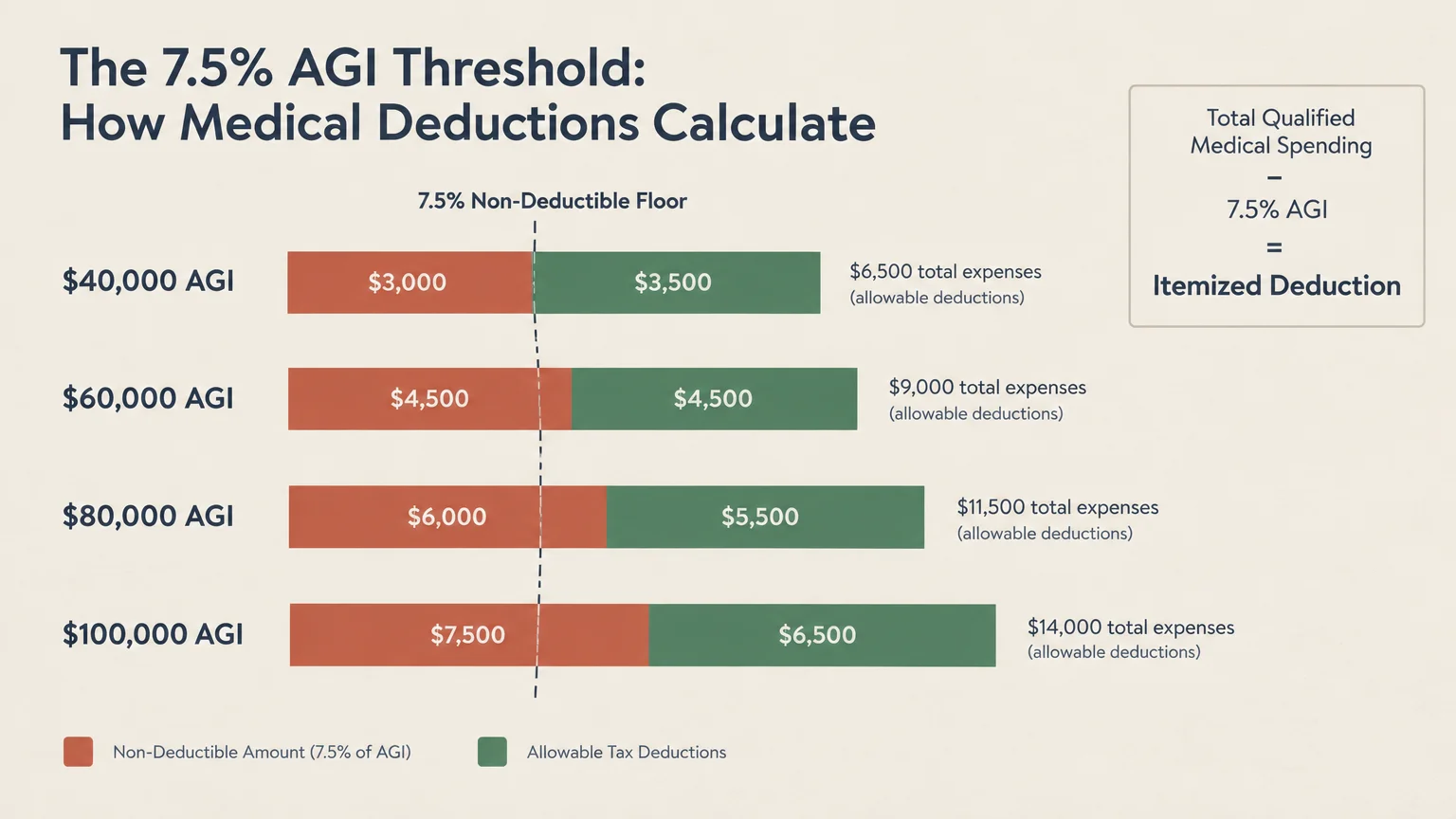
To deduct healthcare expenses, you must itemize deductions on Schedule A instead of taking the standard deduction. You can only deduct eligible expenses that exceed 7.5% of your Adjusted Gross Income (AGI).
The IRS medical deduction threshold acts as a baseline hurdle. You calculate the deduction by subtracting 7.5% of your income from your total qualified medical spending.
For example, if your annual AGI equals $50,000, your deduction baseline is $3,750. If you spent $8,000 on medical bills, you can deduct $4,250 on your tax return.
Older taxpayers often receive an extra standard deduction once they reach age 65. You should compare your total itemized deductions against this enhanced standard deduction to choose the largest tax benefit.
| Adjusted Gross Income (AGI) | 7.5% Floor (Non-Deductible) | Total Medical Expenses | Allowable Tax Deduction |
|---|---|---|---|
| $40,000 | $3,000 | $6,500 | $3,500 |
| $60,000 | $4,500 | $9,000 | $4,500 |
| $80,000 | $6,000 | $11,500 | $5,500 |
| $100,000 | $7,500 | $14,000 | $6,500 |
Every dollar spent above your personal baseline reduces your taxable income directly. Gathering all qualifying costs ensures you clear this hurdle more easily.
01 Medicare Premiums and Supplemental Coverage
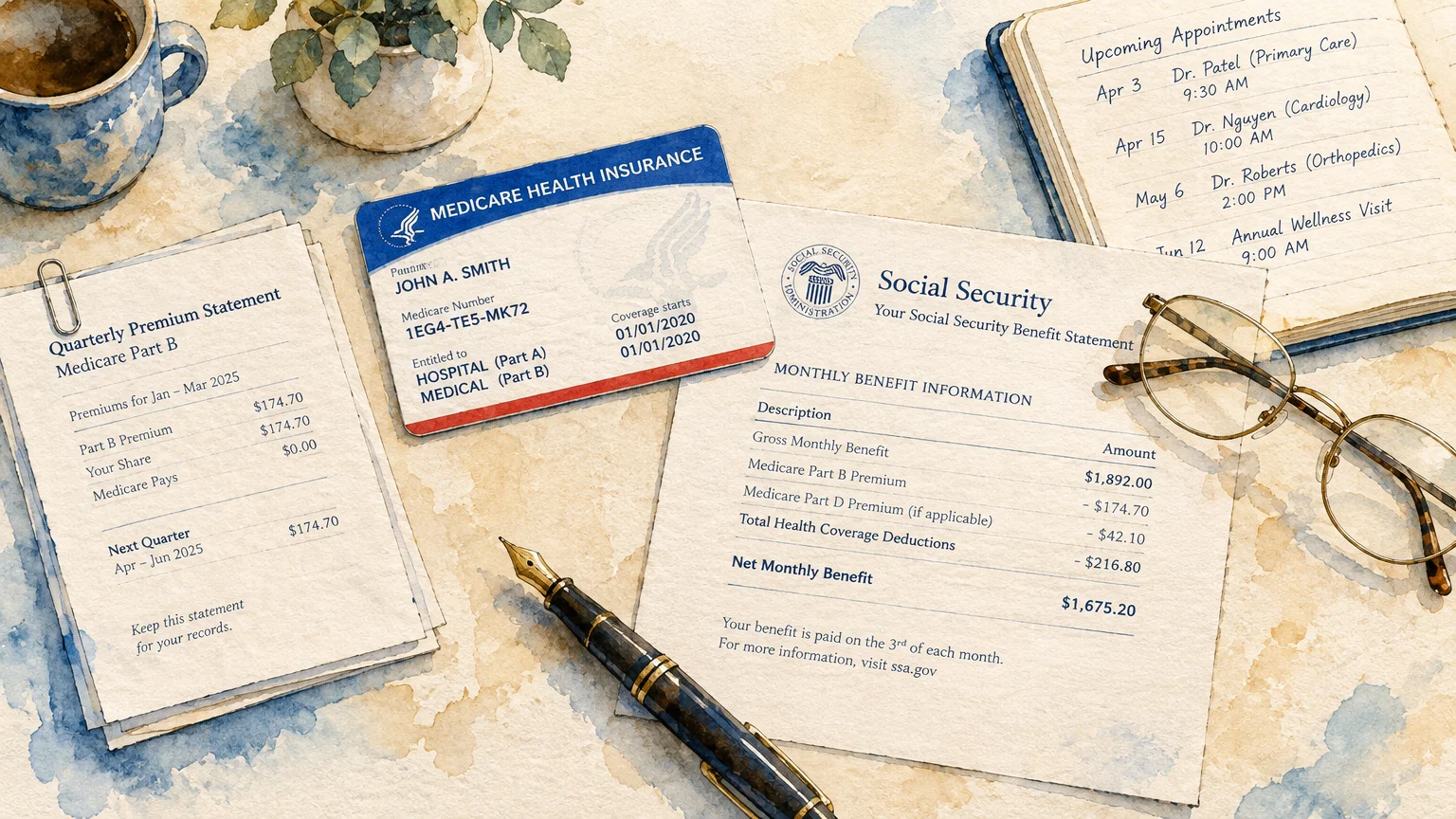
Many retirees forget that monthly health insurance premiums count directly toward deductible medical expenses. Premiums deducted directly from your Social Security checks remain fully eligible for this deduction.
According to Centers for Medicare & Medicaid Services (CMS), standard Part B premiums represent a mandatory monthly expense for most retirees. You can deduct Part B payments alongside your voluntary Part D prescription plan premiums.
If you purchase a Medicare Advantage plan or a private Medigap supplemental policy, those monthly payments qualify as well. These insurance costs add up quickly over twelve calendar months.
The following premium payments qualify toward your annual medical deduction total:
- Medicare Part B monthly premiums withheld from Social Security payments
- Medicare Part D prescription drug coverage premiums
- Medicare Advantage (Part C) monthly plan fees
- Private Medicare Supplement (Medigap) policy premiums
- Voluntary Medicare Part A premiums if you lack sufficient work credits
According to guidance from Medicare.gov, checking your annual Social Security Benefit Statement reveals the exact Part B amounts withheld. Keep these annual statements safely filed with your tax documentation.
02 Age-Based Long-Term Care Insurance Premiums
Long-term care insurance policies protect your assets from severe healthcare costs later in life. The IRS treats qualified long-term care insurance premiums as deductible medical expenses up to specific age-based caps.
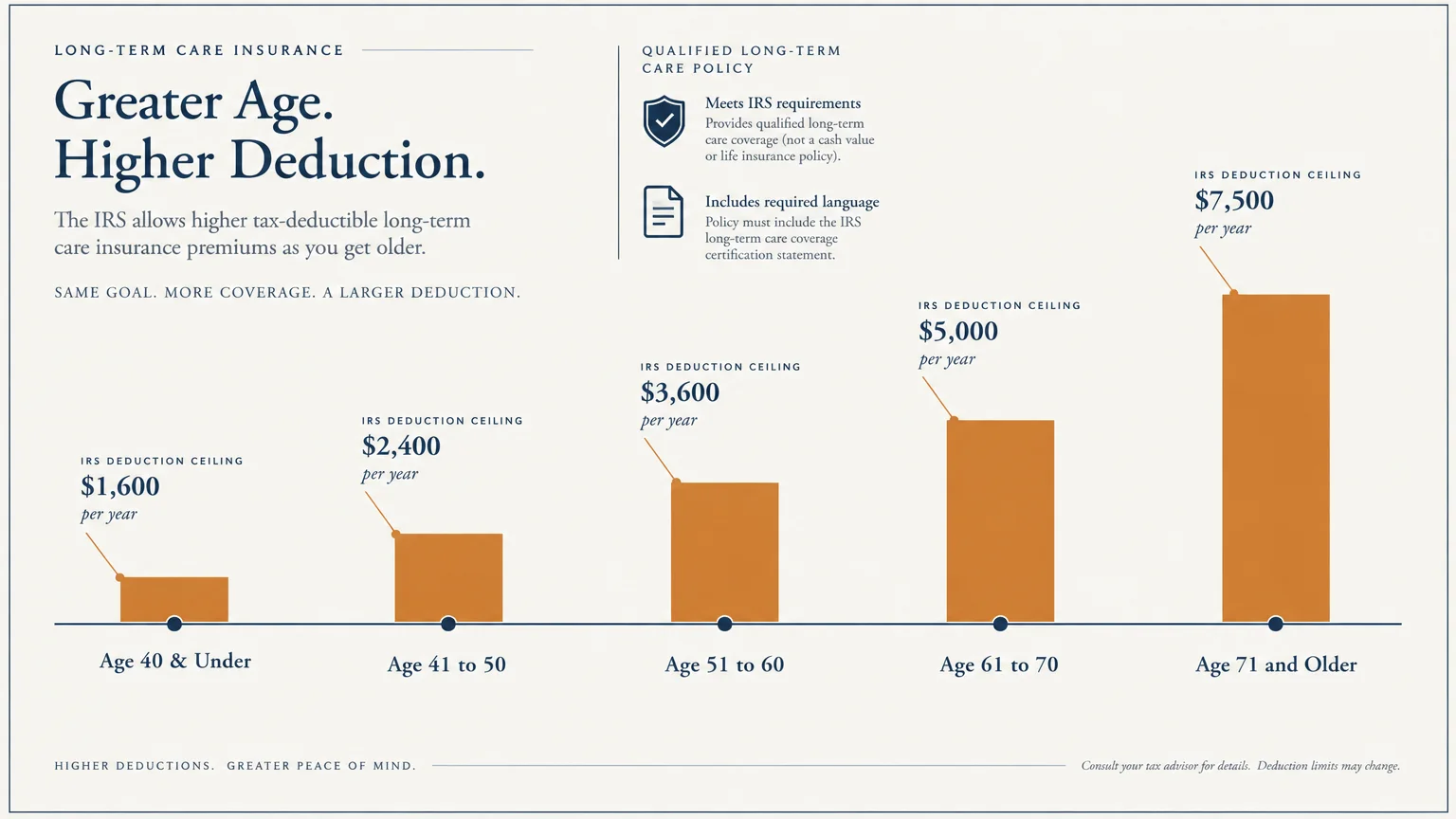
The older you get, the higher your allowable deduction limit becomes. These statutory caps adjust annually for inflation to provide greater tax relief as you age.
You cannot simply write off the total premium if it exceeds the federal limit. You can only apply the allowed dollar figure for your specific age group toward your 7.5% deduction threshold.
| Attained Age Before Close of Tax Year | Maximum Annual Deductible Premium |
|---|---|
| 40 or under | $470 |
| 41 to 50 | $880 |
| 51 to 60 | $1,760 |
| 61 to 70 | $4,710 |
| 71 and older | $5,880 |
Married couples filing jointly can claim age-appropriate deduction limits for each spouse independently. If both spouses are 68, you can combine two separate deductions to maximize your total write-off.
Confirm that your carrier classifies your contract as a tax-qualified long-term care insurance policy. Your insurance provider provides an annual statement verifying qualified tax status every January.

03 Home Modifications for Aging in Place
Many seniors modify their residences to maintain safety and mobility as physical needs change. According to National Institute on Aging (NIA), home safety alterations help older adults age safely in place and prevent falls.
The IRS permits full medical deductions for home improvements installed primarily to accommodate a disability or physical limitation. These alterations must relate directly to medical care rather than general home renovation.
Capital expenses that do not add value to your residence are deductible in full as medical costs. When an installation increases your property value, you can only deduct the difference between the project cost and the added value.
Common deductible home modifications include the following installations:
- Constructing wheelchair ramps for entering and exiting your home
- Widening exterior doorways and interior hallways for walker access
- Installing support bars and safety railings in bathrooms and stairwells
- Lowering kitchen cabinets and counters to accommodate physical reach
- Modifying hardware on doors and fixtures for individuals with arthritis
- Installing specialized chair lifts or elevator units between floors
Always secure a written recommendation or prescription from your physician before beginning home modifications. Keep invoices from licensed contractors to substantiate the medical necessity of every project.

04 Medical Travel, Mileage, and Transportation
Getting to and from medical appointments involves real expenses that retirees routinely forget to tally. The IRS allows you to deduct transportation costs incurred primarily for medical treatment.
You can track actual out-of-pocket vehicle expenses or use the federal standard medical mileage rate. Parking fees and highway tolls remain fully deductible regardless of which vehicle calculation method you select.
Public transportation fares qualify for medical deductions as well. You can include taxi fares, rideshare receipts, bus passes, and train tickets purchased to reach healthcare providers.
If you must travel out of town for specialized medical procedures, lodging costs qualify under specific federal guidelines. The IRS allows up to $50 per night per individual for qualified medical lodging.
If a companion must travel with an incapacitated patient, their lodging also qualifies up to an additional $50 nightly. Meals purchased during medical travel remain strictly non-deductible.
Maintain an accurate mileage log in your car or on your smartphone. Record the appointment date, clinic destination, medical reason, and round-trip mileage for every healthcare visit.

05 Specialized Dental, Vision, and Hearing Care
Original Medicare generally excludes routine dental exams, eyeglasses, and hearing aids from its core coverage. Because retirees pay these substantial costs completely out of pocket, they generate massive potential tax deductions.
Dental work represents one of the largest single healthcare costs retirees face each year. You can deduct periodontal treatments, tooth extractions, crowns, root canals, dental implants, and dentures.
Vision care costs also qualify for medical expense write-offs under federal guidelines. You can deduct prescription eyeglasses, corrective contact lenses, diagnostic eye exams, and cataract surgeries.
Hearing health expenses represent another significant deduction category that older adults frequently miss. The cost of hearing aids, maintenance adjustments, specialized cleaning kits, and replacement batteries qualifies for deductions.
Even service animals trained to assist individuals with severe vision or hearing impairments generate deductible expenses. You can deduct the purchase price, veterinary care, and food required to maintain an official service animal.

06 In-Home Care and Assisted Living Services
Long-term care represents one of the largest financial challenges facing American retirees today. When you pay for custodial care or assisted living, portions of those bills often qualify as medical deductions.
To qualify, a licensed healthcare practitioner must certify the senior as chronically ill. This designation requires an inability to perform at least two activities of daily living without substantial assistance.
Activities of daily living include eating, bathing, dressing, toileting, transferring, and maintaining continence. Seniors with severe cognitive impairments like dementia also meet these certification requirements.
Eligible care expenses fall into distinct categories:
- In-home nursing care provided by licensed healthcare professionals
- Personal care attendant services assisting with daily living activities
- Adult day care center fees addressing chronic health conditions
- The specific medical portion of monthly assisted living facility fees
- Full room and board costs when staying in a dedicated nursing home primarily for medical reasons
Assisted living facilities typically provide an annual statement outlining the percentage of fees allocated toward medical care. Request this breakdown from the facility administrator every January for accurate filing.

07 Prescription Drugs and Specialized Medical Devices
Prescription medication costs continue to burden senior household budgets across the country. Every dollar you spend out of pocket on prescribed medications counts toward your medical expense deduction.
Insulin remains fully deductible even when purchased without an explicit prescription. However, standard over-the-counter pain relievers, cold medicines, and multi-vitamins do not qualify unless prescribed directly by your doctor.
Specialized medical equipment and durable supplies also represent valid medical write-offs. You can deduct the cost of purchasing, renting, and maintaining essential medical machinery.
Deductible medical supplies and devices include:
- Continuous positive airway pressure (CPAP) machines and replacement masks
- Blood glucose test strips, lancets, and continuous glucose monitoring sensors
- Portable oxygen concentrators, oxygen tanks, and delivery tubing
- Hospital beds, specialized mattresses, and patient lifting equipment
- Mobility aids including walkers, crutches, canes, and motorized wheelchairs
- Prescription orthotic shoe inserts and orthopedic braces
Keep detailed pharmacy printouts alongside equipment receipts. Most nationwide pharmacies can print a single annual summary of all your prescription co-pays upon request.

08 Diagnostic Tests and Preventive Screenings
Preventive screenings and laboratory diagnostics protect your health through early disease detection. Out-of-pocket costs for diagnostic assessments represent allowable medical deductions on your annual tax return.
You can deduct fees paid for blood panels, lipid profiles, and metabolic screening tests. When private insurance or Medicare leaves an unpaid balance for clinical lab work, that remaining balance qualifies.
Advanced imaging procedures frequently require out-of-pocket co-insurance or deductible payments. You can deduct unpaid fees for MRIs, CT scans, bone density scans, and cardiovascular ultrasounds.
Specialized genetic tests qualify when ordered by a doctor to guide ongoing medical treatment. Cancer screenings, colonoscopies, and diagnostic mammograms also create legitimate deductible medical costs.
Even mental health diagnostic assessments and individual psychotherapy sessions qualify under federal law. Ensure that your licensed mental health professional provides formal receipts detailing treatment dates and clinical service codes.

09 Qualified Dependent and Spousal Medical Expenses
Retirees frequently cover medical bills for their spouses or aging parents without realizing these payments qualify for tax deductions. You can include medical costs paid for your legal spouse on a joint return.
You can also deduct medical bills paid on behalf of an aging parent or family member if they qualify as your medical dependent. A family member can qualify for medical expense purposes even if they cannot be claimed as a dependent for income tax credits.
To qualify, you must provide more than half of the relative’s total financial support during the calendar year. The individual must also be a U.S. citizen or legal resident alien.
The standard gross income test does not apply when qualifying someone for medical expense deductions. An aging parent with Social Security and pension income above normal limits can still be your medical dependent.
Ensure you pay the healthcare provider or facility directly from your own financial accounts. Writing checks directly to medical providers creates clear paper trails that satisfy IRS auditing standards.
Smart Strategies to Maximize Your Healthcare Tax Savings
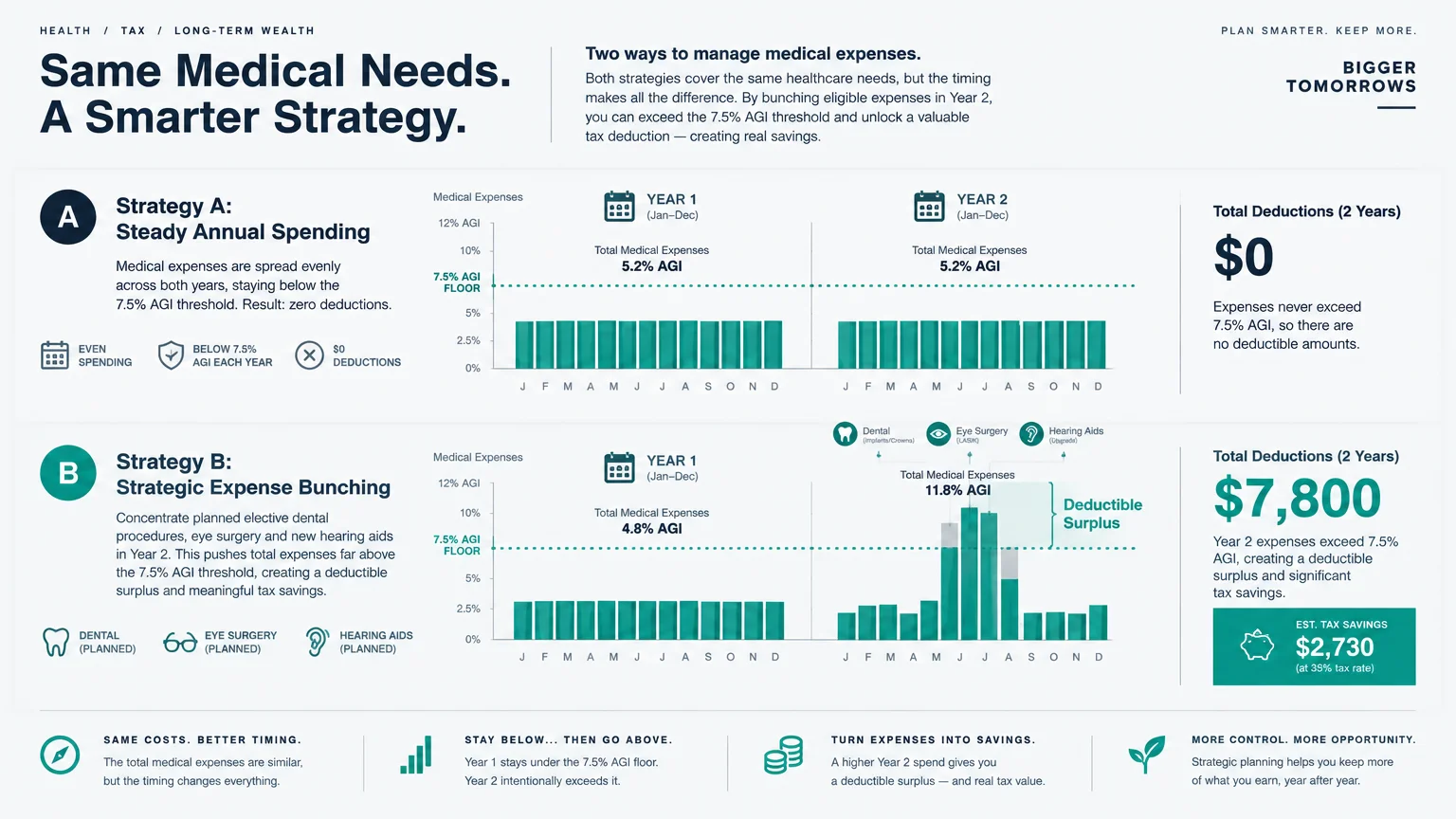
Clearing the 7.5% AGI threshold requires deliberate planning and expense tracking. You can leverage simple timing strategies to consolidate your healthcare costs into a single calendar year.
Tax professionals often recommend an expense bunching strategy for elective medical and dental treatments. Bunching involves concentrating discretionary medical services into alternating years to surpass your deduction floor.
According to Benefits.gov, finding government assistance and tax relief options helps older adults navigate fixed retirement incomes. Using smart financial strategies ensures you keep essential resources intact.
Follow these actionable strategies to optimize your healthcare tax position:
- Schedule elective surgeries, dental crowns, and new eyeglasses within the same calendar year.
- Prepay ongoing medical treatments or therapy sessions in December if your current year spending already exceeds the threshold.
- Aggregate spousal medical expenses onto a single joint return to surpass the 7.5% floor faster.
- Maintain digital scans of all pharmacy printouts, physician bills, and insurance Explanation of Benefits (EOB) statements.
- Utilize an automated mileage tracking application to log trips to clinics and pharmacies throughout the year.
Careful timing transforms scattered medical costs into a meaningful deduction. Coordinate with your accountant before year-end to identify which upcoming expenses you can legally accelerate.

Common Medical Tax Mistakes Retirees Must Avoid
Claiming healthcare deductions requires strict adherence to federal regulations. Making common filing mistakes can trigger IRS notices or disallow otherwise legitimate deductions.
The most common error involves attempting to deduct expenses reimbursed by insurance or flexible spending accounts. You can only deduct medical expenses that you paid entirely out of your own pocket.
Double-dipping with Health Savings Accounts (HSAs) remains strictly prohibited by the IRS. You cannot claim an itemized medical deduction for any bill paid using tax-free HSA funds.
Retirees also mistakenly try to deduct non-qualifying health and wellness products. The IRS explicitly denies deductions for general well-being purchases, including gym memberships, diet foods, and over-the-counter vitamins.
Cosmetic procedures designed solely to improve appearance do not qualify as medical care. However, reconstructive surgery following a trauma, disease, or mastectomy remains fully deductible.
Never estimate your medical expenses when completing Schedule A. The IRS expects exact figures substantiated by receipts, canceled checks, and official billing statements.
Frequently Asked Questions
Can I claim medical expenses if I take the standard deduction?
No, you cannot claim medical deductions if you use the standard deduction. You must itemize your deductions on IRS Form 1040 Schedule A to claim qualifying out-of-pocket healthcare expenses.
Can I pay Medicare premiums with an HSA and still deduct them?
You cannot double-dip on tax benefits. If you pay Medicare premiums using tax-free HSA distributions, you cannot include those same premium payments as itemized medical deductions on Schedule A.
Is all assisted living rent tax-deductible for retirees?
Only the portion of rent tied directly to medical care qualifies for a deduction. However, if a senior enters a facility primarily for medical treatment, the entire cost including room and board may qualify.
Can I deduct medical bills I paid for an adult child?
You can deduct medical bills paid for an adult child only if you provided over half of their financial support during the tax year. They must qualify under IRS rules as your medical dependent.
Are daily supplements and vitamins tax-deductible with a doctor note?
Generally, no. The IRS considers dietary supplements and vitamins personal expenses for general health maintenance unless explicitly prescribed by a physician to treat a specific medical condition.
For additional senior resources, visit
Consumer Financial Protection Bureau (CFPB), Administration for Community Living (ACL), Eldercare Locator, AARP and Alzheimer’s Association.
Disclaimer: The information in this article is for educational purposes only and is not intended to be a substitute for professional financial, legal, or medical advice. Always consult with a qualified expert for advice tailored to your personal situation.