

Earning $50,000 a year in retirement provides a solid financial foundation, but your actual take-home pay depends heavily on how taxes apply to your specific income sources. A dollar from Social Security does not face the same tax rules as a dollar withdrawn from a traditional 401(k) or a Roth IRA. Understanding how retirement income is taxed allows you to avoid unexpected tax bills and keep more money in your pocket every month. By evaluating standard deductions, senior tax credits, and Medicare premium deductions, you can map out a clear, predictable budget. This guide breaks down the exact numbers so you know precisely what your $50,000 retirement budget looks like after federal and state obligations.
Understanding How Taxation Changes in Retirement
When you transition from a regular paycheck to retirement distributions, the tax collector changes the rules. During your working years, your employer automatically deducted Social Security and Medicare taxes (FICA taxes totaling 7.65%) from your earnings alongside federal and state taxes. Once you retire, you stop paying FICA taxes on retirement distributions, which instantly saves you money. However, every income stream you touch in retirement carries its own federal tax formula.
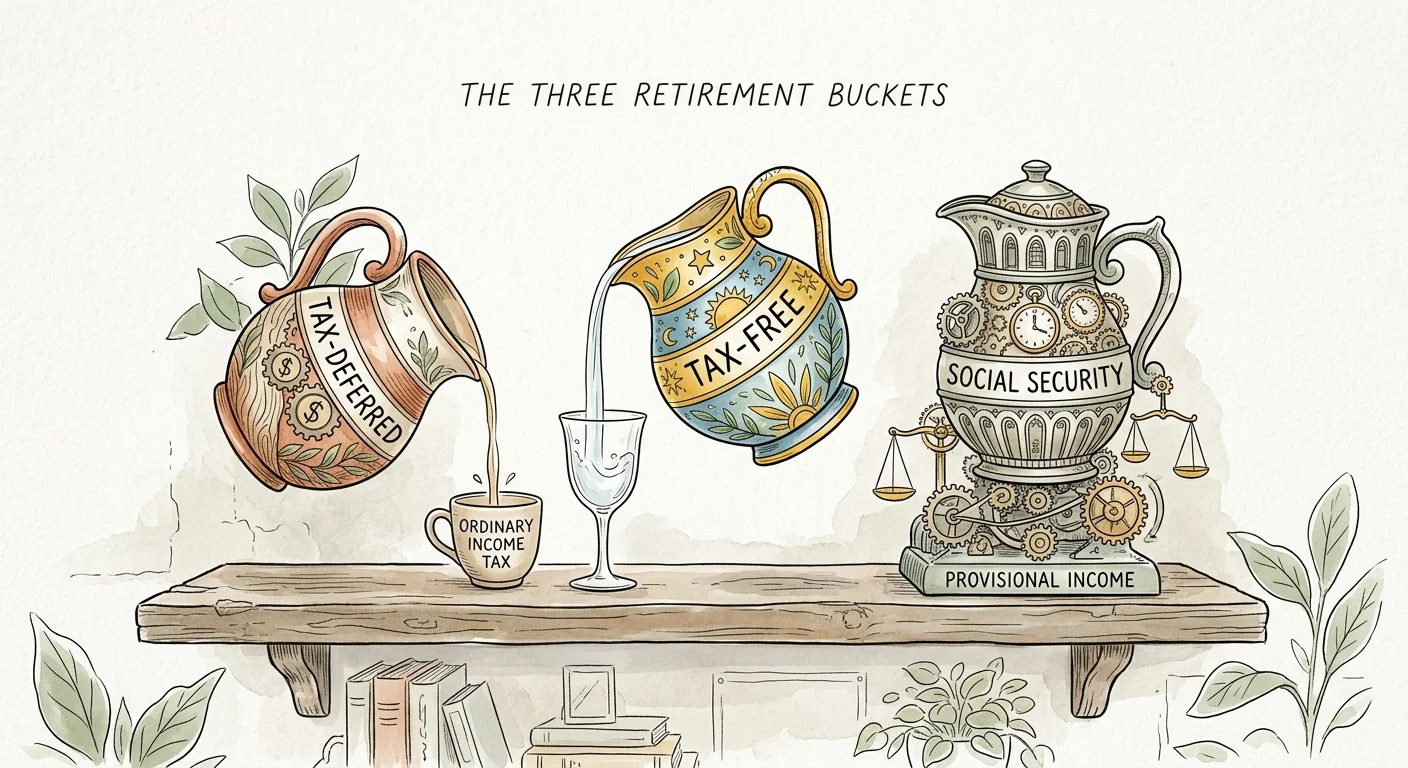
Financial planners categorize retirement dollars into three main tax buckets: tax-deferred accounts, tax-free accounts, and taxable benefits. Traditional IRAs, 401(k) accounts, and pre-tax pensions fall into the tax-deferred bucket. The Internal Revenue Service (IRS) treats withdrawals from these accounts as ordinary income, taxing them at your standard federal income tax rate. Conversely, Roth IRAs and Roth 401(k) accounts deliver completely tax-free income, provided you meet basic distribution rules.
Social Security operates under a unique combined income formula known as provisional income. To calculate your provisional income, add your Adjusted Gross Income (AGI), any tax-exempt interest, and exactly 50% of your total annual Social Security benefits. According to the Social Security Administration (SSA), up to 85% of your benefit becomes subject to federal income tax if your provisional income crosses established federal limits.
For single filers, a provisional income between $25,000 and $34,000 requires you to pay income tax on up to 50% of your Social Security benefits. If your provisional income exceeds $34,000, up to 85% of your Social Security benefits become taxable. For married couples filing jointly, the 50% taxable threshold sits between $32,000 and $44,000, while provisional income above $44,000 triggers taxation on up to 85% of benefits. Because Congress never indexed these threshold numbers to inflation, standard annual cost-of-living adjustments naturally push more retirees into taxable territory over time.

The Anatomy of a $50,000 Retirement Income: Three Real-World Scenarios
Two retirees who both collect $50,000 per year can end up with vastly different take-home amounts. The key variable is where their money comes from. The following three real-world scenarios illustrate how income composition directly dictates federal tax liabilities and net monthly spending power for a single filer aged 65 or older.
Scenario A: Moderate Social Security Plus Traditional IRA Withdrawals
Imagine you collect $30,000 annually from Social Security and withdraw $20,000 from a traditional IRA. First, calculate your provisional income: $20,000 (IRA income) plus $15,000 (50% of your Social Security benefit) equals $35,000. Because $35,000 slightly exceeds the single filer threshold of $34,000, a portion of your Social Security becomes taxable. Following the federal formula, exactly $5,350 of your Social Security benefit becomes subject to tax. Adding that to your $20,000 IRA withdrawal results in an Adjusted Gross Income (AGI) of $25,350.
Next, apply your allowable deductions. As a single filer aged 65 or older, you receive a base standard deduction of $16,100, an additional senior standard deduction of $2,050, and an enhanced senior tax deduction of up to $6,000. These three tax breaks combine for a massive total deduction of $24,150. Subtracting $24,150 from your AGI of $25,350 leaves a taxable income of just $1,200. Taxed at the lowest 10% bracket, your annual federal income tax totals only $120. Subtracting federal tax and the standard annual Medicare Part B premium of $2,434.80 leaves you with an annual net income of $47,445.20—or roughly $3,953.77 per month.
Scenario B: 100% Traditional IRA or Pension Income
Now consider a situation where you draw your full $50,000 entirely from traditional IRA withdrawals or a private pension, without any Social Security income. Your AGI equals the full $50,000. Subtracting your total senior standard deduction of $24,150 leaves a taxable income of $25,850. The IRS taxes the first $12,400 at 10% ($1,240) and the remaining $13,450 at the 12% marginal rate ($1,614). Your total federal income tax bill equals $2,854. After deducting federal taxes and Medicare Part B premiums ($2,434.80), your annual take-home pay equals $44,711.20, providing $3,725.93 per month.
Scenario C: Balanced Mix of Social Security, Traditional IRA, and Roth IRA
In this optimized scenario, you collect $20,000 from Social Security, withdraw $15,000 from a traditional IRA, and draw $15,000 tax-free from a Roth IRA. Your provisional income is $15,000 (traditional IRA) plus $10,000 (50% of Social Security), totaling $25,000. Because your provisional income reaches but does not exceed $25,000, zero dollars of your Social Security benefit are subject to federal income tax. Your AGI is simply $15,000. Because your allowable senior tax deductions ($24,150) far exceed your AGI, your taxable income drops to $0. You owe zero federal income tax. After deducting your annual Medicare Part B premiums, your net income reaches $47,565.20—giving you $3,963.77 in monthly spending power.
| Income Scenario (Single, Age 65+) | Gross Income | Taxable Income | Est. Federal Tax | Medicare Part B | Net Annual Take-Home | Net Monthly Income |
|---|---|---|---|---|---|---|
| Scenario A: $30k SS + $20k Trad. IRA | $50,000 | $1,200 | $120 | $2,434.80 | $47,445.20 | $3,953.77 |
| Scenario B: $50k Trad. IRA / Pension | $50,000 | $25,850 | $2,854 | $2,434.80 | $44,711.20 | $3,725.93 |
| Scenario C: $20k SS + $15k Trad. IRA + $15k Roth | $50,000 | $0 | $0 | $2,434.80 | $47,565.20 | $3,963.77 |
How Federal Income Taxes and Deductions Apply to Seniors
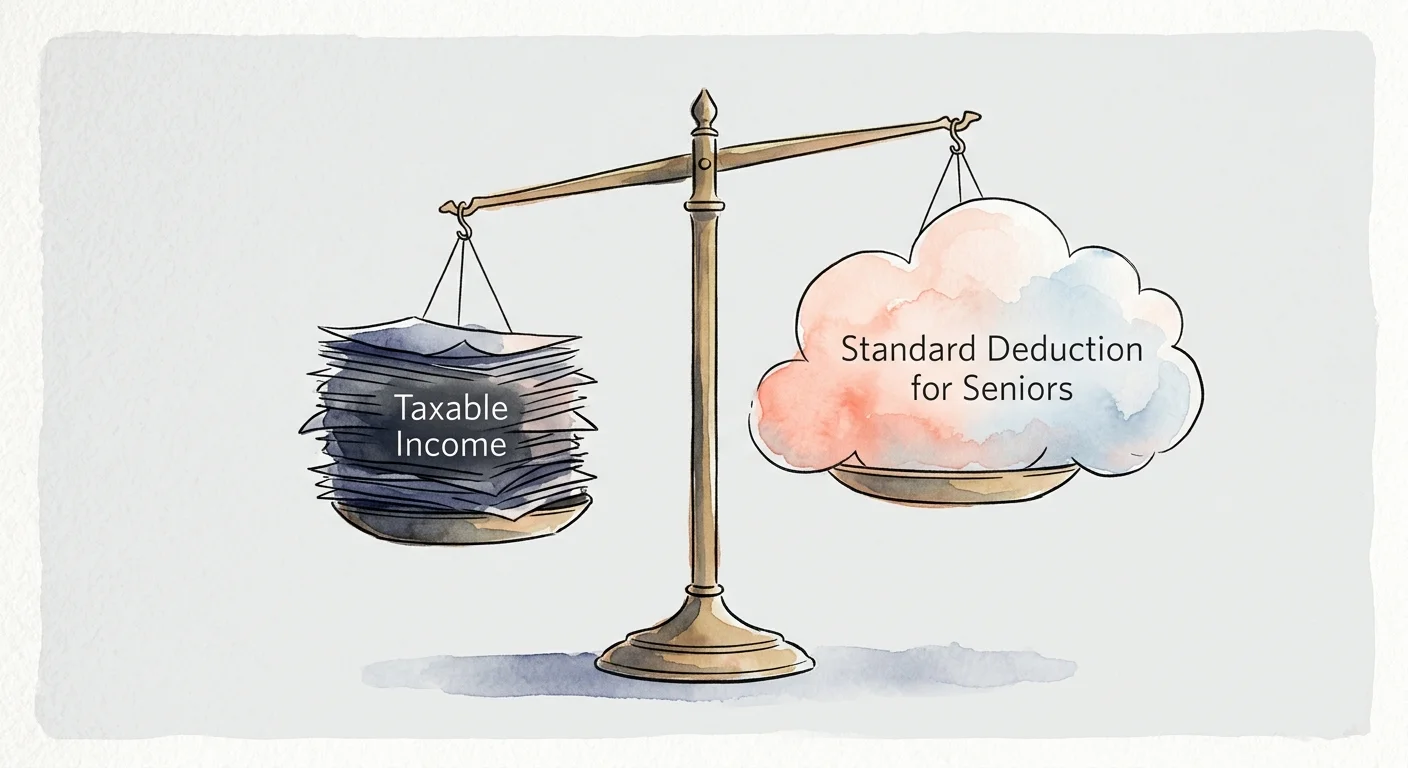
Federal tax rules offer generous shields for older Americans, making taxes on retirement income substantially lower than taxes on regular wages. Understanding how standard deductions stack together prevents you from overpaying the IRS or worrying needlessly about aggressive tax rates.
The standard federal tax framework includes three separate protective layers for senior taxpayers:
- Basic Standard Deduction: Single filers receive a base standard deduction of $16,100, while married couples filing jointly receive $32,200.
- Additional Senior Standard Deduction: Taxpayers aged 65 or older receive an extra tax buffer. Single filers claim an additional $2,050 deduction. Married couples claim an extra $1,650 for each qualifying spouse aged 65 or older (totaling $3,300 if both qualify).
- Enhanced Senior Tax Deduction: Temporary federal tax rules allow qualifying seniors aged 65 and older an additional deduction of up to $6,000 per person ($12,000 for married couples filing jointly). This enhanced deduction applies in full for single filers with a modified adjusted gross income (MAGI) up to $75,000 and married couples with a MAGI up to $150,000.
When you stack these deductions together, a single senior aged 65 or older shields up to $24,150 of income from federal taxes ($16,100 + $2,050 + $6,000). A married couple aged 65 or older filing jointly shields up to $47,500 ($32,200 + $3,300 + $12,000). As a result, a married senior couple earning a combined $50,000 retirement income rarely owes a single dollar in federal income tax, regardless of whether their funds originate from pensions, IRAs, or Social Security.
If your income exceeds total deduction allowances, the remaining balance falls into low marginal tax brackets. Federal income tax brackets tax the first $12,400 of taxable income for single filers ($24,800 for joint filers) at just 10%. Taxable income between $12,401 and $50,400 for single filers ($24,801 to $100,800 for joint filers) falls into the modest 12% marginal bracket. This structure ensures that your effective federal tax rate stays exceptionally low on a $50,000 gross budget.

Hidden Costs: Medicare Part B and Healthcare Deductions
Taxes are not the only mandatory deduction that reduces your gross income. Healthcare expenses represent a major fixed monthly outlay for almost every retiree. Understanding how these fees interact with your Social Security check prevents cash-flow surprises when reviewing your bank statement.
The standard monthly Medicare Part B premium sits at $202.90 per person, which adds up to $2,434.80 annually. Official rules published on Medicare.gov specify that if you collect Social Security benefits, the federal government automatically deducts your Part B premium directly from your monthly benefit check before transferring the net payment into your bank account. If you and your spouse both enroll in Medicare Part B, your household healthcare overhead totals $405.80 per month ($4,869.60 per year).
In addition to monthly premiums, Medicare Part B carries an annual deductible of $283 before coverage kicks in. You must also budget for Medicare Part D prescription coverage, Medicare Supplement (Medigap) plans, or Medicare Advantage out-of-pocket maximums. Supplemental coverage premiums typically range between $100 and $250 per month depending on your state, age, and coverage level.
High-income retirees sometimes face extra Medicare Part B and Part D surcharges known as the Income-Related Monthly Adjustment Amount (IRMAA). However, IRMAA surcharges only apply to individuals with a MAGI exceeding $106,000 ($212,000 for joint filers). Living on a $50,000 annual retirement income keeps you safely below these thresholds, protecting you entirely from unexpected Medicare surcharges.
State Taxes: Where You Live Changes What You Keep
Your geographic location plays a central role in determining how much money remains in your bank account each month. State tax codes across the United States treat retirement income with extreme diversity, ranging from zero income tax to heavy taxation on retirement account withdrawals.
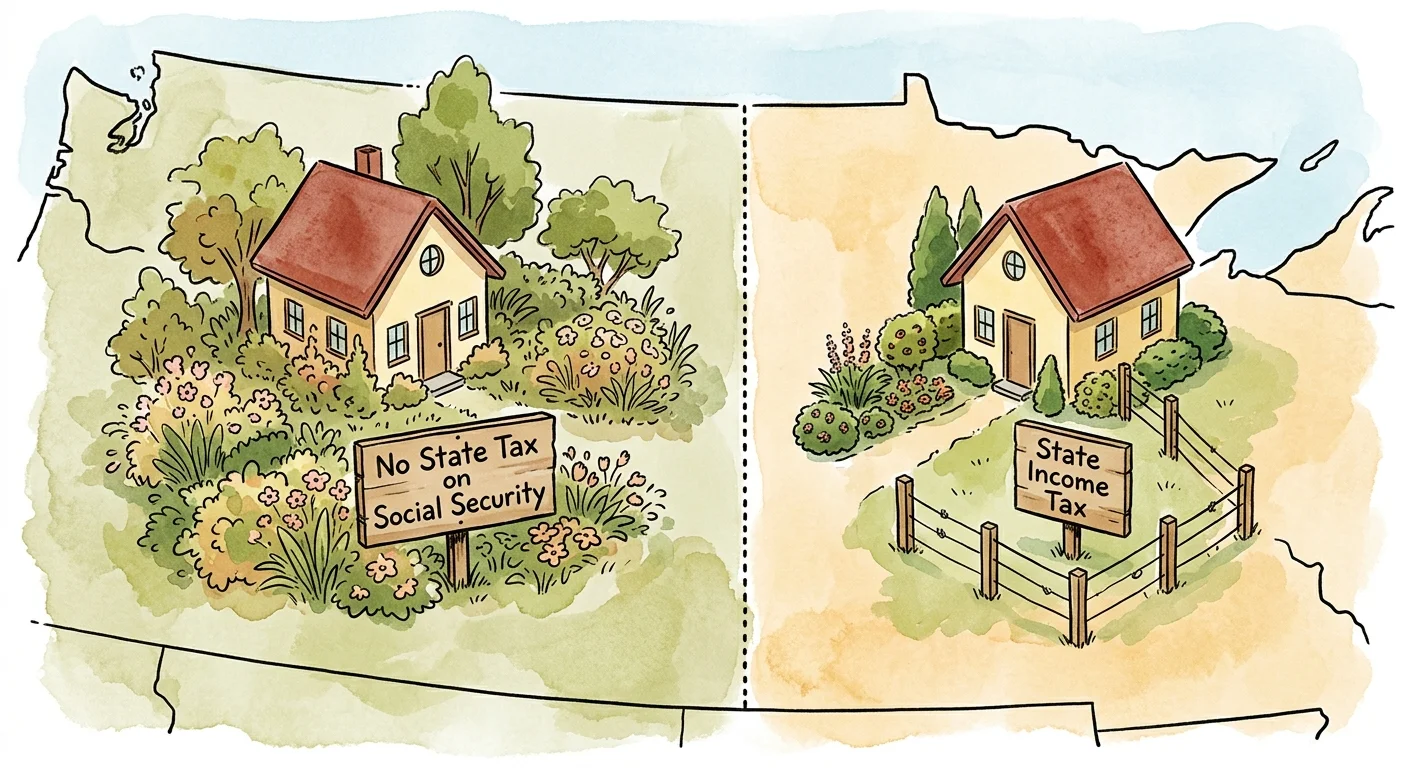
State treatment of Social Security benefits offers great news for most seniors. Exactly 42 states and Washington, D.C., impose zero state income tax on Social Security benefits. Only eight states continue to tax Social Security income under specific circumstances: Colorado, Connecticut, Minnesota, Montana, New Mexico, Rhode Island, Utah, and Vermont. Fortunately, even within these eight states, broad income exemptions shield low and moderate earners—including most households living on $50,000—from paying state tax on their benefits.
However, state taxation on pensions, traditional IRAs, and 401(k) distributions varies widely. Nine states impose no state income tax at all: Alaska, Florida, Nevada, New Hampshire, South Dakota, Tennessee, Texas, Washington, and Wyoming. If you live in one of these states, your state tax bill on a $50,000 retirement income is zero.
In contrast, states like Pennsylvania and Mississippi exempt private and public pensions along with retirement account distributions, despite charging state tax on standard wages. Other states, such as Georgia and South Carolina, provide generous senior income exclusions (often $35,000 to $65,000 per person) for taxpayers aged 62 or 65 and older. High-tax states like California or New York enforce progressive state income tax brackets on IRA withdrawals, though New York exempts up to $20,000 of private pension and IRA income for seniors aged 59½ or older. Factoring state tax rules into your financial planning ensures you choose a location that supports your long-term budget goals.

Building a Realistic $50,000 Retirement Budget
Once federal taxes and Medicare premiums settle, a typical single senior receiving $50,000 in gross retirement income takes home approximately $3,900 per month (or roughly $46,800 annually). Crafting a practical monthly budget requires matching your fixed overhead expenses against this realistic net figure.
Financial guidance from the Consumer Financial Protection Bureau (CFPB) emphasizes maintaining a manageable housing ratio to protect fixed-income households from sudden inflation spikes or unexpected expense shocks. Dividing your monthly net pay of $3,900 across standard lifestyle categories establishes a sustainable financial routine.
- Housing (Rent/Mortgage, Property Taxes, Home Insurance): $1,250 (32% of net income). Keeping housing costs near one-third of your net income leaves room for daily living needs. Paying off a mortgage before retiring dramatically strengthens this category.
- Healthcare Overhead (Medigap, Part D, Copays, Dental, Vision): $400 (10% of net income). Beyond your automatic Medicare Part B deduction, reserve funds for supplemental insurance policies, dental procedures, prescriptions, and routine eye exams.
- Groceries and Household Supplies: $500 (13% of net income). This allows $125 per week for fresh food, nutrition supplies, and standard household items.
- Utilities and Telecommunications: $320 (8% of net income). Covers electric service, heating fuel, water, trash pickup, high-speed internet, and a basic cell phone plan.
- Transportation (Vehicle Maintenance, Fuel, Insurance): $350 (9% of net income). Maintains a safe, reliable vehicle while covering auto insurance premiums and routine mechanical servicing.
- Personal Care, Clothing, and Dining Out: $300 (8% of net income). Provides flexibility for haircuts, modest wardrobe updates, social gatherings, and occasional restaurant meals.
- Emergency Fund and Leisure/Travel: $780 (20% of net income). Allocating funds toward a liquid emergency savings account protects you against home repairs, unexpected medical needs, or family visits without resorting to credit cards.

Common Tax Pitfalls and Mistakes to Avoid
Managing your money in retirement requires avoiding hidden structural traps that can trigger unexpected tax bills, penalties, or unnecessary reductions in your net monthly benefits. Paying attention to these tax nuances preserves your hard-earned wealth.
Failing to Set Up Tax Withholding
Unlike corporate employers who automatically deduct income taxes from wages, IRA custodians and pension providers do not automatically withhold federal taxes unless you instruct them to do so. If you draw thousands of dollars from traditional tax-deferred accounts without withholding funds, you might owe a sizeable tax bill when filing your annual return. The IRS may also levy estimated tax penalties if you underpay your taxes throughout the calendar year. Submit IRS Form W-4P to your account custodians to establish regular federal withholding on monthly retirement distributions.
Taking Large Lump-Sum Withdrawals
Withdrawing a large chunk of money from a traditional IRA or 401(k) to buy a vehicle or pay off a home mortgage can backfire financially. A massive single-year withdrawal spikes your Adjusted Gross Income, pushing you into higher federal tax brackets and triggering taxability on up to 85% of your Social Security benefits. Spread major capital expenditures across multiple tax years or draw funds from tax-free Roth accounts to keep your taxable income stable.
Ignoring Required Minimum Distributions (RMDs)
Federal tax law requires you to start taking annual Required Minimum Distributions (RMDs) from traditional IRAs and 401(k)s once you reach age 73 (rising to age 75 for those reaching age 74 after 2032). Failing to take your full RMD on time exposes you to an IRS penalty equal to 25% of the unwithdrawn required amount. Automate your RMD withdrawals with your financial institution well before December 31 each year to prevent administrative oversights.
Falling Victim to Senior Financial Scams
Bad actors frequently target retirees with phone calls, text messages, or letters claiming to represent the IRS or Social Security Administration. These scams often claim that you owe immediate back taxes or that your Social Security number faces suspension. The IRS and SSA never demand immediate payment via pre-paid gift cards, wire transfers, or cryptocurrency. Always verify official tax correspondence directly through official government contact channels before sharing personal information or transferring funds.

Smart Strategies to Maximize Your After-Tax Income
With proactive tax planning, you can keep more of your $50,000 retirement budget available for daily living and personal enjoyment. Implementing targeted withdrawal methods allows you to legally minimize tax drag year after year.
- Utilize Qualified Charitable Distributions (QCDs): If you are aged 70½ or older and donate money to qualified charities, make those contributions directly from your traditional IRA using a Qualified Charitable Distribution. A QCD transfers up to $105,000 annually directly to a non-profit organization without counting toward your AGI. This strategy satisfies your mandatory RMD obligations without increasing your taxable income or raising the tax on your Social Security benefits.
- Execute Strategic Roth Conversions: During low-income years—such as the gap between job retirement and starting Social Security—consider converting portions of traditional IRA balances into a Roth IRA. You pay income tax on the converted amount during that low-bracket year, allowing the money to grow completely tax-free for the rest of your life. Future withdrawals from the Roth IRA will not count toward provisional income calculations or trigger tax on Social Security.
- Coordinate Withdrawal Sequencing: Optimize the order in which you draw money from different account types. Drawing taxable pension funds and traditional IRA amounts up to the top of the 10% tax bracket first, then filling remaining income needs with tax-free Roth IRA withdrawals, keeps your overall tax liability near zero while preserving growth across your portfolios.
- Claim Senior Property Tax Exemptions: Many county tax assessors offer homestead exemptions, property tax freezes, or deferral programs specifically for resident homeowners aged 65 and older. Lowering your real estate property taxes directly reduces your monthly housing overhead, effectively expanding your net spending power without increasing your income tax burden.
Frequently Asked Questions
Is a $50,000 annual income considered good for retirement?
Yes, a $50,000 annual income provides a comfortable lifestyle for many single retirees and married couples, particularly in areas with a moderate cost of living. Because seniors enjoy enhanced tax deductions and no longer pay 7.65% in FICA payroll taxes, a $50,000 retirement income often delivers spending power comparable to a $60,000 working wage. Paying off major debt obligations, such as a home mortgage or car loan, further enhances your daily financial security.
Will I pay federal tax on Social Security if my total income is $50,000?
It depends entirely on your income sources. If your $50,000 comes mostly from traditional IRAs or pensions alongside Social Security, a portion of your Social Security (up to 50% or 85%) will be subject to federal income tax based on the provisional income test. However, if your non-Social Security income remains low or includes distributions from tax-free accounts like Roth IRAs, your Social Security benefits may remain completely untaxed.
How do I request federal tax withholding from my Social Security check?
You can set up voluntary tax withholding from your monthly Social Security payments by completing IRS Form W-4V (Voluntary Withholding Request) and submitting it to your local Social Security office. You can select flat withholding rates of 7%, 10%, 12%, or 22%. Establishing withholding prevents unexpected tax bills and avoids underpayment penalties when filing your tax return.
Does Medicare Part B lower my taxable income?
If you itemize deductions on Schedule A of your federal tax return, you can include Medicare Part B and Part D premiums alongside other out-of-pocket medical expenses. However, medical expenses are only deductible to the extent that they exceed 7.5% of your Adjusted Gross Income. Because most seniors benefit far more from taking the expanded standard deduction ($24,150 for single filers aged 65+), Medicare premiums generally do not provide an extra tax deduction for standard filers.
What happens if I move to another state in retirement?
Moving to a different state can alter your net monthly income. Relocating from a state that taxes income or Social Security to one of the nine states with zero state income tax automatically increases your take-home pay. However, evaluate overall living costs—including local property taxes, sales taxes, healthcare access, and housing affordability—before moving based solely on state tax rates.
For additional senior resources, visit
Eldercare Locator, AARP and Alzheimer’s Association.
Disclaimer: The information in this article is for educational purposes only and is not intended to be a substitute for professional financial, legal, or medical advice. Always consult with a qualified expert for advice tailored to your personal situation.









Leave a Reply