

Mastering confusing Medicare terminology protects your retirement savings and ensures you receive the healthcare coverage you deserve. Misunderstanding a single policy definition can easily cost you thousands of dollars in unexpected hospital bills.
Federal healthcare programs use complex insurance jargon that looks nothing like traditional employer coverage. Learning these eight distinct concepts gives you complete control over your medical choices and your household budget.
This straightforward guide clarifies the most misunderstood terms so you can select your benefits with total confidence. Review these crucial differences today to avoid costly surprises at the pharmacy counter or doctor’s office.
1. Medicare Part A vs. Part B: Inpatient Facility Care vs. Outpatient Services
Understanding the difference between Medicare Part A and Part B is essential when reviewing your medical coverage. Together, these two programs form Original Medicare.
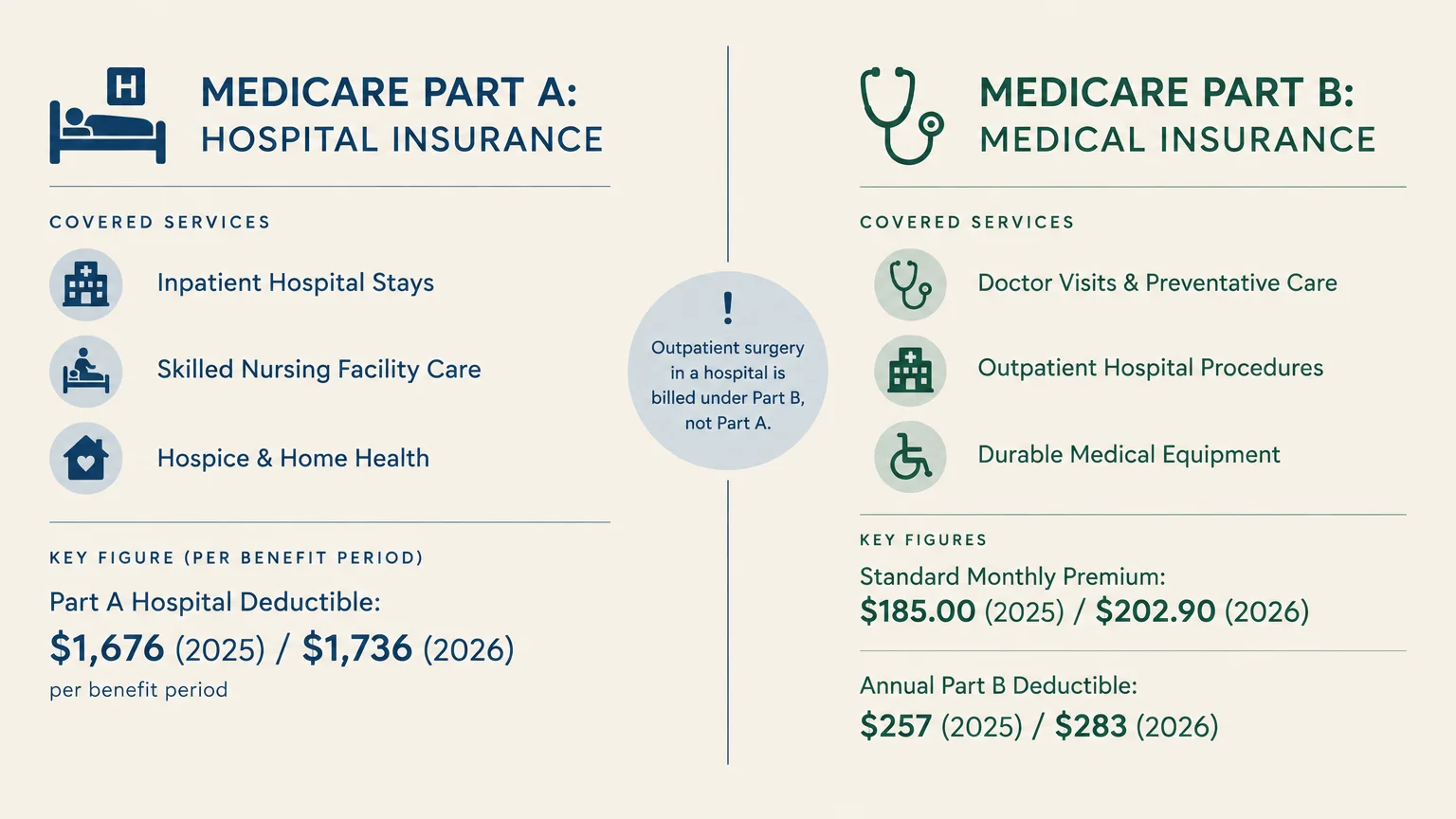
Medicare Part A serves as your hospital insurance. It covers inpatient hospital stays, care in a skilled nursing facility, hospice care, and limited home healthcare.
Most retirees do not pay a monthly premium for Part A because they paid Medicare payroll taxes while working. However, Part A is not entirely free when you receive medical treatment.
In 2025, you must pay a Part A hospital deductible of $1,676 for each benefit period. This deductible increases to $1,736 in 2026.
Medicare Part B covers outpatient medical services and preventive care. This includes routine doctor visits, diagnostic lab tests, ambulance transportation, and durable medical equipment.
According to Medicare.gov, the standard monthly premium for Part B is $185.00 in 2025. This rate rises to $202.90 per month in 2026.
The federal government typically deducts your Part B premium directly from your monthly Social Security check. You must also satisfy an annual Part B deductible before coverage begins.
For 2025, the Part B deductible is $257 per year, rising to $283 in 2026. Once you satisfy this deductible, you generally pay coinsurance for covered treatments.
Retirees often assume hospital care always falls under Part A. However, outpatient procedures performed in a hospital setting are billed under Part B.
Keeping this distinction in mind prevents unexpected medical billing disputes after outpatient surgery. Knowing which part covers your treatment helps you budget your expenses accurately.

2. Copayment vs. Coinsurance: Fixed Fees vs. Percentage Splits
Many retirees use the terms copayment and coinsurance interchangeably. However, confusing these two cost-sharing methods can result in significant financial surprises.
A copayment is a predetermined, fixed dollar amount that you pay at the time of service. For example, your plan might charge a flat $25 copay for an office visit.
Copayments provide financial predictability because you know the exact charge before your appointment. You encounter copayments frequently in Medicare Advantage plans and Part D prescription formularies.
Coinsurance represents a percentage split of the total Medicare-approved cost for a medical service. Instead of paying a flat fee, you pay a portion of the final bill.
Under Original Medicare Part B, you typically pay a 20% coinsurance rate for outpatient care. Medicare covers the remaining 80% of the approved amount.
Coinsurance carries greater financial unpredictability than a copayment. A 20% share of an expensive procedure, such as outpatient chemotherapy, can reach thousands of dollars.
Reviewing whether a plan charges copayments or coinsurance for specialist visits helps you anticipate your out-of-pocket exposure. Flat copays are generally much safer for fixed retirement incomes.
| Cost-Sharing Feature | Copayment | Coinsurance |
|---|---|---|
| Payment Structure | Fixed dollar amount (e.g., $20 or $40) | Percentage split of the approved bill (e.g., 20%) |
| Predictability | High; you know the cost before the visit | Variable; depends on the total provider charges |
| Common Usage | Medicare Advantage plans, Part D pharmacy tiers | Original Medicare Part B outpatient medical care |
| Financial Risk | Low per transaction | High for complex outpatient surgeries and treatments |
Always verify whether an upcoming diagnostic procedure requires a flat fee or coinsurance. This single check prevents large billing surprises from catching you off guard.

3. Benefit Period Deductibles vs. Maximum Out-of-Pocket Limits
Commercial employer insurance usually calculates deductibles on a standard calendar-year basis. Medicare Part A handles deductibles very differently through a mechanism called a benefit period.
A Part A benefit period starts the day you enter a hospital as an inpatient. It ends once you have spent 60 consecutive days out of the facility.
If you leave the hospital and return 65 days later, a new benefit period begins. You must pay the full $1,676 deductible again in 2025.
Consequently, an individual could face multiple Part A deductibles within a single calendar year. This structure surprises many retirees who expect an annual cap.
Even more surprising is that Original Medicare has no annual Maximum Out-of-Pocket (MOOP) limit. Your potential out-of-pocket spending under Parts A and B has no legal ceiling.
If you receive extensive medical care under Original Medicare alone, you remain responsible for your 20% coinsurance indefinitely. There is no catastrophic stop-loss threshold.
In contrast, Medicare Advantage plans must provide a federally mandated annual MOOP limit. This cap protects beneficiaries from limitless healthcare bills.
Federal regulations cap Medicare Advantage in-network out-of-pocket spending at $9,350 for 2025. That maximum ceiling drops slightly to $9,250 in 2026.
| Coverage Type | Deductible Frequency | Annual Out-of-Pocket Maximum (MOOP) |
|---|---|---|
| Original Medicare Part A | Per benefit period ($1,676 in 2025; $1,736 in 2026) | No limit (beneficiary pays coinsurance after day 60) |
| Original Medicare Part B | Annual calendar year ($257 in 2025; $283 in 2026) | No limit (beneficiary pays 20% indefinitely) |
| Medicare Advantage (Part C) | Varies by individual private plan | Capped federally ($9,350 in 2025; $9,250 in 2026) |
Understanding that Original Medicare lacks an out-of-pocket limit highlights the importance of financial protection. Most retirees add supplemental insurance to protect their retirement nest eggs.

4. Medicare Advantage (Part C) vs. Medigap: Private Networks vs. Supplemental Coverage
Confusing Medicare Advantage with Medigap is perhaps the most common enrollment error seniors make. These two insurance options represent completely separate paths for your healthcare.
Medicare Advantage, also called Part C, replaces how you receive your Medicare benefits. Private insurance companies contract with the government to manage your hospital, medical, and prescription coverage.
Medicare Advantage plans frequently use restricted provider networks, such as HMOs or PPOs. They often require prior authorizations and specialist referrals before covering complex medical procedures.
Medigap, officially known as Medicare Supplement Insurance, works alongside Original Medicare. It helps pay your remaining out-of-pocket expenses, such as the 20% Part B coinsurance.
With Medigap, you can see any healthcare provider in the United States who accepts Original Medicare. You never need network referrals or prior authorization to consult a specialist.
According to the Centers for Medicare & Medicaid Services (CMS), federal regulations strictly prohibit combining these products. Under Section 1882 of the Social Security Act, selling a Medigap plan to a Medicare Advantage policyholder is illegal.
You must choose either Medicare Advantage or Original Medicare paired with a Medigap supplement. You cannot hold both policies simultaneously.
- Medicare Advantage: Bundles coverage into one plan, offers low monthly premiums, but restricts provider networks and requires prior approvals.
- Medigap: Charges a higher monthly premium, but provides nationwide doctor freedom and virtually eliminates out-of-pocket medical bills.
Choosing between these two paths depends on your travel lifestyle, medical history, and household budget. Selecting the wrong path can restrict your access to regional specialists.
5. The Prescription Drug “Donut Hole” vs. The New Part D Out-of-Pocket Cap
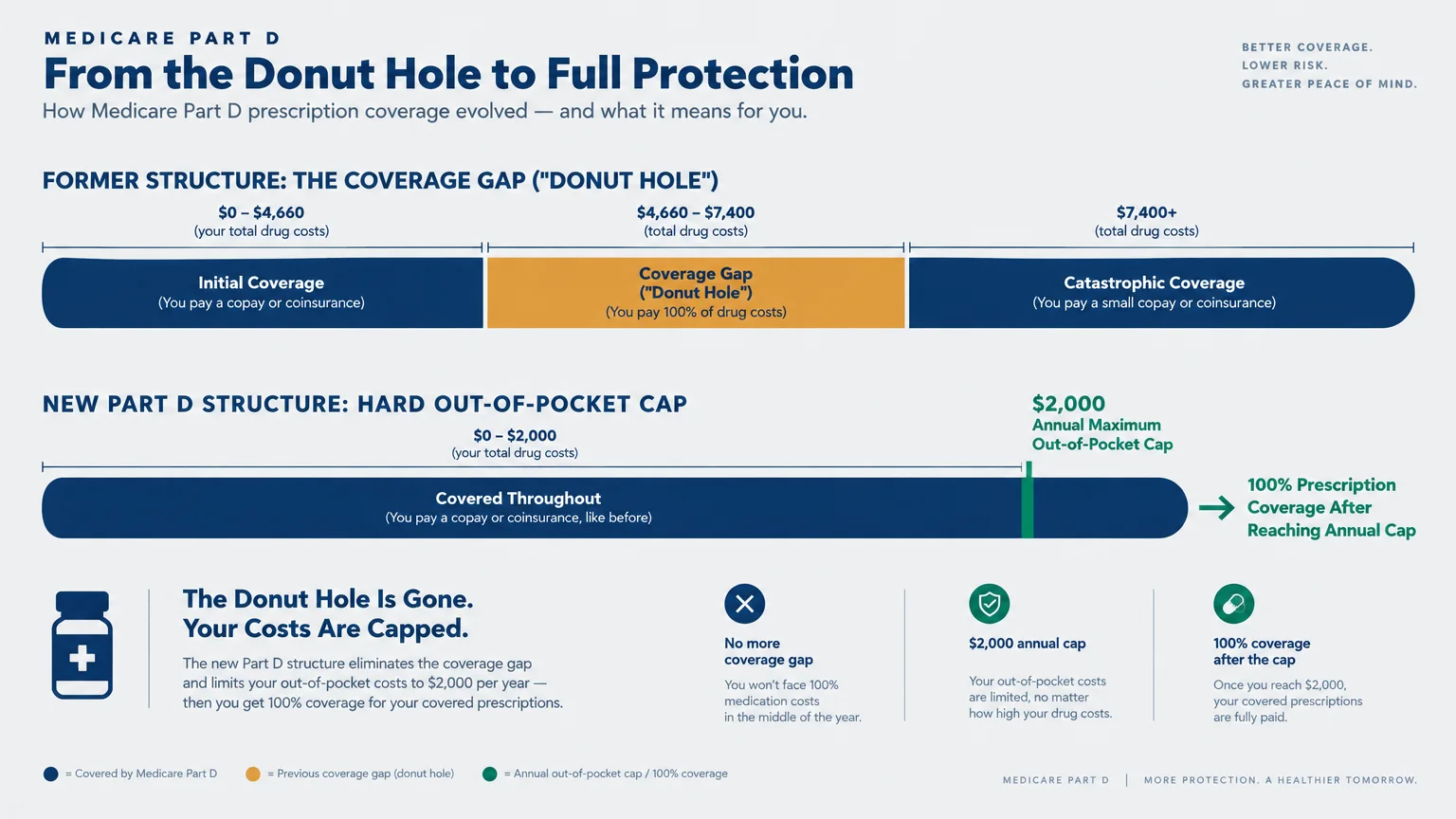
For two decades, seniors feared entering the dreaded Medicare Part D coverage gap, commonly known as the donut hole. In that phase, drug coverage dropped, leaving retirees with steep pharmacy bills.
Federal legislative reforms have completely restructured Medicare prescription drug coverage. Starting on January 1, 2025, the historical donut hole coverage gap was permanently eliminated.
The Inflation Reduction Act established a hard annual out-of-pocket spending cap for Medicare Part D medications. In 2025, your out-of-pocket prescription drug costs cannot exceed $2,000.
For 2026, the federal prescription drug out-of-pocket spending cap adjusts slightly to $2,100. Once you reach that limit, your covered medications cost $0 for the remainder of the year.
Medicare also launched the Medicare Prescription Payment Plan on January 1, 2025. This optional program allows you to spread out-of-pocket pharmacy expenses across manageable monthly installments.
Instead of facing a massive pharmacy bill in January or February, your costs are distributed evenly. This program helps retirees on fixed incomes maintain predictable monthly cash flow.
You must opt into the payment plan through your Part D plan sponsor. It does not reduce your total prescription costs, but it prevents burdensome upfront charges.
Make sure you verify whether your specific medications appear on your plan’s formulary. Drugs excluded from your plan’s formulary do not count toward the $2,000 annual spending cap.

6. Initial Enrollment Period (IEP) vs. Annual Enrollment Period (AEP)
Enrolling at the wrong time can trigger lifelong financial penalties and delayed healthcare coverage. Retirees frequently confuse their personal enrollment window with the general fall enrollment season.
Your Initial Enrollment Period (IEP) is a personalized 7-month window tied directly to your 65th birthday. It begins three months before your birthday month, includes your birth month, and lasts three months after.
Enrolling during your IEP ensures your Medicare coverage starts promptly without gaps. It also protects you from costly lifetime late-enrollment penalties.
According to the Social Security Administration (SSA), delaying Part B without creditable employer coverage incurs a permanent 10% penalty for each full 12-month period you waited.
In contrast, the Annual Enrollment Period (AEP) occurs every fall from October 15 through December 7. Every Medicare beneficiary can participate in AEP, regardless of age.
During AEP, you can switch between Original Medicare and Medicare Advantage. You can also join, change, or drop Medicare Part D prescription drug plans, with changes taking effect January 1.
Retirees also confuse AEP with the Medicare Advantage Open Enrollment Period (MA OEP). The MA OEP runs from January 1 to March 31 each year.
Only beneficiaries already enrolled in a Medicare Advantage plan can use the MA OEP. It allows you to switch to another Advantage plan or return to Original Medicare.
- IEP (7-Month Window): Sign up around age 65 to establish your baseline Medicare coverage.
- AEP (Oct 15 – Dec 7): Modify your existing Advantage or Part D plans for the upcoming calendar year.
- MA OEP (Jan 1 – Mar 31): Adjust your Medicare Advantage coverage if your current plan is unsatisfactory.
Mark these enrollment deadlines on your calendar every year. Missing your enrollment windows can leave you locked into an unsuitable plan for twelve full months.

7. Observation Status vs. Inpatient Admission: The Hidden Cost Trap
Waking up in a hospital bed does not automatically mean the hospital admitted you as an inpatient. Doctors often classify patients under observation status instead.
Observation status means you are technically an outpatient, even if you stay overnight in a hospital room. The hospital is simply evaluating whether you need formal inpatient admission.
This distinction matters tremendously for your household finances. Inpatient hospital stays fall under Medicare Part A, while observation care falls under Part B outpatient benefits.
Because observation care bills under Part B, you are responsible for the 20% coinsurance for each individual service and doctor consultation. Those fees can accumulate quickly.
Furthermore, Medicare Part A only covers skilled nursing facility rehab if you complete a formal 3-day inpatient stay first. Time spent under observation status does not count toward those three days.
If you transition to a nursing facility after an observation stay, Medicare will deny the rehab claim. You would then be responsible for the entire nursing home bill.
Always ask hospital staff directly whether they admitted you as an inpatient or placed you on observation. Clarifying your status early helps you protect your rehab benefits.
Requesting that your attending physician formally admit you can protect your wallet. Never assume your hospital stay is covered under Part A without verbal confirmation.
8. Participating Providers vs. Non-Participating Providers: Understanding Assignment
When you schedule an appointment with a doctor, you need to understand how they bill Medicare. Not all physicians who accept Medicare patients charge the same rates.
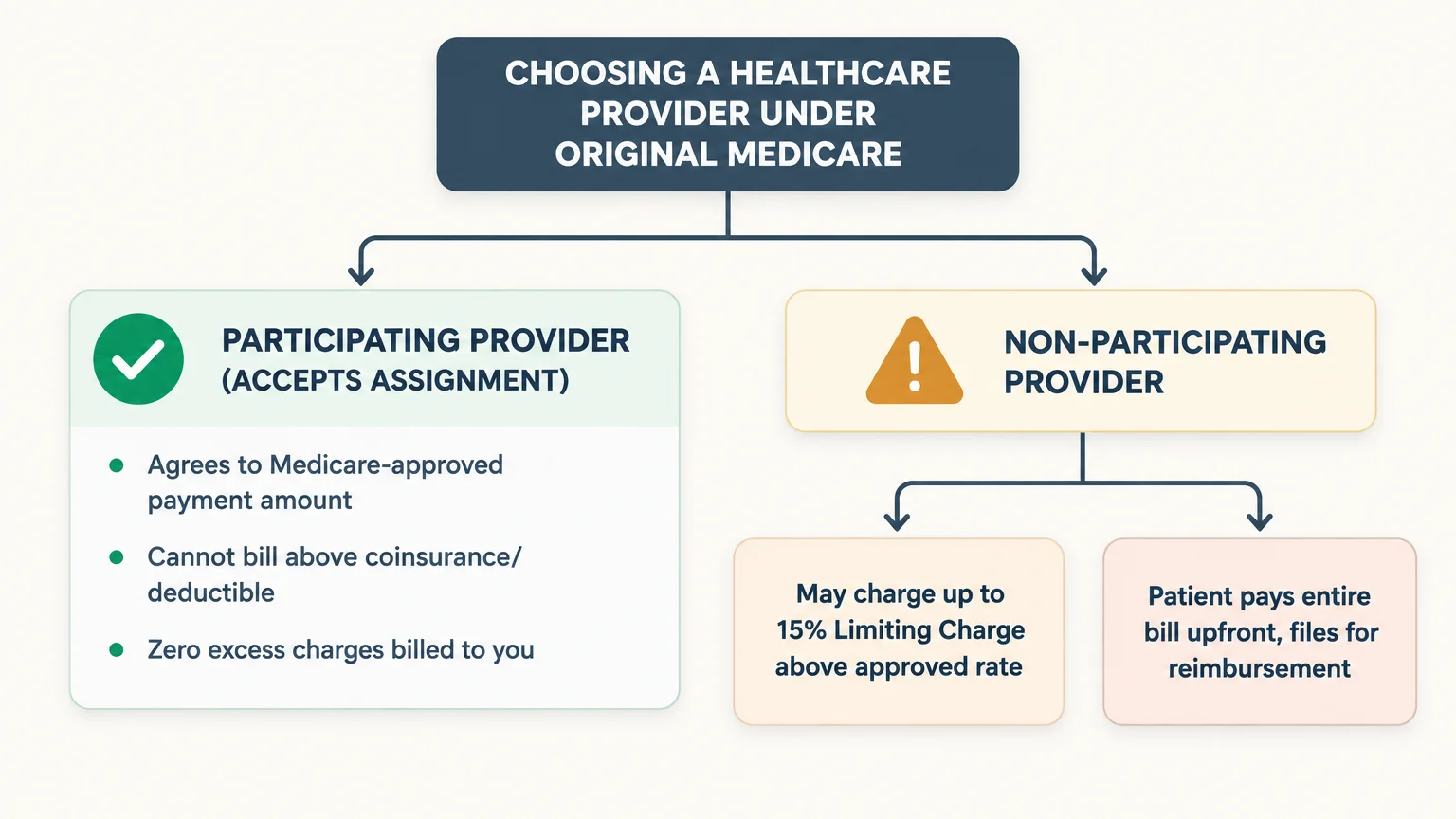
Participating providers agree to accept Medicare assignment for all covered services. This means they accept the Medicare-approved amount as payment in full.
When seeing a participating provider, you only pay your standard 20% coinsurance. The physician cannot bill you for any remaining balance beyond that approved amount.
Non-participating providers accept Medicare patients, but they choose not to accept assignment on all claims. They can charge up to 15% above the Medicare-approved rate.
This additional charge is known as a Medicare Part B excess charge. You must pay this excess balance out of your own pocket unless your Medigap policy covers it.
Medigap Plan G covers Part B excess charges, shielding you from these surprise costs. However, Medigap Plan N requires you to pay excess charges yourself.
Finally, opt-out providers have signed agreements to leave the Medicare program entirely. If you visit an opt-out doctor, Medicare pays nothing, and you are responsible for the entire bill.
Opt-out providers require you to sign a private contract agreeing to pay their full cash rates. Always ask if your doctor accepts Medicare assignment before your initial consultation.

Costly Enrollment Mistakes and Medicare Scams to Avoid
Navigating Medicare terminology can feel overwhelming, which makes retirees prime targets for deceptive marketing. Being aware of common pitfalls helps protect your savings and your identity.
According to consumer warnings from AARP, misleading television commercials and robocalls often promise free flex cards or grocery allowances to entice seniors into switching plans.
These offers often come with hidden restrictions and require you to leave your trusted doctor networks. Always verify claims through official Medicare channels before changing your policy.
Here are several crucial mistakes every retiree should avoid during their Medicare journey:
- Relying on COBRA coverage after age 65 instead of enrolling in Part B on time.
- Assuming Original Medicare covers routine dental checkups, hearing aids, and eyeglasses.
- Failing to review your plan’s Annual Notice of Change (ANOC) letter every September.
- Believing that Original Medicare protects you with an annual maximum out-of-pocket ceiling.
- Purchasing duplicate coverage that violates federal Medicare anti-duplication regulations.
Never give your Medicare number or Social Security number to unverified callers over the phone. Official Medicare representatives will never call you unprompted to demand personal account details.
If you suspect Medicare fraud or deceptive marketing practices, report the incident promptly to state insurance authorities or local senior advocates.
Frequently Asked Questions
Can I be enrolled in both Medicare Advantage and Medigap at the same time?
No, you cannot hold both policies simultaneously. Federal law prohibits insurance companies from selling Medigap policies to individuals enrolled in Medicare Advantage plans.
Medigap only pays costs associated with Original Medicare. If you switch to Medicare Advantage, you must drop your Medigap coverage.
What happens if I delay enrolling in Medicare Part B because I am still working?
If you have qualifying health coverage through your active employer or your spouse’s employer, you can delay Part B without penalty. You will qualify for a Special Enrollment Period when employment ends.
However, COBRA coverage and retiree health benefits do not qualify as active employer insurance. Delaying Part B while on COBRA results in lifetime late-enrollment penalties.
How does the Part D $2,000 out-of-pocket cap work in 2025?
Under the Inflation Reduction Act, your total out-of-pocket spending on covered Part D medications cannot exceed $2,000 in 2025. This threshold adjusts to $2,100 in 2026.
Once your payments for deductibles, copayments, and coinsurance reach that dollar threshold, your plan covers 100% of your covered prescription costs for the rest of that calendar year.
Why did I receive a hospital bill if I already paid my Part A deductible this year?
Medicare Part A deductibles do not follow a calendar year. Instead, Part A deductibles apply on a per-benefit-period basis.
If you were discharged and remained out of the hospital for 60 consecutive days, a new benefit period began. You must pay the deductible again upon re-admission.
What is the Medicare Prescription Payment Plan, and how do I join?
The Medicare Prescription Payment Plan is a voluntary program launched in 2025 that divides your out-of-pocket drug costs into monthly bills. It does not reduce your total drug costs.
Instead, it prevents large upfront pharmacy bills early in the calendar year. You can opt into the program through your Part D plan sponsor at any time.
For additional senior resources, visit
Social Security Administration (SSA), Consumer Financial Protection Bureau (CFPB), Administration for Community Living (ACL) and Eldercare Locator.
Disclaimer: The information in this article is for educational purposes only and is not intended to be a substitute for professional financial, legal, or medical advice. Always consult with a qualified expert for advice tailored to your personal situation.









Leave a Reply