

Your monthly Social Security benefits will change next year, and September determines the exact dollar amount you receive. Every autumn, a single month of federal price data locks in your upcoming cost-of-living adjustment.
Understanding the 2027 Social Security COLA calculation helps you plan your retirement budget with confidence. It allows you to anticipate rising expenses for utilities, food, and housing well before January arrives.
September serves as the mathematical tipping point for your pocketbook. Here is why this specific month carries so much weight and how it shapes your future income.

The Legal Formula: How COLA Is Calculated
Congress does not arbitrarily pick your annual benefit increase; federal law dictates the exact math. Section 215(i) of the Social Security Act establishes the precise mechanism for annual adjustments.
The government relies on a specialized economic metric called the Consumer Price Index for Urban Wage Earners and Clerical Workers (CPI-W). The Bureau of Labor Statistics updates and publishes these figures every month.
According to the Social Security Administration (SSA), this formula safeguards your purchasing power against ongoing inflationary pressure. It prevents inflation from eroding the real value of your hard-earned benefits over time.
The calculation uses a strict rounding rule written into law. Analysts calculate the percentage increase and round it to the nearest tenth of one percent.
Federal statute also includes a crucial safeguard called the no-decrease floor. If consumer prices fall or stay flat across the measuring window, your benefits do not drop; your COLA simply becomes zero percent.
Deflation never reduces your gross monthly check. This protective rule provides peace of mind when market volatility creates economic uncertainty.
The Critical Third-Quarter Measuring Window
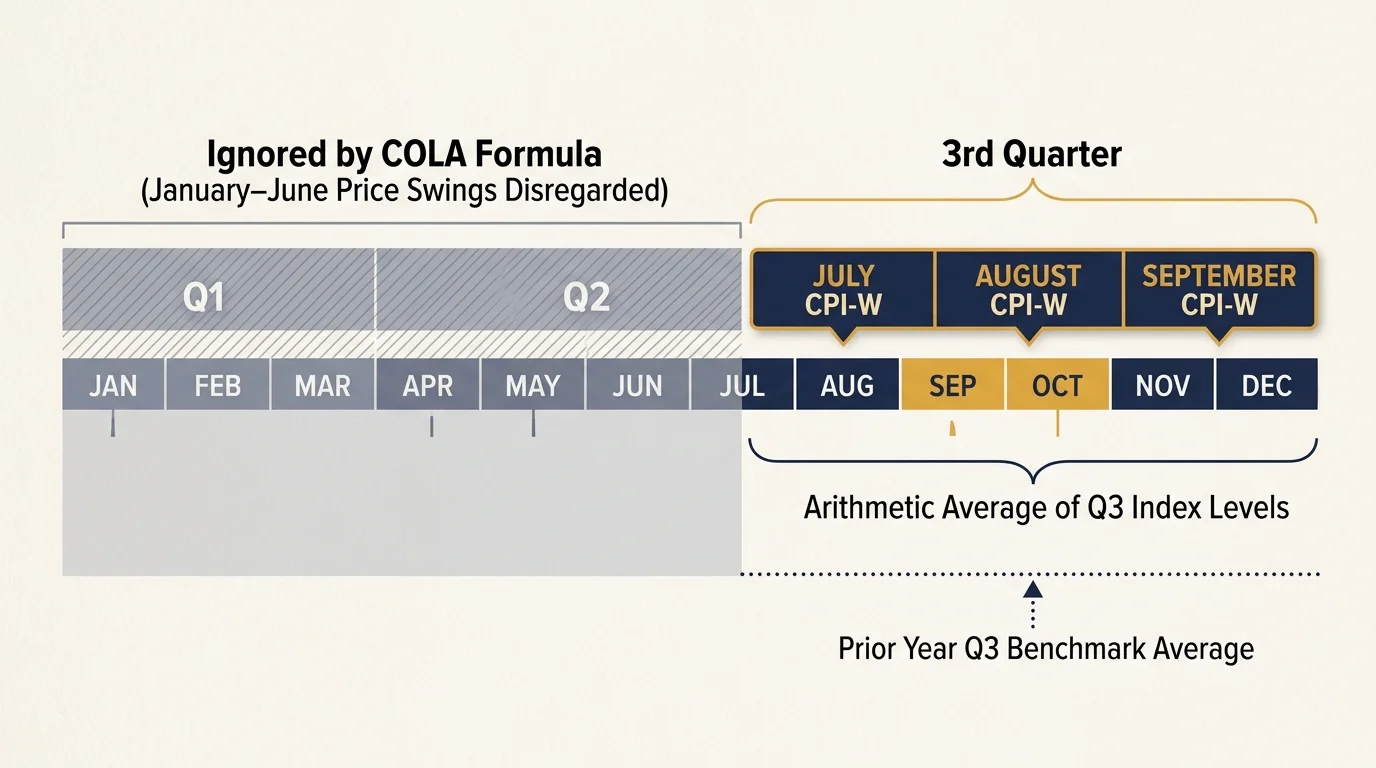
Many people assume the government measures inflation across all twelve months to set the COLA. In reality, federal regulators examine only a narrow three-month period known as the third calendar quarter.
The third quarter includes July, August, and September. The formula ignores price swings from January through June when calculating your annual adjustment.
To determine your increase, economists calculate the arithmetic average of the CPI-W index levels for these three specific months. They compare this quarterly average against the benchmark average from the previous year.
If you have ever wondered why early spring inflation reports do not change your benefit check, this calendar rule explains why. Spring price spikes only influence your benefits if they remain elevated through the summer months.
The formula divides the third-quarter increase by the prior benchmark index level; the resulting percentage change establishes your new raise. This laser focus makes late summer price readings extraordinarily influential.

Why September Inflation Data Drives the Entire Outcome
September acts as the decisive anchor for the entire quarterly equation. While July and August establish two-thirds of the data pool, September delivers the final, defining reading.
A sharp movement in September consumer prices can dramatically swing the quarterly average up or down. Energy costs, grocery prices, and rental housing expenses during this final month exert tremendous mathematical leverage.
If fuel prices tumble in September, that drop can pull down the entire quarterly average. Conversely, an unexpected late-summer price surge can lift your final COLA percentage by several tenths of a point.
September inflation data COLA tracking also creates the official announcement trigger. Government statisticians collect pricing surveys through September 30 to finalize the comprehensive index.
Once the Bureau of Labor Statistics publishes the September report in mid-October, the calculation ends immediately. The government computes your exact cost-of-living adjustment on that very day.

Current Benchmarks and 2027 Social Security COLA Projections
Understanding where benefits are heading requires reviewing the mathematical baseline established in previous quarters. The third-quarter average CPI-W for 2025 finished at 317.265, which serves as the permanent baseline for the 2027 calculation.
Recent annual adjustments highlight how much inflation trends have varied for retirees. For 2024, beneficiaries received a 3.2% increase, followed by a 2.5% adjustment for 2025.
The 2026 adjustment rose to 2.8%, driven by persistent service and housing costs. That 2.8% boost lifted the average monthly retired worker benefit by approximately $56, reaching an average of $2,071 per month.
Early economic indicators for the 2027 cycle began emerging with the release of the July CPI-W reading at 327.104. That single monthly figure reflected a 3.4% increase over the previous year.
Advocacy organizations like AARP track these numbers closely to provide early estimates. Policy analysts currently project the 2027 COLA will likely fall between 3.1% and 3.6%, depending directly on late-summer price volatility.
| Benefit Year | Baseline Q3 CPI-W Average | Official COLA Percentage | Average Monthly Benefit Increase |
|---|---|---|---|
| 2024 | 301.236 | 3.2% | +$59 / month |
| 2025 | 308.729 | 2.5% | +$49 / month |
| 2026 | 317.265 | 2.8% | +$56 / month |
| 2027 (Projected) | Pending Q3 Data | 3.1% – 3.6% (Estimated) | +$64 – +$75 / month (Estimated) |
The table above reveals how steady inflation keeps compounding baseline checks. Even modest percentage shifts translate into meaningful dollars when spread across a full calendar year.
The Medicare Part B Deduction and Your Net Payout
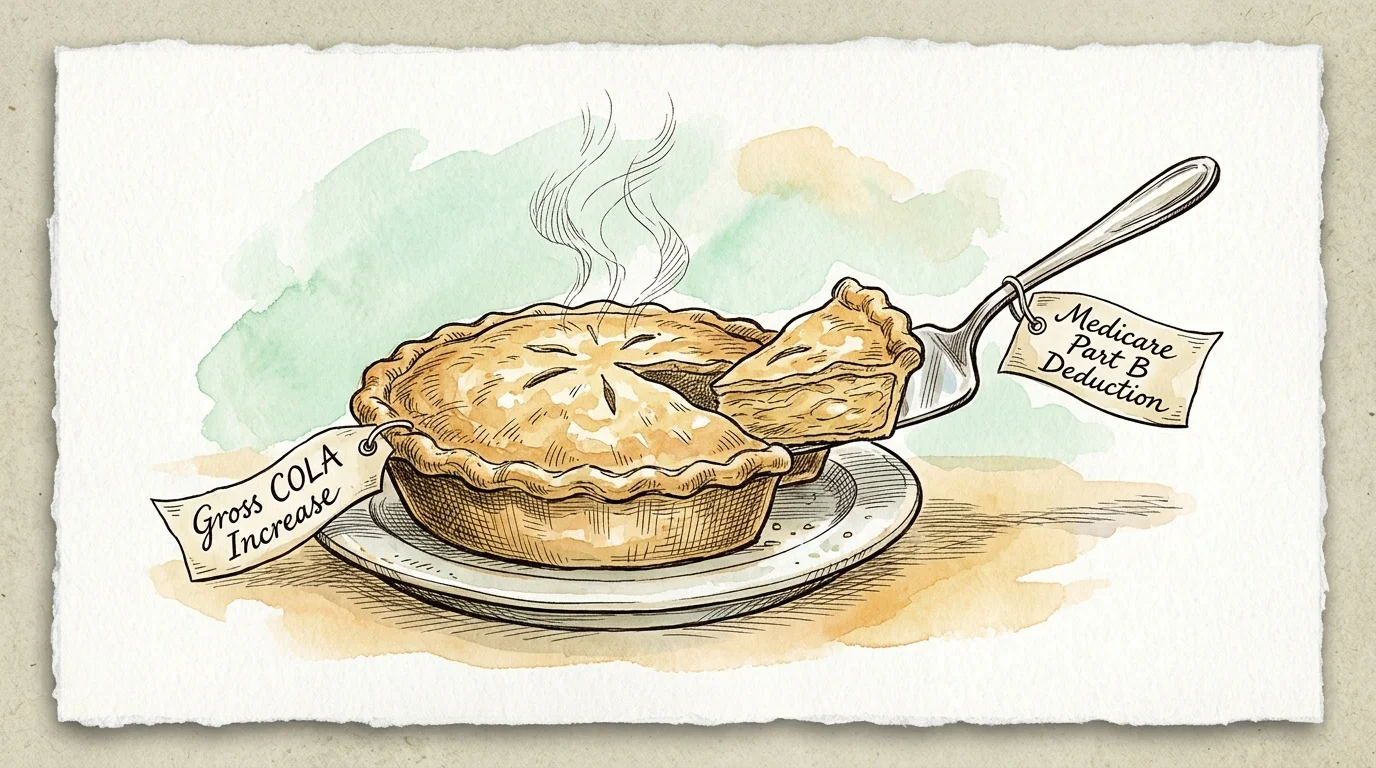
A higher COLA percentage does not automatically mean that full increase lands in your checking account. Most seniors have their Medicare Part B monthly premiums deducted directly from their Social Security checks.
Each fall, the Centers for Medicare & Medicaid Services (CMS) announces premium rates for the upcoming year. If Part B premiums rise sharply, that increase absorbs a noticeable portion of your COLA gain.
For example, a $60 monthly Social Security increase sounds generous on paper. Yet if your Part B premium rises by $15, your actual take-home increase shrinks to $45.
Fortunately, federal law includes a protective measure known as the hold harmless provision. This statutory rule prevents your net Social Security check from declining due to standard Part B premium hikes.
Under this protection, your Part B premium increase cannot exceed your COLA dollar raise. While this prevents your check from shrinking, it can still consume most of your new raise.
You must evaluate your net benefit rather than focusing solely on the gross percentage. Budgeting based on net income keeps your household finances realistic and secure.

CPI-W vs. CPI-E: Why Inflation Feels Higher for Seniors
Many seniors notice that their everyday expenses rise faster than the official COLA percentage indicates. This frustrating gap occurs because the CPI-W formula tracks spending patterns of active urban workers.
Urban workers spend significant portions of their income on commuting, career attire, and consumer electronics. Retirees, by comparison, spend far more of their monthly income on medical care and home heating.
Healthcare expenses and prescription medications historically climb at rates higher than general consumer goods. Because the CPI-W underweights medical costs, it often understates the true inflation experienced by older adults.
Senior advocates have long pushed lawmakers to adopt the Consumer Price Index for the Elderly (CPI-E). The experimental CPI-E places much greater mathematical weight on healthcare and housing.
Advocacy groups argue that switching to the CPI-E would provide fairer, more accurate annual adjustments. Until Congress updates the governing statute, however, September CPI-W data remains the binding legal standard.

Critical Timeline: What Happens Between October and January
The process moves through several structured milestones once September concludes. Knowing this timeline helps you avoid confusion as government agencies release their updates.
- October 14: The Bureau of Labor Statistics releases finalized September inflation data, and the Social Security Administration officially announces the 2027 COLA.
- Late October to November: CMS announces official Medicare Part B premium changes and annual deductibles for the upcoming year.
- Late November to Early December: Beneficiaries receive individualized COLA notices by mail or through their secure online accounts.
- December 31: Supplemental Security Income (SSI) recipients receive their first increased payment since January 1 is a federal holiday.
- January: Standard Social Security retirement and disability payments roll out on staggered Wednesdays based on your birth date.
Your payment date depends on the day of the month you were born. Beneficiaries born between the 1st and 10th receive funds on the second Wednesday of January.
Those born between the 11th and 20th receive their checks on the third Wednesday. Beneficiaries born after the 20th receive their updated deposits on the fourth Wednesday.

Smart Financial Steps to Take While Waiting for the Official Number
You do not need to wait until January to prepare your household budget for the upcoming year. Taking proactive steps in late autumn protects your financial stability regardless of the final percentage.
Start by auditing your recurring expenses, separating fixed utility and insurance costs from discretionary spending. Knowing your true baseline spending makes it easier to allocate any upcoming monthly increase.
Create or log in to your personal account on the official Social Security website. Setting up your profile early ensures you receive your electronic COLA notice as soon as it posts.
Autumn is also prime time for opportunistic financial scams targeting older Americans. According to the Consumer Financial Protection Bureau (CFPB), you should never share your Social Security number with callers offering early benefit increases.
Scammers often pose as government representatives promising to unlock larger COLA payments for an administrative fee. Remember that COLA adjustments are completely automatic; you never have to apply or pay for them.
Use any positive margin from your raise to replenish emergency savings or offset rising prescription co-pays. Treating the adjustment as a protective buffer helps safeguard your retirement independence.
Frequently Asked Questions
Can my Social Security check decrease if September inflation numbers drop?
No, your monthly benefit will not decrease due to low inflation or deflation. Federal law mandates a zero percent floor, ensuring your gross benefits stay the same if prices fall.
Do I need to submit an application to receive the 2027 COLA increase?
You never need to apply for your cost-of-living adjustment. The Social Security Administration recalculates your benefit automatically and applies the increase directly to your regular monthly deposit.
When will I find out my exact new benefit amount in dollars?
You can view your personalized notice online in early December through your personal Social Security account. Paper notices arrive in mailboxes throughout December detailing your gross raise and Medicare deductions.
Does the annual COLA increase cause higher taxes on Social Security benefits?
A higher monthly check can push a portion of your benefits into taxable territory. Because federal tax thresholds on retirement benefits are not indexed to inflation, larger checks sometimes increase tax exposure.
Why does my friend receive a larger dollar increase than I do?
COLA is applied as a percentage of your individual primary insurance amount rather than a flat dollar distribution. Beneficiaries with higher baseline checks naturally receive larger dollar additions from the same percentage raise.
For additional senior resources, visit
National Institute on Aging (NIA), Centers for Disease Control and Prevention (CDC) and Medicare.gov.
Disclaimer: The information in this article is for educational purposes only and is not intended to be a substitute for professional financial, legal, or medical advice. Always consult with a qualified expert for advice tailored to your personal situation.









Leave a Reply