

Your pension represents decades of hard work, yet dense administrative paperwork often obscures how your benefits actually function. Mastering basic pension plan terminology helps you secure every dollar you earned.
Deciphering complex retirement pension vocabulary allows you to protect your surviving spouse, sidestep tax penalties, and maximize lifetime cash flow. Minor contractual details can shift your monthly income by hundreds of dollars.
This guide clarifies essential pension plan basics through practical examples, giving you the knowledge to make confident financial choices today.
Why Pension Language Matters for Your Retirement Security
Employer retirement benefits have shifted dramatically over the past four decades. Understanding how pensions work explained in plain language gives you an immediate advantage.
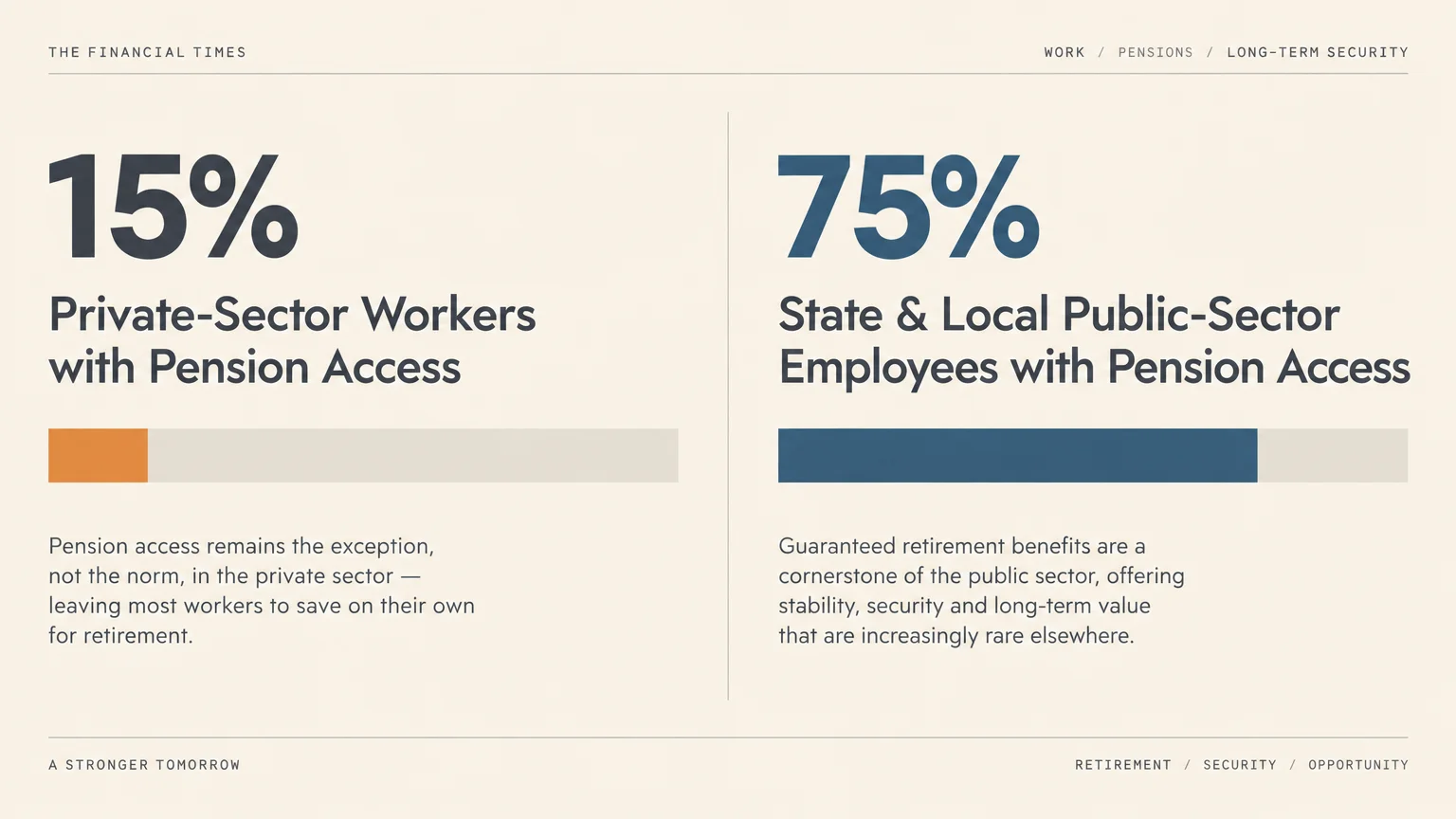
According to the Bureau of Labor Statistics, only 15% of private-sector workers have access to a traditional pension today. In contrast, over 75% of state and local public-sector employees still retain these benefits.
If you hold a traditional pension, you belong to an increasingly rare group of retirees. That benefit provides guaranteed income, but only if you select the right distribution options.
Plan administrators present election paperwork packed with legal jargon. Making an uneducated choice during your election window can permanently reduce your household income.
Take the time to examine each term carefully. The decisions you finalize upon retirement are almost always irrevocable.
1 & 2. Defined Benefit vs. Defined Contribution Plans
To grasp retirement pension vocabulary, you must first separate defined benefit plans from defined contribution plans.
1. Defined Benefit Plan
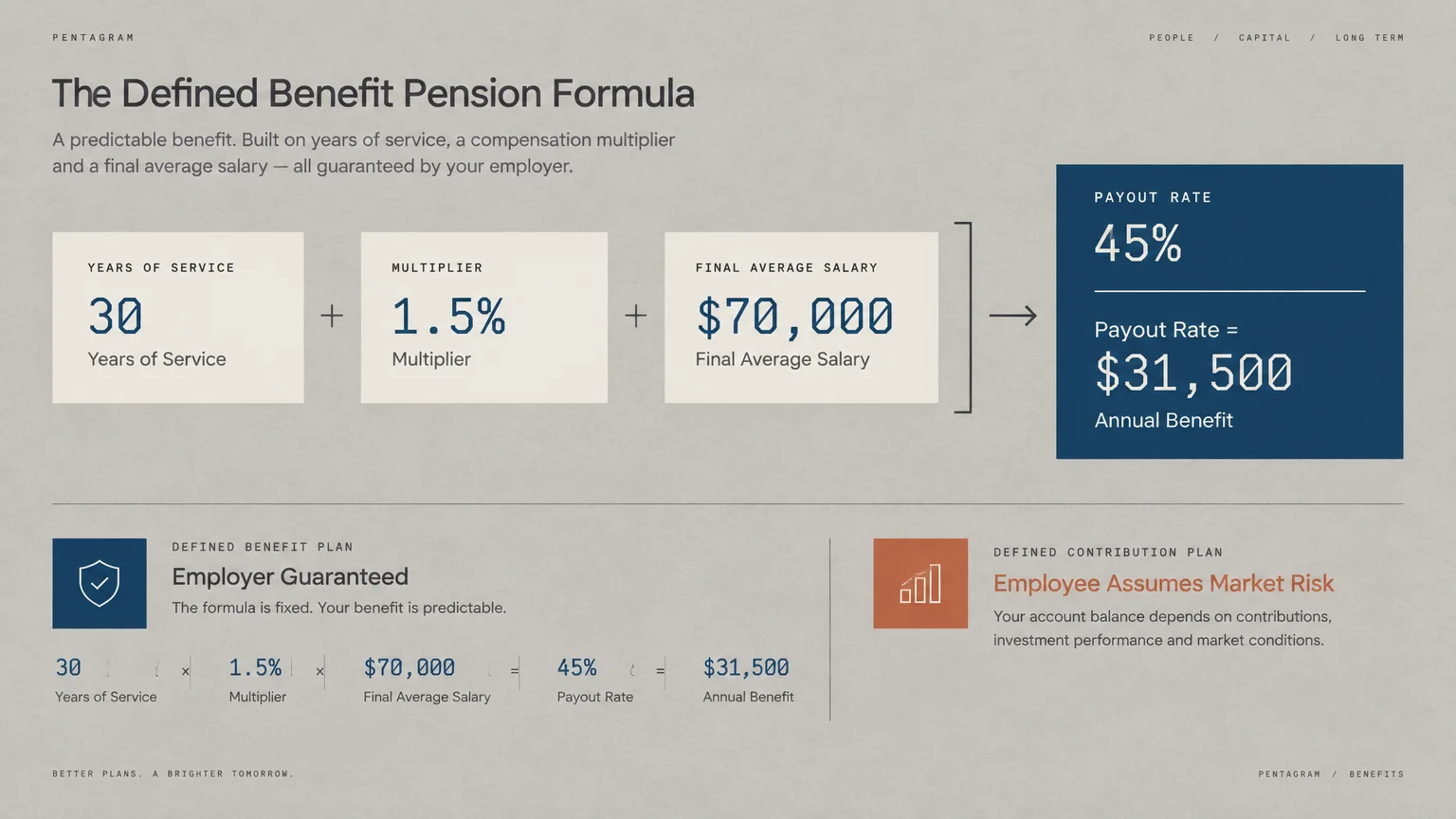
A defined benefit plan is a traditional pension that guarantees a specific monthly dollar payout for life. Your employer assumes the entire investment risk and funds the underlying trust.
Actuaries determine your monthly benefit through a specific formula. This formula typically multiplies your years of service, your final average salary, and a fixed percentage multiplier.
For example, if your plan uses a 1.5% multiplier and you worked 30 years with a $70,000 average salary, your calculation is straightforward. You receive 45% of your average salary, totaling $31,500 annually.
Market swings do not decrease this payout. Whether Wall Street rises or falls, your employer must deliver that exact monthly check.
2. Defined Contribution Plan
A defined contribution plan places the funding and investment burden directly on your shoulders. Common examples include 401(k), 403(b), and 457(b) accounts.
You deposit a percentage of your salary each pay period, and your employer may match a portion. Your ultimate retirement balance depends entirely on market investment performance.
Unlike a defined benefit pension, these accounts offer no lifetime income guarantees. When your balance reaches zero, the payments stop permanently.
Many modern employers offer both structures simultaneously. Understanding pension terms helps you coordinate withdrawals from both sources without depleting your savings prematurely.
3 & 4. Vesting Schedules and PBGC Protection
Retirement security requires knowing when benefits belong to you and who guarantees them if an employer fails.
3. Vesting Schedule
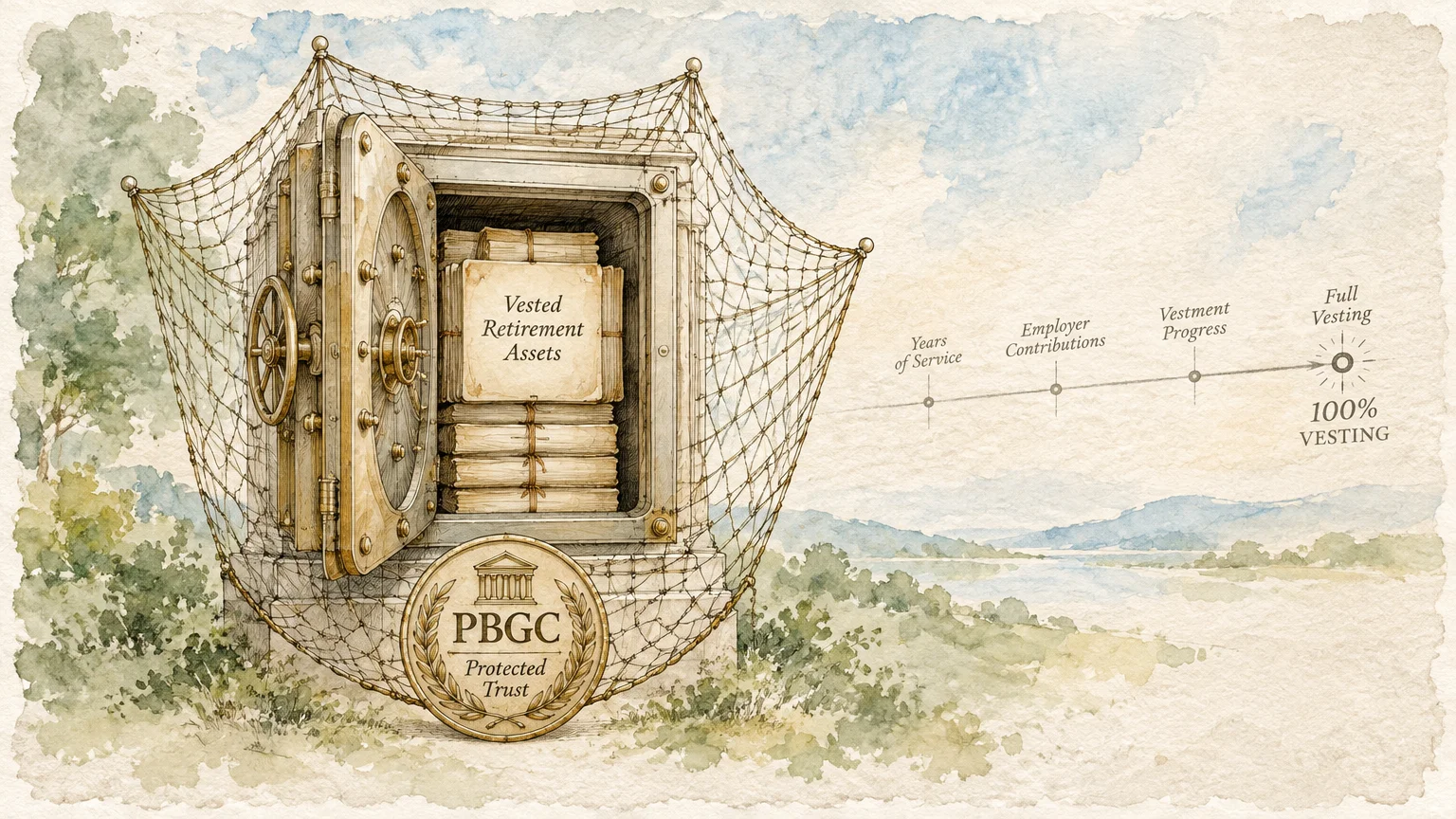
Vesting defines the minimum amount of time you must work for an organization before earning full ownership of your accrued pension benefits. If you leave your job before vesting, you forfeit that retirement income.
Under the Employee Retirement Income Security Act (ERISA), private employers must adopt one of two standard vesting formats: cliff vesting or graded vesting.
Cliff vesting grants zero ownership until you hit a specific milestone, usually five years. Once you reach that exact date, you become 100% vested instantly.
Graded vesting releases ownership gradually over time. Federal rules mandate at least 20% vesting after three years of service, increasing by 20% each subsequent year until reaching 100% at seven years.
For cash-balance hybrid pensions, federal statutes cap cliff vesting at three years. Always verify your official vesting date with your human resources department before planning a career change.
4. Pension Benefit Guaranty Corporation (PBGC)
The Pension Benefit Guaranty Corporation is an independent federal agency created by ERISA to protect private-sector defined benefit pensions. If an employer goes bankrupt, the PBGC steps in to pay benefits.
According to the Consumer Financial Protection Bureau (CFPB), monitoring your pension plan administrator’s financial disclosures helps you identify insolvency risks early.
The PBGC operates under statutory payment ceilings that adjust annually. For a 65-year-old retiree electing a straight-life annuity in a single-employer plan, the maximum guaranteed payouts are clear:
- 2024: $85,295 annually ($7,108 monthly)
- 2025: $89,182 annually ($7,432 monthly)
- 2026: $93,477 annually ($7,790 monthly)
If your promised pension exceeds these federal caps, an employer bankruptcy could reduce your monthly check. Keep in mind that PBGC insurance does not cover state or municipal government pensions.
5 & 6. Single-Life Annuity vs. Qualified Joint and Survivor Annuity
Choosing your distribution structure is the most critical pension decision you will make. This choice dictates the financial security of your surviving household.
5. Single-Life Annuity
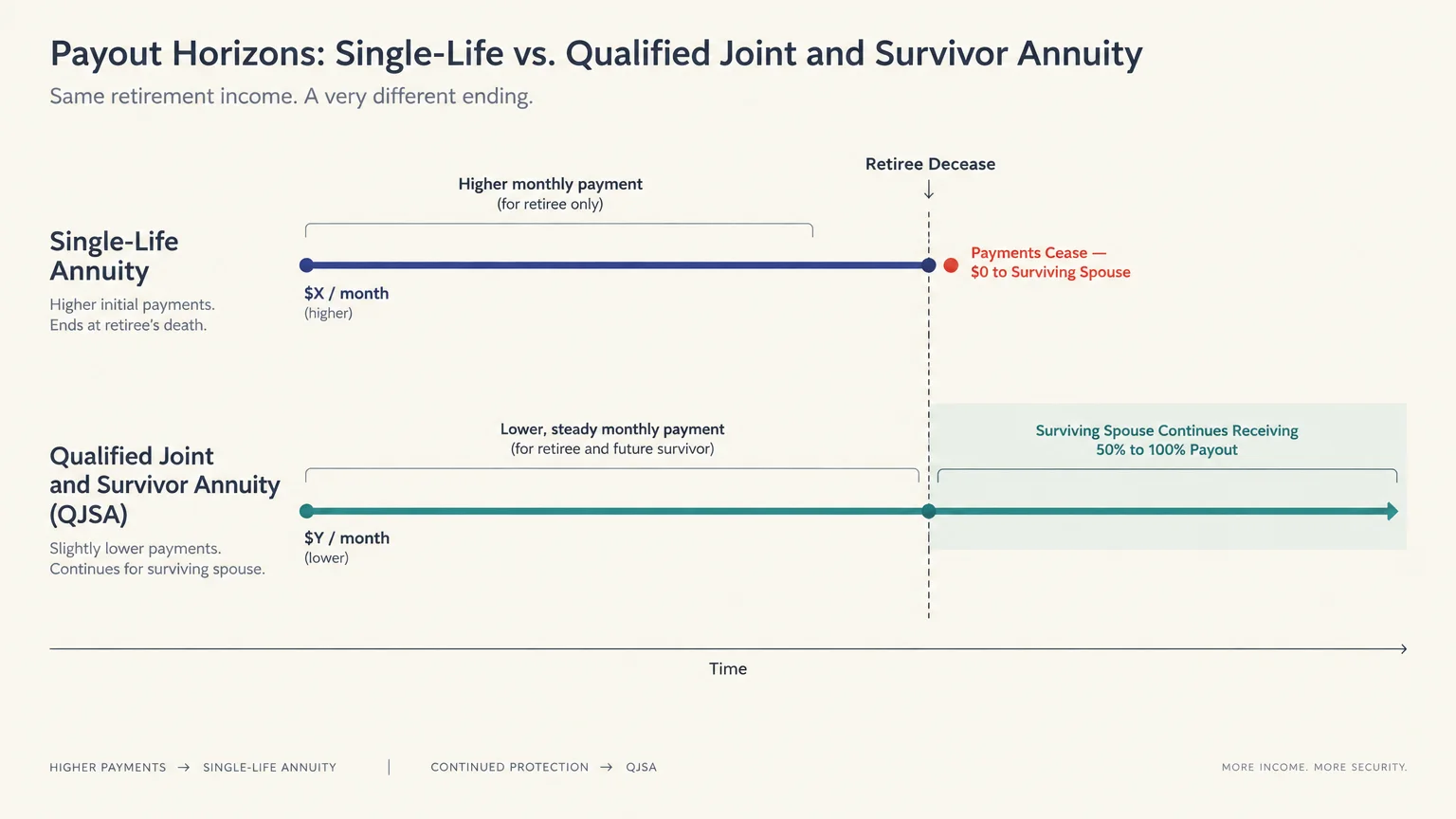
A single-life annuity delivers the highest possible monthly payout throughout your retirement. The calculation reflects only your life expectancy and your accumulated career earnings.
However, all payments terminate immediately upon your death. The plan administrator retains any remaining funds, leaving zero monthly pension income for your spouse or heirs.
This option works well for unmarried individuals without dependents. For married couples, choosing a single-life annuity introduces profound financial danger for the surviving partner.
6. Qualified Joint and Survivor Annuity (QJSA)
A Qualified Joint and Survivor Annuity provides a guaranteed monthly payment across two lifetimes—yours and your spouse’s. When you pass away, the plan pays your survivor a designated percentage for life.
Common survivor continuation percentages are 50%, 75%, and 100%. Because the plan covers two lifetimes, your initial monthly payment is lower than a single-life annuity.
Federal law protects married spouses through the Retirement Equity Act. Traditional private plans must default to a QJSA providing at least a 50% survivor benefit.
As noted by retirement experts at AARP, choosing a survivor annuity prevents older widows and widowers from experiencing sudden, severe income drops after losing a partner.
An employee cannot waive the QJSA to take a single-life annuity unilaterally. Federal law requires the spouse to sign an explicit, notarized written waiver before that change takes effect.
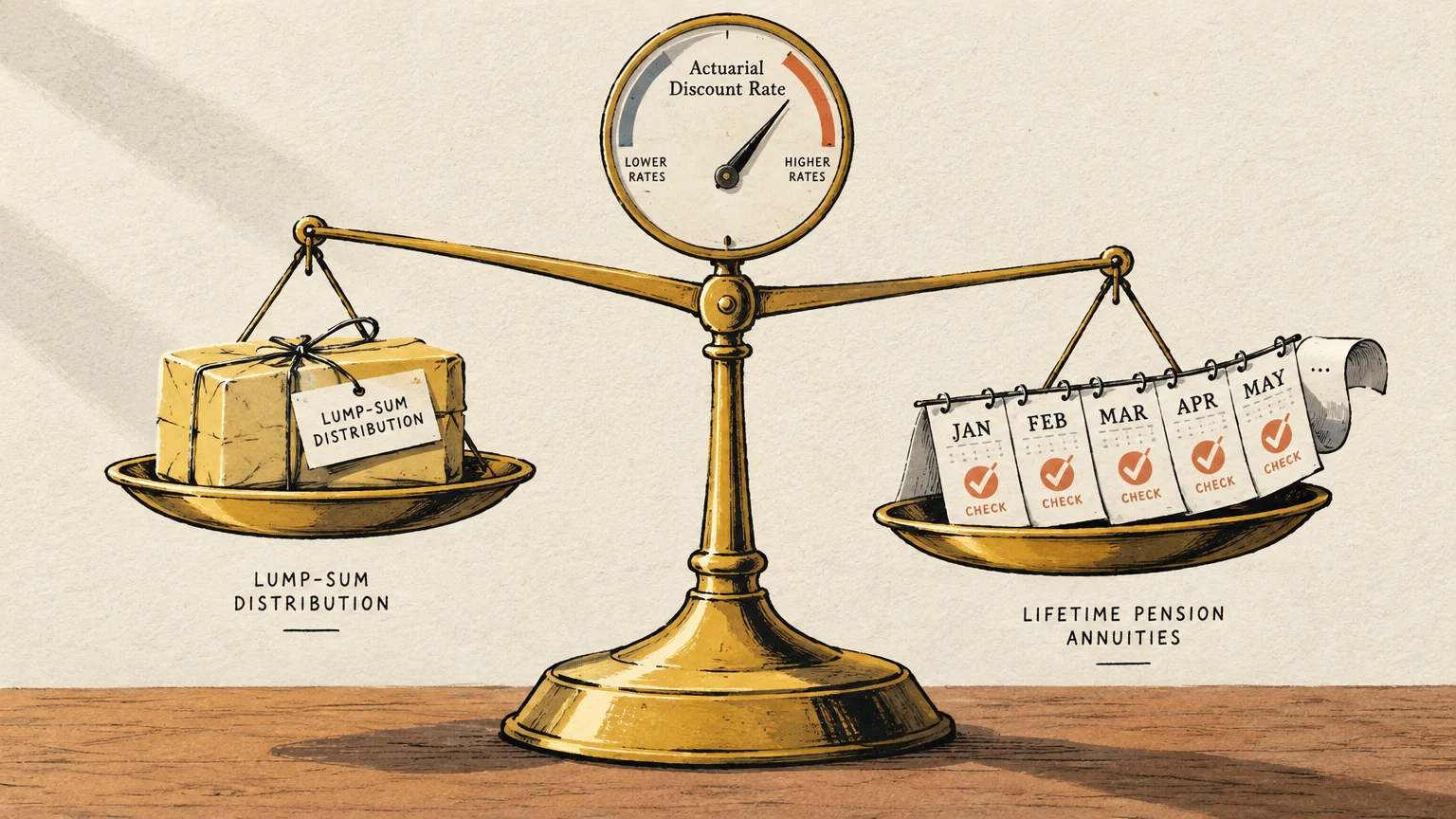
7 & 8. Lump-Sum Distributions and Actuarial Discount Rates
Many private companies now offer retiring workers a single cash payment instead of a monthly pension check. Evaluating this trade-off requires understanding how cash values are calculated.
7. Lump-Sum Distribution
A lump-sum distribution cashes out the total estimated lifetime value of your pension in a single transaction. You receive all the funds at once, which you can roll into a traditional IRA.
Taking the lump sum grants complete investment control and allows you to leave unspent balances to your children. However, you also assume full investment and longevity risk.
If financial markets plummet or you outlive your savings, your retirement income vanishes. Managing a lump sum requires strict personal discipline and professional portfolio oversight.
8. Actuarial Discount Rate (IRC Section 417(e))
The actuarial discount rate is the mathematical interest rate used to convert future pension checks into a single current lump sum. Plan sponsors use IRS corporate bond segment rates under Internal Revenue Code Section 417(e).
Discount rates share an inverse relationship with lump-sum values. When interest rates rise, lump-sum offers shrink significantly; when rates fall, lump-sum offers expand.
Consider a pension promising $3,000 each month for life. During a low-interest environment of 2%, that lump-sum cash offer might equal $600,000.
If interest rates surge toward 5%, the discount rate adjustment drops that cash buyout to roughly $440,000. Knowing your plan’s look-back month for discount rates helps you time your retirement date strategically.
9 & 10. Cost-of-Living Adjustments and Required Minimum Distributions
Long-term retirement planning requires protecting your income against inflation and navigating federal tax distribution rules.
9. Cost-of-Living Adjustment (COLA)
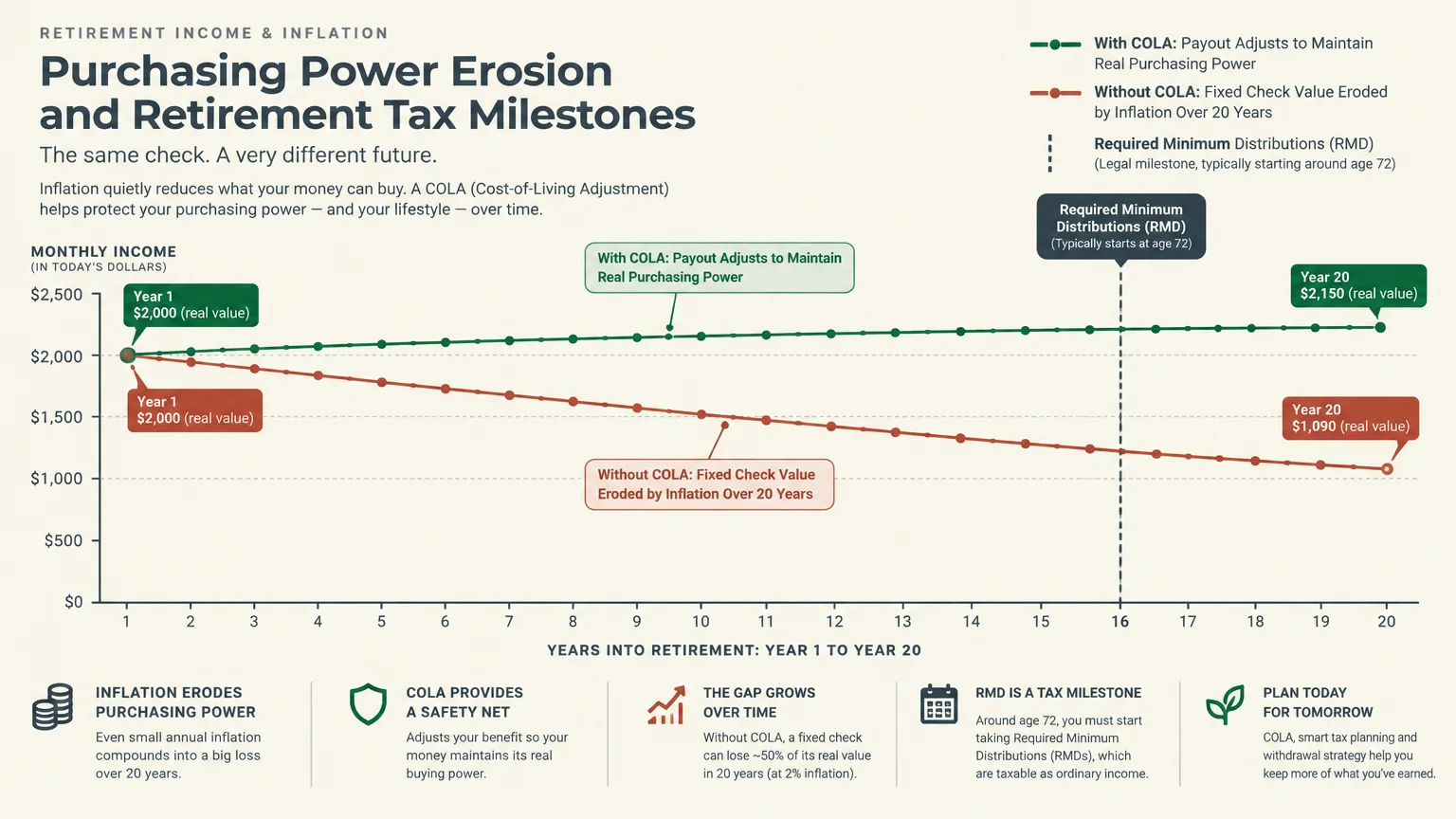
A Cost-of-Living Adjustment automatically raises your monthly benefit over time to offset general consumer inflation. Most COLAs tie directly to changes in the federal Consumer Price Index.
Public-sector pensions for teachers, firefighters, and state workers frequently include annual COLAs. By contrast, private-sector corporate pensions rarely provide inflation adjustments.
A flat $2,500 monthly benefit without a COLA loses substantial purchasing power over time. With 3% annual inflation, that check loses nearly half its real buying power within 24 years.
Retirees with flat pensions must coordinate other assets to offset rising living costs. Research from the Social Security Administration (SSA) highlights how regular cost-of-living increases protect senior purchasing power over extended retirements.
10. Required Minimum Distribution (RMD)
A Required Minimum Distribution is the minimum dollar amount you must withdraw annually from qualified retirement accounts under federal tax law. Congress established these rules to ensure deferred taxes are eventually paid.
The SECURE 2.0 Act updated federal guidelines, raising the starting RMD age to 73. This benchmark age will rise to 75 beginning in 2033.
If you receive traditional monthly annuity payments from your defined benefit plan, those regular checks automatically satisfy your annual RMD rules. You do not need to calculate extra distributions.
However, if you take a lump sum and roll it into a traditional IRA, you must calculate and withdraw RMDs starting at age 73. Missing an RMD deadline triggers a 25% federal excise tax on the unwithdrawn amount.
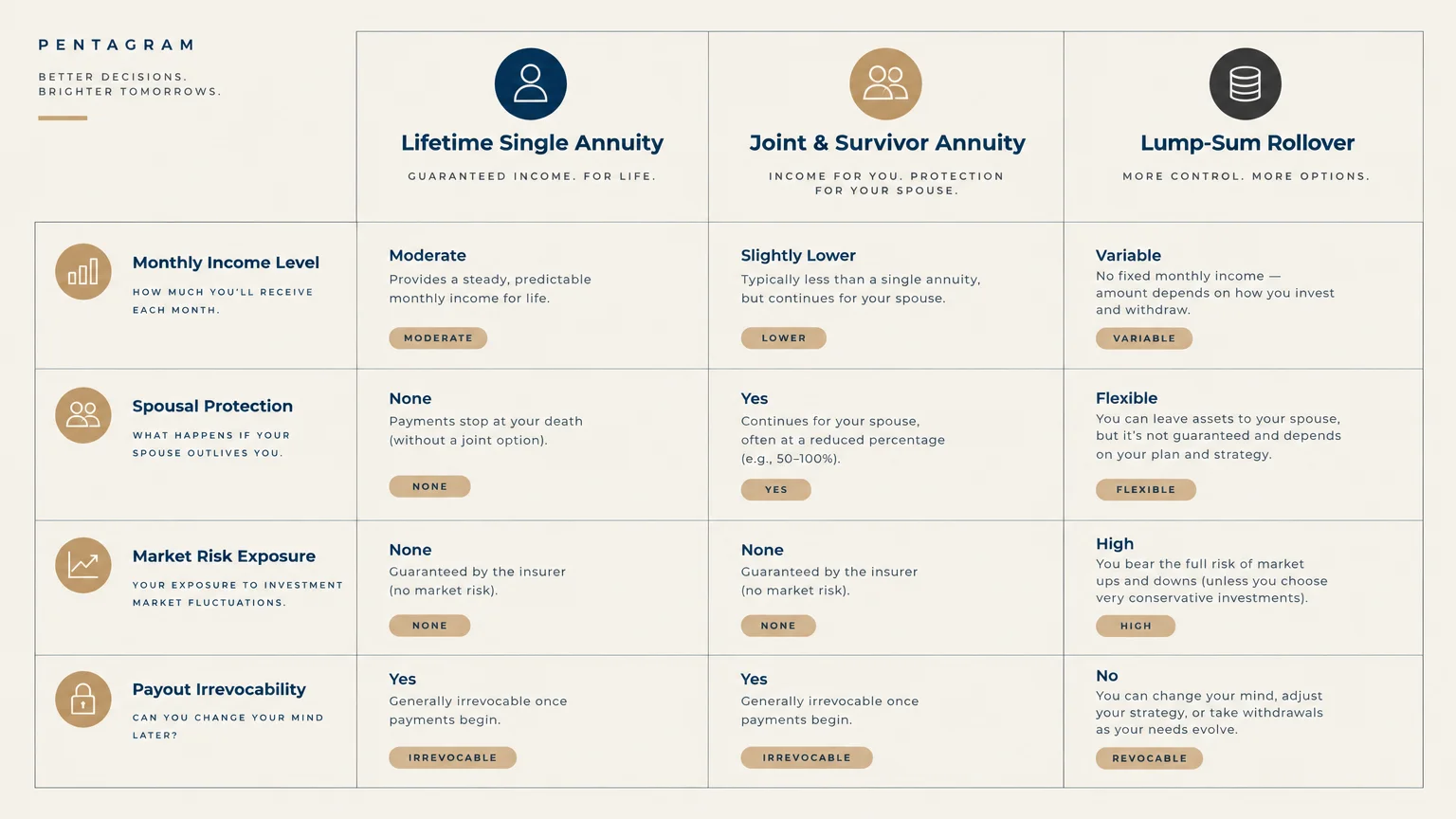
Pension Payout Comparison Guide
Choosing between annuity options and cash distributions requires weighing specific financial trade-offs. The table below illustrates how primary payout models compare across key factors.
| Payout Option | Lifetime Income Guarantee | Spousal Survivor Protection | Market Risk Exposure | Heir Inheritance Potential |
|---|---|---|---|---|
| Single-Life Annuity | Guaranteed for your lifetime only | None (terminates at death) | Zero (borne by plan) | None |
| 100% Joint & Survivor | Guaranteed across both lifetimes | Full 100% benefit continues | Zero (borne by plan) | None after survivor dies |
| 50% Joint & Survivor | Guaranteed across both lifetimes | 50% of benefit continues | Zero (borne by plan) | None after survivor dies |
| Lump-Sum Rollover | No guarantee (depends on withdrawals) | Controlled by IRA beneficiary terms | Full market exposure | High (remaining balance transfers) |
Reviewing these distinctions helps clarify which structure matches your health profile, marriage needs, and outside wealth resources.

Costly Pension Mistakes Retirees Must Avoid
Every year, seniors lose substantial retirement revenue through administrative misunderstandings. Watching out for common pitfalls protects your hard-earned wealth.
The most devastating error involves signing away spousal survivor rights without calculating the survivor’s standalone living expenses. Surviving spouses often lose one Social Security check alongside household earnings.
Another frequent trap is ignoring IRS Section 415(b) statutory benefit limits. Federal tax rules cap annual defined benefit payouts at $275,000 in 2024, $280,000 in 2025, and $290,000 in 2026.
Retirees must also guard against predatory financial schemes targeting lump-sum payouts. Unscrupulous brokers often encourage seniors to cash out pensions to purchase expensive, fee-heavy commercial annuities.
If you previously changed jobs and misplaced a vested benefit, federal resources can help you recover it. You can track missing benefits and verify government support programs through Benefits.gov.
Never rush your pension decision. Request your official benefit estimate six months prior to retirement so you have ample time to consult an independent financial advisor.
Frequently Asked Questions
What happens to my pension if my former employer goes bankrupt?
If you have a private-sector defined benefit plan, the PBGC takes over administration and continues paying benefits up to federal limits. Public municipal and church plans lack PBGC coverage.
Can I change my pension payout election after I start receiving checks?
In almost all circumstances, pension payout elections are irrevocable once benefit distributions begin. Plan sponsors rarely permit changes once your official retirement paperwork clears administrative processing.
Is my monthly pension payment subject to federal and state income taxes?
Most pension checks represent pre-tax contributions and are fully taxable as ordinary income at the federal level. State tax treatment varies depending on where you maintain your primary legal residence.
What is the difference between a cash-balance plan and a traditional pension?
A cash-balance plan is a hybrid pension that defines your benefit as a stated account balance rather than a monthly lifetime formula. It retains PBGC backing but features shorter three-year cliff vesting.
Should I take my pension as a lump sum or a monthly annuity?
A monthly annuity guarantees dependable, lifetime income without market exposure. Choose a lump sum only if you have poor health, significant alternative wealth, or need to leave capital to non-spousal heirs.
For additional senior resources, visit
National Institute on Aging (NIA), Centers for Disease Control and Prevention (CDC), Medicare.gov and National Institute of Mental Health (NIMH).
Disclaimer: The information in this article is for educational purposes only and is not intended to be a substitute for professional financial, legal, or medical advice. Always consult with a qualified expert for advice tailored to your personal situation.









Leave a Reply