

Remarrying in your golden years brings emotional joy, but it can unexpectedly alter your monthly Social Security income. Understanding these shifts before walking down the aisle protects your household budget and ensures you claim every dollar you earned.
Your marital status directly shapes your eligibility for spousal, survivor, and divorced partner payments. A single timing mistake can permanently forfeit thousands of dollars in lifetime government support.
Here are the ten key Social Security changes you must know before saying “I do” again.
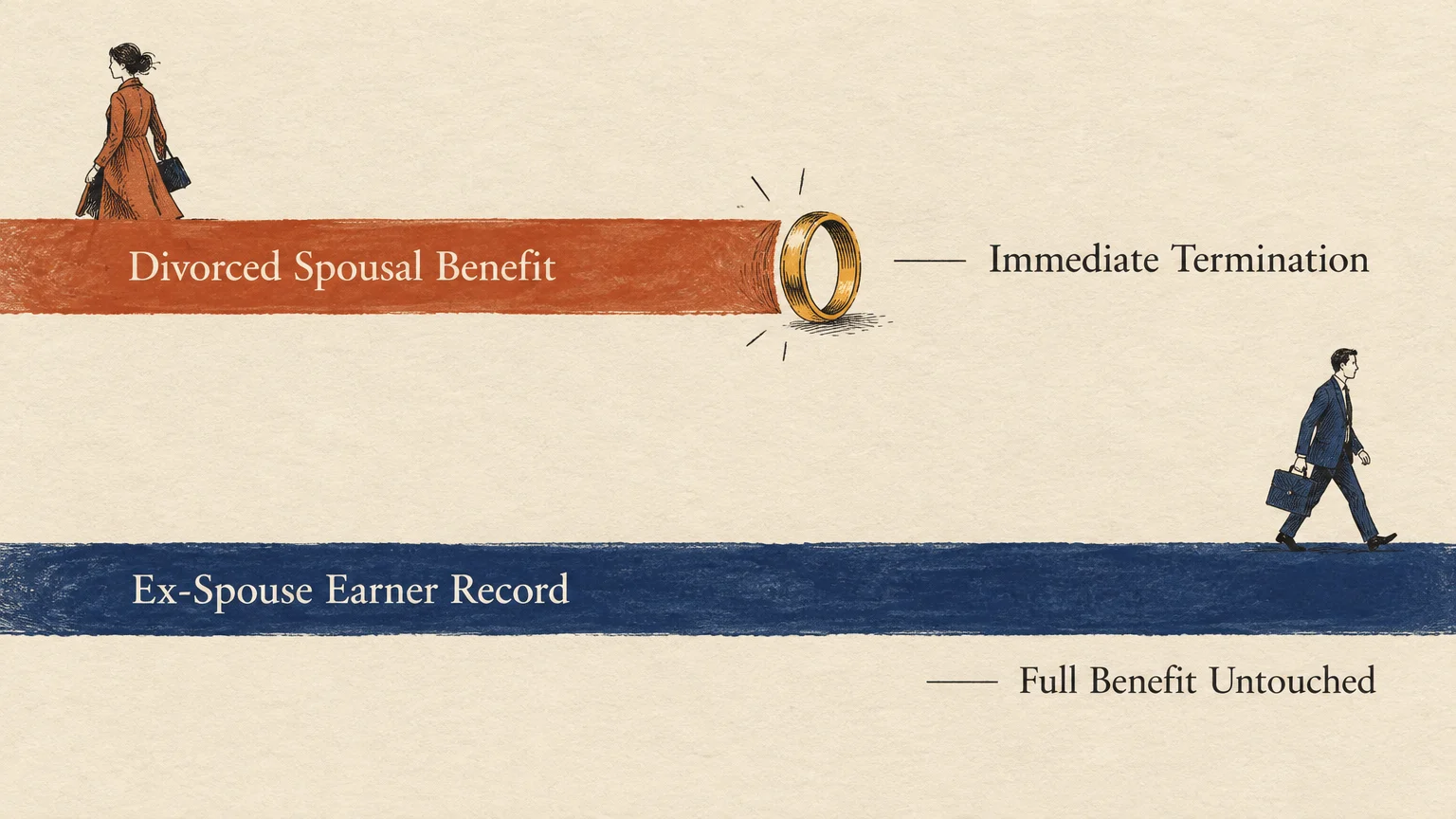
Divorced Spousal Benefits and Living Ex-Partners
Many seniors rely on divorced spousal payments to maintain financial independence. When you remarry, these payments face immediate disruption under federal guidelines.
1. Divorced Spousal Benefits End Immediately
If you collect benefits based on a living ex-spouse’s earnings record, those payments terminate the moment you remarry. The law does not grant a grace period.
According to the Social Security Administration (SSA), eligibility for living divorced spousal support requires you to remain completely unmarried. Age does not protect this benefit category.
Even if your previous marriage lasted over ten years, new vows extinguish your claim on your living ex-partner’s work record. You must notify the agency promptly to prevent accidental overpayments.
2. Your Remarriage Never Affects Your Ex-Spouse’s Payout
Divorced seniors often worry that remarrying will alter their former spouse’s income. You can rest assured that your personal decisions have zero effect on their monthly benefit.
Federal regulations ring-fence each worker’s record. Your ex-spouse will continue receiving their full, earned benefit amount without interruption.
Likewise, any benefits your former spouse’s current partner receives remain untouched. The system calculates each entitlement independently.
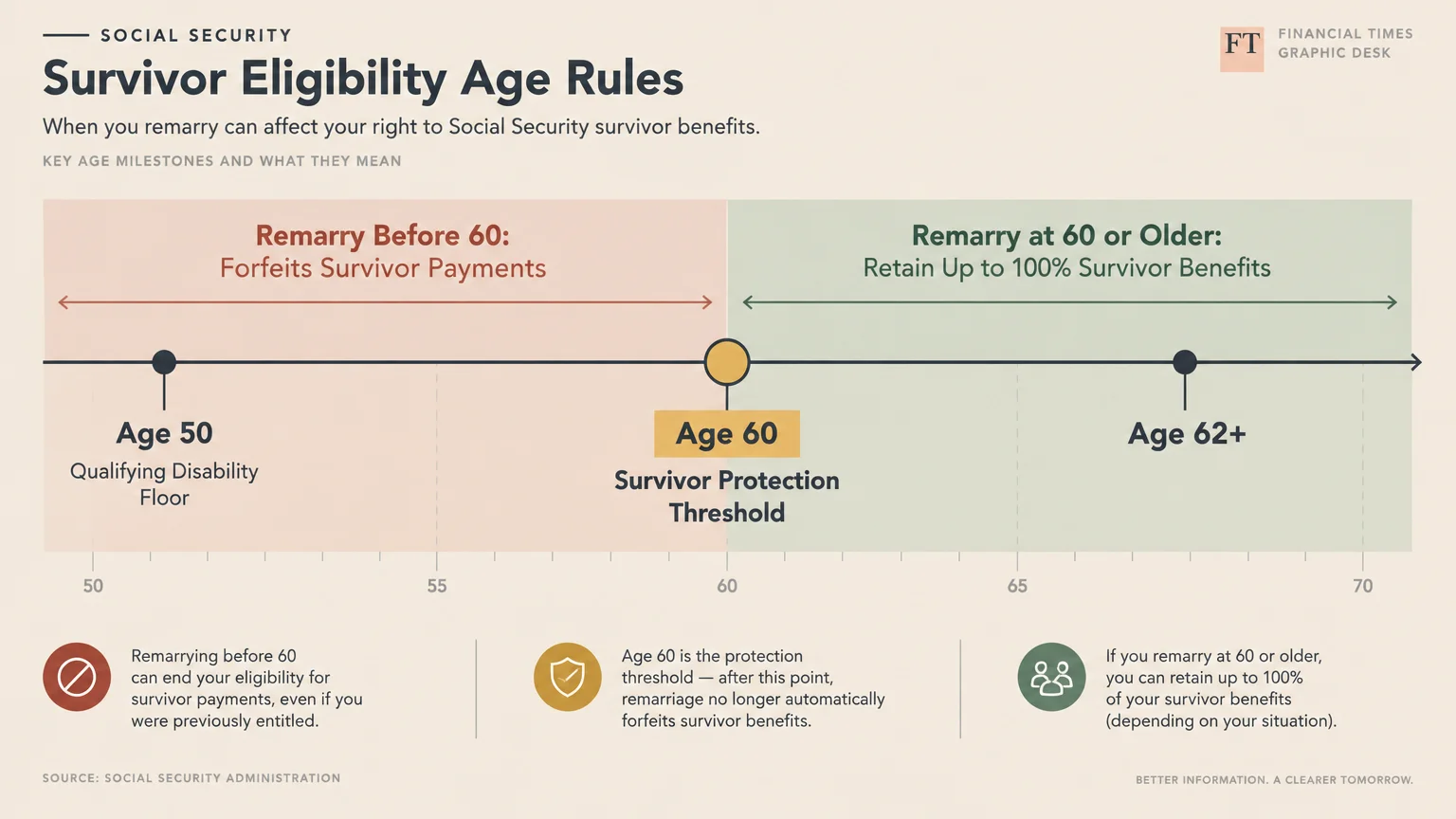
Survivor Benefits and the Age 60 Threshold
Widows, widowers, and surviving divorced spouses navigate a unique set of regulations. The age at which you exchange vows determines whether your survivor income continues.
3. Survivor Benefits Remain Intact at Age 60 or Older
A social security widow remarry threshold protects older survivors. If you remarry at age 60 or older, you retain the right to collect survivor benefits from your deceased spouse.
This age floor drops to 50 if you have a qualifying disability. You continue receiving up to 100 percent of your late partner’s primary insurance amount.
This protection also applies to surviving divorced spouses whose previous marriages lasted at least ten years. Your new marriage certificate will not reduce that baseline income.
4. Remarrying Before Age 60 Forfeits Survivor Payments
Exchanging vows even one month before your 60th birthday carries steep financial consequences. The agency terminates survivor benefits remarriage rights if the wedding occurs prior to age 60.
Couples often delay legal ceremonies by several months to bypass this financial trap. Waiting until your 60th birthday preserves crucial monthly checks for life.
Financial planners routinely advise couples in their late fifties to cohabitate until crossing this statutory milestone. Patience protects your long-term retirement security.
5. Strategic Switching Between Benefits Remains an Option
Survivor benefits remarriage rules permit flexible claiming strategies. If you remarry after 60, you can still switch between your survivor benefit and your own earned record.
According to research from AARP, coordinating survivor payments with personal delayed retirement credits can substantially boost your age-70 income.
You can collect survivor benefits now while allowing your personal retirement credit to grow by 8 percent annually until age 70. This creates a powerful dual-income safety net.

Qualifying for Benefits on Your New Spouse’s Record
Tying the knot opens future opportunities to claim spousal benefits on your new partner’s work history. However, these spousal benefits after remarriage require specific waiting periods.
6. New Spousal Benefits Require a One-Year Waiting Period
You cannot immediately collect spousal retirement benefits on your new husband’s or wife’s earnings record. You must remain married for at least one continuous year before applying.
Once you reach this one-year mark, you may qualify for up to 50 percent of your new spouse’s full retirement benefit. You must also be at least 62 years old to apply.
If you claim prior to your own full retirement age, the agency permanently reduces that 50 percent maximum. Planning your claim date preserves higher monthly payouts.
7. Future Survivor Protections Require Nine Months of Marriage
Life can be unpredictable, making survivor protections essential for older newlyweds. To qualify for survivor benefits on a new spouse’s record, you must generally remain married for nine continuous months.
If your new partner passes away before nine months conclude, federal rules generally disallow survivor claims on that record. Specific exceptions exist only for accidental deaths or active-duty service.
Understanding this timeline helps you structure life insurance and transitional savings during your first year of marriage.
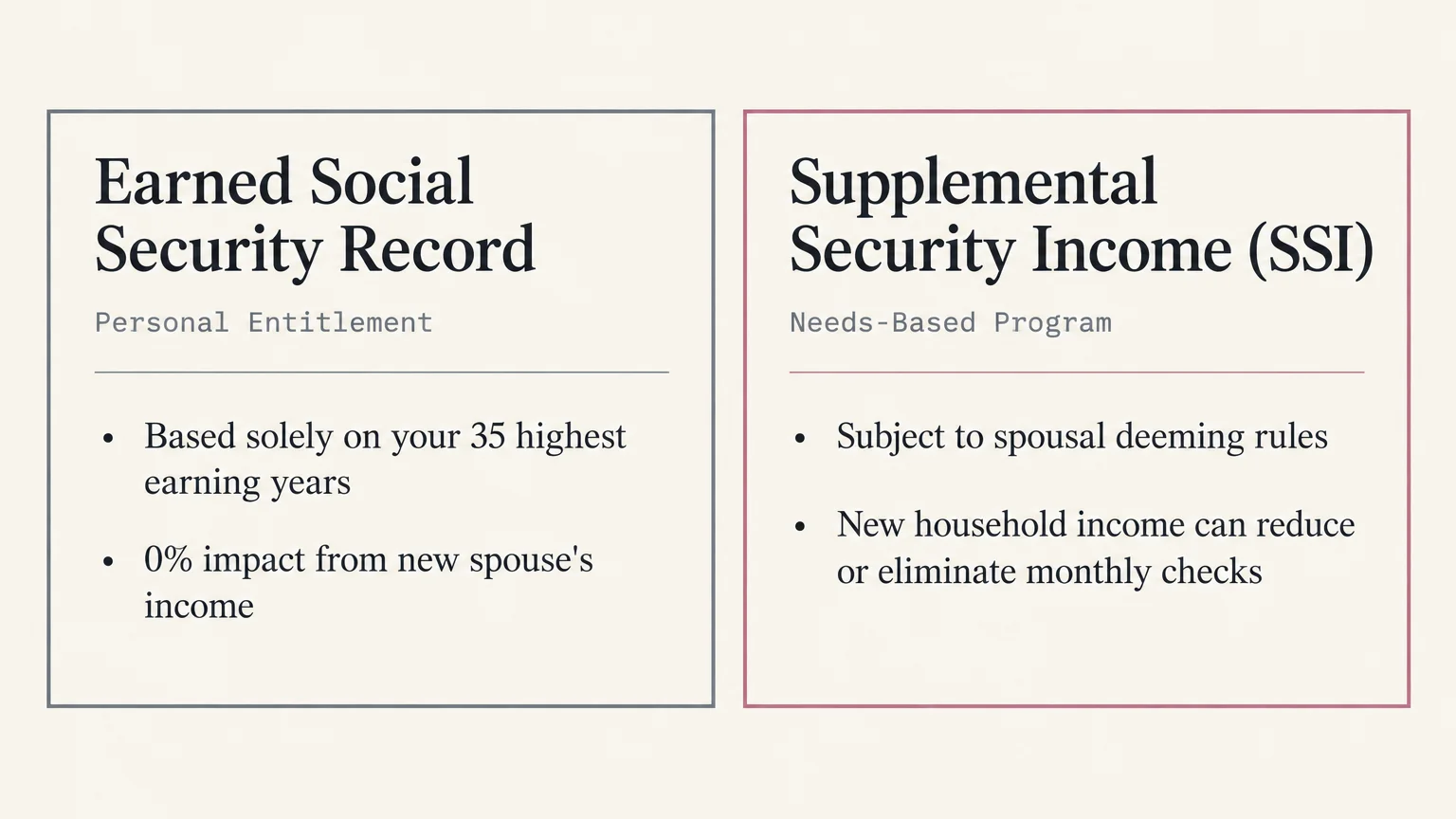
Your Own Retirement Record and SSI Deeming Rules
Not all benefit types respond to marriage in the same manner. Distinguishing between earned benefits and need-based assistance is critical.
8. Your Earned Retirement Benefits Never Change
Your primary retirement benefit rests entirely on your personal 35-year work history. Remarriage has zero impact on your earned Title II monthly payments.
Whether you marry once, twice, or never, your personal retirement check remains identical. You earned those credits through payroll taxes over decades of employment.
The government cannot reduce, penalize, or seize your earned retirement benefits simply because your household tax status changes.
9. Supplemental Security Income (SSI) Faces Spousal Deeming
While earned retirement benefits remain secure, Supplemental Security Income operates under drastically different standards. SSI is a strict, need-based program for low-income seniors and disabled individuals.
Guidance from the Consumer Financial Protection Bureau (CFPB) emphasizes that changes in household assets directly affect means-tested government programs.
When you marry, the agency applies spousal deeming rules. They count a portion of your new spouse’s income and assets as your own.
If your new spouse earns modest wages or owns significant retirement accounts, your SSI checks may shrink or disappear completely. You may also lose accompanying Medicaid coverage.

Restoring Benefits If a Marriage Ends
Life does not always follow our ideal plans. If a subsequent marriage terminates, the law provides clear pathways to recover prior entitlements.
10. Prior Entitlements Can Be Restored if the New Marriage Terminates
If you lost divorced spousal benefits or early survivor benefits by remarrying, that loss is not necessarily permanent. If your new marriage ends through death, divorce, or annulment, your prior rights revive.
According to information outlined on Benefits.gov, qualifying individuals can reapply for past spousal or survivor benefits once the intervening marriage dissolves.
You cannot collect multiple spousal checks simultaneously. However, the agency allows you to claim whichever qualifying record yields the highest monthly payment.
Keep your historic marriage certificates and legal divorce decrees stored in an accessible location. Having original documentation accelerates benefit reinstatement if circumstances change.
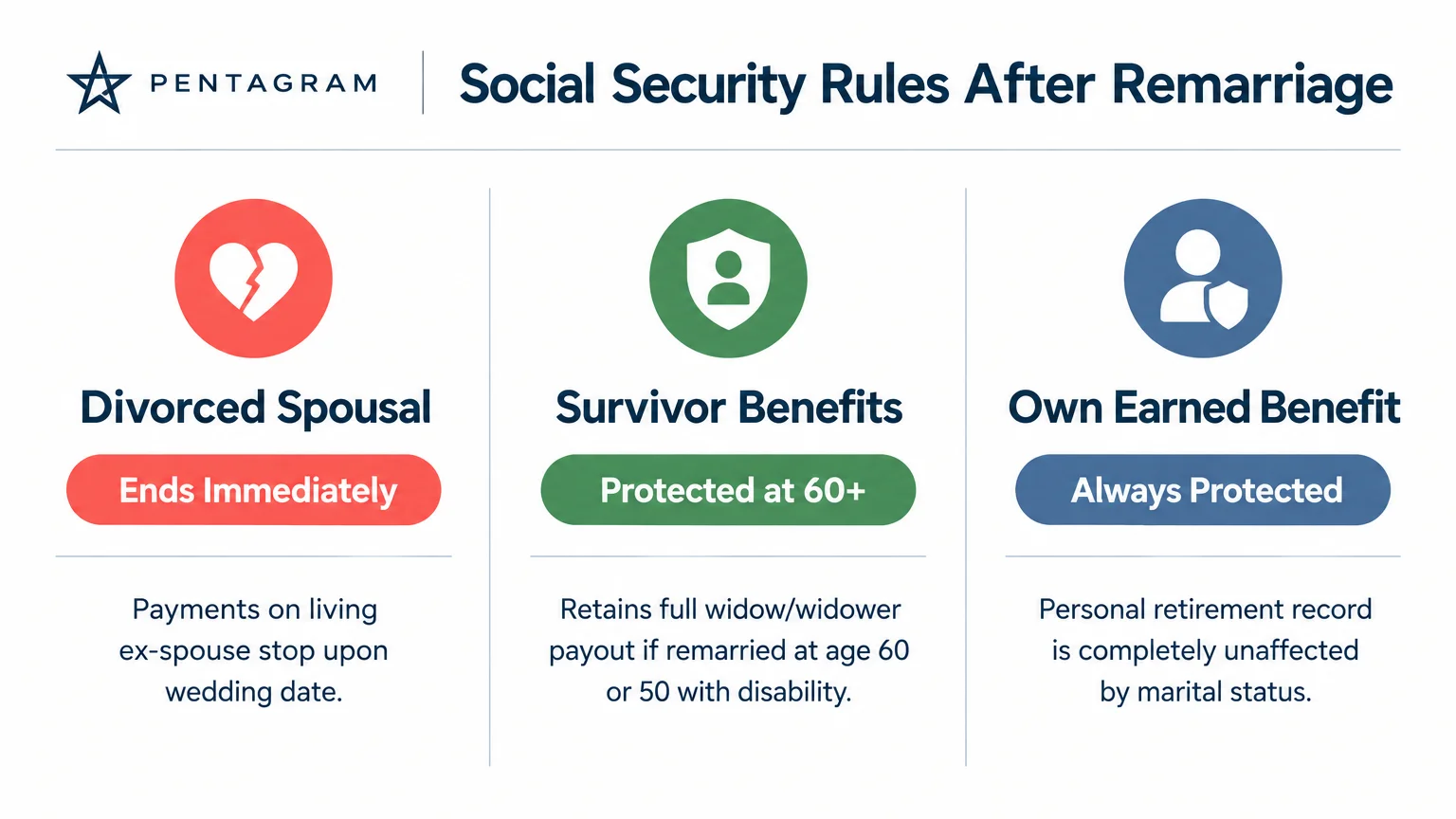
Social Security Rules Comparison Guide
Reviewing how different benefit categories react to a change in marital status helps you avoid costly oversights. Use this reference table to evaluate your current situation.
| Benefit Category | Remarriage Rule | Minimum Claiming Age | Maximum Payout |
|---|---|---|---|
| Living Divorced Spousal | Terminates immediately upon marriage | Age 62 | Up to 50% of ex-spouse PIA |
| Survivor (Remarried Age 60+) | Continues without reduction | Age 60 (50 if disabled) | Up to 100% of deceased PIA |
| Survivor (Remarried Under 60) | Suspended during the marriage | Age 60 (50 if disabled) | Ineligible while married |
| New Current Spousal | Requires 1 continuous year of marriage | Age 62 | Up to 50% of new spouse PIA |
| New Future Survivor | Requires 9 continuous months of marriage | Age 60 (50 if disabled) | Up to 100% of new spouse PIA |
| Personal Earned Retirement | No impact whatsoever | Age 62 | Based on personal work history |
| Supplemental Security Income | Subject to spousal deeming rules | Age 65 or disabled | Federal monthly benefit cap |
To maximize your household cash flow, avoid these common administrative missteps:
- Rushing to wed at age 59: Waiting until age 60 can save you tens of thousands of dollars in survivor payments.
- Failing to report marital changes: The agency will claw back overpayments if you continue collecting living ex-spousal checks after remarrying.
- Overlooking your own earnings: Always compare your personal retirement credits against spousal options before filing.
- Ignoring Medicare implications: Combining household incomes may trigger higher Medicare Part B and Part D premiums under IRMAA brackets.
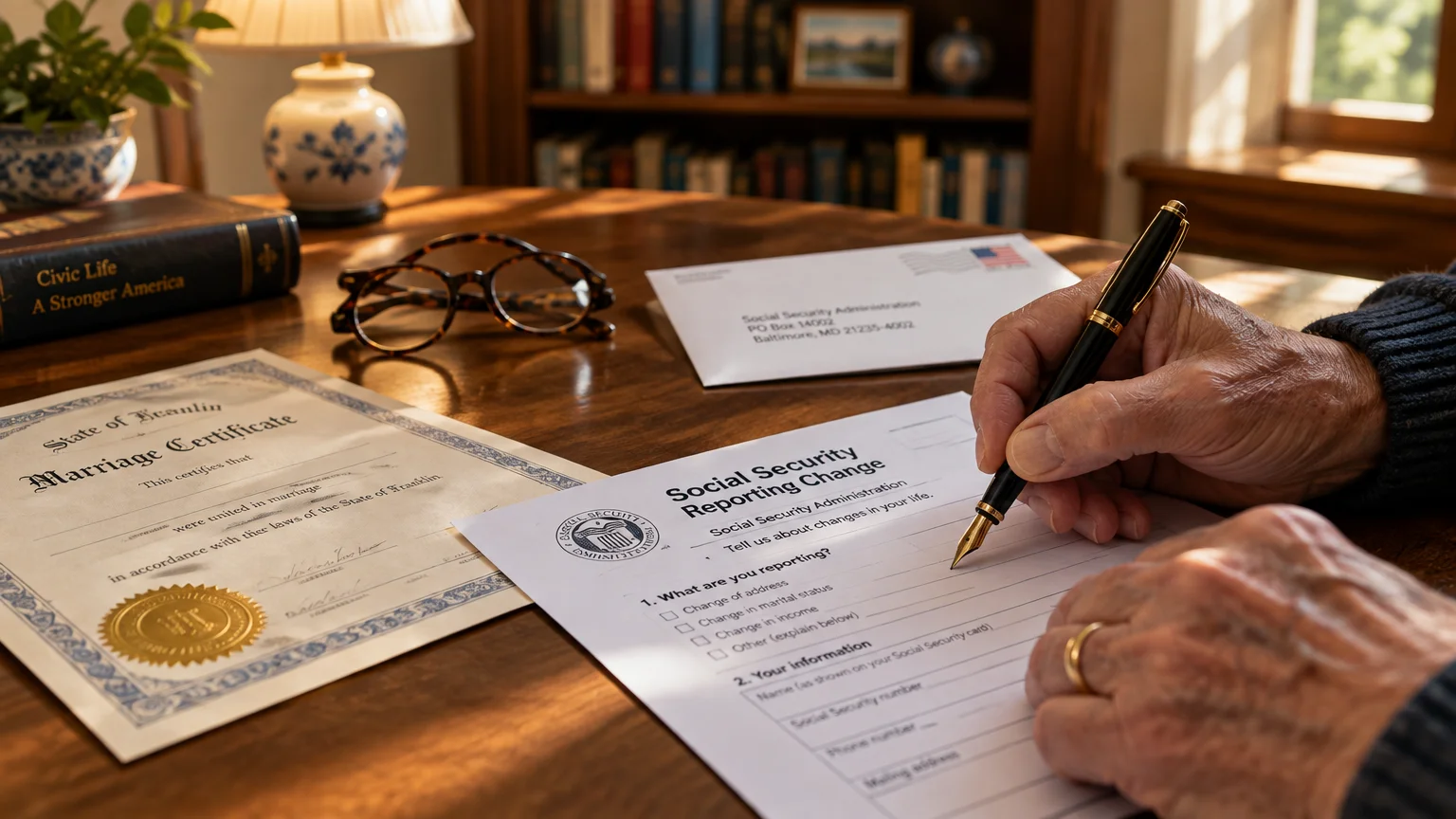
How to Report Marital Changes to the Government
Updating your records ensures you receive accurate checks and prevents bureaucratic nightmares. Follow these actionable steps whenever your marital status changes.
- Gather certified documents: Locate your official marriage certificate, prior divorce decrees, and any relevant death certificates. The agency requires certified copies rather than photocopies.
- Schedule an agency appointment: Call your local field office to set up an interview. In-person reviews help verify complex multi-marriage claiming histories.
- Request a comprehensive benefits review: Ask the representative to run side-by-side calculations of your personal record, your new spouse’s record, and any previous partner’s records.
- Update your legal name: If you plan to change your surname, update your Social Security card before modifying bank accounts or filing joint tax returns.
- Recalculate household cash flow: Factor potential changes in spousal support, tax brackets, and health insurance surcharges into your retirement spending plan.
Frequently Asked Questions
Can I collect Social Security from my deceased spouse if I remarry after 60?
Yes, remarrying at age 60 or older does not affect your eligibility for survivor benefits. You can continue receiving checks based on your late spouse’s earnings history.
Does remarrying reduce my ex-spouse’s monthly Social Security check?
No, your marital status has no impact on your former partner’s payments. The agency calculates each person’s entitlement independently under federal law.
What happens if I get married at age 59 and a half?
You will forfeit your eligibility for survivor benefits from a late spouse. Waiting until your 60th birthday preserves those monthly payments for the rest of your life.
How long must I be married to claim benefits on a new spouse’s record?
You must generally remain married for one full year before applying for spousal retirement benefits. For survivor benefits, the requirement is nine months.
Will my remarriage affect my Supplemental Security Income (SSI)?
Yes, SSI is strictly means-tested. The government counts your new spouse’s assets and income, which frequently reduces or eliminates monthly SSI payments.
For additional senior resources, visit
Centers for Medicare & Medicaid Services (CMS), Social Security Administration (SSA), Consumer Financial Protection Bureau (CFPB), Administration for Community Living (ACL) and Eldercare Locator.
Disclaimer: The information in this article is for educational purposes only and is not intended to be a substitute for professional financial, legal, or medical advice. Always consult with a qualified expert for advice tailored to your personal situation.









Leave a Reply