

Deciding when and how to claim your retirement benefits is one of the biggest financial choices you will make after age 60. Having clear, reliable Social Security questions and answers can add tens of thousands of dollars to your lifetime income.
Recent 2026 updates have adjusted everything from monthly benefit payouts and earnings limits to pension rules for retired public servants. Understanding your Social Security eligibility and claiming options helps you avoid costly penalties and protect your household budget.
Below, we break down the twenty most critical questions seniors ask about retirement, spousal, and survivor benefits. You will also find practical steps for claiming Social Security safely and avoiding common financial traps.
Eligibility and Work Credits: Questions 1 to 4
Before you can map out a retirement budget, you need to know how the system measures your work history. Having your Social Security benefits explained in plain language makes it much easier to verify where you stand today.
1. How do I qualify for Social Security retirement benefits?
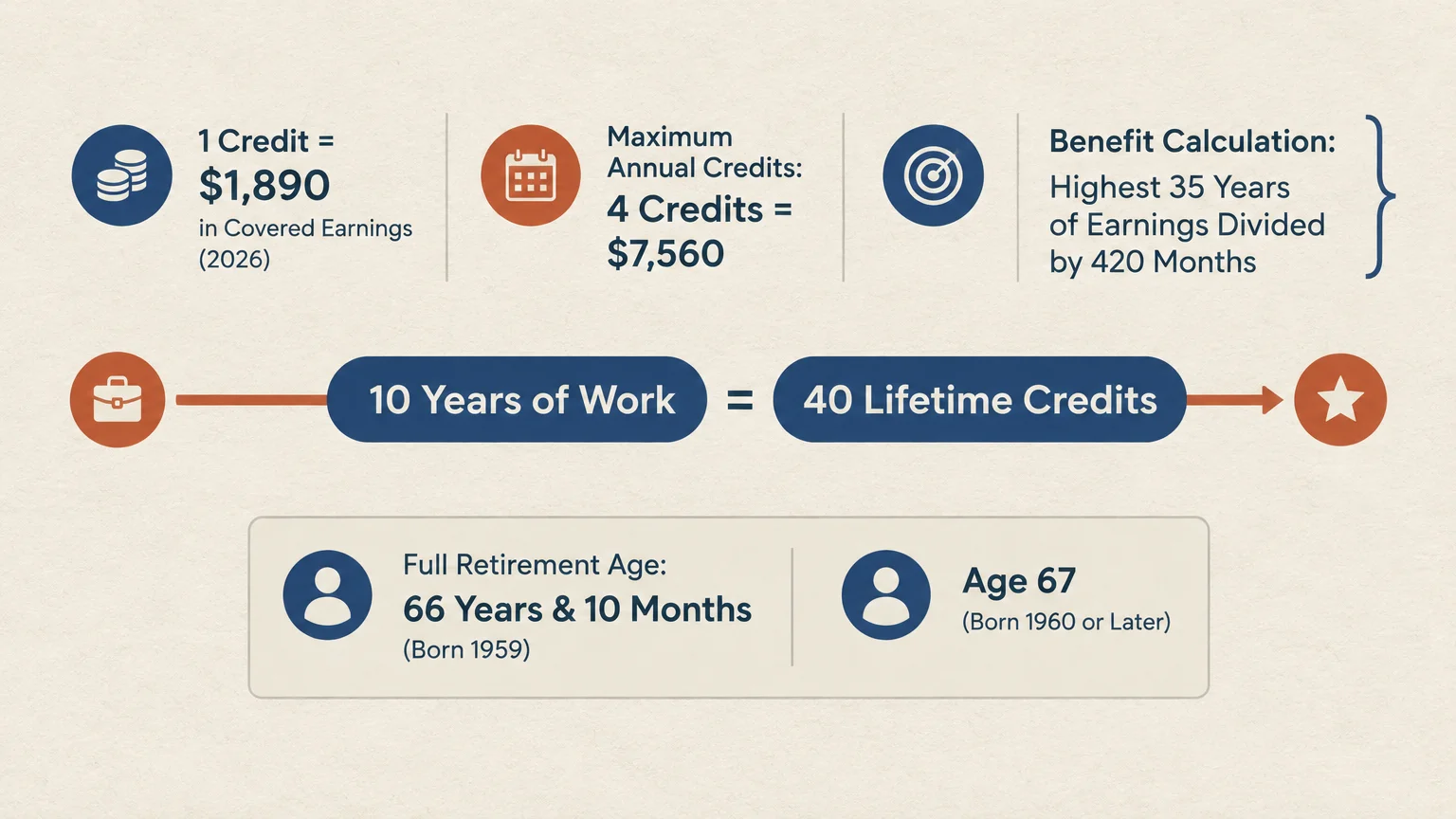
You qualify for retirement benefits by earning “work credits” through jobs or self-employment where you pay Social Security payroll taxes. Most workers need 40 work credits—which equals about 10 years of work—to establish full Social Security eligibility.
You can earn up to a maximum of four credits per calendar year. In 2026, it takes $1,890 in covered earnings to earn a single credit, meaning you earn all four annual credits once you make $7,560.
Your credits remain on your permanent record even if you take years off to raise children, care for aging parents, or change careers. According to the Social Security Administration (SSA), earning more than 40 credits does not increase your benefit amount; your actual dollar payout depends on your lifetime earnings.
2. What is my Full Retirement Age (FRA)?
Your Full Retirement Age (FRA) is the exact age at which you qualify to receive 100% of your calculated monthly benefit without any early-claiming reductions. Congress gradually raised this milestone from age 65 to age 67 over several decades.
If you were born in 1959, your Full Retirement Age is 66 and 10 months. Specifically, seniors born between March 2, 1959, and January 1, 1960, reach their FRA milestone during the 2026 calendar year.
If you were born in 1960 or later, your Full Retirement Age is flatly set at 67. Knowing this exact date is essential because every claiming rule—from early penalties to working limits—hinges on your specific FRA.
3. How does the government calculate my monthly benefit amount?
The government calculates your payment by looking at your highest 35 years of earnings, adjusted for historical wage inflation. It adds those 35 highest-earning years together and divides the total by 420 (the number of months in 35 years).
That calculation produces your Average Indexed Monthly Earnings (AIME). Next, a progressive formula is applied to your AIME to determine your Primary Insurance Amount (PIA), which is the base check you get at Full Retirement Age.
If you worked fewer than 35 years, the system plugs in a “$0” for every missing year, which pulls down your average. Working an extra year or two in your 60s can replace a zero-earning year and permanently boost your monthly check.
4. What is the difference between Social Security retirement, SSDI, and SSI?
It is very easy to confuse the three primary programs run by the Social Security Administration. Standard Social Security retirement benefits are paid to workers aged 62 and older who have accumulated at least 40 work credits.
Social Security Disability Insurance (SSDI) is for workers under Full Retirement Age who cannot work due to a severe medical condition. In 2026, non-blind SSDI recipients can generally earn up to $1,690 per month ($2,830 if blind) before benefits are jeopardized, and monthly earnings over $1,210 trigger a Trial Work Period.
Supplemental Security Income (SSI) is a strictly needs-based program for adults aged 65 and older, or blind or disabled individuals of any age, who have very limited income and assets. For 2026, the maximum federal SSI payment is $994 per month for an eligible individual and $1,491 per month for an eligible couple.
Claiming Age and Payout Calculations: Questions 5 to 8
Once you meet the basic work requirements, your most important lever is the age you choose to file. Your claiming age permanently locks in the baseline size of your monthly deposit for the rest of your life.
5. Should I claim Social Security at 62, Full Retirement Age, or 70?
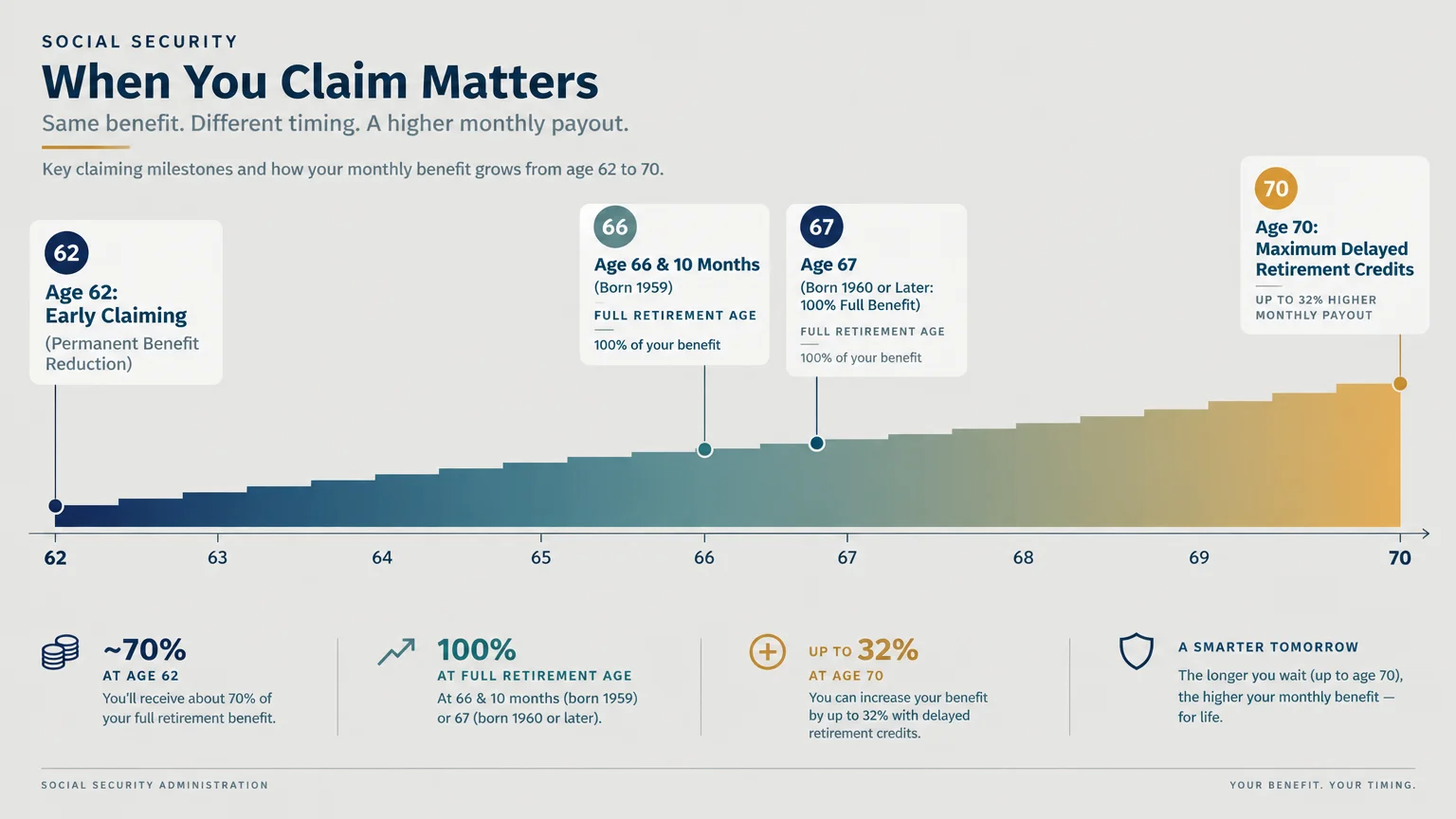
You can start claiming Social Security retirement benefits as early as age 62, or you can wait as late as age 70. Claiming at 62 shrinks your monthly check permanently—by up to 30% if your Full Retirement Age is 67.
If you wait until your Full Retirement Age, you receive 100% of your earned benefit. Better yet, delaying your claim past your FRA earns you Delayed Retirement Credits of 8% per year (or two-thirds of 1% per month) until you hit age 70.
Research from the Consumer Financial Protection Bureau (CFPB) shows that waiting even a year or two past age 62 provides valuable longevity protection for retirees on fixed incomes. However, if you have serious health concerns or urgently need cash to pay bills, claiming early may still be the right move for your household.
6. What is the maximum Social Security benefit in 2026?
The maximum possible monthly check depends entirely on the age you choose to retire and whether you earned the maximum taxable income for at least 35 years. In 2026, a worker must earn at least $184,500 to hit the annual taxable wage cap.
If you qualify for the top payout and claim at age 62 in 2026, your maximum benefit is $2,969 per month. If you wait until your Full Retirement Age in 2026, the maximum payout jumps to $4,152 per month.
Those who patiently delay claiming until age 70 in 2026 can receive up to the absolute maximum of $5,181 per month. The table below illustrates how claiming age shapes your benefit percentage and maximum 2026 payout.
| Claiming Age Milestone | Impact on Monthly Benefit (FRA of 67) | 2026 Maximum Monthly Benefit | Best Suited For |
|---|---|---|---|
| Age 62 (Earliest Eligibility) | Reduced by 30% (You receive 70% of base benefit) | $2,969 | Seniors in poor health or facing immediate income needs |
| Full Retirement Age (66 & 10 mos to 67) | No reduction (You receive 100% of base benefit) | $4,152 | Retirees wanting full benefits or planning to work part-time |
| Age 70 (Maximum Delay) | Increased by 24% to 32% via 8% annual delayed credits | $5,181 | Healthy seniors seeking maximum lifetime and survivor income |
7. How much did benefits increase with the 2026 COLA?
Social Security and SSI checks automatically rose by 2.8% in January 2026 thanks to the annual Cost-of-Living Adjustment (COLA). That 2.8% bump is slightly higher than the 2.5% adjustment beneficiaries received in 2025.
For a retiree who received $2,000 per month last year, the 2026 COLA adds $56 to their gross monthly benefit before Medicare deductions. Notice that delaying your claim magnifies future COLAs, because percentage increases are applied to a larger base check.
8. What if I claim early at 62 and then regret my decision?
Life changes fast—you might claim at 62 and then unexpectedly receive a great part-time job offer or an inheritance. Fortunately, the government gives you two distinct ways to course-correct if you regret filing early.
First, within 12 months of first claiming benefits, you can file Form SSA-521 to officially withdraw your application. You must repay every dollar you and your family received—including withheld taxes and Medicare premiums—after which your record resets as if you never filed.
Second, if more than 12 months have passed, you must wait until you reach your Full Retirement Age. Once you hit FRA, you can ask the agency to voluntarily suspend your payments, allowing your benefit to grow by 8% per year until age 70.

Working, Taxes, and Medicare Deductions: Questions 9 to 12
Many seniors find that gross benefit projections look very different from the net deposit that actually hits their checking account. Understanding earnings limits, taxes, and healthcare deductions keeps unpleasant surprises out of your monthly budget.
9. Can I work while collecting Social Security benefits?
Yes, you can work while collecting retirement or survivor benefits, but your age determines whether your checks are temporarily held back. If you are under your Full Retirement Age for the entire year in 2026, you can earn up to $24,480 ($2,040 per month) without penalty.
For every $2 you earn above that $24,480 limit, the agency withholds $1 in benefits. A much higher limit applies during the calendar year in which you finally reach your Full Retirement Age.
In 2026, you can earn up to $65,160 ($5,430 per month) during the months leading up to your FRA birthday month, with $1 withheld for every $3 earned above the cap. Starting the exact month you reach Full Retirement Age, there is no earnings limit at all—you can earn any amount without losing a dime of benefits.
Best of all, any money withheld under the earnings test is not gone forever. When you reach Full Retirement Age, your monthly payment is automatically recalculated upward to credit you for the months your check was withheld.
10. Do I have to pay federal or state income taxes on my Social Security check?
Depending on your total retirement income, you may owe federal income taxes on up to 85% of your Social Security benefits. The IRS uses a formula called “combined income,” which equals your Adjusted Gross Income (AGI), plus nontaxable interest, plus half of your annual Social Security benefits.
Because Congress has never indexed these tax brackets for inflation, most retirees with modest 401(k) withdrawals or pensions cross the threshold:
- Individual Filers ($25,000 to $34,000 combined income): Up to 50% of your Social Security benefits may be subject to federal income tax.
- Individual Filers (Above $34,000 combined income): Up to 85% of your benefits may be subject to federal income tax.
- Married Filing Jointly ($32,000 to $44,000 combined income): Up to 50% of your benefits may be subject to federal income tax.
- Married Filing Jointly (Above $44,000 combined income): Up to 85% of your benefits may be subject to federal income tax.
Note that “up to 85% taxable” does not mean the government takes 85% of your check! It simply means 85% of your benefit amount is added to your regular taxable income and taxed at your normal marginal rate (such as 10%, 12%, or 22%).
11. Do I still pay Social Security payroll taxes if I work in retirement?
Yes, if you work a job or run a business while collecting benefits, you must continue paying FICA payroll taxes regardless of your age. Employees pay 6.2% for Social Security (12.4% if you are self-employed) on wages up to the 2026 cap of $184,500, plus 1.45% for Medicare on all earnings.
While paying payroll taxes in your late 60s or 70s can feel frustrating, there is a genuine silver lining. Every year you work, the agency reviews your updated earnings record.
If your 2026 income is higher than one of the 35 inflation-adjusted years currently used to compute your benefit, your monthly check will automatically increase the following year.
12. How are Medicare premiums deducted from my Social Security payment?
Once you enroll in both Medicare and Social Security, your monthly Medicare Part B premium is automatically deducted right out of your benefit check before it reaches your bank. According to Medicare.gov, the standard Medicare Part B monthly premium is $202.90 in 2026, alongside an annual Part B deductible of $283.
Higher-income seniors may pay an additional surcharge known as IRMAA (Income-Related Monthly Adjustment Amount) based on their tax return from two years prior. Conversely, a protective rule called the “hold harmless” provision stops rising Medicare Part B premiums from reducing the net dollar amount of most retirees’ Social Security checks from one year to the next.

Spousal, Divorce, and Public Pension Rules: Questions 13 to 15
Social Security was designed to protect whole households, not just individual wage earners. Whether you are married, divorced, or retired from public service, family and pension rules play a massive role in your retirement security.
13. How do spousal benefits work, and how much can a spouse receive?
Even if you never worked outside the home or did not earn all 40 work credits, you can qualify for benefits based on your spouse’s work record. At your Full Retirement Age, a spousal benefit can equal up to 50% of your higher-earning spouse’s Full Retirement Age benefit (their PIA).
To claim a spousal benefit, you must be at least 62 years old, and your working spouse must have already filed for their own retirement benefit. When you apply, the agency always pays your own earned retirement benefit first, and then tops it up with a spousal boost if that 50% figure is higher.
Keep in mind that spousal benefits do not earn delayed retirement credits past your Full Retirement Age. There is no financial upside to delaying a pure spousal benefit beyond age 66 and 10 months or age 67.
14. Can I collect benefits on my ex-spouse’s work record?
Yes, divorced seniors can collect spousal benefits worth up to 50% of an ex-spouse’s Full Retirement Age benefit, provided they meet a few straightforward rules. You are eligible to claim on a former spouse’s record if you meet all of the following conditions:
- Your marriage to your ex-spouse lasted at least 10 continuous years before the divorce was finalized.
- You are currently unmarried (if you remarried, you generally cannot claim on an ex-spouse unless your later marriage ended by death, divorce, or annulment).
- You are at least 62 years old, and your ex-spouse is eligible for Social Security retirement or disability benefits.
- The benefit you would receive on your own work record is smaller than the divorced-spouse benefit.
If you have been divorced for at least two full years, you do not even have to wait for your ex-spouse to file for their benefits—you can claim independently as long as both of you are at least 62. Best of all, your ex-spouse is never notified that you filed on their record, and your claim has zero impact on their check or their current spouse’s benefits.
15. Did the Social Security Fairness Act really eliminate the WEP and GPO penalties?
Yes, and this is one of the most historic changes to retirement law in decades! On January 5, 2025, the Social Security Fairness Act was signed into law, permanently repealing both the Windfall Elimination Provision (WEP) and the Government Pension Offset (GPO) retroactive to January 2024.
For decades, the WEP slashed the personal Social Security checks of workers who also received a pension from a job that did not withhold Social Security taxes. Similarly, the GPO reduced or completely wiped out spousal and survivor benefits for retirees collecting non-covered government pensions.
As noted by experts at AARP, millions of public-sector retirees—including teachers, firefighters, police officers, and federal CSRS workers, as well as retirees with foreign pensions—now qualify for their full, unreduced personal, spousal, and survivor benefits. If you previously skipped applying for spousal or survivor benefits because the GPO reduced your payout to zero, you should contact the Social Security Administration immediately to file a claim.
Step-by-Step Guide to Claiming Social Security Benefits
Filing your application does not have to be stressful or confusing. Following a structured timeline ensures your first payment arrives right on schedule without paperwork bottlenecks.
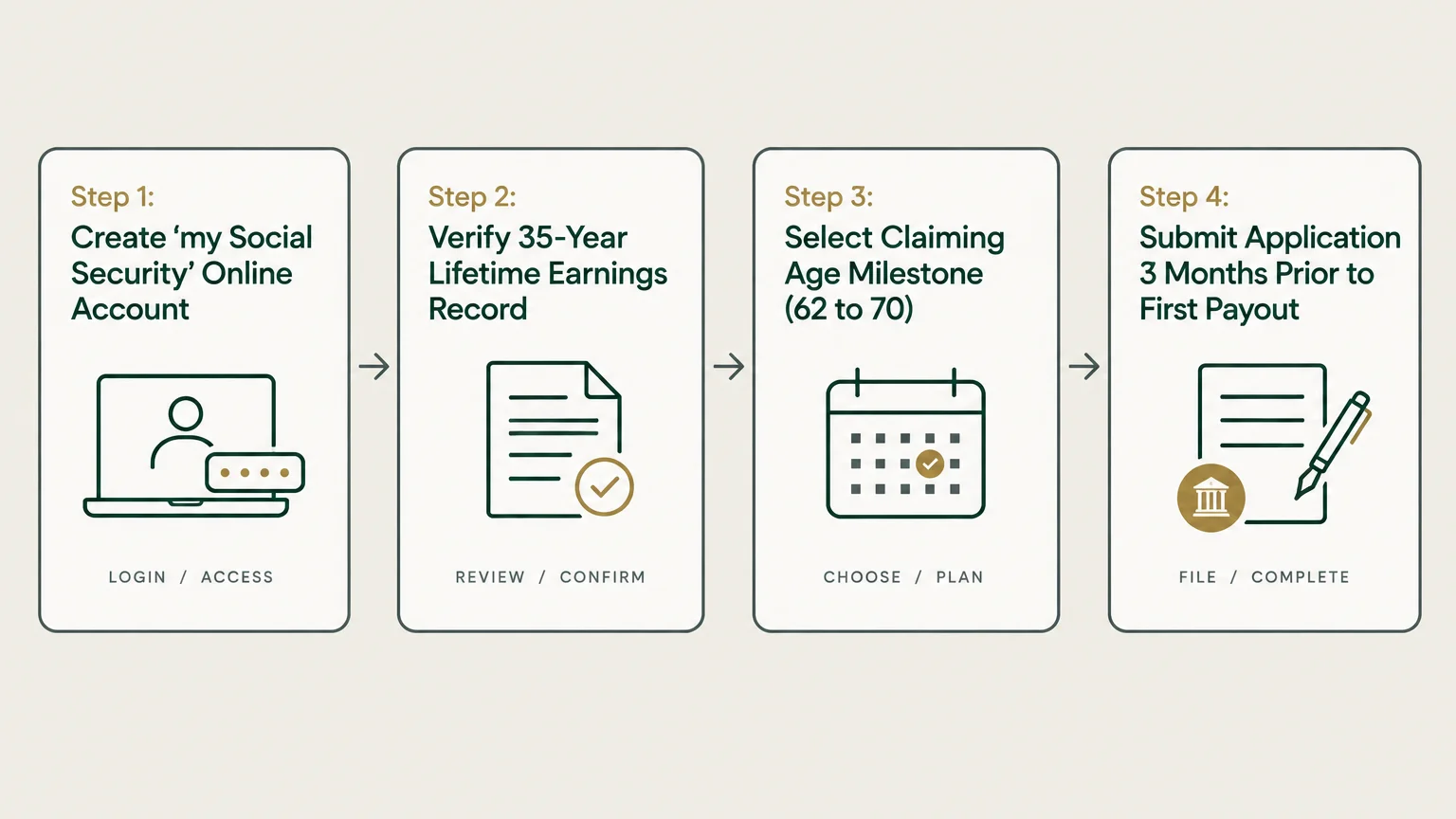
- Create or log in to your “my Social Security” account: Visit the official agency website at least six months before you plan to retire. Review your annual earnings history line by line to make sure every year of income was properly recorded.
- Pick your exact entitlement month: You can submit your application up to four months before the month you want your benefits to start. Remember that Social Security pays one month behind—so if you choose June as your start month, your first deposit will arrive in July.
- Gather your essential documents: Collect your Social Security number, original or certified birth certificate, most recent W-2 or self-employment tax return, and checking account routing numbers for direct deposit. If applying for spousal, divorced, or survivor benefits, have your marriage certificate, divorce decree, or spouse’s death certificate ready.
- Submit your application: You can complete the entire retirement application online in about 15 to 30 minutes from the comfort of home. If you struggle with vision issues, arthritis, or technology barriers, call the national toll-free line to schedule a telephone or in-person appointment at your local field office.
- Set up optional tax withholding: If you expect to owe federal income taxes on your benefits, submit IRS Form W-4V alongside your claim. You can elect to have 7%, 10%, 12%, or 22% automatically withheld from each check so you do not face quarterly estimated tax headaches.
If a health limitation makes it hard for you to manage the application yourself, a trusted adult child or family member can help you prepare the paperwork. However, you must personally sign or electronically attest to the application unless the agency has appointed an official Representative Payee for you.
Common Claiming Mistakes and Scams to Avoid
Even savvy retirees can fall into expensive traps when navigating a complex federal program. Knowing the most common pitfalls—and recognizing modern financial scams—keeps your hard-earned money safe.
Three Costly Claiming Mistakes
The biggest mistake many seniors make is claiming at age 62 out of panic that the Social Security trust fund is going broke. Even if Congress delays fixing the trust fund shortfall in the 2030s, ongoing payroll taxes still fund the vast majority of benefits, and claiming early locks in an immediate 30% cut for life.
A second frequent misstep happens when widows and widowers claim both their personal retirement benefit and their survivor benefit at the exact same time. Unlike spousal benefits, you are allowed to claim a reduced survivor benefit as early as age 60 while letting your own retirement benefit grow by 8% a year until age 70 (or vice versa)—giving you a powerful two-step income strategy.
Third, many part-time workers forget to report their expected wages to the agency when claiming before Full Retirement Age. Failing to report income above the $24,480 annual limit in 2026 can result in sudden overpayment clawbacks months or years down the road.
How to Spot 2026 Social Security Scams
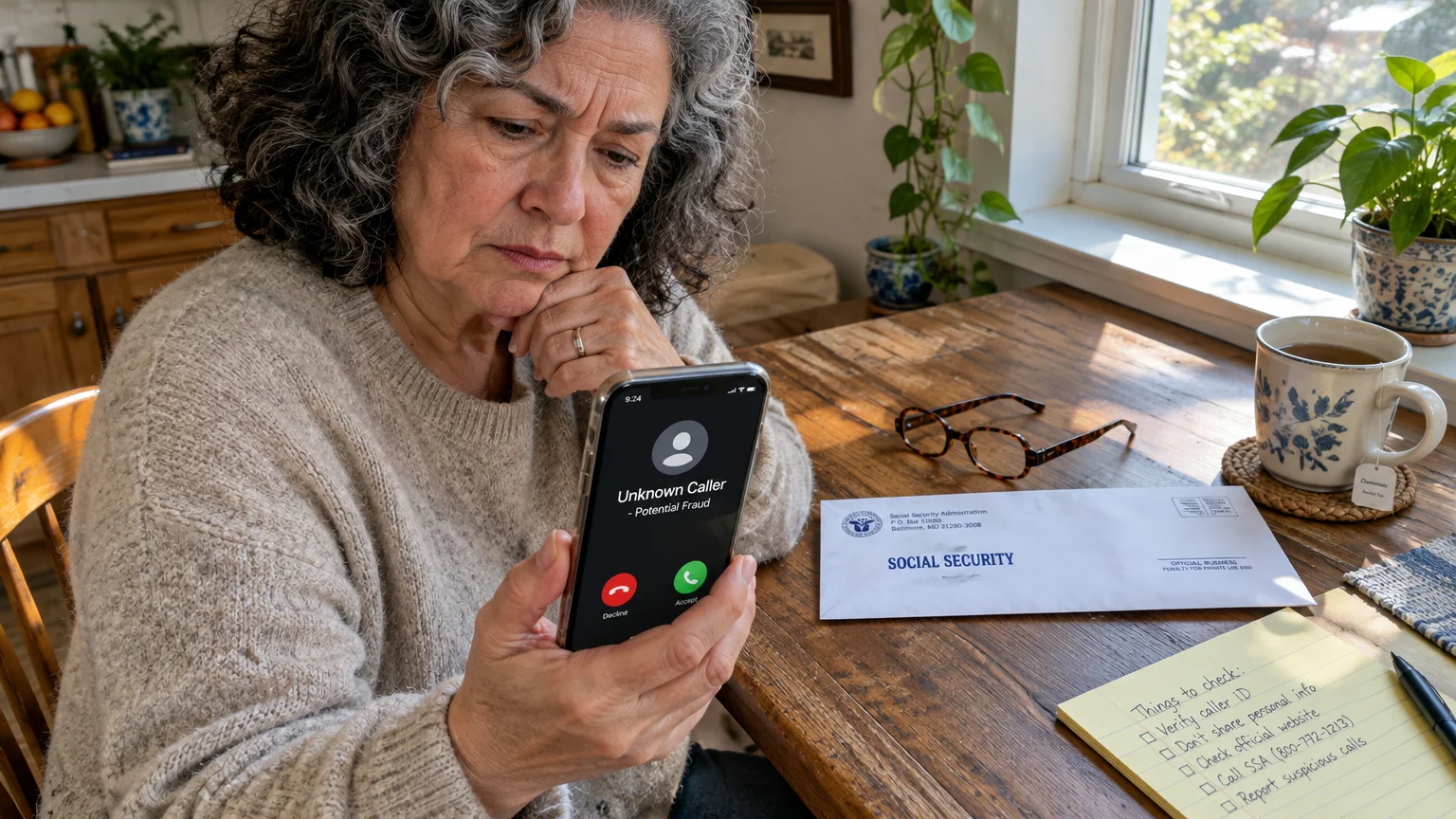
Criminals aggressively target older adults by impersonating government agents over the phone, via text, or by email. Right now, scammers are trying to exploit confusion around the 2.8% COLA increase and the repeal of the WEP and GPO pension rules.
Never trust anyone who calls or messages you claiming you must pay a “processing fee” or verify your bank password to unlock retroactive WEP/GPO payments or COLA adjustments. Keep these golden safety rules in mind:
- The Social Security Administration will never threaten to arrest you or “suspend” your Social Security number.
- Government employees will never demand payment via gift cards, wire transfers, cryptocurrency, or prepaid debit cards.
- The agency generally only mails you an official physical letter if there is an actual issue with your benefit account or overpayment status.
If you ever receive a suspicious call, hang up immediately. Look up the official agency phone number independently and call them directly to verify your account status.
Frequently Asked Questions
16. How do survivor benefits work when a spouse passes away?
When a spouse dies, the surviving spouse can generally step into the deceased worker’s shoes and receive up to 100% of the benefit the deceased spouse was receiving (or was entitled to receive). You can claim survivor benefits starting at age 60 (or age 50 if you are disabled), though claiming before your survivor Full Retirement Age reduces the monthly amount.
Keep in mind that a surviving spouse cannot collect both checks added together—you essentially keep the larger of the two checks. Additionally, a surviving spouse living in the same household (or an eligible child) can claim a one-time $255 lump-sum death payment within two years of the worker’s death.
17. What day of the month will my Social Security check arrive?
For most retirees who claimed after May 1997, your payment date is tied directly to the day of the month you were born. If your birthday falls between the 1st and the 10th of the month, your deposit arrives on the second Wednesday of each month.
Birthdays between the 11th and the 20th are paid on the third Wednesday, while birthdays between the 21st and the 31st are paid on the fourth Wednesday. If you also receive SSI—or if you started collecting benefits before May 1997—your Social Security payment typically arrives on the 3rd of each month.
18. Can I receive Social Security benefits if I retire outside the United States?
If you are a U.S. citizen, you can live or travel in almost any foreign country and continue receiving your monthly Social Security payments without interruption. The agency can even wire your checks directly into foreign bank accounts in dozens of countries.
There are only a handful of restricted countries (such as Cuba and North Korea) where the U.S. Treasury is prohibited from sending payments. However, remember that traditional Medicare generally does not cover medical care outside the United States, so you will need an international health insurance plan.
19. Do my children or grandchildren qualify for benefits on my work record?
Yes, once you file for retirement or disability benefits, certain dependent family members may qualify for auxiliary benefits worth up to 50% of your Full Retirement Age amount. Eligible dependents include unmarried biological, adopted, or stepchildren who are under age 18 (or up to age 19 if still attending high school full-time).
Unmarried adult children of any age also qualify if they have a severe disability that began before age 22. Grandchildren whom you legally adopt—or financially support because their biological parents are deceased or disabled—can also qualify, subject to an overall family maximum benefit cap of 150% to 180% of your base check.
20. How do I correct an error on my Social Security earnings statement?
If you spot a missing year of wages or an incorrect dollar figure on your online statement, gather your proof of income right away. Look for old W-2 forms, tax returns, pay stubs, or wage statements showing the employer’s name and dates of employment.
You can submit a request for correction online through your “my Social Security” account or call the agency to schedule an appointment at your local office. Even if you no longer have paper W-2s from decades ago, provide the agency with the employer’s name, location, and approximate dates worked so they can search their archives.
For additional senior resources, visit
Alzheimer’s Association, American Heart Association, Benefits.gov and National Institute on Aging (NIA).
Disclaimer: The information in this article is for educational purposes only and is not intended to be a substitute for professional financial, legal, or medical advice. Always consult with a qualified expert for advice tailored to your personal situation.









Leave a Reply