

Planning your retirement savings requires staying ahead of major tax law changes and shifting contribution thresholds. The upcoming 2027 401(k) update brings higher elective deferral limits, expanded catch-up opportunities, and crucial regulatory shifts for older workers.
Whether you plan to retire soon or want to maximize your final working years, understanding these new 401(k) rules helps protect your wealth. You can make informed choices about your pre-tax and Roth contributions right now.
This comprehensive guide outlines the latest 2027 401(k) contribution limits, new federal incentives, and updated distribution requirements to secure your financial future.
In this guide8 sections
- 2027 401(k) Contribution Limits and Projections
- The Age 60 to 63 Super Catch-Up Opportunity
- Mandatory Roth Catch-Up Rules for Higher Earners
- The New Federal Saver’s Match Program
- Required Minimum Distribution Rules for 2027
- Strategic Retirement Savings Moves for Older Workers
- Common 401(k) Pitfalls and Scams Targeting Seniors
- Frequently Asked Questions
2027 401(k) Contribution Limits and Projections
Each autumn, the Internal Revenue Service calculates cost-of-living adjustments using statutory inflation formulas. While official IRS announcements arrive in mid-November, actuarial forecasts provide clear 401k projections for the upcoming plan year.
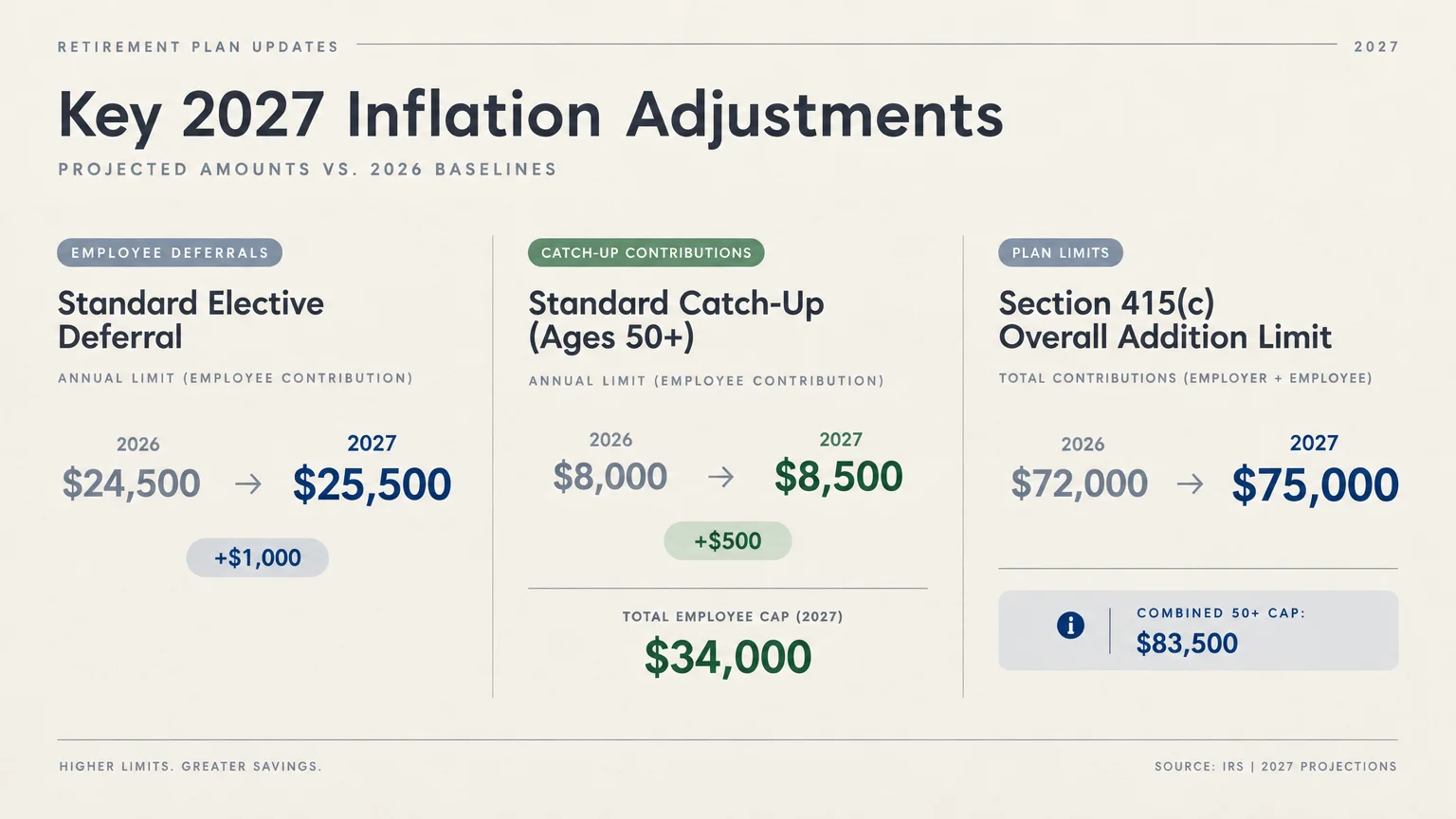
Leading industry analyses, including projections from actuarial firms like Milliman, project the standard elective deferral limit to rise to $25,500 in 2027. This marks a $1,000 increase from the 2026 limit of $24,500.
This elective deferral cap applies across all primary workplace retirement structures. You share this ceiling among traditional 401(k), 403(b), most 457 plans, and the federal Thrift Savings Plan.
If you are age 50 or older, you receive an additional catch-up allowance. Forecasters expect the standard age-50 catch-up limit to rise to $8,500 in 2027, up from $8,000 in 2026.
This adjustment lifts the projected total employee deferral limit to $34,000 for workers aged 50 and older. It provides an effective mechanism to accelerate your final savings sprint before stepping away from full-time work.
Beyond your personal salary deferrals, the IRS caps total combined additions to your defined contribution account. Under Internal Revenue Code Section 415(c), this overall limit includes your elective contributions, employer matching, and non-elective profit sharing.
For 2027, the Section 415(c) overall addition limit is projected to reach $75,000 per employer. This represents a substantial increase from $72,000 in 2026.
When you combine the standard catch-up deferral with employer additions, older participants can accumulate substantial balances in a single tax year. For workers aged 50 and older, the combined projected cap climbs to $83,500.
The table below summarizes these projected baseline limits, comparing them directly to established 2026 benchmarks.
| Contribution Category | 2026 Baseline | 2027 Projected Limit |
|---|---|---|
| Standard Employee Elective Deferral | $24,500 | $25,500 |
| Standard Catch-Up (Ages 50+) | $8,000 | $8,500 |
| Total Employee Limit (Ages 50–59 & 64+) | $32,500 | $34,000 |
| Super Catch-Up (Ages 60–63 Only) | $11,250 | $11,750 |
| Total Employee Limit (Ages 60–63) | $35,750 | $37,250 |
| Overall Defined Contribution Limit (Section 415(c)) | $72,000 | $75,000 |
| Total Maximum Limit with Age 50+ Catch-Up | $80,000 | $83,500 |
| Total Maximum Limit with Super Catch-Up | $83,250 | $86,750 |
Monitoring these 401k contribution limits 2027 allows you to adjust your automated payroll withholding early. Small percentage adjustments made in January compound substantially over an entire calendar year.

The Age 60 to 63 Super Catch-Up Opportunity
One of the most consequential changes enacted under the SECURE 2.0 legislation is the enhanced catch-up contribution. This special provision targets workers navigating their peak earning years right before conventional retirement ages.
Congress established a distinct savings bracket specifically for employees who attain ages 60, 61, 62, or 63 during the calendar year. This mechanism provides an elevated ceiling well beyond the standard age-50 catch-up.
The statutory formula sets this super catch-up amount at the greater of $10,000 or 150% of the standard catch-up limit. Because the standard catch-up projects to $8,500 in 2027, the 150% calculation dictates the new threshold.
Actuarial projections place the 2027 super catch-up limit at $11,750. This figure reflects an increase from the $11,250 limit established in 2026.
When you add this enhanced catch-up to the standard $25,500 deferral, your individual contribution potential reaches $37,250. That represents a significant annual tax-sheltered investment capacity for eligible older workers.
Research from AARP shows that many workers in their early sixties face an urgent need to build their nest egg before leaving the workforce. This four-year window offers an unprecedented opportunity to close lingering wealth gaps.
To take advantage of this provision, your workplace retirement plan must actively support the SECURE 2.0 catch-up enhancements. While plan adoption has expanded rapidly, you should verify with your human resources department that payroll systems accommodate the higher limit.
Eligibility hinges strictly on the calendar year in which you celebrate your birthday. If you turn 60 on December 31, 2027, you qualify for the full $11,750 super catch-up for that entire tax year.
Conversely, the year you turn 64 marks your return to standard catch-up rules. When you reach age 64 in 2027, your catch-up allowance drops back down to the standard $8,500 limit.
When combined with generous employer profit-sharing or matching contributions, workers aged 60 through 63 can achieve a total annual plan addition of $86,750. Planning around this temporary window requires deliberate budgeting and cash-flow coordination.
Mandatory Roth Catch-Up Rules for Higher Earners
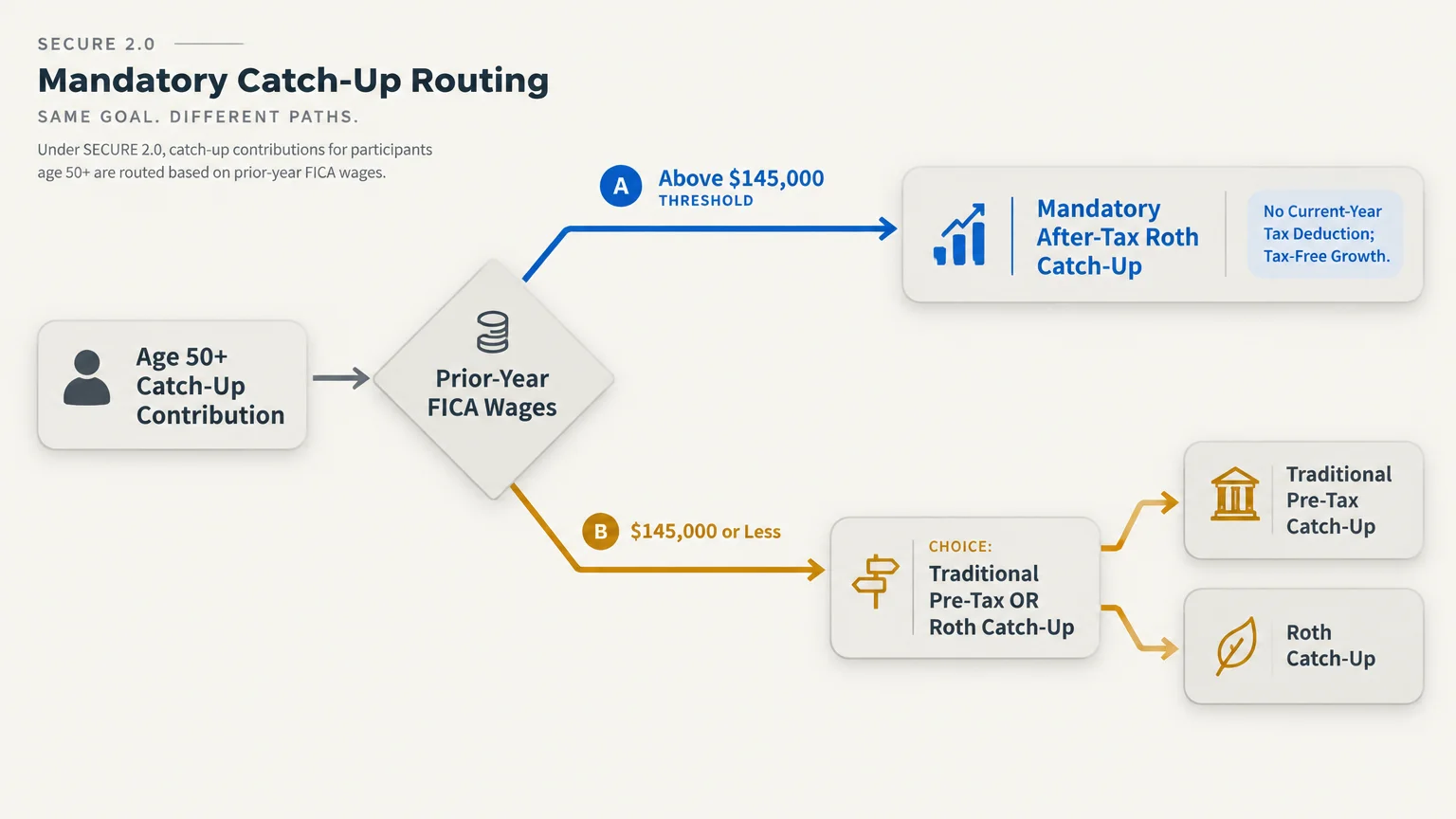
Significant administrative shifts govern how catch-up contributions operate for higher-earning older employees. Under Section 603 of the SECURE 2.0 Act, certain participants can no longer make catch-up contributions on a traditional, pre-tax basis.
The statute mandates that catch-up deposits made by designated high earners must enter after-tax Roth accounts. While this rule began transitioning in 2026 under IRS good-faith compliance guidelines, final IRS regulations formally take effect on January 1, 2027.
The mandate triggers based on your compensation from the prior calendar year. Specifically, it reviews the wages reported in Box 3 of your Form W-2 from the employer sponsoring your plan.
Congress initially established the baseline wage threshold at $145,000, indexing that figure annually for inflation. The threshold climbed to $150,000 in 2026 and projects to reach $155,000 for the 2027 plan year.
If your 2026 FICA wages exceed $155,000 from your current employer, your 2027 catch-up contributions must flow into a designated Roth account. You cannot deduct these catch-up dollars from your current-year taxable income.
This mandate applies whether you qualify for the standard $8,500 catch-up or the $11,750 super catch-up. Your base deferral of up to $25,500 can remain pre-tax, but your additional catch-up dollars must be Roth.
This structural change carries a critical administrative catch for employees at smaller companies. If your employer does not offer a Roth 401(k) option, high-earning workers cannot make any catch-up contributions at all.
Fortunately, most modern corporate plans have integrated Roth features to protect their staff’s savings ability. You should confirm your plan’s Roth availability immediately if your prior-year compensation exceeds the projected $155,000 boundary.
While losing the immediate pre-tax deduction increases your current tax bill, Roth savings deliver compelling long-term advantages. All qualified distributions from your Roth account in retirement—including all accumulated investment earnings—are completely exempt from federal income tax.
Moreover, building a substantial Roth reserve provides greater tax flexibility throughout your retirement years. It helps you manage marginal tax brackets and avoid unexpected spikes in taxable income when large expenses arise.

The New Federal Saver’s Match Program
Beginning in 2027, the federal government fundamentally reshapes how it incentivizes retirement savings for lower- and moderate-income households. Section 103 of the SECURE 2.0 Act officially launches the federal Saver’s Match, replacing the former nonrefundable Saver’s Credit.
IRS Notice 2026-48 outlines the operational mechanics for this major program. Unlike the old tax credit, which merely reduced an existing tax liability, the Saver’s Match provides direct government money into your account.
Under this program, the federal government matches 50% of your eligible retirement contributions up to a maximum contribution of $2,000 per person. This yields a direct federal deposit of up to $1,000 per individual saver.
Married couples filing jointly who both contribute to eligible accounts can receive up to $2,000 in combined matching funds. This government contribution acts as an immediate 50% return on your qualifying deposits.
Guidance published on Benefits.gov highlights that direct federal matching can substantially increase retirement readiness for eligible lower-income households. It rewards disciplined savings habits regardless of your total tax liability.
The U.S. Treasury deposits the matching funds directly into your eligible traditional retirement account, such as a traditional 401(k) or traditional IRA. These deposits arrive after you claim the match on your 2027 federal tax return filed in early 2028.
Because the match represents an incentive for long-term wealth building, the government does not allow deposits into Roth accounts. The funds must reside in a traditional pre-tax structure, where they grow tax-deferred until distribution.
Full eligibility requires that your Modified Adjusted Gross Income (MAGI) fall below strict statutory thresholds. For married couples filing jointly in 2027, the full 50% match applies at a MAGI of $41,000 or less.
The benefit gradually phases out for married joint filers earning between $41,000 and $71,000. Individuals earning above $71,000 cannot claim the Saver’s Match.
For single filers and married individuals filing separately, the full match applies to incomes of $20,500 or less. The single phaseout range spans from $20,500 to $35,500.
Heads of household receive full matching funds with a MAGI up to $30,750, with complete phaseout occurring at $53,250. These income bands allow many part-time workers and early retirees with modest taxable incomes to secure federal funding.
The table below illustrates how the Saver’s Match eligibility thresholds function across common tax filing statuses.
| Filing Status | Full 50% Match (Max $1,000) | Phaseout Range | No Match Above |
|---|---|---|---|
| Married Filing Jointly | $41,000 or less | $41,001 – $71,000 | $71,000 |
| Head of Household | $30,750 or less | $30,751 – $53,250 | $53,250 |
| Single / Married Filing Separately | $20,500 or less | $20,501 – $35,500 | $35,500 |
Crucially, the federal Saver’s Match does not count toward your annual 401(k) contribution limit. It represents an external boost to your nest egg that accelerates your path toward financial independence.
Required Minimum Distribution Rules for 2027
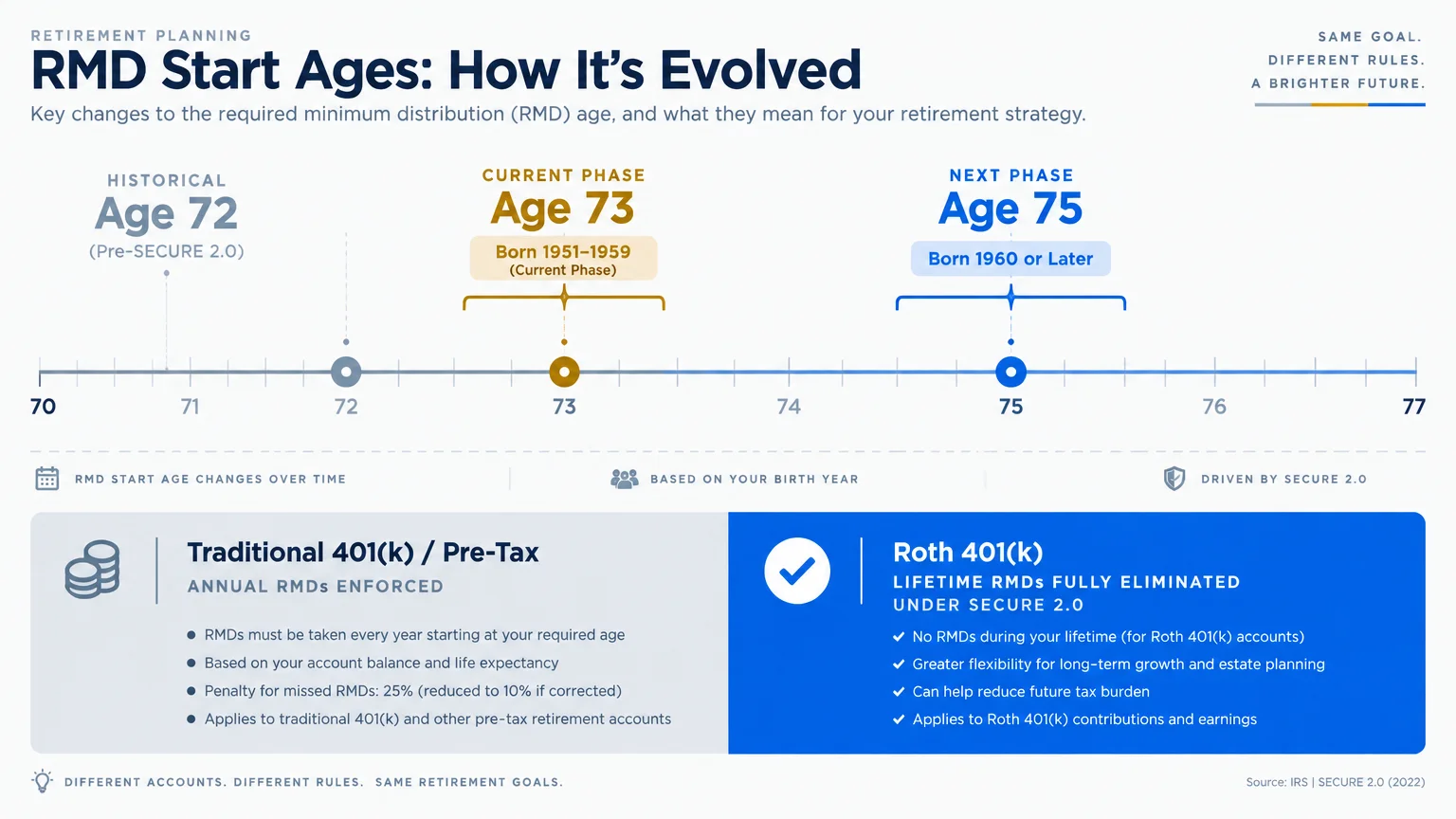
Navigating distribution mandates is just as vital as managing your contributions. For 2027, the starting age for Required Minimum Distributions (RMDs) remains firmly established at age 73.
Although the SECURE 2.0 Act eventually raises the RMD starting age to 75, that adjustment does not occur until 2033. If you navigate retirement distributions in 2027, age 73 remains your legal milestone.
Your exact birth year dictates when your mandatory withdrawals must begin. Individuals born in 1954 will reach age 73 during 2027.
If you were born in 1954, your required beginning date is April 1, 2028. However, waiting until April 2028 forces you to take two separate RMDs in a single tax year.
Your second RMD would fall due by December 31, 2028. Doubling your distributions in a single calendar year can artificially inflate your taxable income, pushing you into higher tax brackets.
Meanwhile, seniors born in 1953 reached age 73 during 2026. If you were born in 1953 and deferred your initial distribution, you must withdraw your first RMD by April 1, 2027.
You must also complete your regular 2027 distribution by December 31, 2027. Coordinating these distribution schedules prevents painful tax surprises and protects your Medicare premiums from income-related surcharges.
Fortunately, designated Roth accounts inside 401(k) and 403(b) plans are completely exempt from lifetime RMDs. This taxpayer-friendly rule, permanently active since 2024, aligns workplace Roth accounts with the rules governing Roth IRAs.
You no longer need to roll over your Roth 401(k) into a Roth IRA simply to escape forced lifetime distributions. Your Roth workplace balances can continue compounding tax-free for your entire lifetime.
Penalties for missing an RMD remain substantial, though lower than previous historical rates. The SECURE 2.0 legislation lowered the excise penalty from 50% down to 25% of the undistributed amount.
If you identify and correct the error within a timely two-year correction window, the IRS reduces that penalty further to 10%. Nevertheless, automating your annual withdrawals remains the safest strategy to avoid statutory fines.

Strategic Retirement Savings Moves for Older Workers
Translating new 401k rules into measurable wealth requires proactive planning. Rather than leaving your retirement savings on autopilot, execute targeted adjustments to capture every available tax advantage.
First, review your year-to-date earnings and prior-year tax forms to establish your catch-up status. If your 2026 W-2 Box 3 wages exceed $155,000, direct your payroll office to route your 2027 catch-up contributions to a Roth account.
Failing to establish a designated Roth election can result in payroll systems rejecting your catch-up contributions entirely. Contact your benefits administrator before December 31 to confirm your contribution designations.
Second, if you turn age 60, 61, 62, or 63 during 2027, adjust your contribution percentages to capture the $11,750 super catch-up. Spreading $37,250 across your annual pay periods requires disciplined budget allocation.
Third, align your workplace savings strategy with your broader Social Security claiming timeline. Maximizing your 401(k) deposits in your final working years allows you to build a bridge fund to delay Social Security benefits.
As noted by experts at the Social Security Administration (SSA), delaying your benefit claim past full retirement age increases your monthly benefit by up to 8% per year until age 70. Workplace savings serve as the ideal liquidity buffer to finance this delay.
Fourth, take note of updated employer compliance protections issued under IRS Revenue Procedure 2026-34. This guidance makes permanent an administrative safe harbor allowing plan sponsors to correct automatic enrollment errors within 9½ months.
If your employer miscalculates your automatic contribution percentage or misses an escalation date, they can fix the error promptly without penalty. Monitor your monthly paystubs carefully to confirm that your selected elective percentages match your actual deductions.
Follow this practical action checklist as you prepare for the 2027 plan year:
- Review your 2026 Form W-2 Box 3 wages to see if you trigger the $155,000 mandatory Roth catch-up rule.
- Verify that your employer’s plan document permits Roth catch-up contributions.
- If you celebrate your 60th through 63rd birthday in 2027, update your elective deferrals to target the $37,250 maximum limit.
- Check your Modified Adjusted Gross Income to evaluate your eligibility for the new federal Saver’s Match program.
- Review designated beneficiary forms on all workplace accounts to confirm they reflect your current estate planning goals.
- Calculate anticipated RMD obligations if you turn 73 or maintain pre-tax balances from prior working years.
Executing these targeted steps protects your cash flow and ensures you capitalize on every favorable rule change.
Common 401(k) Pitfalls and Scams Targeting Seniors
Managing retirement assets near the end of your career exposes you to unique financial risks. Avoiding structural tax mistakes and predatory schemes is essential to safeguarding your accumulated wealth.
A frequent mistake involves exceeding individual elective deferral caps across multiple employers. If you switch jobs mid-year, your new employer’s payroll system does not know what you contributed at your previous position.
You remain personally responsible for ensuring your total elective deferrals across all jobs do not exceed $25,500 (or your applicable catch-up ceiling). Excess deferrals trigger double taxation if not formally corrected by April 15 of the following year.
Another major trap involves outdated beneficiary designations on legacy retirement plans. Many savers assume that provisions in their legal last will and testament govern their 401(k) balances.
In reality, plan beneficiary designations override any instructions written in your will. If you experienced a marriage, divorce, or loss of a spouse, update your plan documents immediately to ensure assets pass to your intended heirs.
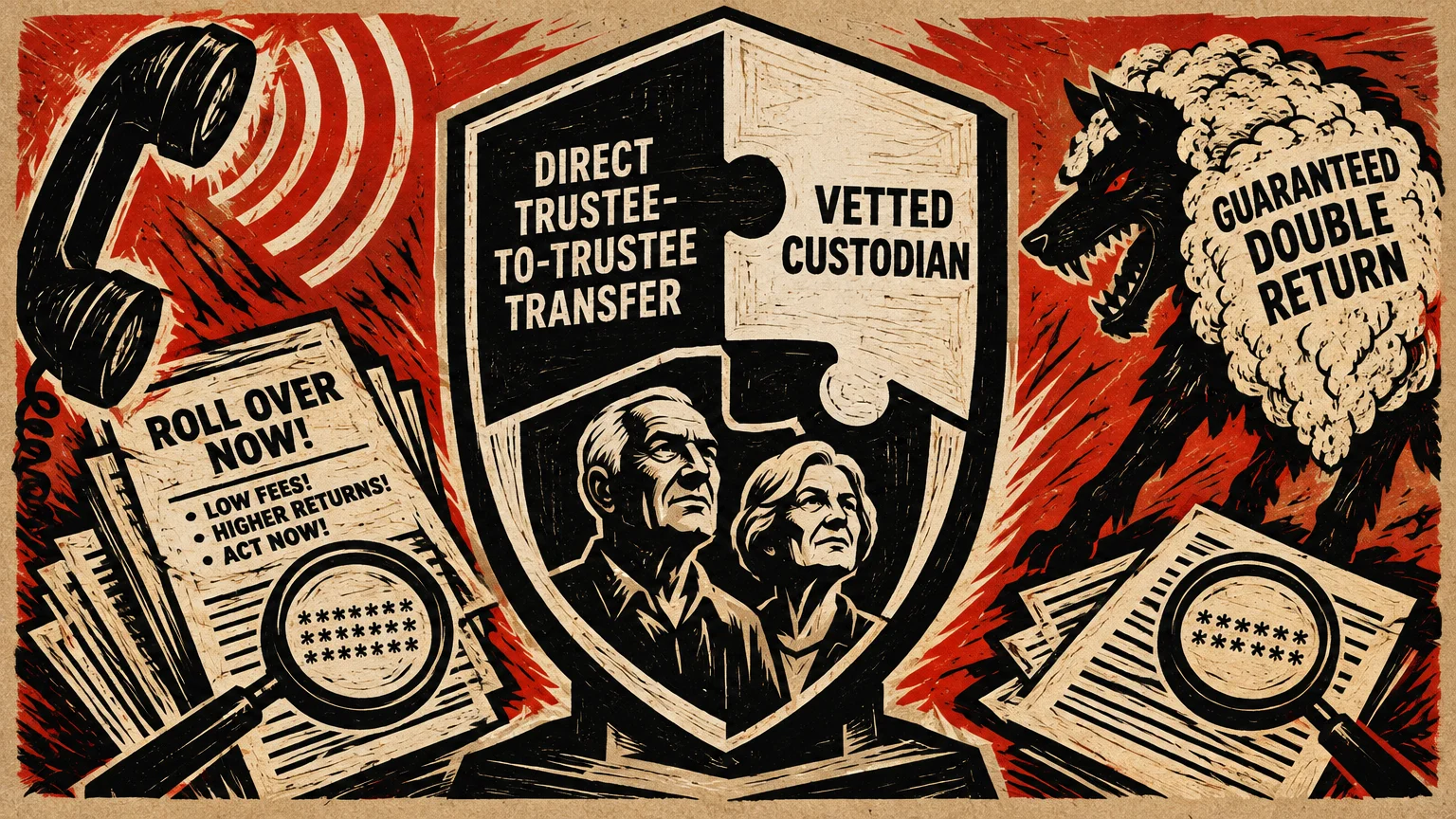
Seniors must also exercise vigilance against predatory financial schemes targeting rollover assets. Impending retirement frequently prompts aggressive sales pitches pushing high-fee annuities or unregulated alternative investments.
According to the Consumer Financial Protection Bureau (CFPB), older adults lose billions of dollars annually to deceptive financial practices and unsuitable investment products. Be skeptical of unsolicited calls or dinner seminars promising guaranteed returns without market risk.
Cybercriminals also increasingly target senior workplace accounts through phishing emails and fraudulent password resets. Always log into your plan administrator’s web portal directly rather than clicking links contained in unverified emails or text messages.
Enable two-factor authentication on every financial account to add an indispensable layer of digital defense. Securing your accounts ensures that your hard-earned savings remain intact for your true retirement needs.
Frequently Asked Questions
When does the IRS officially announce the final 2027 401(k) limits?
The IRS traditionally releases its official cost-of-living adjustments for retirement accounts in mid-November of the preceding year. Current figures are projections based on established actuarial formulas and Consumer Price Index inflation trends.
Can I contribute to both the regular catch-up and the super catch-up in the same year?
No, you cannot combine both catch-up allowances in a single tax year. If you are aged 60 through 63, your total catch-up limit is $11,750, which completely replaces the standard $8,500 catch-up limit.
Does the federal Saver’s Match deposit count toward my annual 401(k) contribution limit?
No, the federal Saver’s Match does not reduce your individual elective deferral limit or employer contribution caps. It represents a supplementary government incentive credited directly to your account after filing your federal tax return.
What happens if my employer does not offer a Roth 401(k) option and I earn over $155,000?
Under SECURE 2.0 rules, if you earn over the prior-year wage threshold and your employer lacks a Roth option, you cannot make catch-up contributions. You can still contribute up to the standard elective deferral limit of $25,500.
Do I have to take an RMD from my Roth 401(k) in 2027?
No, original account owners do not have to take Required Minimum Distributions from designated Roth 401(k) accounts. SECURE 2.0 permanently eliminated lifetime RMD requirements for employer Roth balances starting in 2024.
For additional senior resources, visit
Social Security Administration (SSA), Consumer Financial Protection Bureau (CFPB), Administration for Community Living (ACL) and Eldercare Locator.
Disclaimer: The information in this article is for educational purposes only and is not intended to be a substitute for professional financial, legal, or medical advice. Always consult with a qualified expert for advice tailored to your personal situation.