
Showing a government ID or proof of age unlocks thousands of dollars in annual savings across retail, transit, and recreation. You earned these price breaks through decades of working and contributing to your community.
Many national businesses do not actively advertise their age-related reductions on storefront signs or register displays. You simply need to carry your identification and ask the cashier which programs offer genuine value.
This guide details nine valuable perks available right now, helping you stretch your retirement budget without sacrificing your everyday lifestyle.
In this guide12 sections
- Federal Recreation and National Park Passes
- Public Transportation and Passenger Rail Savings
- Everyday Retail and Apparel Markdowns
- Supermarket and Pharmacy Shopping Days
- Tailored 55-Plus Wireless and Cell Phone Plans
- Free and Low-Cost Higher Education Tuition
- Subsidized Fitness Programs and Gym Access
- Hospitality, Car Rental, and Dining Reductions
- Enhanced Senior Tax Deductions and Local Relief
- How to Verify and Organize Your Proof of Age
- Common Traps and Scams Targeting Older Shoppers
- Frequently Asked Questions
Federal Recreation and National Park Passes
Outdoor recreation offers tremendous physical and mental health benefits for retirees. You can access national treasures across the country for a fraction of the standard tourist rate.
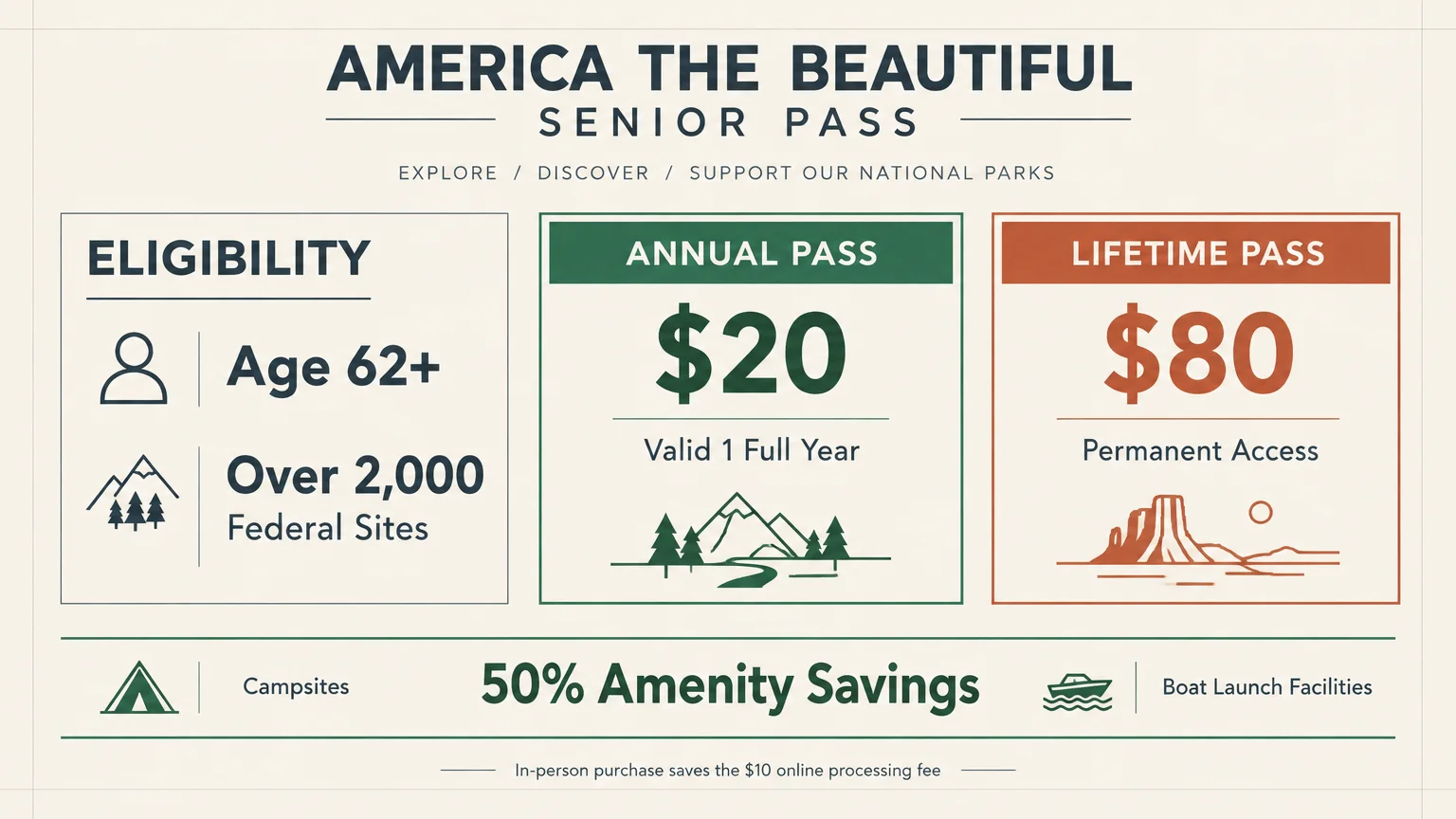
U.S. citizens and permanent residents age 62 and older qualify for the America the Beautiful Senior Pass. This pass grants entry to more than 2,000 federal recreation sites nationwide.
You can select either an Annual Senior Pass for $20 or a Lifetime Senior Pass for $80. Purchasing the pass online or by mail adds a small $10 processing fee.
Passholders receive free admission to all national parks, national wildlife refuges, and national forests. The pass covers entrance fees for the cardholder and traveling companions in a single private vehicle.
In addition to free entry, the pass provides a 50% discount on select expanded amenity fees. These savings apply to federal campsites, boat launch ramps, and swimming facilities.
You can buy your pass in person at any federal recreation site that collects fees. Bringing a state driver’s license or passport validates your age and residency immediately.
- Minimum qualifying age: 62 years old.
- Annual pass cost: $20 per year.
- Lifetime pass cost: $80 for permanent access.
- Expanded amenity savings: 50% off select camping and boat facilities.
Private concessionaires inside national parks do not always honor the amenity discount. Always confirm discounts with campground operators before booking your reservation.

Public Transportation and Passenger Rail Savings
Navigating busy highways can create unnecessary stress during retirement travel. Passenger rail offers a relaxing alternative that lets you view scenic countryside without driving.
Amtrak provides a 10% discount on most rail fares across the country for travelers age 65 and older. You can apply this discount when booking tickets online or at station counters.
The standard rail discount excludes Saver Fares, Auto Train tickets, weekday Acela departures, and private sleeping compartments. Regular coach seats on regional lines qualify for the savings.
Cross-border travelers can take advantage of lower age requirements. On rail routes operated jointly with VIA Rail Canada, the 10% discount begins at age 60.
Certain regional rail lines offer even steeper price reductions for older passengers. The Amtrak Downeaster, running from Boston through Maine, offers 50% off one-way coach fares for riders age 65 and older.
West Coast travelers enjoy dedicated regional discounts as well. California routes like the Pacific Surfliner, Capitol Corridor, and Gold Runner offer 15% off tickets for riders age 62 and older.
| Service or Route | Eligible Age | Discount Rate | Key Restrictions |
|---|---|---|---|
| Amtrak National Coach | 65 and older | 10% off | Excludes Saver Fares and weekday Acela trains |
| VIA Rail Cross-Border | 60 and older | 10% off | Valid only on joint cross-border routes |
| Amtrak Downeaster | 65 and older | 50% off | Applies to one-way coach travel |
| California Regional Lines | 62 and older | 15% off | Valid on Pacific Surfliner and Capitol Corridor |
Local transit authorities also provide subsidized bus and subway fares. Most municipal transit agencies issue free or reduced-fare cards once you show proof of age.

Everyday Retail and Apparel Markdowns
Updating your wardrobe or buying home essentials does not require paying full retail prices. Several major department and discount chains designate specific shopping days each week for older adults.
Kohl’s offers a 15% in-store discount every Wednesday for shoppers age 60 and older. You must present a valid government-issued photo ID at the checkout counter to receive the markdown.
The Kohl’s senior markdown applies to clothing lines, shoes, and home accessories. It cannot be combined with certain manufacturer coupons, but it stacks with Kohl’s Cash rewards.
Ross Dress for Less hosts a dedicated discount day through its Every Tuesday Club. Shoppers age 55 and older receive 10% off their entire in-store purchase every Tuesday.
You only need to visit the customer service desk at Ross to enroll with your identification. The cashier then applies the price reduction automatically during checkout.
Creative hobbyists can save money on art supplies, framing, and holiday decor at Michaels. Customers age 55 and older receive a 10% discount every day on their entire purchase.
To access the Michaels discount, link your birth year to a free Michaels Rewards account. The discount applies automatically at checkout and works on sale items.
- Kohl’s: 15% off every Wednesday for ages 60 and older.
- Ross Dress for Less: 10% off every Tuesday for ages 55 and older.
- Michaels: 10% off daily for ages 55 and older with rewards membership.

Supermarket and Pharmacy Shopping Days
Grocery and healthcare expenses represent significant portions of any household retirement budget. Establishing your shopping schedule around designated senior savings days produces substantial monthly relief.
Walgreens hosts “Seniors Day” on the first Tuesday of every month for shoppers age 55 and older. AARP members also qualify for these savings regardless of their exact age.
Participants receive 20% off eligible regular-priced merchandise across the entire store. You can access the savings in retail locations or online using promotional code SENIOR20.
This Walgreens promotion covers vitamins, personal care products, household supplies, and over-the-counter medications. It excludes prescription medications, dairy products, and gift cards.
Regional grocery chains provide recurring weekly discounts for neighborhood shoppers. Harris Teeter offers a 5% discount every Thursday to customers age 60 and older.
Shoppers register for the Harris Teeter “Club 60” program using their free store VIC card. Cashiers apply the 5% reduction to your grocery cart once you scan the card.
In the Pacific Northwest, Fred Meyer offers 10% off select merchandise on the first Tuesday of each month. Shoppers age 55 and older save on store-brand groceries, apparel, and home goods.
Planning your shopping trips around these designated days helps you avoid paying retail markups. A household spending $400 monthly on groceries can save several hundred dollars each year.
Tailored 55-Plus Wireless and Cell Phone Plans
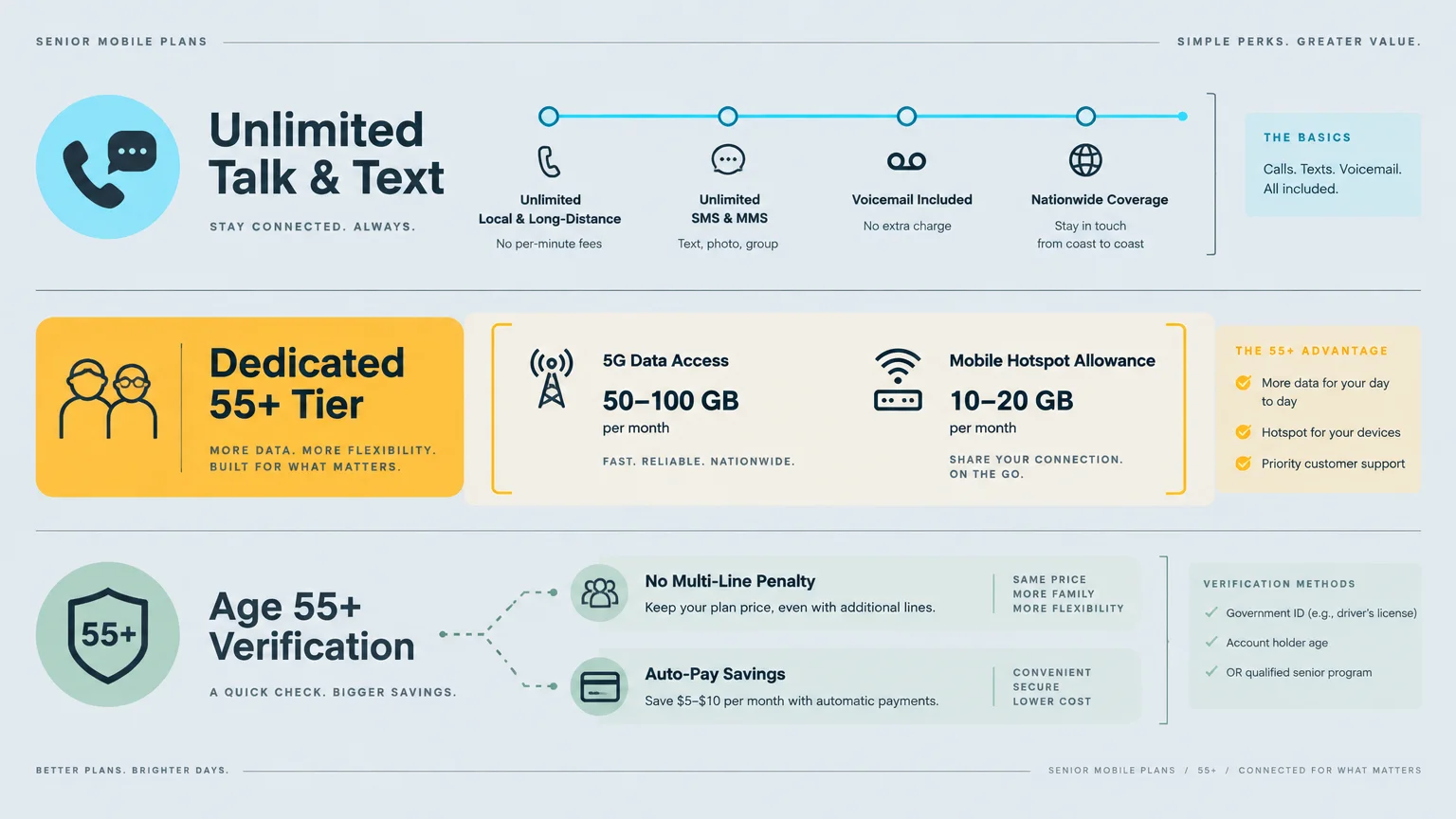
Staying connected with children and grandchildren should not require an expensive mobile phone bill. Major telecommunications carriers provide discounted rate plans designed specifically for customers age 55 and older.
T-Mobile features the Essentials Choice 55 plan starting at $45 per month for a single line with AutoPay. The plan includes unlimited domestic talk, text, and smartphone data.
AT&T provides the AT&T 55+ plan at $50 per month for one line or $99 per month for two lines. This pricing requires enrollment in AutoPay and paperless billing.
AT&T discontinued its older membership discounts in favor of this dedicated age-based plan. Customers must verify their age with a state-issued identification card during setup.
Verizon offers a 55+ Unlimited Plan for $45 per month for one line or $80 per month for two lines. This specific promotion remains restricted to account holders with Florida billing addresses.
Budget-conscious retirees can choose low-cost prepaid carriers like Mint Mobile. The Mint 55+ plan starts at $15 per month for 5GB of high-speed data when paid annually.
| Carrier | Monthly Rate | Eligible Age | Plan Highlights |
|---|---|---|---|
| T-Mobile Essentials Choice 55 | $45 (1 line) | 55 and older | Unlimited talk, text, and 5G data nationwide with AutoPay |
| AT&T 55+ | $50 (1 line) / $99 (2 lines) | 55 and older | Requires AutoPay and paperless billing enrollment |
| Verizon 55+ Unlimited | $45 (1 line) / $80 (2 lines) | 55 and older | Restricted exclusively to Florida billing addresses |
| Mint Mobile 55+ | $15 (annual prepay) | 55 and older | Includes 5GB high-speed data and free setup support |
Before switching wireless carriers, verify network coverage in your specific neighborhood. Most providers allow you to transfer your existing smartphone and telephone number without penalty.

Free and Low-Cost Higher Education Tuition
Retirement provides the ideal opportunity to explore new subjects and stimulate your intellect. Public colleges and universities across the nation welcome older adults into collegiate classrooms for free.
Over 45 U.S. states mandate or offer tuition waivers and course auditing programs for senior residents. State legislation allows retirees to attend university lectures without paying regular credit fees.
Eligibility thresholds vary depending on your state of residence. States like Colorado, Louisiana, and Tennessee allow participation starting at age 55.
Other states open their university doors slightly later. South Carolina, Alabama, and Mississippi grant tuition waivers to state residents age 60 and older.
States such as Texas, Illinois, Alaska, and Missouri extend free college enrollment to individuals age 65 and older. You must present your state ID to verify residency and age.
According to the Administration for Community Living (ACL), continuous social engagement and cognitive learning promote overall healthy aging. Taking campus classes keeps your mind active and connects you with diverse generations.
Most colleges allow seniors to audit lecture courses on a space-available basis after degree-seeking students enroll. Auditing means you attend lectures without taking exams or receiving letter grades.
You remain responsible for incidental campus costs. These expenses include textbooks, parking passes, and specialized science laboratory or technology fees.

Subsidized Fitness Programs and Gym Access
Maintaining regular physical activity helps preserve joint flexibility, bone mineral density, and cardiovascular endurance. Many retirees receive full gym memberships without paying out of pocket.
The SilverSneakers program provides free fitness facility access to eligible adults age 65 and older. Coverage is provided through participating Medicare Advantage (Part C) and Medigap supplemental insurance plans.
Approximately 93% of Medicare Advantage plans include an integrated fitness benefit. You simply show your health insurance card and photo ID to receive a gym keycard.
As noted by experts at the Centers for Disease Control and Prevention (CDC), regular physical exercise reduces the risk of chronic conditions and prevents falls among older adults. Exercise programs help you stay independent longer.
SilverSneakers members gain access to more than 17,000 participating fitness facilities nationwide. Partner locations include major chains like Planet Fitness, LA Fitness, and community YMCAs.
In addition to standard weight rooms and cardio machines, participating gyms offer instructor-led fitness classes. These classes focus on gentle stretching, balance training, and low-impact aerobics.
If you prefer exercising at home, the program provides online live-streamed classes and on-demand workout videos. You can log into virtual classes from your tablet or home computer.

Hospitality, Car Rental, and Dining Reductions
Leisure travel expands during retirement, making travel-related savings especially valuable. Joining age-focused consumer associations provides access to negotiated rates across major hospitality brands.
Standard membership through AARP costs $20 per year. Selecting automatic renewal reduces the first-year cost to $15, while a five-year membership costs $79.
AARP also offers a lifetime membership for $250. Every paid membership includes a complimentary secondary membership for another adult residing in your household.
Members receive discounts of up to 30% off base rental car rates with companies like Avis and Budget. These agreements often waive additional driver fees for your spouse.
Major hotel chains offer room rate reductions ranging from 5% to 20% off standard pricing. Brands including Marriott, Hilton, and Wyndham provide discounted rates for guests who display their membership ID.
National restaurant chains deliver consistent savings on dining out. Casual restaurants like Denny’s and Outback Steakhouse offer 10% to 15% off food and non-alcoholic beverages.
Independent diners and regional bistros frequently run their own unadvertised senior discount programs. Asking your server if they offer a senior markdown often yields 10% off your bill.
Enhanced Senior Tax Deductions and Local Relief
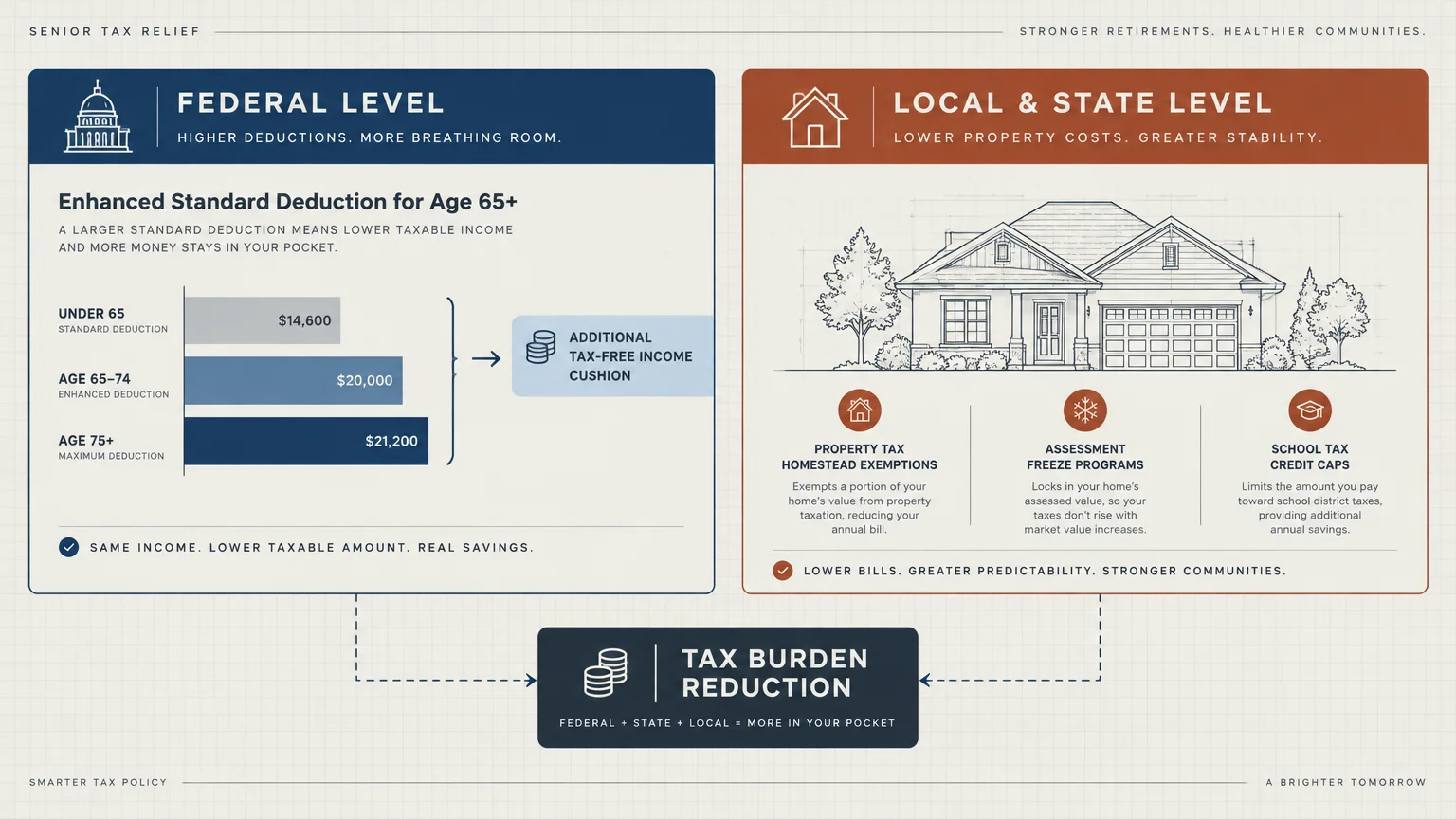
Reaching age 65 unlocks significant federal and municipal tax savings that protect your retirement assets. Presenting proof of age on official tax filings reduces your annual tax obligations.
For the 2026 tax year, the Internal Revenue Service provides an additional standard deduction for filers age 65 and older. Single and head-of-household filers receive an extra $2,050 deduction.
Married couples filing jointly receive an extra $1,650 deduction for each qualifying spouse age 65 and older. This bonus deduction lowers your taxable income without requiring itemization.
Federal tax provisions effective from 2025 through 2028 introduce a separate enhanced senior deduction. Qualifying individuals age 65 and older can deduct up to $6,000 per person.
Married couples filing jointly can claim up to $12,000 under this enhanced senior deduction. The benefit phases out for single filers earning over $75,000 and joint filers earning over $150,000.
Municipalities also provide substantial property tax relief to older homeowners. County tax assessors offer homestead exemptions that freeze assessed property values or lower annual tax bills for qualifying seniors.
As highlighted on Benefits.gov, numerous state and local programs offer assistance with utility costs and property taxes. Reviewing your local tax assessor’s guidelines ensures you do not miss available relief.
How to Verify and Organize Your Proof of Age
Taking advantage of senior discounts requires having reliable identification ready when paying. Keeping your documentation organized avoids confusion and delays at the cash register.
A state driver’s license or state-issued non-driver identification card serves as the most widely accepted proof of age. Both cards display your official birthdate and photo clearly.
Frequent travelers should consider getting a U.S. passport card. This durable wallet-sized card verifies your age and citizenship without revealing your home street address.
Avoid carrying your original Social Security card or Medicare card in your wallet. Showing cards displaying your Social Security number exposes you to unnecessary identity theft risks.
Many grocery stores and pharmacies require linking your senior status to a store loyalty card. Once linked, the checkout system applies your savings automatically every time you scan your phone.
Formulate a simple habit of asking about senior discounts whenever you make a purchase. Cashiers rarely offer age discounts unprompted, but they gladly apply them when asked politely.
Common Traps and Scams Targeting Older Shoppers
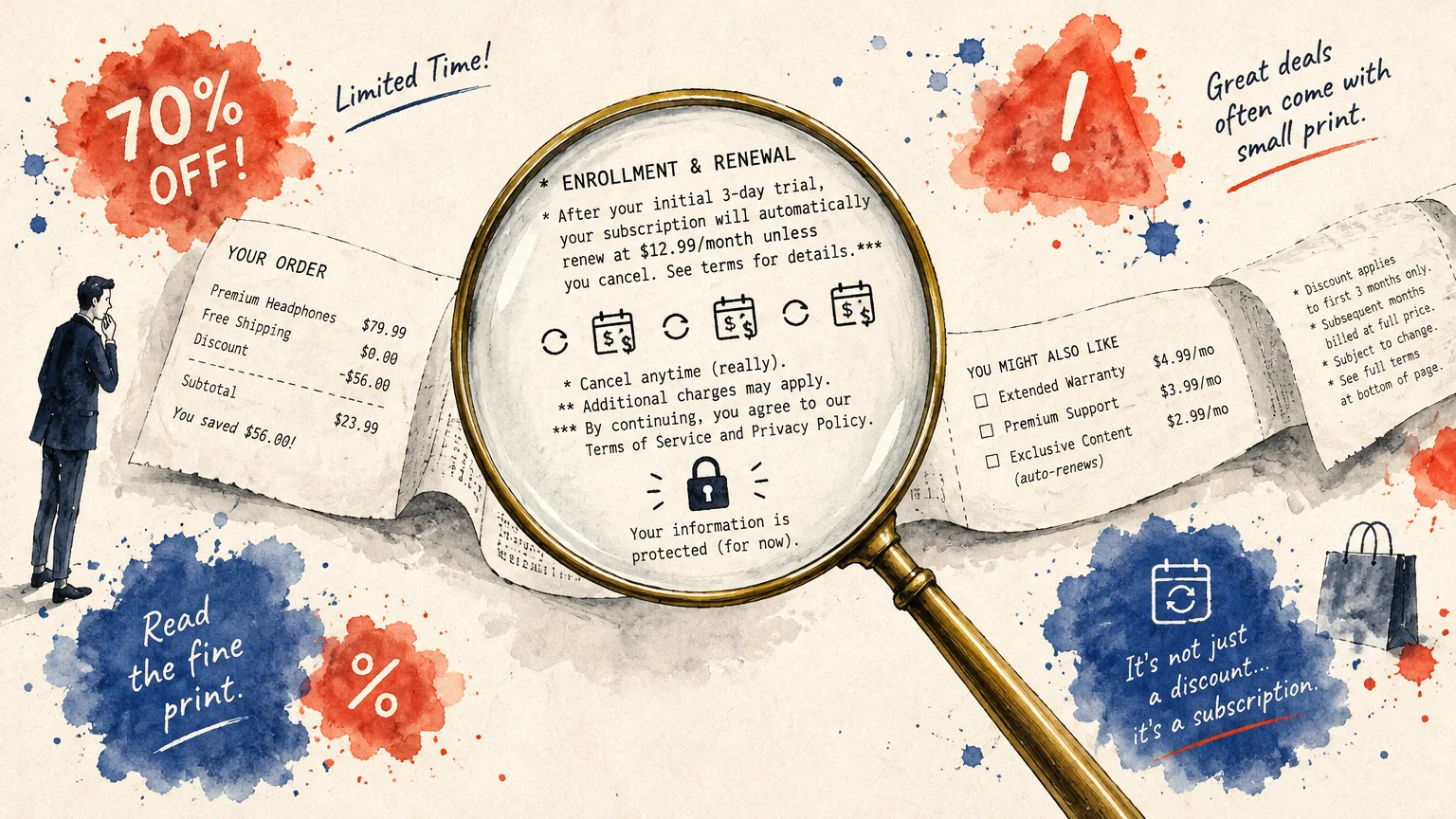
While legitimate senior discounts help you save money, deceptive marketers often target older consumers. Understanding how these promotions work protects your wallet from costly marketing traps.
Beware of independent companies selling unauthorized “national senior discount cards.” These commercial promoters charge monthly subscription fees for discount lists that are already freely available.
According to the Consumer Financial Protection Bureau (CFPB), older consumers should protect sensitive financial details and question unexpected fees. You should never pay for access to standard retail discounts.
Guard against deceptive healthcare solicitations that offer free medical equipment or grocery gift cards. Fraudulent operators use these promises to steal Medicare identification numbers for bogus billings.
Always compare final prices rather than assuming a senior discount offers the best available bargain. A 10% senior discount on full-price merchandise may cost more than using a store clearance markdown.
Check the expiration dates and restriction details on all store coupons. Many retailers prohibit combining promotional digital coupons with age-based senior percentage discounts.
Frequently Asked Questions
At what age do senior discounts officially begin?
Senior discounts begin between ages 50 and 65 depending on the specific business or government program. Private retailers like Ross start at 55, while federal programs generally require age 62 or 65.
Do I have to carry a physical card, or will a photo on my phone work?
Most physical storefronts and national parks require an original government-issued photo identification card. Some retail chains allow you to verify your age once inside a digital mobile app.
Can I combine senior discounts with digital coupons and store sales?
Most retailers do not allow shoppers to stack senior discounts on top of existing manufacturer coupons. However, stores like Michaels and Fred Meyer frequently allow discounts on top of sale items.
Is an AARP membership required to receive senior discounts?
No, an AARP membership is not required for most retail, transit, and national park discounts. A standard driver’s license or state identification card satisfies age verification at most businesses.
Why do some national retailers exclude online purchases from senior discounts?
Verifying age online requires complex identity software that many retail websites choose not to integrate. Retailers often restrict senior markdowns to in-store registers where clerks can physically inspect your identification.
For additional senior resources, visit
Medicare.gov, National Institute of Mental Health (NIMH) and National Institutes of Health (NIH).
Disclaimer: The information in this article is for educational purposes only and is not intended to be a substitute for professional financial, legal, or medical advice. Always consult with a qualified expert for advice tailored to your personal situation.