

Smart year-end tax planning before December 31 can protect your retirement nest egg and keep hard-earned money in your pocket. Taking proactive steps today directly helps lower your 2026 tax bill.
Recent legislative updates have created fresh opportunities for older adults, from enhanced senior deductions to updated giving rules. Overlooking these changes could cause you to pay thousands more than necessary.
Acting before the calendar turns ensures you lock in key deductions and avoid costly penalties. Here are eight essential year-end tax strategies designed to maximize your retirement savings.
Why Year-End Tax Planning Matters for Seniors in 2026
Taxes in retirement work differently than taxes during your working years. You no longer simply hand a single Form W-2 to a preparer each spring.
Instead, your taxable income comes from diverse streams like pensions, investments, and retirement accounts. Each income stream faces distinct IRS rules and thresholds.
Managing your income levels before December 31 keeps you in lower marginal tax brackets. It also shields your monthly cash flow from secondary financial hits.
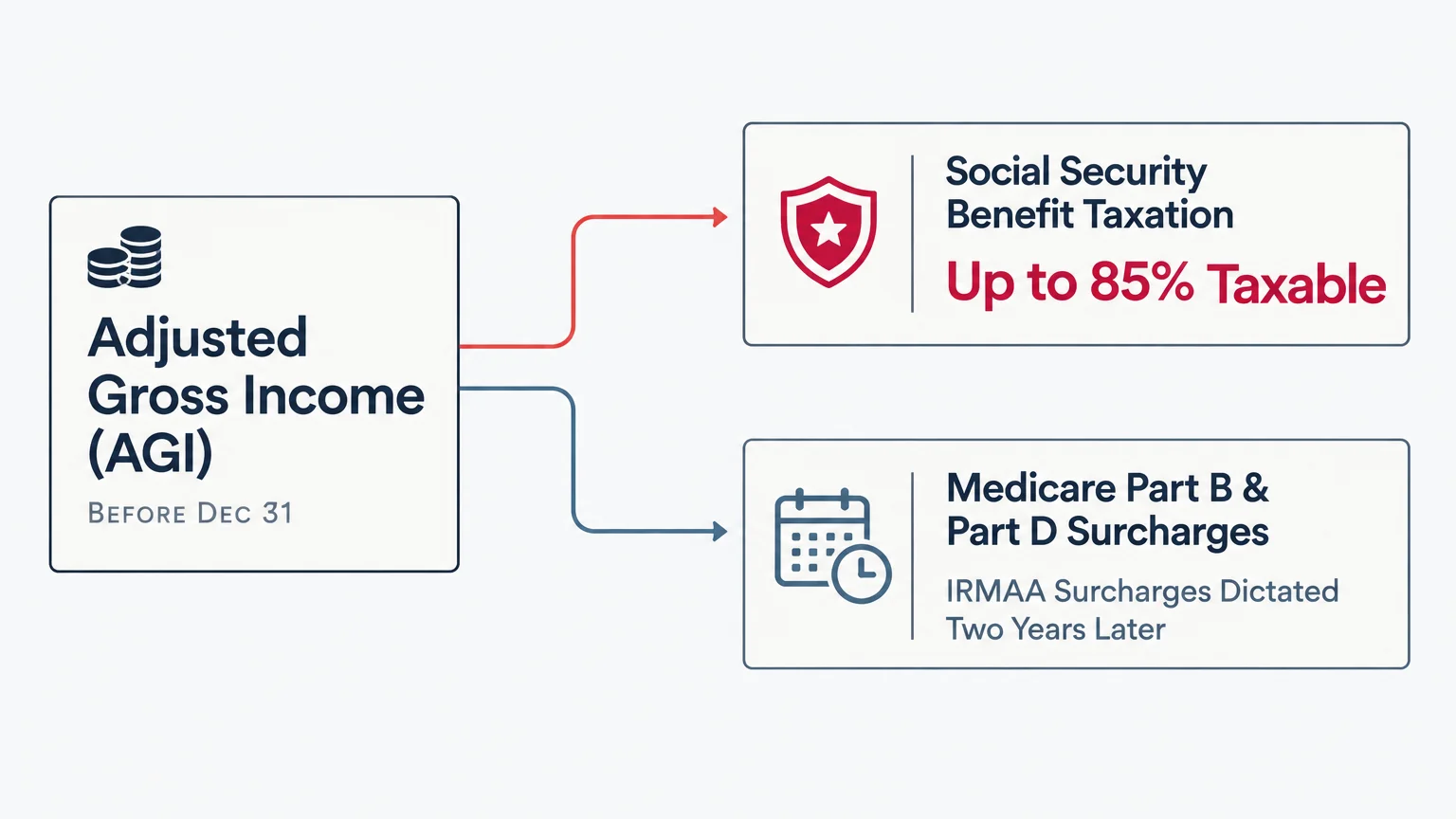
For example, a higher modified adjusted gross income can increase the taxation of your Social Security benefits. Guidance from the Social Security Administration (SSA) explains that up to 85% of your benefits can become taxable when your combined income exceeds federal limits.
Higher income also triggers Medicare surcharges known as the Income-Related Monthly Adjustment Amount (IRMAA). These surcharges raise your Part B and Part D premiums significantly.
According to regulations enforced by the Centers for Medicare & Medicaid Services (CMS), your 2026 income directly dictates your Medicare premiums two years later. A sudden spike in earnings today can create an unwelcome premium surcharge down the road.
Careful year-end tax moves give you full control over your adjusted gross income. Taking decisive action before December 31 prevents costly tax surprises when you file.

Move 1: Satisfy Your Required Minimum Distribution to Avoid Steep Penalties
The IRS requires retirees to withdraw a minimum amount annually from traditional retirement accounts. This requirement applies to traditional IRAs, 401(k) plans, and 403(b) accounts once you reach age 73.
If you turned 73 during 2026, you have until April 1, 2027, to withdraw your first required minimum distribution (RMD). However, delaying that initial distribution forces you to take two separate RMDs in 2027.
Taking two distributions in a single calendar year can easily push you into a higher tax bracket. For most retirees, taking your first RMD by December 31, 2026, is the cleaner financial move.
If you reached age 73 before 2026, your deadline is firm. You must complete your annual withdrawal by December 31, 2026.
The penalty for missing your distribution is severe. The IRS charges an excise tax penalty of 25% on the amount you fail to withdraw.
If you discover an error and correct it within two years, the IRS may reduce that penalty to 10%. Even so, losing a tenth of your distribution to avoidable penalties hurts any fixed budget.
Contact your plan custodian or brokerage firm well before mid-December. Financial institutions experience high transaction volumes during the holidays, and processing delays can cause you to miss the year-end deadline.
Follow these steps to manage your RMD safely this year:
- Calculate your total RMD obligation across all traditional retirement accounts.
- Confirm whether your custodian automatically withholds federal and state taxes from the payout.
- Submit your distribution paperwork before December 15 to allow adequate bank processing time.
- Keep written verification of the distribution confirmation in your permanent tax files.
Move 2: Use Qualified Charitable Distributions to Slash Adjusted Gross Income
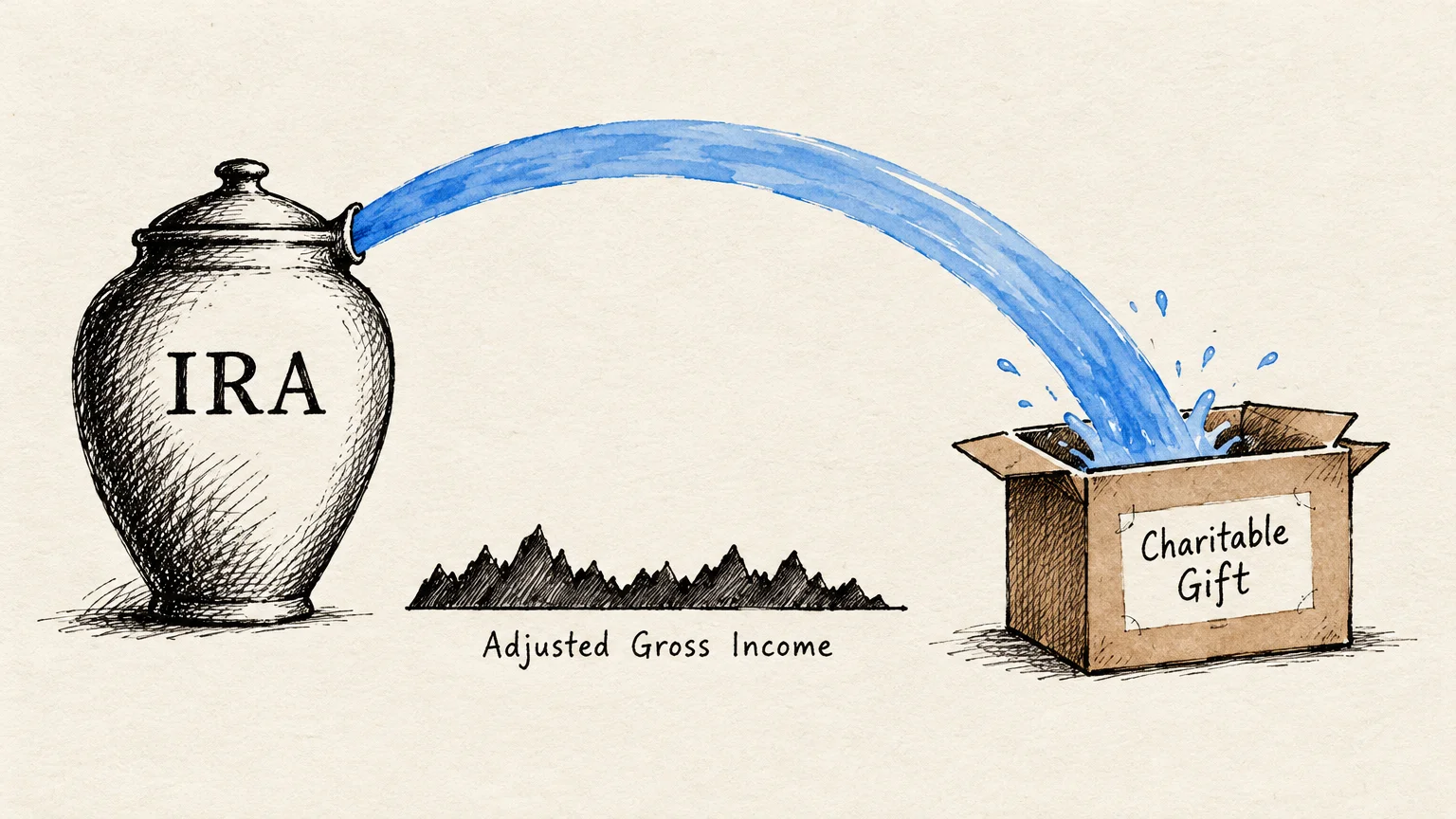
If you are age 70½ or older, a Qualified Charitable Distribution (QCD) offers an exceptional tax advantage. This strategy allows you to send money directly from your traditional IRA to a qualified charity.
In 2026, you can transfer up to $111,000 per person directly to eligible nonprofit organizations. If you and your spouse each own traditional IRAs, you can collectively donate up to $222,000.
A QCD counts directly toward satisfying your annual RMD for the year. Most importantly, the donated sum is completely excluded from your adjusted gross income.
This exclusion provides a much stronger tax benefit than an itemized charitable deduction. Because the money never touches your gross income, it cannot push you into higher tax brackets or trigger Medicare IRMAA surcharges.
The 2026 rules also permit a one-time split-interest gift of up to $55,000. This special transfer funds a Charitable Remainder Trust or Charitable Gift Annuity, providing lifetime income alongside your gift.
Retirees who do not use QCDs should note the regular charitable giving updates for 2026. Non-itemizers can deduct cash gifts up to $1,000 for single filers or $2,000 for married couples filing jointly.
Meanwhile, itemizers face a new rule requiring contributions to exceed 0.5% of adjusted gross income before qualifying for deductions. These rules make direct IRA gifts more appealing than traditional cash donations.
To execute a QCD properly before year-end, observe these critical rules:
- The check must be issued payable directly from your IRA custodian to the designated 501(c)(3) charity.
- Never withdraw the funds into your personal checking account first, as this invalidates the tax exemption.
- Obtain a written acknowledgment letter from the charity before filing your tax return.
- Ensure the distribution completes before December 31 so it counts for the 2026 tax year.
Move 3: Claim the New Senior Bonus Deduction Alongside the Standard Deduction
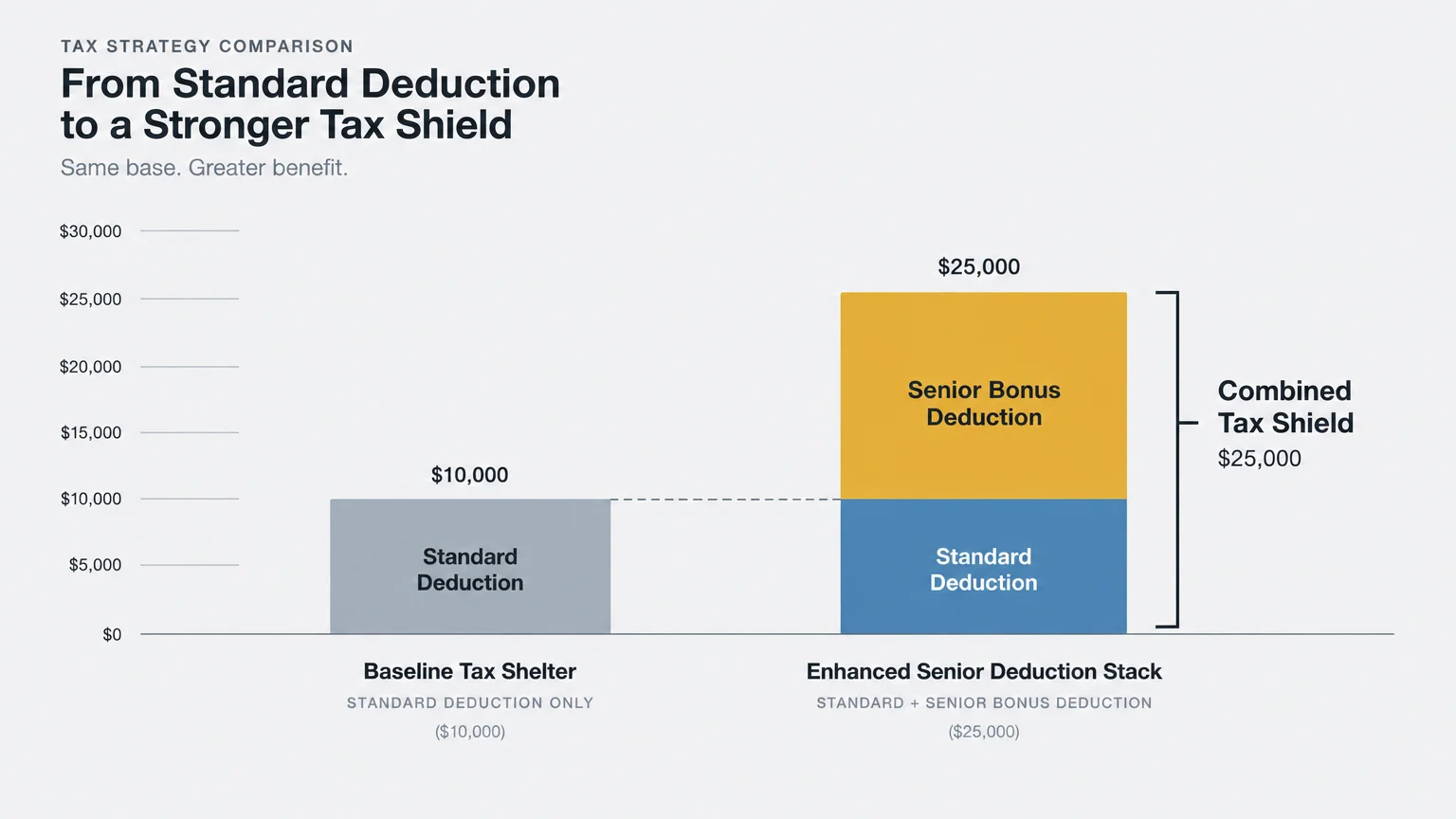
The standard deduction provides a vital foundation for senior tax savings. For the 2026 tax year, the base standard deduction is $16,100 for single filers and $32,200 for married couples filing jointly.
Heads of household receive a base standard deduction of $24,150. In addition, older Americans receive traditional senior boost amounts once they reach age 65.
Single filers aged 65 or older receive an additional $2,050 deduction. Married filers receive an extra $1,650 for each spouse who meets the age requirement.
Furthermore, taxpayers benefit from the enhanced Senior Bonus Deduction enacted for the 2025 through 2028 tax years. This law provides an extra $6,000 deduction per eligible individual aged 65 or older.
A married couple filing jointly where both spouses are 65 or older claims an extra $12,000 deduction. This new deduction is available on Schedule 1-A to both itemizers and non-itemizers alike.
This bonus deduction phases out at a rate of 6% for incomes above certain thresholds. The phaseout begins when modified adjusted gross income exceeds $75,000 for single filers or $150,000 for joint filers.
| Filing Status | Base Standard Deduction | Traditional 65+ Addition | Enhanced Senior Bonus | Total Potential Deduction |
|---|---|---|---|---|
| Single (Age 65+) | $16,100 | $2,050 | $6,000 | $24,150 |
| Married Jointly (One Spouse 65+) | $32,200 | $1,650 | $6,000 | $39,850 |
| Married Jointly (Both 65+) | $32,200 | $3,300 | $12,000 | $47,500 |
Review your total earnings before year-end to see if your income falls near the phaseout limits. Deferring income or executing deductions can keep your bonus deduction fully intact.
Move 4: Top Off Lower Brackets with Strategic Year-End Roth Conversions
A Roth conversion transfers money from a traditional pre-tax retirement account into an after-tax Roth IRA. You pay income tax on the converted balance in the year of the transfer.
In exchange, future growth and withdrawals from the Roth IRA become completely tax-free. Roth accounts also eliminate future RMD requirements for the original owner.
Because federal tax rates remain at favorable levels, converting funds before December 31 can protect your long-term wealth. The seven ordinary federal income tax rates are 10%, 12%, 22%, 24%, 32%, 35%, and 37%.
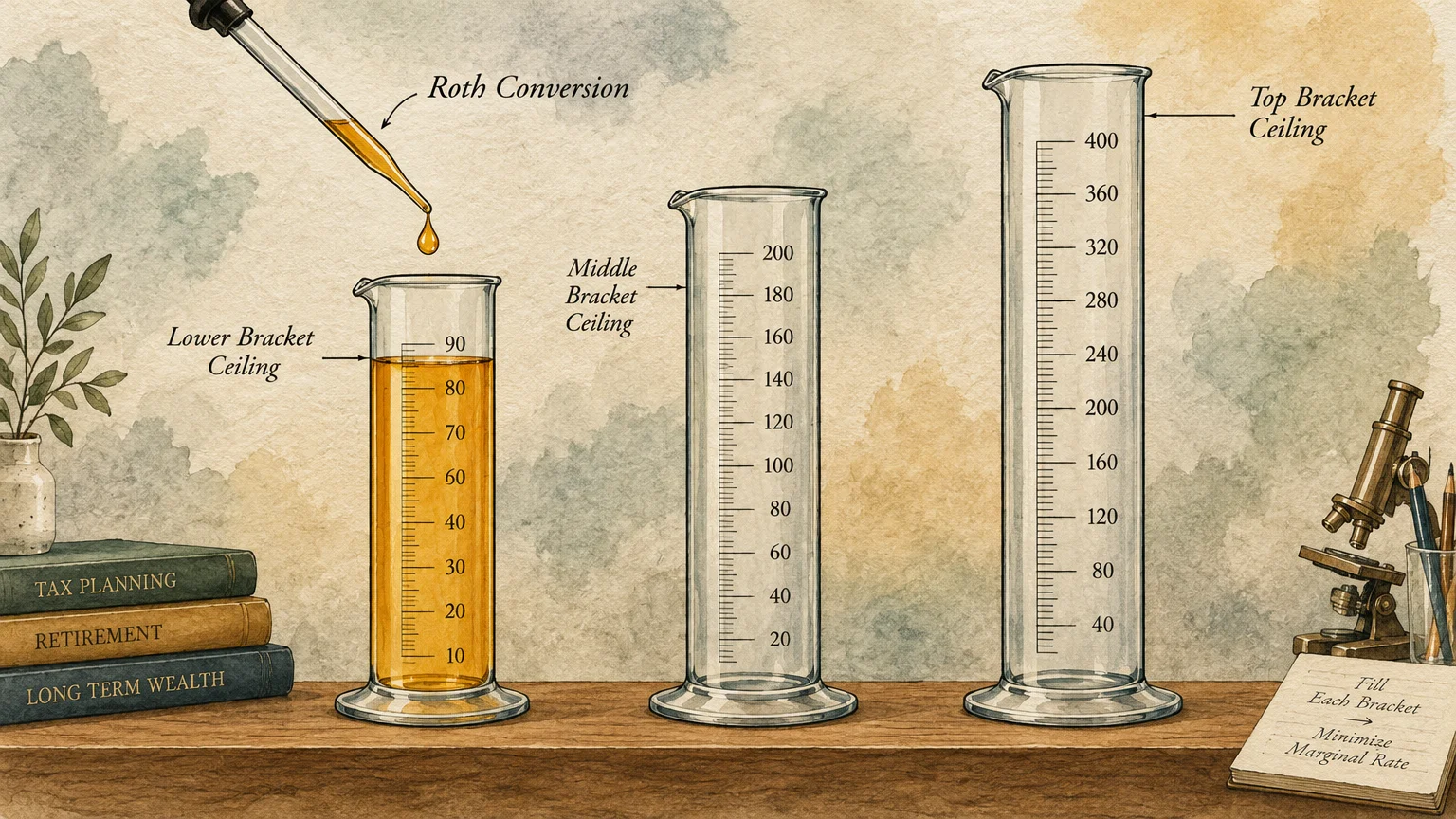
A proven strategy involves converting just enough pre-tax money to fill your existing tax bracket without spilling into the next one. Financial planners call this approach “topping off” your tax bracket.
For 2026, the 12% tax bracket tops out at $50,400 of taxable income for single filers and $100,800 for married couples filing jointly. If your projected income leaves room below those ceilings, you can convert traditional savings at that low 12% rate.
Retirees with slightly higher income might top off the 22% bracket, which ends at $105,700 for singles and $211,400 for joint returns. The 24% bracket reaches $201,775 for single filers and $403,550 for joint filers.
| Federal Tax Rate | 2026 Single Filer Ceiling | 2026 Married Filing Jointly Ceiling |
|---|---|---|
| 12% Bracket | $50,400 | $100,800 |
| 22% Bracket | $105,700 | $211,400 |
| 24% Bracket | $201,775 | $403,550 |
Be careful when determining your conversion amount. Pushing your taxable income too high can increase your Medicare Part B and D costs two years later.
Remember that all Roth conversions must settle on or before December 31 to apply to the 2026 tax year. The IRS does not allow retroactive Roth conversions completed during the spring tax filing season.

Move 5: Harvest Capital Losses and Lock in 0% Capital Gains Rates
Reviewing non-retirement investment accounts before December 31 presents excellent opportunities to lower your tax liability. You can balance winning investments against underperforming assets through tax-loss harvesting.
When you sell investments that lost value, you generate realized capital losses. These capital losses offset your realized capital gains dollar-for-dollar across your entire taxable portfolio.
If your total realized losses exceed your gains, you can use up to $3,000 of excess losses to offset ordinary income. Married individuals filing separately can offset up to $1,500.
Any remaining losses do not vanish. You can carry them forward into future tax years to offset gains indefinitely.
Watch out for the IRS wash-sale rule when harvesting losses. You cannot claim an investment loss if you repurchase the exact same asset within 30 days before or after the sale.
Conversely, seniors in lower tax brackets can take advantage of tax-gain harvesting. The IRS offers a 0% federal tax bracket on long-term capital gains for assets held longer than one year.
For 2026, the 0% long-term capital gains threshold extends up to $49,450 for single filers and $98,900 for married couples filing jointly. Head-of-household filers can earn up to $66,200 at the 0% rate.
If your total taxable income sits below these thresholds, you can sell appreciated stock without paying federal capital gains tax. You can immediately repurchase the shares to raise your cost basis without violating wash-sale rules.

Move 6: Bunch Unreimbursed Medical and Long-Term Care Insurance Expenses
Healthcare costs represent one of the largest expenses for retired adults. Fortunately, the tax code allows you to deduct qualifying, unreimbursed medical expenses if you itemize your deductions.
To qualify, your total unreimbursed medical and dental expenses must exceed 7.5% of your adjusted gross income. You can only deduct the portion of expenses that surpasses that 7.5% threshold.
If you have had heavy medical expenses this year, consider paying outstanding medical bills before December 31. Scheduling and paying for vision exams, dental work, or hearing aids before year-end helps you clear the hurdle.
Tax-qualified long-term care (LTC) insurance premiums also count as deductible medical expenses. The IRS establishes annual deduction caps for LTC premiums based on your age at the end of the year.
For the 2026 tax year, the deductible limits per person are:
- Age 40 or younger: Up to $500
- Age 41 to 50: Up to $930
- Age 51 to 60: Up to $1,860
- Age 61 to 70: Up to $4,960
- Age 71 and older: Up to $6,200
If you receive periodic benefits from a qualified LTC policy, those payments are generally tax-free up to $430 per day. Any payments exceeding that cap are taxable unless spent directly on actual long-term care services.
Additionally, remember that the state and local tax (SALT) deduction cap is $40,400 in 2026 for itemizers ($20,200 if married filing separately). This expanded cap makes itemizing medical and property taxes far more worthwhile for many homeowners.
Consumer educational guides from the Consumer Financial Protection Bureau (CFPB) emphasize keeping clear receipts for all healthcare payments. Accurate documentation ensures you can defend every itemized expense if questions arise.

Move 7: Maximize Catch-Up Retirement and Health Savings Account Contributions
Many seniors continue working full-time or part-time well into their 60s and 70s. If you earn wages, maximizing retirement plan contributions before year-end delivers substantial tax reductions.
For 2026, the baseline employee contribution limit for 401(k), 403(b), and 457 plans is $24,500. Workers aged 50 and older can contribute an additional catch-up amount of $8,000, bringing their total limit to $32,500.
Workers aged 60, 61, 62, and 63 qualify for a special “super catch-up” contribution limit. Instead of $8,000, these individuals can contribute an extra $11,250, allowing a total annual deferral of $35,750.
Keep one key rule in mind if you earned high wages recently. If your FICA wages exceeded $150,000 in 2025, the IRS requires your 2026 catch-up contributions to enter a Roth account.
Traditional and Roth IRAs also allow catch-up savings. The 2026 IRA limit is $7,500, with a $1,100 catch-up contribution for individuals aged 50 and older, totaling $8,600.
While IRA contributions can occur until April 15, 2027, employer-sponsored 401(k) contributions must run through payroll by December 31, 2026. Adjust your year-end payroll withholdings immediately if you wish to reach the maximum limit.
If you are still working and enrolled in an eligible high-deductible health plan without Medicare, consider a Health Savings Account (HSA). The 2026 HSA limits are $4,400 for self-only coverage and $8,750 for family coverage.
Individuals aged 55 and older can make an extra $1,000 catch-up contribution. HSA contributions lower your taxable income today, grow tax-free, and withdraw tax-free for qualified medical expenses.
Be cautious if you plan to enroll in Medicare soon. You must stop contributing to an HSA six months before enrolling in Medicare Part A to avoid retroactive tax penalties.

Move 8: Transfer Wealth Tax-Free Through Annual Exclusion Gifting
Helping children or grandchildren financially during your lifetime provides emotional joy while lowering your overall taxable estate. The IRS annual gift tax exclusion makes this possible without complicated tax forms.
For 2026, the annual gift tax exclusion is $19,000 per recipient. A married couple can combine their exclusions to give up to $38,000 per recipient without filing a gift tax return.
You can give this amount to as many individual recipients as you wish each year. You can provide gifts to children, grandchildren, or trusted family friends without any recipient owing income tax.
Annual gifting reduces your future estate assets safely. For 2026, the lifetime estate and gift tax exemption stands at $15,000,000 per individual and $30,000,000 for married couples.
You can also take advantage of unlimited exclusions by paying expenses directly. If you pay tuition directly to an educational institution, that money does not count against your $19,000 annual limit.
The same exception applies to medical care. Paying a hospital or healthcare provider directly on behalf of a loved one is entirely exempt from gift limits.
To count for the 2026 tax year, your gifts must be delivered and deposited before December 31. Checks mailed on New Year’s Eve that clear in January will count toward your 2027 limits instead.

Common Year-End Tax Pitfalls and Scams to Avoid
Tax season unfortunately brings out dishonest actors seeking to exploit seniors. Fraudsters frequently impersonate government officials as December 31 approaches.
The IRS will never call you unexpectedly demanding immediate payment via prepaid debit cards, gift cards, or wire transfers. Real tax agencies always initiate contact through official mail delivered by the U.S. Postal Service.
Senior advocacy research published by AARP highlights that aggressive phone calls threatening arrest or account freezes are clear warning signs of fraud. If you receive an urgent or threatening call regarding back taxes, hang up immediately.
Beyond external scams, simple administrative mistakes can derail your tax strategies. Waiting until the final week of December to request distributions often results in missed deadlines.
Pay close attention to these common pitfalls during year-end tax planning:
- Failing to take an RMD due to confusion over account types or age requirements.
- Writing personal checks to charities instead of using direct custodian transfers for QCDs.
- Violating the 30-day wash-sale rule when harvesting portfolio losses.
- Triggering unexpected Medicare IRMAA surcharges by converting too much pre-tax retirement income at once.
- Missing the December 31 processing cutoff for employer retirement plan contributions.
Take time to review your numbers with a qualified tax professional or certified financial planner. Verifying transactions early gives you peace of mind as the new year begins.
Frequently Asked Questions
When must I complete these year-end tax moves to count for 2026?
Most transactions must be completed on or before December 31, 2026. This strict deadline applies to RMDs, Qualified Charitable Distributions, 401(k) contributions, capital loss harvesting, and annual family gifts.
Traditional and Roth IRA contributions are the primary exceptions. You have until April 15, 2027, to complete annual IRA contributions for the 2026 tax year.
Can a Qualified Charitable Distribution count toward my RMD if I already took the cash?
No, you cannot retroactively turn an ordinary cash withdrawal into a Qualified Charitable Distribution. Once funds enter your personal bank account, they count as taxable income.
To qualify as a QCD, your IRA custodian must send the funds directly to the eligible nonprofit organization.
How does the enhanced Senior Bonus Deduction affect my standard deduction?
The enhanced Senior Bonus Deduction provides an extra $6,000 deduction per qualifying individual aged 65 or older. This bonus deduction sits on top of your standard deduction and traditional senior additions.
You claim this deduction on Schedule 1-A, and it is available whether you take the standard deduction or itemize your deductions.
Does selling stock at a loss affect my Social Security taxation?
Harvesting capital losses lowers your adjusted gross income by offsetting investment gains and up to $3,000 in ordinary income. A lower adjusted gross income reduces your provisional income calculation.
Keeping provisional income below federal thresholds helps reduce the portion of your Social Security benefits subject to income tax.
Can I make an HSA catch-up contribution if I am enrolled in Medicare?
No, federal law prohibits contributions to a Health Savings Account once you enroll in any part of Medicare. You must stop HSA contributions six months prior to applying for Medicare Part A to prevent tax penalties.
For additional senior resources, visit
Medicare.gov, National Institute of Mental Health (NIMH), National Institutes of Health (NIH), Centers for Medicare & Medicaid Services (CMS) and Social Security Administration (SSA).
Disclaimer: The information in this article is for educational purposes only and is not intended to be a substitute for professional financial, legal, or medical advice. Always consult with a qualified expert for advice tailored to your personal situation.









Leave a Reply