

You can dramatically reduce your healthcare expenses through dedicated government relief programs created for retirees. If high medical bills strain your budget, substantial financial assistance is available right now.
Seven key programs help older adults save thousands of dollars each year by covering essential Medicare costs. These initiatives protect your retirement savings while preserving your access to high-quality healthcare.
Finding the right support takes only a few minutes once you understand the criteria. You can secure immediate financial relief and safeguard your fixed income today.
The Reality of Medicare Costs and Available Relief
Many seniors enter retirement expecting Medicare to cover all their medical needs without significant personal expense. However, standard Medicare coverage still requires substantial out-of-pocket contributions that can overwhelm a fixed income.
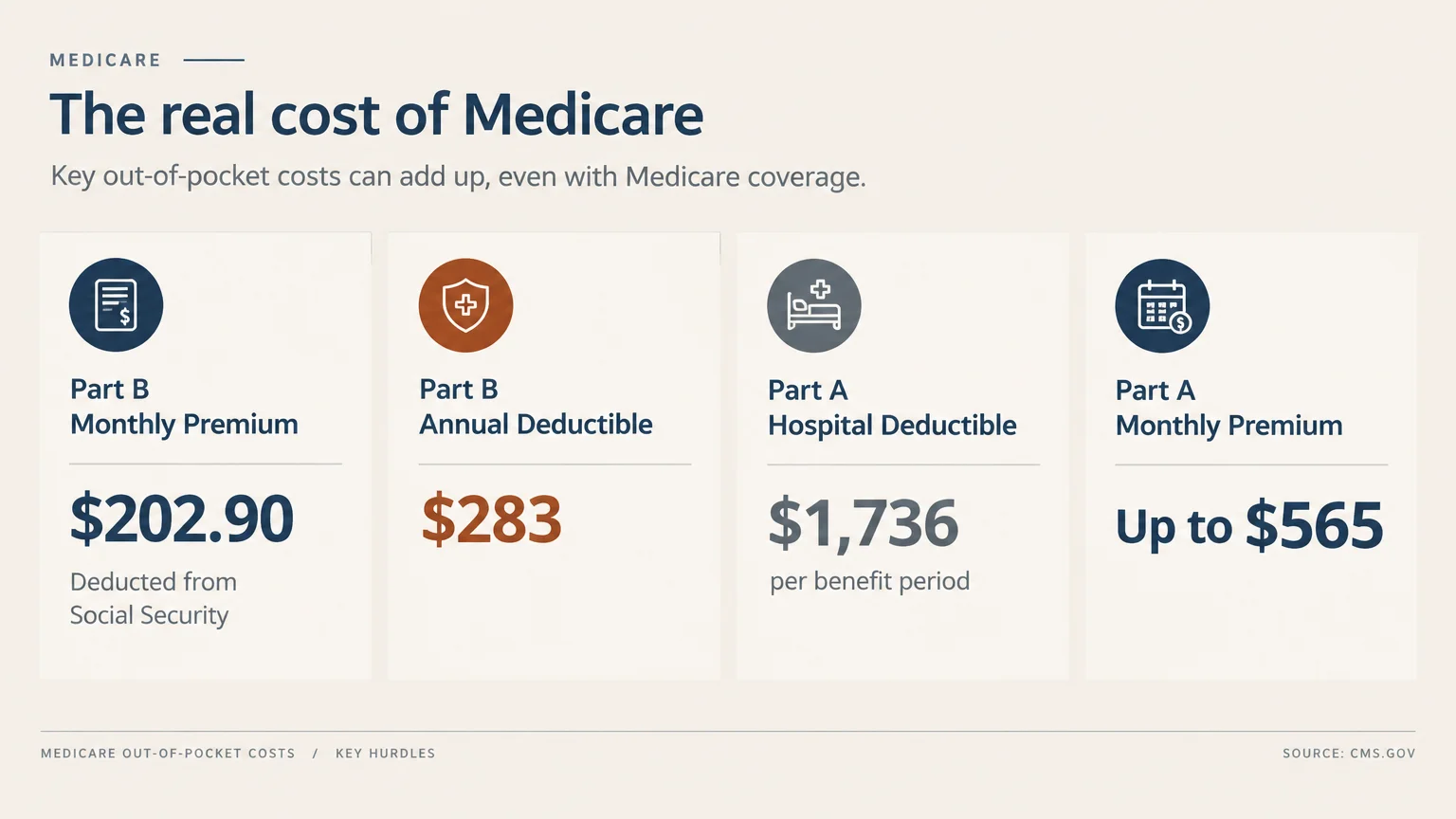
For example, the standard Medicare Part B monthly premium is $202.90. This amount is typically deducted directly from your monthly Social Security benefit check.
Before Part B pays for doctor visits or outpatient services, you must also satisfy an annual deductible of $283. Inpatient hospital admissions present even higher hurdles, with a Part A deductible of $1,736 per benefit period.
If you lack sufficient work history, Medicare Part A premiums can cost up to $565 per month. When you combine these expenses with prescription drug costs, basic healthcare can quickly become unaffordable.
Fortunately, specialized federal and state initiatives provide low-income senior assistance. These programs bridge the affordability gap so you never have to choose between medical care and daily necessities.
State agencies administer several of these options, while federal departments oversee others. Qualifying for even one program can save you thousands of dollars each year.
The Four Core Medicare Savings Programs
Medicare Savings Programs, commonly known as MSPs, represent four distinct state-administered pathways that pay your Medicare premiums. In many cases, they also eliminate deductibles, copayments, and coinsurance entirely.
According to Medicare.gov, qualifying for any Medicare Savings Program automatically enrolls you in extra financial relief for prescription drugs. This dual benefit offers immediate peace of mind for cost-conscious retirees.
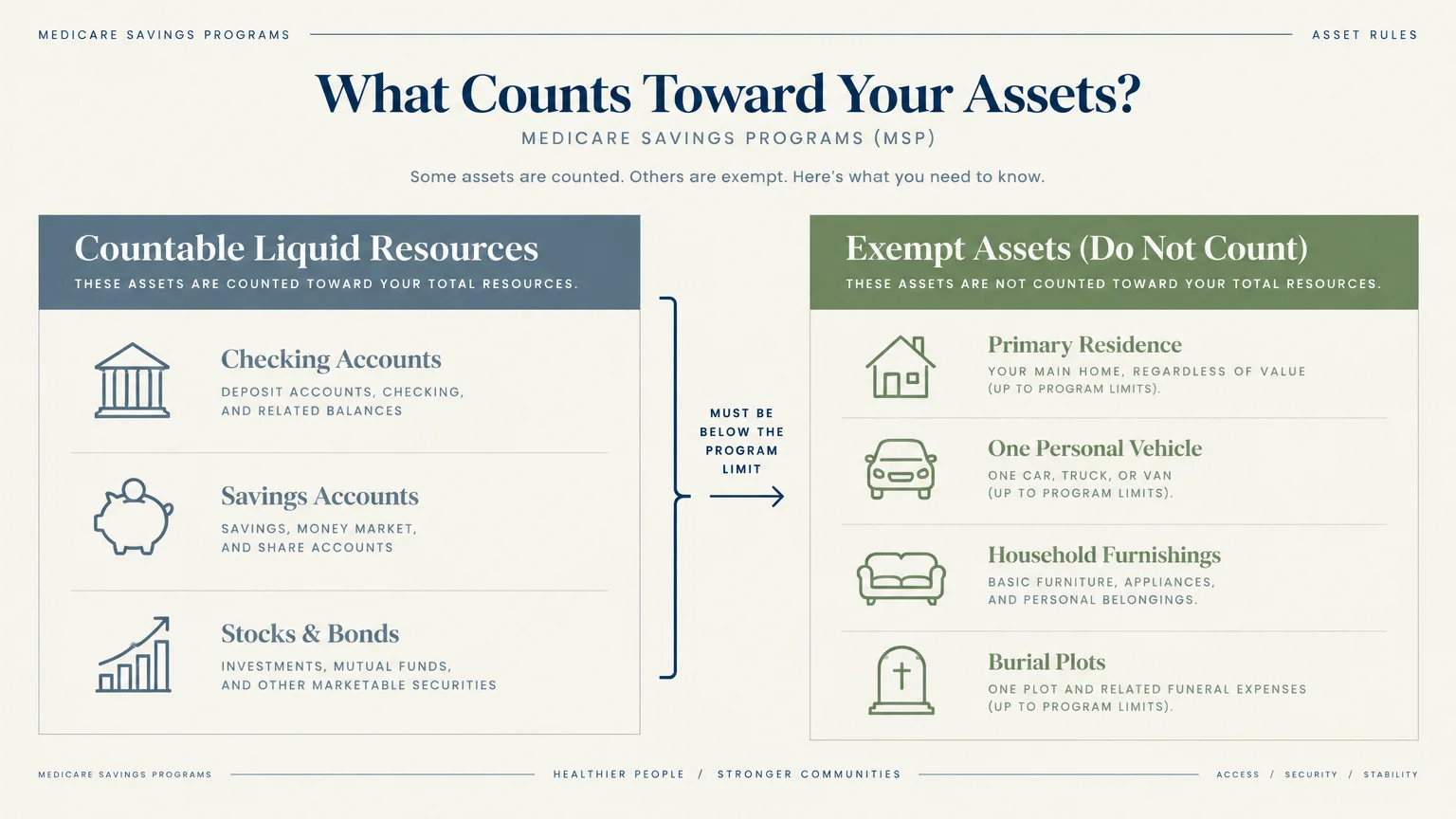
To qualify for an MSP, your income and countable resources must fall below specific federal thresholds. Countable resources include checking accounts, savings accounts, stocks, bonds, and mutual funds.
However, your home, one personal vehicle, household furnishings, personal effects, and designated burial plots do not count toward your asset limit. Many states also offer higher income allowances or have eliminated asset tests completely.
For the first three MSP programs below, the standard federal resource limit is $9,950 for an individual and $14,910 for a married couple.
1. Qualified Medicare Beneficiary (QMB) Program
The Qualified Medicare Beneficiary program delivers the most comprehensive financial protection among all MSPs. QMB pays your Medicare Part A premium and your monthly Part B premium of $202.90.
Additionally, QMB covers all Medicare deductibles, coinsurance, and copayments for Medicare-covered services. Healthcare providers are strictly forbidden by federal law from billing QMB enrollees for covered services.
To qualify in 2026, your monthly income cannot exceed $1,350 for an individual or $1,824 for a married couple. These limits include the standard $20 unearned income disregard applied by states.
2. Specified Low-Income Medicare Beneficiary (SLMB) Program
If your monthly income slightly exceeds the QMB threshold, the SLMB program offers vital financial assistance. SLMB specifically pays your monthly Part B premium, putting $202.90 back into your monthly Social Security check.
Over the course of a full year, SLMB returns $2,434.80 directly to your personal budget. This steady relief helps you keep up with rising utility bills and grocery costs.
The 2026 monthly income limit for SLMB is $1,616 for an individual and $2,184 for a married couple. Resource limits match the standard MSP threshold of $9,950 for individuals and $14,910 for couples.
3. Qualifying Individual (QI) Program
The Qualifying Individual program extends Part B premium relief to seniors with slightly higher retirement earnings. Like SLMB, the QI program pays your full $202.90 monthly Part B premium.
QI operates under an annual federal grant allocation distributed to each state. Because funding is capped, states approve eligible applicants on a first-come, first-served basis each calendar year.
In 2026, the monthly income limit for QI is $1,816 for an individual and $2,455 for a married couple. You must reapply annually to maintain your QI benefits.
4. Qualified Disabled and Working Individuals (QDWI) Program
The QDWI program serves a unique group of Medicare beneficiaries who have physical or mental disabilities. It helps individuals under age 65 who lost premium-free Part A benefits after returning to work.
QDWI pays the costly Part A monthly premium, which can reach up to $565 every month. This support allows working individuals with disabilities to maintain essential inpatient coverage.
The 2026 monthly income limit is $5,405 for an individual and $7,299 for a married couple. Countable resource limits for QDWI are $4,000 for an individual and $6,000 for a couple.
| Medicare Savings Program | Monthly Income Limit (Individual) | Monthly Income Limit (Couple) | Core Financial Benefits |
|---|---|---|---|
| QMB | $1,350 | $1,824 | Pays Part A & B premiums, deductibles, coinsurance, and copays |
| SLMB | $1,616 | $2,184 | Pays standard monthly Part B premium ($202.90) |
| QI | $1,816 | $2,455 | Pays standard monthly Part B premium on first-come basis |
| QDWI | $5,405 | $7,299 | Pays Part A monthly premium (up to $565) |

Program 5: Medicare Part D Extra Help
Prescription medications represent one of the largest ongoing expenses for older Americans managing chronic medical conditions. The federal Extra Help program, formally known as the Part D Low-Income Subsidy, minimizes these costs.
According to the Social Security Administration (SSA), Extra Help provides an estimated average annual value of $5,700 per beneficiary. This program transforms unpredictable pharmacy bills into small, manageable copayments.
Under recent federal expansions, all qualifying applicants receive full subsidy benefits up to 150% of the Federal Poverty Level. The former partial subsidy tier has been completely eliminated to provide maximum assistance.
In 2026, the annual income limit for Extra Help is $23,940 for an individual and $32,460 for a married couple. These limits translate to approximately $2,015 monthly for individuals and $2,725 monthly for couples.
Countable resource limits are $18,090 for an individual and $36,100 for a married couple. Crucially, these figures include a built-in $1,500 per-person allowance specifically designated for burial and funeral expenses.
Enrollees in Extra Help pay a $0 monthly plan premium for benchmark drug plans and a $0 annual deductible. In 2026, prescription copayments are capped at just $5.10 for generic medications and $12.65 for brand-name drugs.
Once your drug costs reach the catastrophic coverage threshold, your copayment drops to $0 for covered medications. If you already receive Medicaid, Supplemental Security Income, or an MSP, you qualify for Extra Help automatically.

Program 6: Full Medicaid and Dual-Eligible Special Needs Plans
Retirees with very limited income and assets may qualify for both Medicare and full state Medicaid benefits. Healthcare professionals refer to seniors enrolled in both programs simultaneously as dual-eligible beneficiaries.
In many states, full Medicaid eligibility links directly to the Supplemental Security Income benefit rate. For 2026, the SSI federal benefit rate is $994 per month for an individual and $1,491 for a couple.
Federal countable asset limits for traditional Aged, Blind, and Disabled Medicaid remain $2,000 for individuals and $3,000 for couples. However, progressive states like California have eliminated asset tests for senior Medicaid programs entirely.
When you achieve dual-eligible status, Medicare acts as your primary insurance payer while Medicaid serves as secondary coverage. Medicaid pays your Medicare premiums, covers remaining cost-sharing, and provides services Medicare excludes.
These excluded services frequently include long-term nursing home care, extensive personal care assistance at home, and routine dental visits. This combination shields vulnerable seniors from catastrophic medical debt.
As noted by the Centers for Medicare & Medicaid Services (CMS), Dual Eligible Special Needs Plans coordinate care between state Medicaid programs and Medicare to improve health outcomes.
Known as D-SNPs, these specialized Medicare Advantage plans offer tailored care coordination networks for dual-eligible seniors. D-SNPs frequently include valuable allowances for over-the-counter health items, grocery purchases, and non-emergency medical transportation.

Program 7: Program of All-Inclusive Care for the Elderly
The Program of All-Inclusive Care for the Elderly, known as PACE, is an innovative community care model. PACE enables frail older adults to remain living safely in their homes rather than moving into nursing facilities.
To qualify for PACE, you must be at least 55 years old and live within a designated PACE service area. Your state must also certify that you require a nursing home level of skilled care.
A coordinated team of healthcare professionals manages every aspect of your daily treatment plan. This interdisciplinary team includes primary care physicians, registered nurses, physical therapists, social workers, dietitians, and personal care attendants.
PACE centers provide medical clinic visits, recreational therapy, social activities, hot meals, and occupational rehabilitation. The program also provides door-to-door transportation to the center and external medical appointments.
If you qualify for both Medicare and Medicaid, you pay $0 for all approved PACE services and prescription drugs. PACE assumes complete financial responsibility for your care, eliminating separate copayments and deductibles entirely.
Even if you only have Medicare without Medicaid, you can participate in PACE by paying a monthly premium. This option provides comprehensive long-term care without liquidating your family assets.
New Prescription Safeguards: Out-of-Pocket Caps and LI NET
Recent federal legislation introduced powerful safeguards that work alongside Medicare programs for low-income retirees. These improvements ensure that prescription drug pricing remains predictable and manageable throughout the entire year.
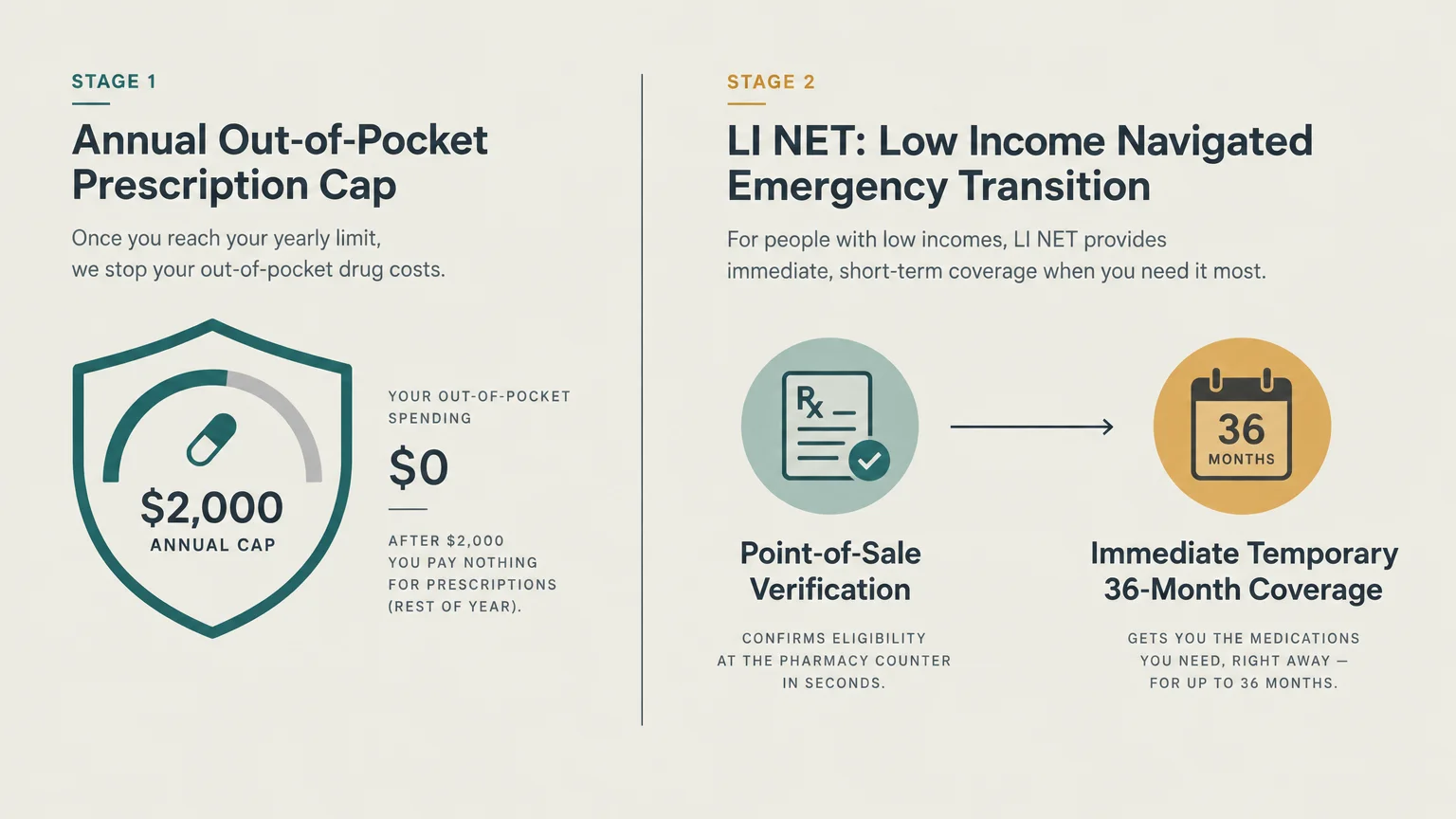
Starting in 2026, all Medicare Part D prescription drug plans feature a hard annual out-of-pocket cap of $2,100. Once you spend $2,100 on covered medications, your plan pays 100% of your drug costs for the rest of the calendar year.
This cap applies to standalone Part D drug plans and Medicare Advantage plans with prescription coverage. It protects retirees facing unexpected diagnoses requiring expensive specialty medications.
Additionally, seniors can opt into the Medicare Prescription Payment Plan through their Part D plan sponsor. This program spreads high out-of-pocket pharmacy costs into interest-free, capped monthly installment payments instead of requiring large lump-sum payments at the pharmacy counter.
Low-income seniors also benefit from the Limited Income Newly Eligible Transition program, known as LI NET. Administered through Medicare, LI NET provides immediate, temporary prescription drug coverage for individuals who qualify for Medicaid or Extra Help but have not yet enrolled in a Part D plan.
If you visit a pharmacy without an active drug plan, the pharmacist can enroll you in LI NET on the spot. You simply present proof of Medicaid or SSI eligibility to obtain your medications at subsidized copayment rates.

Step-by-Step Guide to Applying for Assistance
Applying for low-income senior assistance requires organized preparation, but the application process is straightforward. Following a systematic approach ensures your application moves through state and federal review without unnecessary delays.
- Gather Financial Documentation: Assemble your recent Social Security benefit statements, pension distribution letters, and bank statements for all checking and savings accounts. Collect documentation for life insurance cash surrender values, investment accounts, and property deeds.
- Confirm Your Household Income: Calculate your gross monthly income before deductions. Remember to exclude standard state disregards, such as the standard $20 unearned income disregard applied to Medicare Savings Programs.
- Submit Applications to the Correct Agency: Submit your Medicare Savings Program and Medicaid applications directly to your state social services or Medicaid agency. Apply for Medicare Part D Extra Help directly through the Social Security Administration online or at your local office.
- Track Verification Requests: Respond immediately if a caseworker requests additional documentation or clarification regarding your assets. Keep physical copies of every document and application you submit for your personal records.
You can connect with your local State Health Insurance Assistance Program by contacting the Eldercare Locator for free, confidential enrollment counseling. SHIP counselors provide unbiased, local guidance to help you navigate state-specific income limits.
Unlike standard Medicare enrollment, you do not need to wait for the fall Annual Enrollment Period to apply for low-income assistance. You can apply for Medicare Savings Programs, Medicaid, and Extra Help at any point during the calendar year.
Once approved for Extra Help or dual-eligible Medicaid, you unlock Special Enrollment Periods. These periods allow you to adjust your Medicare Advantage or Part D coverage throughout the year as your healthcare needs evolve.

Critical Pitfalls and Fraud Protection for Seniors
Many eligible seniors miss out on valuable benefits due to common misconceptions about qualification rules. The most widespread error is assuming you earn too much money to qualify without checking your state’s current thresholds.
Several states have expanded their income rules or completely removed asset limits for Medicare Savings Programs. Never disqualify yourself before reviewing the exact guidelines used by your state agency.
Another frequent pitfall involves failing to complete annual redetermination paperwork sent by your state Medicaid office. If you fail to verify your income by the stated deadline, your benefits will terminate abruptly.
Be aware that healthcare providers cannot bill QMB beneficiaries for Medicare deductibles, copayments, or coinsurance. If a clinic sends you a balance bill while you hold QMB status, notify the billing department immediately of your protected legal status.
Low-income seniors must also remain vigilant against dishonest marketing schemes and identity theft. Fraudulent operators frequently target older adults by posing as official Medicare or Social Security representatives.
The Consumer Financial Protection Bureau (CFPB) advises seniors to never share personal financial details or Medicare numbers with unsolicited callers. Legitimate government agencies will never call you unannounced demanding personal information or money to process your assistance benefits.
- Hang up on automated robocalls claiming your Medicare card is expired or scheduled for cancellation.
- Never accept offers of free medical equipment or genetic testing kits in exchange for your Medicare number.
- Review your Medicare Summary Notices quarterly to verify that all billed services reflect care you actually received.
- Shred paper documents containing medical ID numbers, Social Security details, or bank records before discarding them.
Frequently Asked Questions
Can I qualify for a Medicare Savings Program if I own my home and a car?
Yes, you can qualify while owning a home and a personal automobile. Under federal guidelines, your primary residence and one personal vehicle do not count toward the asset limit for Medicare Savings Programs.
What happens if my income is slightly above the federal poverty guidelines?
You may still qualify because state agencies apply specific income deductions, including a standard $20 unearned income disregard. Furthermore, several states set income thresholds significantly higher than the federal baseline.
Do I have to pay back the benefits received from Medicare Savings Programs or Extra Help?
No, you do not have to repay benefits received under MSPs or Part D Extra Help. These programs operate as ongoing financial subsidies rather than loans, and they are not subject to standard estate recovery rules.
Can healthcare providers bill me for copays if I have QMB status?
No, federal law strictly prohibits Medicare-contracted healthcare providers from billing QMB beneficiaries for Medicare cost-sharing. If a doctor bills you improperly, show your QMB card and request an immediate billing correction.
How often do I need to renew my low-income Medicare benefits?
Most states require you to renew your Medicare Savings Program and Medicaid benefits every 12 months. Your local social services department will mail you a renewal packet that you must complete and return promptly.
For additional senior resources, visit
National Institute of Mental Health (NIMH), National Institutes of Health (NIH), Centers for Medicare & Medicaid Services (CMS) and Social Security Administration (SSA).
Disclaimer: The information in this article is for educational purposes only and is not intended to be a substitute for professional financial, legal, or medical advice. Always consult with a qualified expert for advice tailored to your personal situation.









Leave a Reply