

Florida promises sunny days and tax-free retirement checks, but moving south without knowing the real numbers can strain your savings. Understanding actual costs protects your lifelong nest egg before you pack a single moving box.
Shifting property regulations, surging insurance premiums, and hidden living expenses catch thousands of unsuspecting retirees off guard each year. Separating sunshine marketing from daily reality ensures your relocation remains affordable and stress-free.
Here is the clear truth behind seven major Florida retirement myths, giving you practical facts to make the best personal decision for your future.
Myth 1: You Will Pay Zero Taxes in the Sunshine State
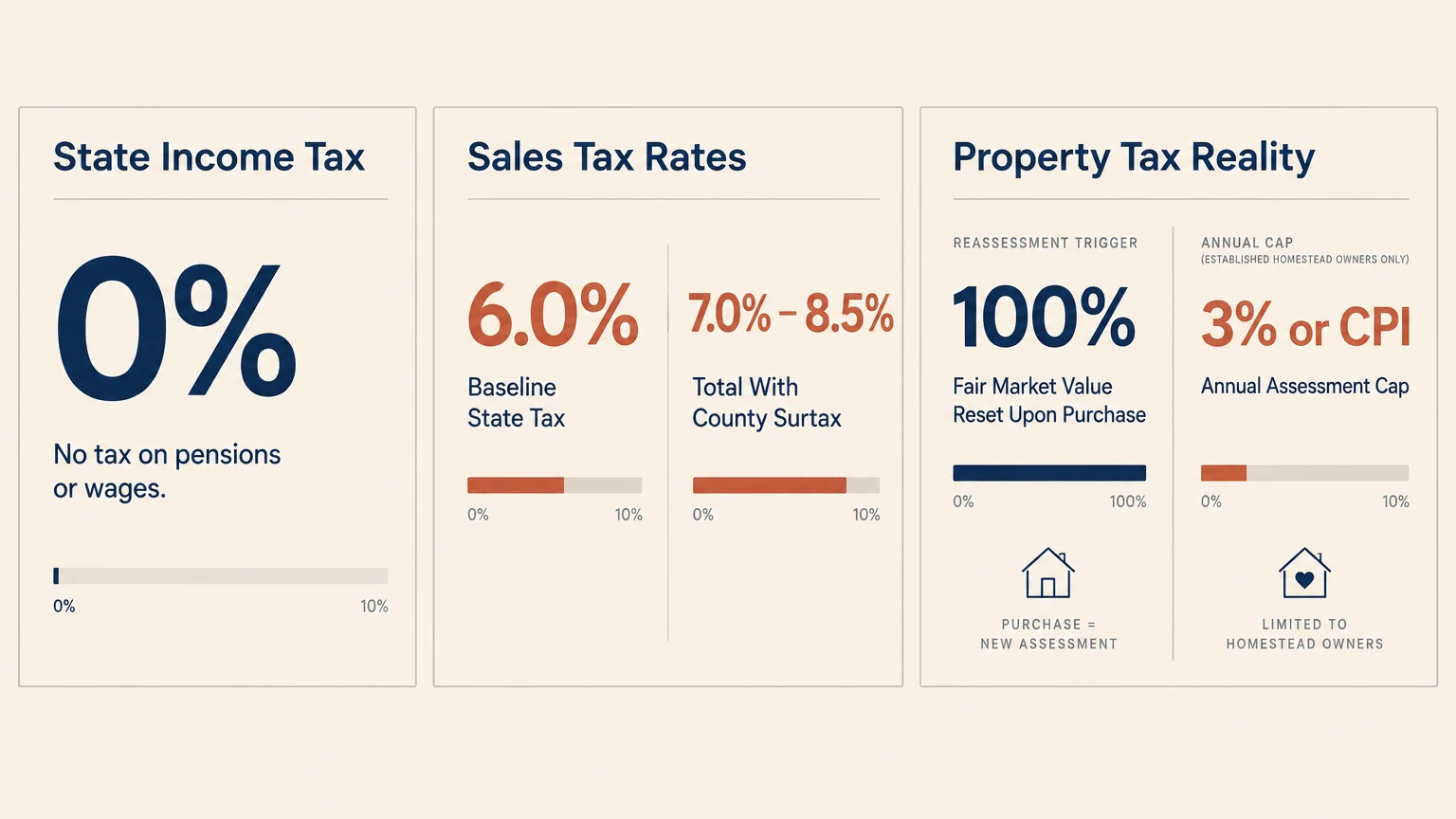
Many retirees believe Florida is entirely tax-free because the state levies no individual income tax. While Florida does not tax your paycheck or pension, local governments collect revenue through other channels.
The state charges a baseline 6.0% sales tax on most goods and services. Discretionary county surtaxes push the total sales tax rate between 7.0% and 8.5% across most populated areas.
Federal taxes still apply to your retirement distributions and investment accounts regardless of where you reside. According to the Social Security Administration (SSA), up to 85% of your Social Security benefits may remain subject to federal taxation based on your combined income.
Property taxes also create unexpected sticker shock for newcomers who purchase real estate. Florida offers a standard Homestead Exemption that exempts up to $50,000 of your primary residence’s assessed value from local taxes.
The constitutional Save Our Homes amendment caps annual assessment increases for existing homesteaded properties at 3% or the Consumer Price Index, which was 2.9% in 2025. However, this protection does not transfer to new buyers.
When you purchase a house, the assessed taxable value automatically resets to 100% of fair market value. You will likely pay significantly higher property taxes than the prior homeowner paid for the exact same home.

Myth 2: Florida Living Is Universally Inexpensive
Past promotional brochures often framed Florida as a bargain destination for seniors on fixed budgets. Rapid population growth has altered that landscape considerably, driving up the overall florida cost of living.
Everyday essentials like groceries, dining out, and personal services frequently carry higher price tags in Florida than in Midwestern or mid-Atlantic communities. Shipping logistics and tourist demand elevate retail prices across coastal corridors.
Electricity expenses also run high throughout the state due to long cooling seasons. You will likely run your central air conditioner for eight to ten months each year to combat persistent heat.
Many planned developments assess Community Development District fees alongside standard municipal taxes. These infrastructure bonds can add $1,000 to $4,000 annually to your regular tax bill for several decades.
| Expense Category | National Baseline | Florida Reality |
|---|---|---|
| State Income Tax | Varies by State (0% to 13.3%) | 0% on Personal Income |
| State and Local Sales Tax | 5.0% to 7.0% Average | 7.0% to 8.5% in Most Counties |
| Average Homeowners Insurance | $1,800 to $2,500 Annually | $3,700 to $8,800+ Annually |
| Assisted Living Median Cost | $4,800 Monthly | $5,324 Monthly |
| Auto Insurance Full Coverage | $2,000 to $2,400 Annually | $2,700 to $3,900+ Annually |
When you weigh the pros and cons florida retirement presents, evaluate your complete financial footprint rather than just state income taxes. A single savings category rarely offsets broader day-to-day retail increases.

Myth 3: Condominiums Provide Hassle-Free Affordable Living
Purchasing a condominium unit once seemed like the ultimate low-maintenance retirement plan for seniors seeking simplicity. Recent statutory overhauls have significantly changed the economics of condominium ownership across Florida.
Following the 2021 Surfside building collapse, Florida enacted strict safety legislation through Senate Bills 4-D and 154 alongside House Bill 913. These laws establish mandatory structural milestone inspections for aging properties.
Buildings three stories or higher must complete formal engineering inspections when reaching 30 years of age, or 25 years if located within three miles of the coastline. These thorough reviews verify foundation and structural integrity.
State law no longer permits condominium associations to vote to waive or underfund their reserve accounts. Associations must conduct a Structural Integrity Reserve Study and fully fund reserves for roofs, load-bearing walls, and waterproofing.
As associations scramble to fund neglected reserves, monthly homeowner association fees have escalated sharply by $200 to $1,000 or more per unit. Unfunded structural repairs trigger surprise special assessments reaching $20,000 to $50,000 per owner.
According to the Consumer Financial Protection Bureau (CFPB), assessing total monthly housing obligations—including fees and assessments—is essential before signing mortgage paperwork. Always review an association’s reserve study before making an offer.

Myth 4: Property and Auto Insurance Premiums Are Manageable
Retirees moving to Florida often budget for typical national insurance rates only to discover an expensive market. Florida property insurance premiums stand as the highest in the entire country.
Standard annual homeowner insurance premiums range from $3,700 to $8,800 depending on location, roof age, and construction materials. Coastal properties in South Florida frequently command annual premiums well above $8,000.
Many private insurance carriers have reduced exposure or left the state entirely, pushing thousands of seniors into Citizens Property Insurance Corporation. Citizens functions as the state-backed insurer of last resort.
Under Senate Bill 2-A, Citizens policyholders face a mandatory requirement to purchase separate flood insurance policies by 2027. This rule applies even if your property sits far outside a high-risk FEMA flood zone.
Florida also ranks among the most expensive states nationwide for automobile insurance coverage. Statewide full-coverage auto policies average between $2,700 and $3,900 per year, which is roughly 50% above national averages.
High litigation rates, uninsured drivers, hurricane hazards, and the mandatory $10,000 Personal Injury Protection no-fault system drive these auto rates higher. Senior drivers should price coverage before registering their vehicles.

Myth 5: Healthcare and Long-Term Care Are Budget-Friendly
Retirees often assume Florida’s large senior population produces cheaper medical care and abundant senior support services. In reality, strong demand and high operating expenses drive long-term care costs higher.
The 2024 Genworth and CareScout Cost of Care Survey reports Florida’s median assisted living cost at $63,885 annually, or roughly $5,324 per month. This figure reflects a steep 12% rise over the previous year.
Skilled nursing facilities demand even greater financial resources from families. A semi-private room averages $124,100 per year ($10,342 monthly), while a private room averages $138,700 annually ($11,558 monthly).
If you prefer aging in place within your home, professional in-home care remains a substantial recurring expense. Full-time home health aide assistance averages $68,640 annually, with hourly caregiver rates ranging from $31 to $34.
Securing specialized medical providers can also require significant patience in high-density retirement corridors. High patient volume often means waiting several months for routine appointments with preferred specialists.
When selecting insurance coverage, use the official plan comparisons at Medicare.gov to ensure local Florida doctors and hospitals participate in your network. Narrow provider networks can restrict your access to necessary care.
To locate vetted support services and community resources in your chosen Florida county, consult the Eldercare Locator. This public service connects older adults directly with trusted local area agencies on aging.
Myth 6: Every Community Caters Exclusively to Seniors
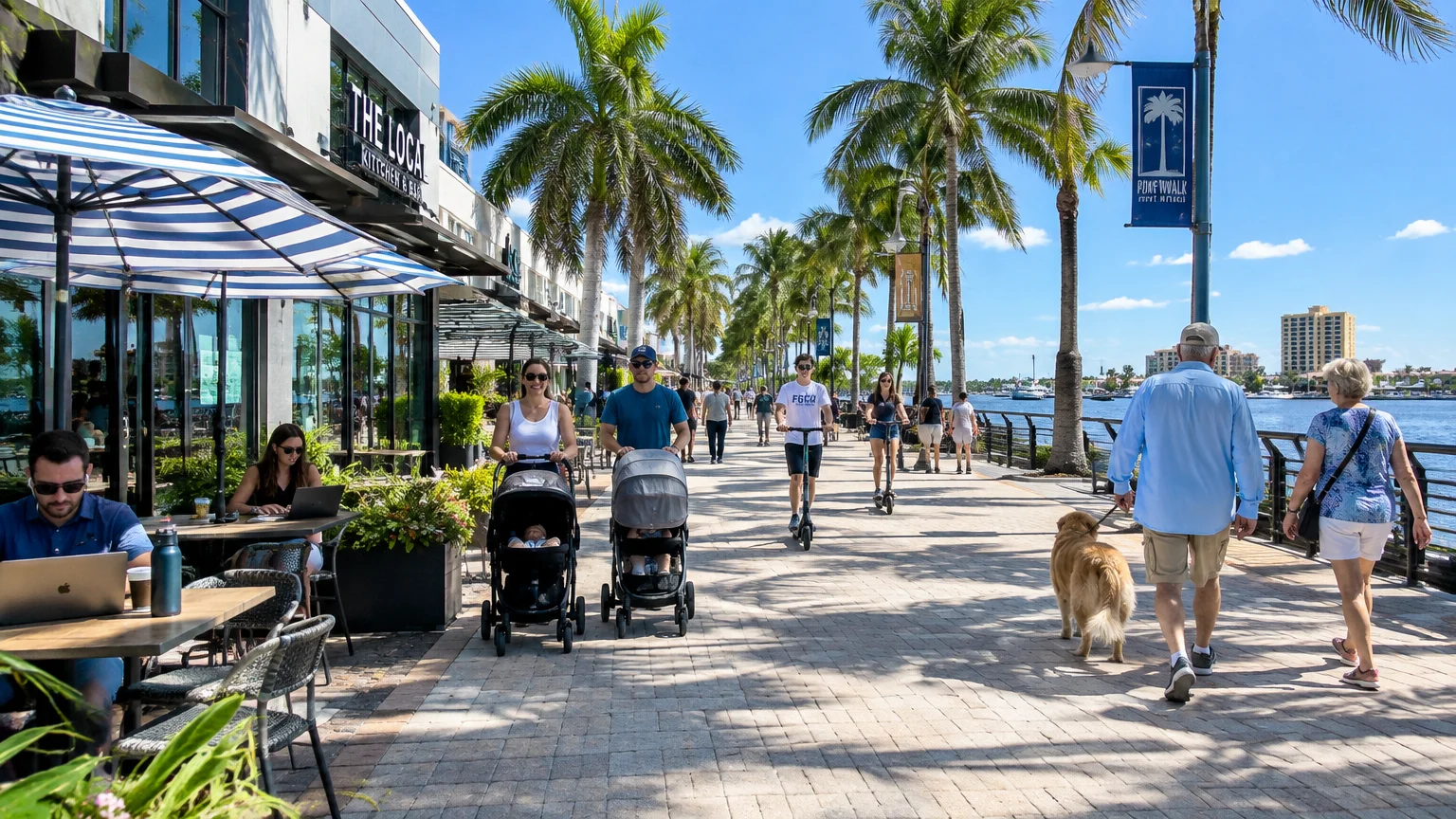
Popular culture often portrays Florida as one massive retirement village filled solely with golf carts and early bird dinners. The reality of Florida’s population mix is far more diverse and vibrant.
According to the U.S. Census Bureau, adults aged 65 and older comprise roughly 21% to 22.8% of Florida residents. While higher than national averages, nearly 78% of the state’s residents are under age 65.
The statewide median age sits at 42.7 years. Thriving tech sectors, corporate relocations, and bustling logistics industries attract millions of young families and working professionals across major metropolitan centers.
Unless you reside in a deed-restricted 55-and-older community, you will share roads, parks, and retail centers with families and commuters. Expect active school zones and standard rush-hour traffic congestion during your daily routines.
Winter brings hundreds of thousands of seasonal temporary residents, commonly called snowbirds, alongside millions of international tourists. This predictable seasonal influx swells grocery store crowds, restaurant waits, and highway traffic from November through April.

Myth 7: The Weather Is an Endless Year-Round Paradise
Florida’s winter weather delivers pleasant afternoons and comfortable temperatures that draw visitors from colder climates. However, assuming that idyllic climate lasts all twelve months leads to swift disappointment.
Summers in Florida bring relentless heat indexes often exceeding 100 degrees from late May through early October. Extreme humidity combines with intense solar radiation, making extended outdoor activity dangerous for older adults.
Many seniors experience a reverse version of seasonal affective disorder during prolonged southern summers. You may find yourself confined indoors in air conditioning for four straight months to avoid heat exhaustion.
The Atlantic hurricane season runs from June 1 through November 30 each year, bringing real storm hazards. Preparing for potential storms requires constant vigilance, physical stamina, and dedicated emergency funds.
Handling storm shutters, stocking emergency rations, and navigating evacuation orders can prove physically and emotionally demanding. You must maintain clear backup power solutions if you rely on refrigerated medications or medical machinery.
Essential Financial Steps Before Moving to Florida
Debunking common retiring to florida myths allows you to make strategic financial decisions before signing purchase agreements. Careful preparation ensures that moving to florida retirement remains a rewarding life chapter.
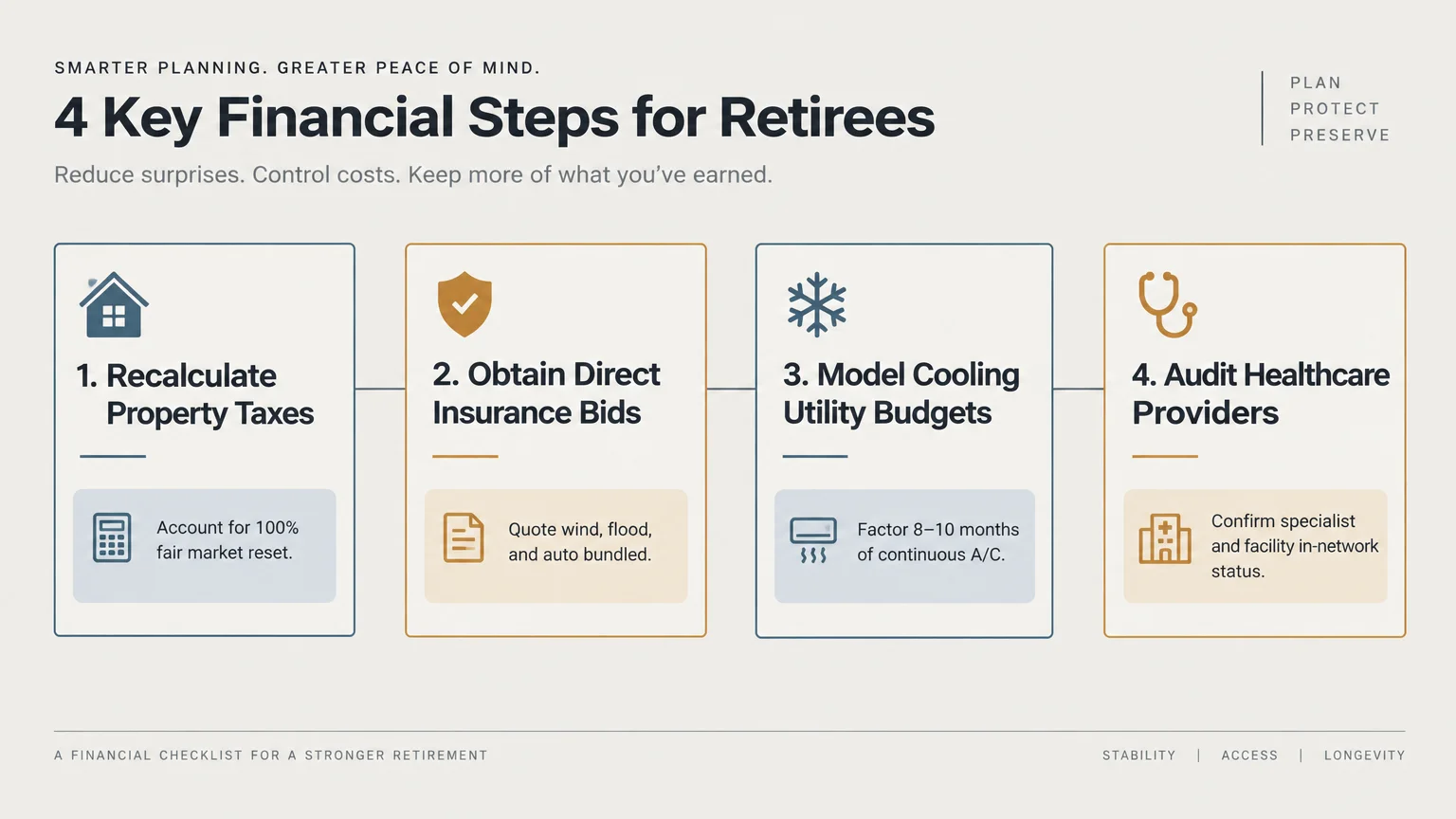
Take the following practical steps to protect your retirement savings before finalizing any relocation plans:
- Rent before purchasing: Spend at least six to twelve months renting in your target city to experience both winter tourism and intense summer humidity firsthand.
- Audit condominium financials: Review the association’s structural reserve study, inspect milestone engineering reports, and check current reserve funding levels before making an offer.
- Run official property tax estimates: Contact the local county property appraiser’s office to estimate taxes based on recent sale values rather than existing owner assessments.
- Obtain insurance quotes upfront: Require binding quotes for homeowners, windstorm, flood, and auto insurance during your contract inspection period.
- Verify medical provider networks: Confirm that local primary care physicians and critical specialists in the region actively accept your specific Medicare coverage.
- Budget for seasonal price spikes: Account for regional cost surges, elevated summer utility cooling bills, and recurring community maintenance fees.
Taking control of these practical details prevents expensive surprises and keeps your retirement assets secure. Realistic preparation creates true peace of mind as you start your new journey.
Frequently Asked Questions
How does the Florida homestead exemption actually work for new residents?
To qualify for the standard $50,000 exemption, you must establish permanent residency and own the property on January 1. You must submit your formal application to the county property appraiser by March 1.
Can I keep my existing Medicare Advantage plan after moving to Florida?
Medicare Advantage plans operate through regional service areas defined by county borders. Moving to a new state triggers a Special Enrollment Period that allows you to select a local Florida plan.
What is a Community Development District fee on a Florida property?
A CDD fee represents a bond assessment used to finance local neighborhood infrastructure such as roads, utilities, and community amenities. The assessment appears on your annual property tax bill and lasts for several decades.
Why are auto insurance rates so high for Florida retirees?
Florida mandates $10,000 in Personal Injury Protection under its no-fault system, which experiences high rates of insurance claims. Severe storm damage risks and heavy tourist traffic also drive vehicle premiums higher.
Is it smarter to buy or rent when first relocating to Florida?
Renting for your first year protects you from unexpected special assessments, unpredictable insurance spikes, and neighborhood mismatch. It gives you valuable time to evaluate climate conditions, healthcare access, and actual living costs.
For additional senior resources, visit
Benefits.gov,
National Institute on Aging (NIA),
Centers for Disease Control and Prevention (CDC),
Medicare.gov and
National Institute of Mental Health (NIMH).
Disclaimer: The information in this article is for educational purposes only and is not intended to be a substitute for professional financial, legal, or medical advice. Always consult with a qualified expert for advice tailored to your personal situation.









Leave a Reply