

A sudden drop in your monthly Social Security benefit can trigger real anxiety for your retirement budget. If your Medicare premiums unexpectedly increased, you are likely paying an Income-Related Monthly Adjustment Amount.
This federal rule imposes a steep Medicare income surcharge on retirees who exceed specific earnings limits. Fortunately, you can take control of these extra costs once you discover how the government assesses your finances.
Here is Medicare IRMAA explained simply, along with nine critical insights to help you protect your retirement cash flow.
1. What IRMAA Really Is and Why It Applies to Both Part B and Part D
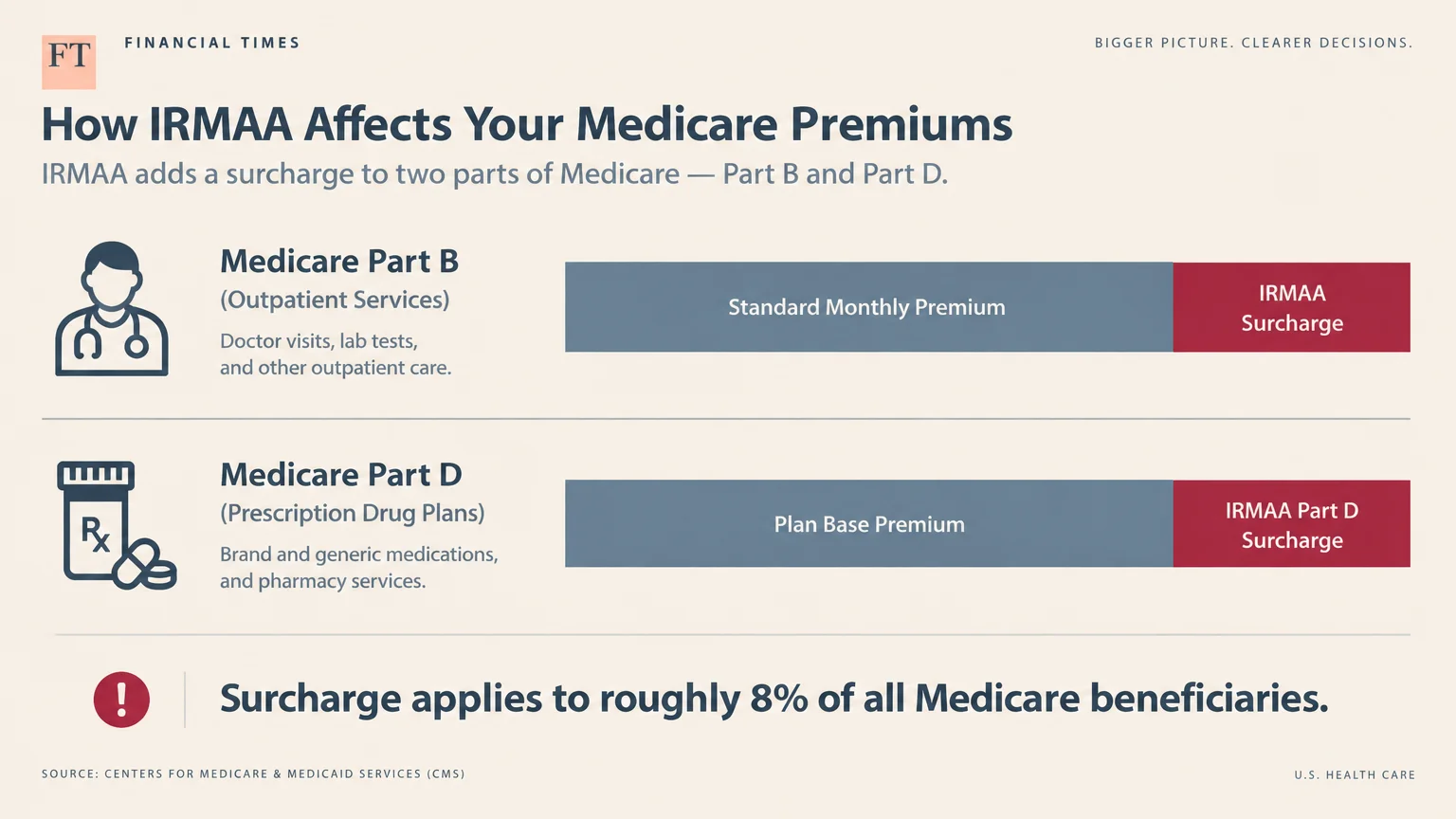
Many seniors open their annual benefit letters and wonder: what is IRMAA? The acronym stands for Income-Related Monthly Adjustment Amount.
IRMAA is not a distinct healthcare policy or separate tier of insurance. Instead, it is a federal Medicare premium surcharge for high earners added to standard premiums.
According to the Centers for Medicare & Medicaid Services (CMS), this surcharge impacts roughly 8% of all Medicare beneficiaries nationwide.
The surcharge targets two distinct parts of your healthcare coverage: Medicare Part B and Medicare Part D.
Part B covers outpatient medical services, including doctor visits, lab tests, and durable medical equipment. Part D provides prescription drug coverage through private insurance carriers.
If your past income exceeds federal thresholds, you must pay an added surcharge on both programs. You cannot decline the surcharge on one part while keeping the other.
Enrolling in a private Medicare Advantage plan will not shield you from these fees. The federal government assesses IRMAA regardless of whether you choose Original Medicare or private managed care.
2. The Two-Year Lookback Rule and How Social Security Assesses You
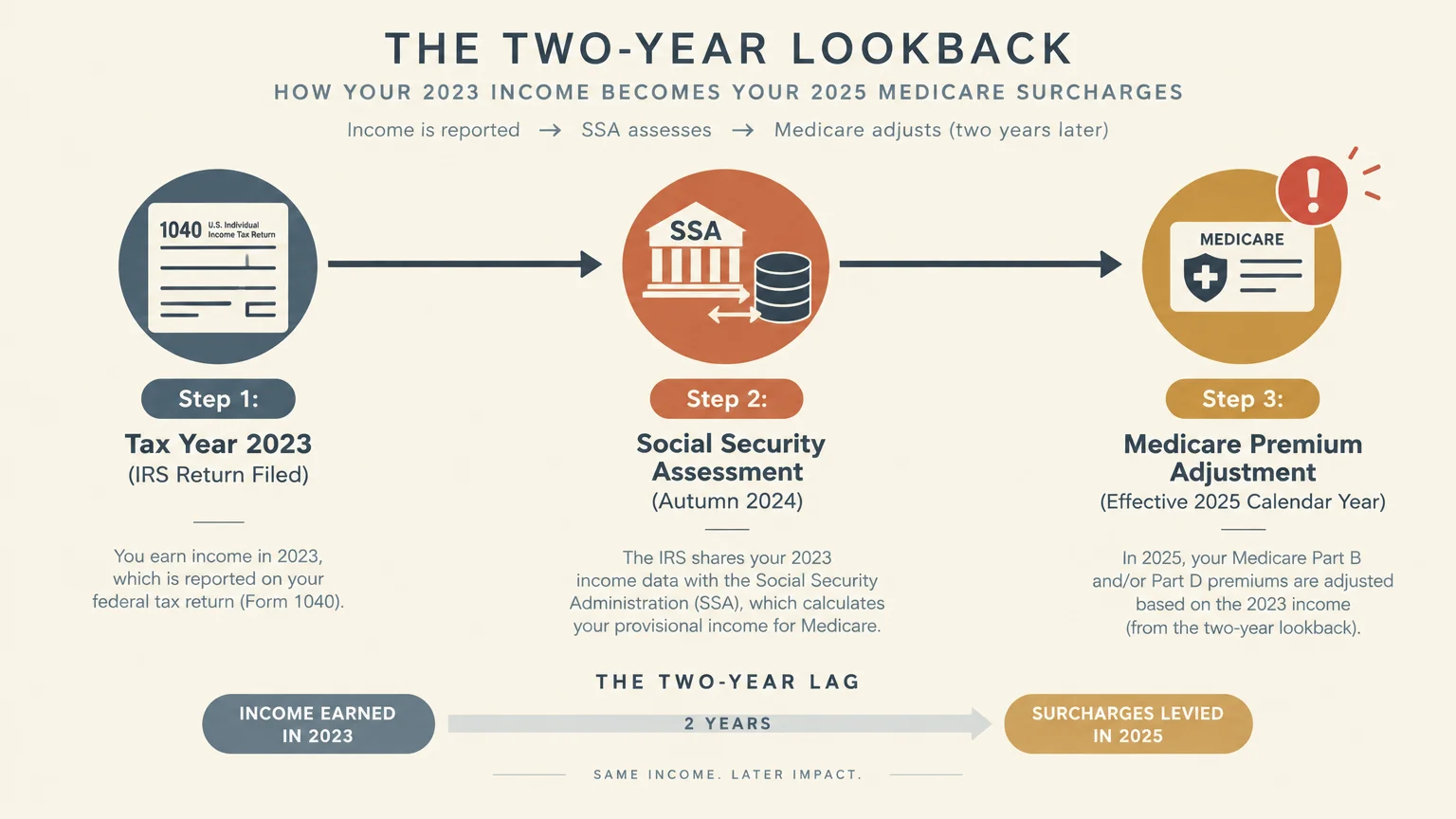
One of the most confusing elements of IRMAA is the timing of the assessment. The federal government determines your current healthcare surcharges using tax data from two years prior.
For example, your 2025 Medicare premiums depend entirely on the adjusted income reported on your 2023 federal tax return. Likewise, your 2024 tax filing will dictate your 2026 premium amounts.
This two-year lag exists because the Internal Revenue Service needs time to process complete annual filings. Once processed, the IRS transmits your financial records to the Social Security Administration.
As noted by the Social Security Administration (SSA), beneficiaries receive determination notices every autumn detailing next year’s premium adjustments.
This time delay often creates serious financial mismatches for recent retirees. You might earn a substantial salary in your final working year, only to retire twelve months later.
When IRMAA strikes two years down the road, your income may have already dropped dramatically. Paying high-earner surcharges on a newly reduced fixed income can place immediate strain on your household budget.
3. How Medicare Defines Your Income: The Special IRMAA MAGI Formula
Medicare does not evaluate your gross paycheck or take-home retirement cash to determine surcharges. Instead, the government uses a custom calculation known as Modified Adjusted Gross Income (MAGI).
Your IRMAA MAGI has a very strict definition under federal tax law. It equals your Adjusted Gross Income (AGI) plus any tax-exempt interest income you earned during the tax year.
To calculate this figure yourself, locate your IRS Form 1040 from two years prior. Add the amount on line 11 (AGI) to the amount on line 2a (tax-exempt interest).
Many seniors assume that municipal bonds protect them from federal surcharges. While municipal bond interest escapes federal income taxes, Medicare adds that interest back when calculating IRMAA.
Your adjusted gross income includes numerous common retirement revenue sources. The following financial streams all flow directly into your Medicare income calculation:
- Wages, bonuses, and self-employment earnings from consulting or part-time work.
- Taxable pension payouts and traditional IRA or 401(k) withdrawals.
- The taxable portion of your monthly Social Security benefits.
- Capital gains generated from selling stocks, mutual funds, or investment properties.
- Ordinary dividends and interest payments from personal brokerage accounts.
Because all these revenue streams count, an unexpected capital gain can trigger surcharges without your knowledge. Monitoring these collective numbers throughout the year is vital.
4. The 2025 IRMAA Brackets Explained and What You Will Pay
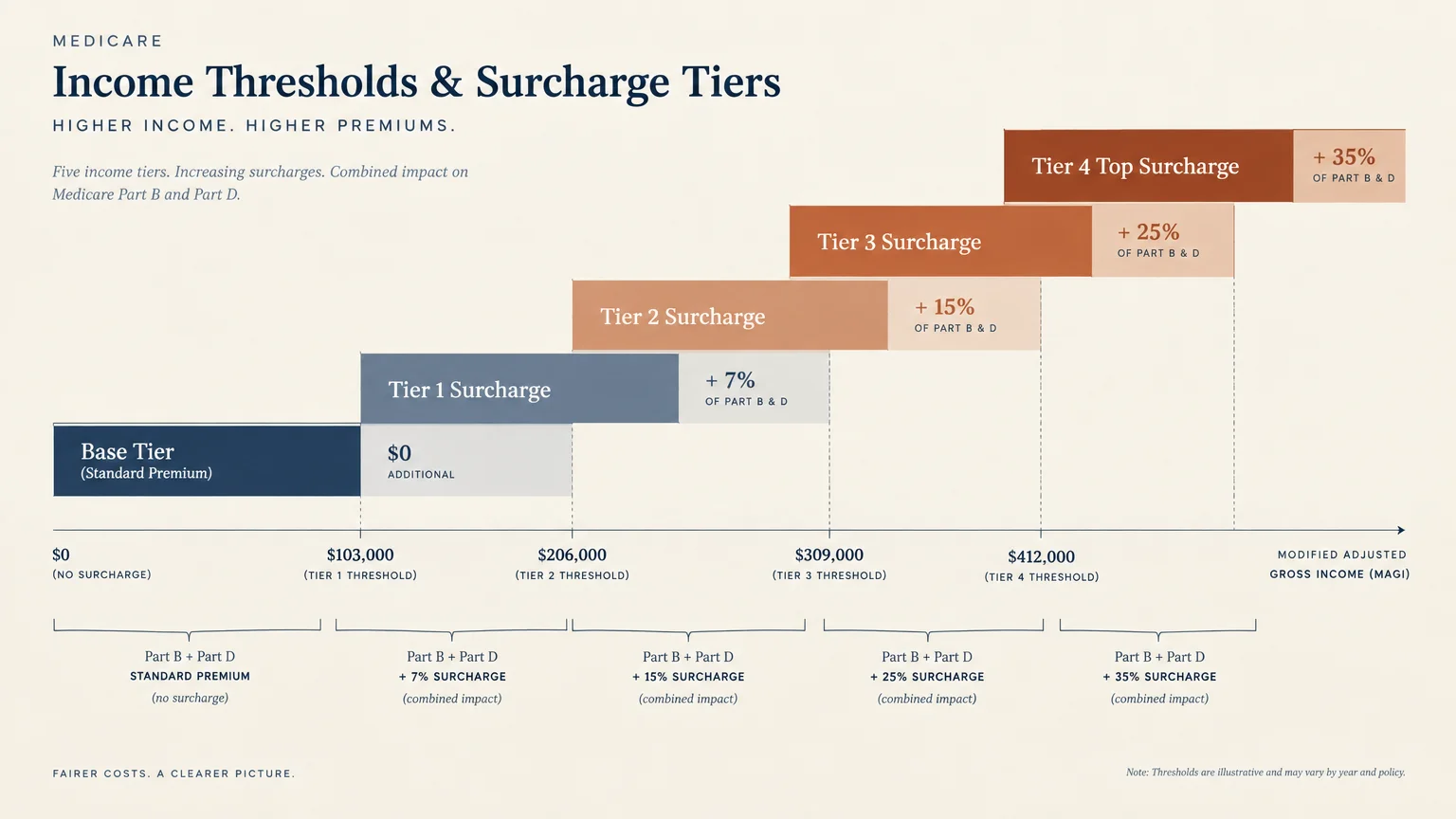
The federal government establishes specific income tiers each year that determine your exact surcharge. Reviewing the IRMAA brackets explained below allows you to anticipate your monthly healthcare expenses.
For 2025, the standard monthly Part B premium without any surcharge is $185.00. Beneficiaries with incomes below the first threshold pay only this standard rate.
The initial surcharge tier begins when your MAGI exceeds $106,000 for single filers or $212,000 for married couples filing jointly. Anyone earning above these figures enters the first surcharge bracket.
| Filing Single (2023 MAGI) | Married Filing Jointly (2023 MAGI) | Part B Surcharge | Total Part B Premium | Part D Surcharge |
|---|---|---|---|---|
| $106,000 or less | $212,000 or less | $0.00 | $185.00 | $0.00 |
| $106,001 to $133,000 | $212,001 to $266,000 | +$73.60 | $258.60 | +$13.70 |
| $133,001 to $160,000 | $266,001 to $320,000 | +$185.00 | $370.00 | +$35.30 |
| $160,001 to $193,000 | $320,001 to $386,000 | +$296.00 | $481.00 | +$57.00 |
| $193,001 to $499,999 | $386,001 to $749,999 | +$407.00 | $592.00 | +$78.60 |
| $500,000 or more | $750,000 or more | +$443.90 | $628.90 | +$85.80 |
Part D surcharges are paid in addition to the monthly plan premium charged by your private prescription drug insurer. These drug surcharges range from $13.70 to $85.80 each month.
If you are married and file separate tax returns while living together, strict rules apply. The thresholds drop significantly, triggering top-tier surcharges at much lower income levels.

5. The Dreaded Cliff Effect: Why $1 Can Cost You Thousands
Standard federal income tax brackets use a progressive marginal rate structure. When you cross into a higher income tax bracket, only the dollars above the line face higher tax rates.
IRMAA does not operate under marginal tax rules. Instead, IRMAA functions as a financial cliff where a single dollar pushes your entire premium into the next tier.
Exceeding an IRMAA bracket threshold by just $1 locks you into that higher tier for the entire calendar year. There is no proportional phase-in or partial grace period.
Consider a single retiree whose 2023 MAGI totals exactly $106,001. That individual is just $1 over the base exemption limit.
That single extra dollar triggers a Part B surcharge of $73.60 per month. It also adds a Part D surcharge of $13.70 per month.
Over twelve months, that $1 excess income costs an extra $1,047.60 in annual premiums. For married couples, the financial damage doubles because both spouses face the surcharge.
A married couple exceeding the threshold by $1 pays an extra $2,095.20 in combined surcharges over the course of the year. Careful tax management is essential to avoid these costly cliffs.

6. How You Pay the Surcharge Under Original Medicare and Medicare Advantage
Understanding how the federal government collects these fees prevents administrative surprises. For most retirees, the collection process happens automatically through monthly benefit deductions.
If you currently collect Social Security benefits, the state deducts your Part B premium and IRMAA surcharge directly from your payment check. Your monthly direct deposit simply arrives smaller.
Beneficiaries who delay Social Security benefits receive a quarterly invoice directly from Medicare. You can settle these bills using Medicare Easy Pay, personal checks, or online credit card transactions.
According to Medicare.gov, Part D IRMAA surcharges must be paid directly to Medicare, never to your private insurance company.
Your private drug plan continues to bill you for its base monthly premium. Meanwhile, the federal government bills you separately for the Part D income surcharge.
Never ignore an IRMAA invoice for Part D coverage. If you fail to pay the surcharge to Medicare, the government will terminate your prescription drug policy entirely.
Re-enrolling after termination can prove difficult and may trigger permanent late-enrollment penalties. Always set up automatic payments to protect your coverage continuity.

7. How to Appeal Your Surcharge Using Form SSA-44
Receiving an IRMAA notice does not mean you are permanently trapped into paying high fees. If your income dropped because of a major life transition, you can appeal the decision.
To request a formal redetermination, you must submit Form SSA-44 to the Social Security Administration. This document is officially titled the Medicare Income-Related Monthly Adjustment Amount – Life-Changing Event form.
The federal government will not approve an appeal simply because you dislike the charge. The SSA strictly limits approved appeals to eight specific qualifying life-changing events:
- The death of a spouse.
- Marriage or legal remarriage.
- Divorce, legal separation, or marriage annulment.
- Work reduction, such as moving from full-time employment to part-time status.
- Complete work stoppage, including formal retirement.
- Loss of income-producing property due to a natural disaster, casualty, or fraud.
- Loss or severe reduction of pension income through plan termination.
- Receipt of a financial settlement from an employer due to bankruptcy or closure.
Normal stock market downturns, voluntary capital gains, and standard investment losses do not qualify as life-changing events. You cannot appeal an IRMAA notice solely because your brokerage portfolio lost value.
When submitting Form SSA-44, you must supply solid supporting evidence. Acceptable documentation includes retirement letters, corporate severance notices, death certificates, or signed tax returns.
You can deliver your completed form and documentation directly to your local Social Security field office. Once approved, the SSA will adjust your premium rates and refund any overpaid amounts.

8. Smart Retirement and Tax Strategies to Avoid Future Surcharges
Proactive financial planning can help you bypass the Medicare income surcharge entirely. By managing how and when you realize income, you can keep your MAGI below key thresholds.
One powerful strategy involves executing Roth IRA conversions before you enroll in Medicare. Converting traditional pretax balances between ages 60 and 62 shifts taxable income into earlier years.
Once you turn 65, qualified withdrawals from your Roth accounts remain entirely tax-free. More importantly, Roth distributions do not count toward your Medicare MAGI calculations.
Charitable seniors can also utilize Qualified Charitable Distributions (QCDs) starting at age 70½. A QCD allows you to send up to $105,000 directly from an IRA to an eligible charity.
This direct transfer satisfies your annual Required Minimum Distribution (RMD) rules without raising your adjusted gross income. The money goes to a worthy cause while keeping your Medicare costs low.
Guidance from the Consumer Financial Protection Bureau (CFPB) encourages retirees to coordinate withdrawal plans early to prevent unintended cost spikes.
If you plan to sell real estate or rebalance an investment portfolio, time those transactions carefully. Staggering asset sales across multiple calendar years prevents sudden, sharp income spikes.
Always consult a certified financial planner or tax professional before making large financial moves. A knowledgeable advisor can model your distributions to keep you under critical cliff boundaries.

9. Common Mistakes and Costly Traps Seniors Must Avoid
Navigating Medicare surcharges requires constant vigilance. Many retirees stumble into expensive traps simply because they misunderstand how the tax code interacts with healthcare rules.
One frequent mistake involves selling a primary family residence without calculating capital gains. While federal law excludes up to $250,000 in gains for singles and $500,000 for couples, rapid home appreciation can exceed those caps.
Any taxable gain above the primary exclusion line flows directly into your AGI. That single property sale can easily push you into the highest IRMAA bracket two years later.
Another widespread trap is investing heavily in tax-exempt municipal bonds to sidestep the surcharge. As discussed earlier, Medicare adds tax-free bond interest back into your MAGI formula.
Failing to open and review annual Social Security notices is another costly mistake. Many beneficiaries discard these autumn letters, missing the sixty-day window to file a streamlined appeal.
Never assume that enrolling in Medicare Advantage removes your IRMAA obligations. Private plans must collect these federal surcharges just like Original Medicare.
Finally, avoid waiting until December to calculate your annual income. Reviewing your earnings in October gives you time to make adjustments before the tax year closes.
Frequently Asked Questions
Does IRMAA last for the rest of my life?
No, IRMAA determinations reset every single calendar year based on updated tax filings. If your income drops below the threshold in subsequent tax years, your surcharge disappears automatically.
Can I avoid IRMAA by switching to a Medicare Advantage plan?
No, switching to Medicare Advantage does not eliminate your surcharge obligation. The federal government requires all Medicare Advantage enrollees to pay standard Part B premiums and applicable IRMAA fees.
What happens if I make an error on Form SSA-44?
Submitting an incomplete or incorrect Form SSA-44 will delay your appeal processing. If your appeal is rejected for errors, you can re-file with proper supporting documentation without permanent penalty.
Does selling my family home trigger Medicare IRMAA?
A home sale triggers IRMAA only if the net profit exceeds the federal primary residence capital gains exclusion. Any profit above $250,000 for singles or $500,000 for married couples increases your MAGI.
How does marrying someone with a lower income affect my IRMAA tier?
Filing a joint tax return combines your total household income, which may either help or hurt your tier. For many high earners, filing jointly provides access to higher threshold brackets that lower overall surcharges.
For additional senior resources, visit
National Institute on Aging (NIA),
Centers for Disease Control and Prevention (CDC),
Medicare.gov,
National Institute of Mental Health (NIMH) and
National Institutes of Health (NIH).
Disclaimer: The information in this article is for educational purposes only and is not intended to be a substitute for professional financial, legal, or medical advice. Always consult with a qualified expert for advice tailored to your personal situation.









Leave a Reply