

Your military service entitles you to substantial financial advantages during your retirement years. These distinct programs can dramatically lower your healthcare bills, preserve your savings, and supplement your monthly income.
Many senior veterans overlook thousands of dollars in earned benefits simply because rules seem complicated. Navigating these federal and state opportunities provides vital relief against rising inflation and healthcare costs.
Understanding your rights ensures you do not leave hard-earned money on the table. Here is your definitive guide to five remarkable financial perks reserved specifically for veteran retirees.

Why Military Service Pays Dividends in Your Senior Years
Military service demands immense personal sacrifice, but it also establishes enduring financial entitlements. When you reach your senior years, your service history unlocks special federal and state programs.
Many aging Americans face intense anxiety over medical bills and long-term care expenses. Veteran retirement benefits act as an indispensable financial shield during uncertain economic times.
These specialized programs do not represent charity or government welfare. You earned every single dollar through your dedication and service in uniform.
Taking time to examine your eligibility can transform your household budget. The following perks offer concrete paths to protect your wealth and peace of mind.
Perk 1: VA Aid and Attendance for Daily Living Costs
Long-term custodial care represents one of the greatest financial threats to retirement security. The VA Aid and Attendance benefit provides a direct monthly cash supplement to offset these crushing expenses.
This pension enhancement supports veterans who require daily personal assistance. If you need help with bathing, dressing, medication management, or eating, you may qualify.
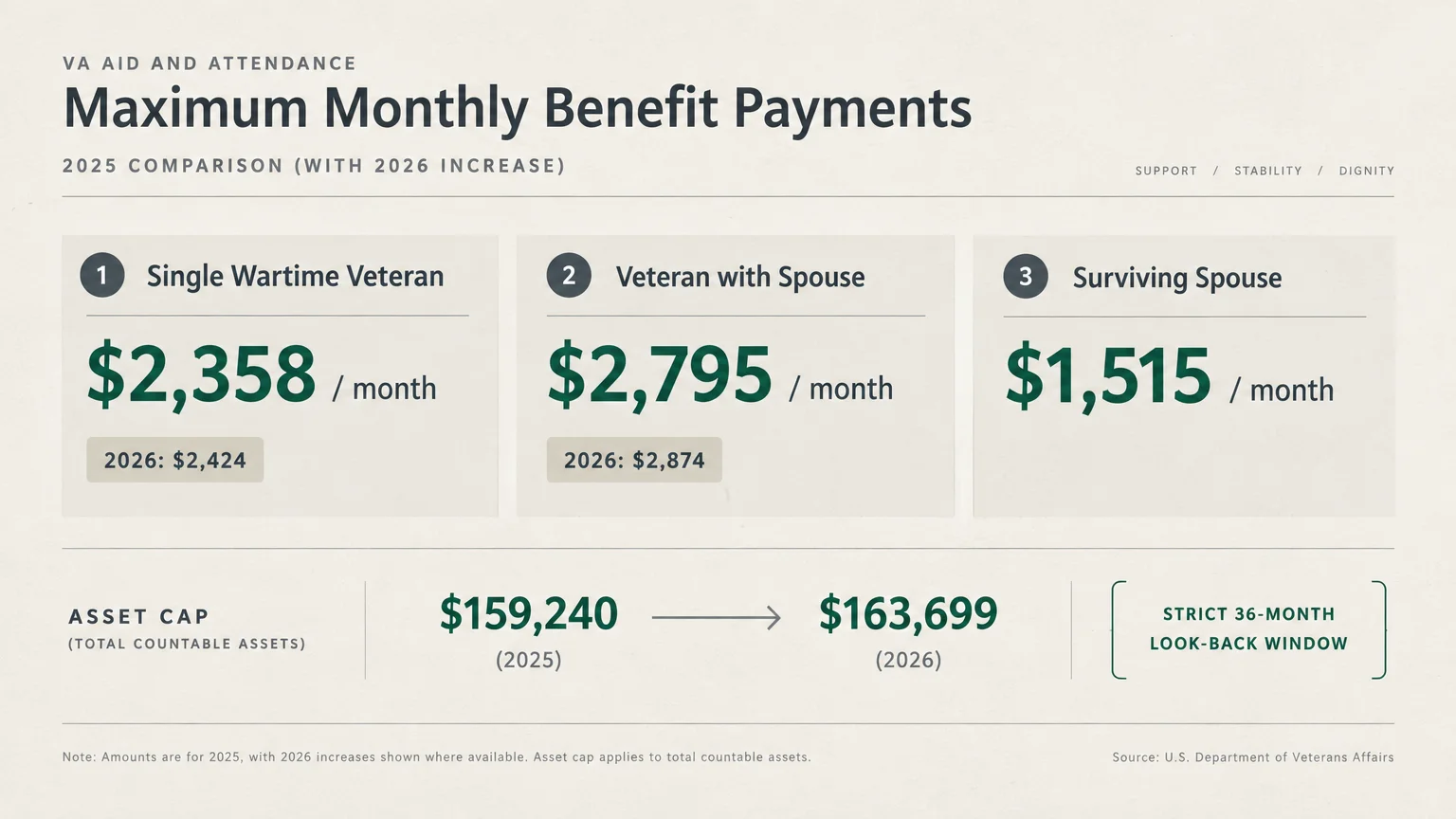
The monthly payment amounts provide substantial financial relief. For 2025, an eligible single wartime veteran can receive up to $2,358 per month in tax-free pension support.
A veteran with a dependent spouse can receive up to $2,795 each month. Surviving spouses are also protected, qualifying for up to $1,515 per month.
Scheduled cost-of-living adjustments will raise these maximum payments even higher in 2026. Single veterans can receive up to $2,424 monthly, while married veterans can receive up to $2,874.
You must meet specific financial criteria to qualify for this benefit. The VA enforces an asset cap of $159,240 through late 2025, which adjusts to $163,699 for 2026.
Be cautious when restructuring assets to meet these ceilings. The VA reviews all asset transfers over a strict 36-month look-back window to prevent artificial impoverishment.
| Beneficiary Category | 2025 Maximum Monthly Benefit | 2026 Projected Monthly Benefit | Applicable Net Worth Limit |
|---|---|---|---|
| Single Wartime Veteran | $2,358 | $2,424 | $159,240 (2025) / $163,699 (2026) |
| Veteran with One Dependent | $2,795 | $2,874 | $159,240 (2025) / $163,699 (2026) |
| Surviving Spouse | $1,515 | $1,557 | $159,240 (2025) / $163,699 (2026) |
This regular cash infusion pays directly for in-home caregivers, memory care, or assisted living communities. It preserves your personal savings while securing high-quality daily care.
Qualifying medical conditions do not need to be related to your military service. As long as you served during an active wartime period, non-service-connected disabilities qualify.

Perk 2: TRICARE For Life as a Premium-Free Healthcare Partner
Healthcare costs can easily consume a significant portion of your fixed retirement income. For career military retirees aged 65 and older, TRICARE For Life eliminates that financial burden.
TRICARE For Life functions as an automatic secondary payer alongside traditional Medicare. You pay zero plan enrollment fees and zero monthly premiums for this comprehensive wraparound policy.
As outlined by Medicare.gov, beneficiaries must enroll in both Medicare Part A and Part B to activate secondary coverage options.
You only pay your standard Part B monthly premium. Once that is active, Medicare pays its share of covered medical expenses first.
TRICARE For Life then steps in to pay remaining coinsurance, copayments, and deductibles. In almost all medical situations, your out-of-pocket balance is reduced to zero dollars.
This coverage partnership delivers several distinct advantages over standard civilian coverage options:
- Zero annual enrollment fees and zero monthly supplemental policy premiums.
- Elimination of standard Medicare Part A and Part B hospital and outpatient deductibles.
- Worldwide medical coverage for urgent and emergency care when traveling abroad.
- Comprehensive prescription coverage through the TRICARE pharmacy network and home delivery.
Compared to commercial Medicare Supplement plans that cost hundreds of dollars monthly, this perk saves thousands annually. It gives military retirees exceptional financial freedom.

Perk 3: Concurrent Retirement and Disability Pay (CRDP)
Military retirees previously faced a frustrating legal offset between earned pensions and disability compensation. The government historically subtracted one dollar from military retired pay for every disability dollar received.
Concurrent Retirement and Disability Pay completely eliminates that penalty for eligible retirees. This rule change restores your full earned military pension alongside your disability compensation.
According to guidelines hosted on Benefits.gov, qualifying programs allow military retirees to receive both payments simultaneously without reduction.
To qualify for CRDP, you must have completed 20 or more years of active military service. You must also hold a service-connected VA disability rating of 50 percent or higher.
The tax advantages of this arrangement are exceptional for retirees. While standard military retirement pay is federally taxable, VA disability compensation is 100 percent tax-exempt.
Receiving your full pension while collecting tax-free disability compensation creates an impressive combined income stream. It protects your purchasing power throughout your retirement years.
You do not need to file a separate bureaucratic application for CRDP. The Defense Finance and Accounting Service coordinates directly with the VA to initiate your payments automatically.

Perk 4: State Veterans Homes and Subsidized Skilled Nursing
Private skilled nursing facilities easily charge upwards of $9,000 per month across the United States. Many families exhaust their entire life savings attempting to fund extended residential care.
State Veterans Homes provide a dignified and remarkably affordable alternative for aging service members. These facilities operate in all 50 states, offering skilled nursing, memory care, and domiciliary services.
According to resources cataloged by the Eldercare Locator, finding specialized local residential care helps families manage chronic conditions safely and affordably.
The VA provides daily per diem subsidies directly to these state-run homes. This federal financial support substantially lowers out-of-pocket costs for veteran residents.
An even greater perk exists under federal regulation 38 CFR Part 51. Veterans with a service-connected disability rating of 70 percent or higher receive complete skilled nursing coverage.
The VA covers 100 percent of skilled nursing care costs for these severely disabled veterans. Veterans rated permanently and totally disabled also qualify for this total financial relief.
This benefit lifts an extraordinary financial weight from aging veterans and their families. It guarantees compassionate professional care without draining the family estate.

Perk 5: State Property Tax Relief for Senior Homeowners
Property taxes represent one of the heaviest ongoing expenses for senior homeowners on fixed incomes. Fortunately, state lawmakers consistently offer substantial property tax exemptions to veteran homeowners.
Every state in the nation provides some variation of veteran property tax relief. Many jurisdictions offer tiered reductions starting at modest disability ratings of 10 percent.
Several states provide complete tax relief for heavily disabled veterans. In states like Texas, Florida, Illinois, and Virginia, qualifying veterans pay zero dollars in homestead property taxes.
This complete exemption applies to your primary residence and frequently transfers to your surviving spouse. Wiping out annual property tax bills saves homeowners thousands of dollars every year.
Senior veterans aged 65 and older often receive additional local exemptions regardless of service-connected disabilities. Check with your local county tax assessor to claim these savings.
| State | Disability Threshold | Tax Relief Benefit | Estimated Annual Savings |
|---|---|---|---|
| Texas | 100% Disability or Unemployable | 100% Homestead Property Tax Exemption | $4,500 – $9,000+ |
| Florida | 100% Permanent & Total | Complete Exemption on Homestead Property | $3,500 – $7,000+ |
| Illinois | 70% to 100% Disability | Complete Exemption from Residential Taxes | $5,000 – $10,000+ |
| Virginia | 100% Service-Connected | Full Real Estate Tax Exemption | $3,000 – $6,500+ |
You must submit proof of military service and your VA disability rating letter to your county assessor. Filing this documentation preserves your home equity for the rest of your life.

Common Application Pitfalls and Financial Traps to Avoid
Navigating veteran benefits can feel overwhelming, which makes seniors tempting targets for predatory operators. You must stay vigilant when exploring your benefit options.
Unscrupulous financial advisors often market themselves as veteran pension experts. These individuals frequently pressure seniors to move savings into high-fee annuities or complicated trusts.
The Consumer Financial Protection Bureau warns seniors that deceptive financial products can compromise eligibility for government assistance.
Moving your assets recklessly can trigger severe penalties under the VA 36-month look-back rule. Doing so may delay your benefits when you need them most.
Keep these critical warning signs in mind when seeking claims assistance:
- Advisors demanding upfront fees to complete and file initial VA paperwork.
- Sales pitches requiring you to transfer your assets into complex, illiquid annuities.
- Promises of guaranteed benefit approvals regardless of your actual financial assets.
- Unsolicited phone calls or mailings offering quick cash buyouts for future benefit checks.
Charging fees to prepare or file an initial VA claim is strictly illegal under federal law. Never pay an advisor who demands upfront money for basic filing assistance.
Always verify the credentials of anyone assisting you with benefits. Insist on working exclusively with accredited representatives who possess official credentials.
A Step-by-Step Action Plan to Claim Your Benefits
Securing your earned veteran perks requires organization and steady persistence. Following a structured roadmap prevents unnecessary delays and ensures complete documentation.
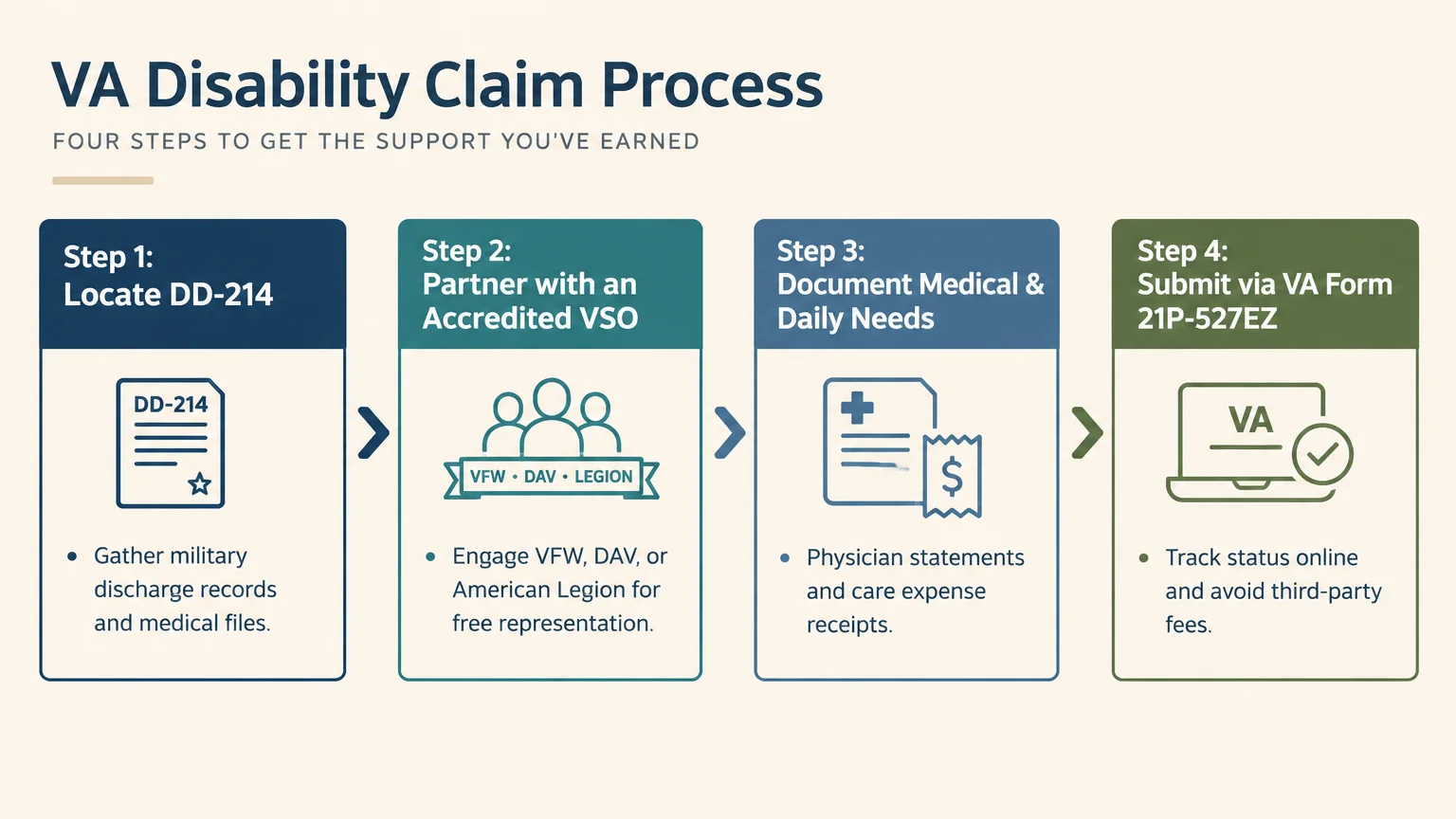
Begin by locating your core military records, especially your official DD Form 214. Keep certified copies in a safe, accessible location alongside your medical documentation.
Next, partner with an accredited Veterans Service Officer (VSO). Organizations like the VFW, DAV, and The American Legion offer free, professional assistance.
Work with your healthcare providers to document your physical condition thoroughly. Clear medical evidence connects your current health challenges to your service records.
Follow these practical steps to initiate your benefit applications smoothly:
- Request certified copies of your military separation paperwork and service medical files.
- Schedule a free consultation with an accredited county or organizational VSO.
- Gather recent financial statements, including income documents and household asset valuations.
- Submit formal medical documentation demonstrating your need for daily personal care assistance.
- File homestead exemption applications with your county property tax assessor.
Review your estate plan to protect your spouse and dependents. Establishing survivor benefit contingencies ensures your family maintains financial stability.
Frequently Asked Questions
Can I receive both Social Security and VA pension benefits at the same time?
Yes, you can receive both benefits simultaneously. However, your Social Security income counts against the income limits for standard needs-based VA pensions.
Your needs-based VA pension reduces dollar-for-dollar by countable income exceeding the threshold. Service-connected disability compensation, however, remains completely unaffected by Social Security earnings.
What is the difference between standard military retirement and VA disability compensation?
Military retirement pay represents earned deferred compensation based on your years of active service. It is taxable at the federal level and in several states.
VA disability compensation pays for conditions resulting from your military duties. This benefit is entirely tax-free and exempt from tax withholding.
Does TRICARE For Life require me to pay an annual deductible?
TRICARE For Life does not charge an enrollment fee or monthly policy premium. You only remain responsible for your standard Medicare Part B deductible and monthly premium.
For medical treatments covered by both Medicare and TRICARE, your out-of-pocket costs are virtually zero. TRICARE automatically covers remaining deductibles and coinsurance portions.
Can surviving spouses access VA burial benefits and national cemeteries?
Yes, eligible spouses and dependent children can receive burial in a VA national cemetery at zero cost. This covers gravesite opening, closing, and perpetual lawn care.
This benefit remains available even if the veteran spouse passes away first. Spouses can also be buried together in the same plot with military honors.
What happens if I transfer assets to qualify for VA Aid and Attendance?
The VA enforces a 36-month look-back period on all asset transfers completed below fair market value. If you transfer assets during this window, the VA may impose a multi-year penalty period.
During this penalty window, you cannot receive monthly pension payments. Always consult an accredited elder law attorney before adjusting your asset holdings.
For additional senior resources, visit
Benefits.gov, National Institute on Aging (NIA), Centers for Disease Control and Prevention (CDC) and Medicare.gov.
Disclaimer: The information in this article is for educational purposes only and is not intended to be a substitute for professional financial, legal, or medical advice. Always consult with a qualified expert for advice tailored to your personal situation.









Leave a Reply