

You can attend college classes for free or at a steep discount simply by tapping into state-mandated senior tuition waivers. Retiring in a vibrant college town lets you enjoy rich cultural amenities, walkable neighborhoods, and lifelong learning without draining your nest egg.
Across the United States, dozens of public universities open their lecture halls to older adults on a space-available basis. These programs allow you to audit fascinating courses or earn degree credits at little to no out-of-pocket cost.
Finding the right community requires balancing academic policies with local healthcare and housing costs. Here are ten exceptional college towns that offer generous tuition perks for seniors.

Why College Towns Attract Lifelong Learners
College communities offer an engaging blend of youthful energy, robust public transit, and world-class medical facilities. You gain easy access to art museums, collegiate sports, theater performances, and expansive libraries right in your backyard.
Staying mentally active also brings profound neurological advantages as you age. Research from the National Institute on Aging (NIA) shows that engaging in intellectually stimulating activities helps maintain sharp cognitive health and supports healthy brain aging.
College campuses also naturally foster intergenerational socialization. Sharing seminar tables with twenty-somethings offers fresh viewpoints and helps prevent the social isolation that often challenges older adults.
According to the Centers for Disease Control and Prevention (CDC), meaningful social connections significantly reduce the risk of cognitive decline, depression, and heart disease in seniors.
Beyond classroom walls, college towns are engineered for pedestrian travel. You can easily walk to coffee shops, lecture halls, and music recitals without navigating stressful highway traffic.
Understanding Senior Tuition Waiver Rules
State legislatures typically establish tuition policies for public colleges and universities. Many states mandate free tuition for seniors, but individual institutions decide how to implement these statutes.
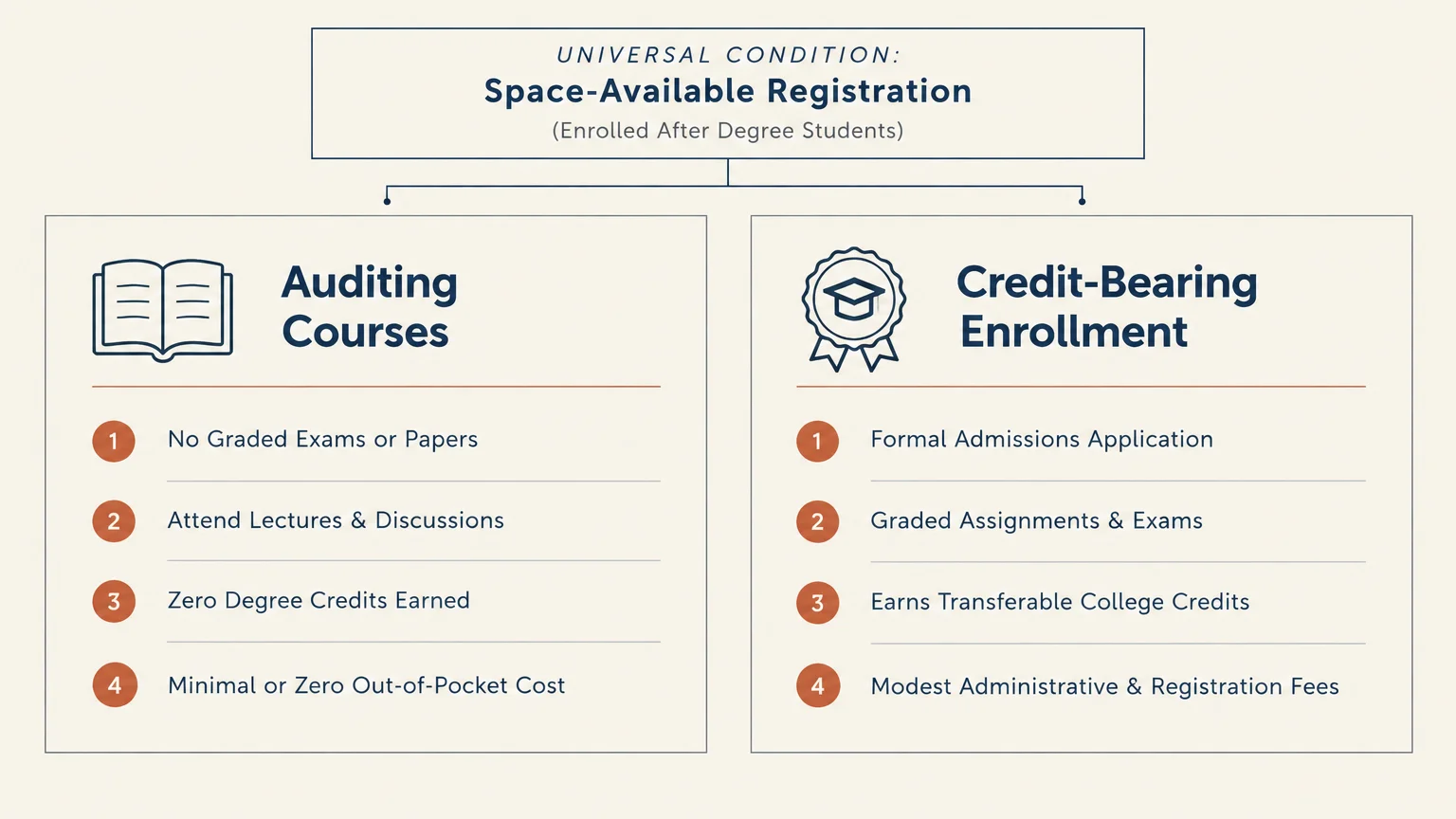
Most universities distinguish between taking a course for credit and auditing. Auditing lets you sit in lectures, listen to discussions, and read course materials without the pressure of exams or term papers.
Credit-bearing enrollment requires formal admission, transcript reviews, and graded assignments. While auditing is frequently free, earning transferable credits sometimes requires modest administrative or registration charges.
Space availability serves as the universal condition across nearly all public institutions. Degree-seeking tuition-paying undergraduates register first, and seniors claim remaining open seats just before classes begin.
You can discover whether your current state funds educational programs by searching state benefit databases on Benefits.gov. Understanding residency rules early ensures you satisfy all domiciliary requirements before trying to register.

10 Standout College Towns With Senior Tuition Waivers
The following ten college towns offer exceptional lifestyle perks paired with statutory tuition discounts. Each destination combines strong municipal charm with deep educational value.
1. Athens, Georgia (University of Georgia)
Athens pairs an iconic southern music heritage with Victorian architecture and a legendary culinary scene. The Classic City provides an affordable cost of living alongside top-tier regional healthcare.
Under Georgia Constitution Amendment 23 and O.C.G.A. § 20-3-31.1, Georgia residents aged 62 and older can attend state university courses for free. The University of Georgia waives 100 percent of tuition and mandatory fees.
You can pursue undergraduate or graduate coursework on a space-available basis without paying standard registration charges. Specialized professional tracks, such as law, medicine, pharmacy, and veterinary studies, are excluded.
2. Charlottesville, Virginia (University of Virginia)
Nestled against the Blue Ridge Mountains, Charlottesville offers historic beauty, renowned vineyards, and the world-class UVA Health medical network. The pedestrian-friendly downtown mall offers endless entertainment and dining options.
The Virginia Senior Citizens Higher Education Act of 1974 (Va. Code § 23.1-640) grants generous privileges to legal residents aged 60 and older. You must maintain Virginia domicile for at least one full year to qualify.
Eligible seniors can audit up to three credit courses per academic term completely free, regardless of individual income. If your taxable income falls below $23,850 annually, you can take credit-bearing courses for free.
3. Austin, Texas (University of Texas at Austin)
Austin features renowned live entertainment venues, sunny walking trails around Lady Bird Lake, and a booming culinary economy. Seniors enjoy warm winter weather alongside access to top healthcare specialists.
Texas Education Code § 54.365 authorizes public universities to waive tuition costs for senior citizens aged 65 and older. The University of Texas at Austin participates fully in this program.
You can take up to six credit hours per semester tuition-free on an open-seat basis. UT Austin requires senior participants to maintain a minimum 2.0 GPA for undergraduate classes, and students cover specific campus fees.
4. Lexington, Kentucky (University of Kentucky)
Surrounded by picturesque horse pastures and rolling hills, Lexington combines southern hospitality with urban cultural sophistication. The University of Kentucky Albert B. Chandler Hospital provides comprehensive geriatric care.
Kentucky Revised Statutes (KRS) § 164.284 and UK’s Herman L. Donovan Fellowship fund tuition waivers for Kentucky residents aged 65 and older. The Donovan Fellowship covers 100 percent of tuition and mandatory course fees.
You can take classes for credit or audit without an arbitrary cap on credit hours. This flexibility allows you to pursue a full degree or casually study art history at your own pace.
5. Gainesville, Florida (University of Florida)
Gainesville delivers a lush, sub-tropical environment filled with botanical gardens, quiet springs, and warm winters. UF Health Shands Hospital gives retirees immediate access to nationally recognized medical specialties.
Florida Statutes § 1009.26(4) and Board of Governors Regulation 7.008 grant tuition and application fee waivers for Florida residents aged 60 and older. This policy applies to available seats across state universities.
The fee-free waiver applies exclusively to audited courses, meaning you do not earn college credits. You enjoy full access to classroom discussions while skipping homework, tests, and standard tuition invoices.
6. Fayetteville, Arkansas (University of Arkansas)
Perched in the Ozark Mountains, Fayetteville boasts scenic paved trail networks, community arts venues, and exceptionally low living costs. Its farmers market on the historic downtown square ranks among the finest in the nation.
Arkansas Code Annotated § 6-60-204 mandates that state-supported colleges waive general student tuition for Arkansas residents aged 60 and older. The University of Arkansas honors this statutory waiver fully.
The program waives 100 percent of general tuition for undergraduate and graduate courses taken for credit. You simply pay for course-specific supplies, parking passes, and personal textbooks.
7. Columbia, South Carolina (University of South Carolina)
Columbia offers riverfront greenways, mild winters, and historic neighborhoods shaded by massive live oaks. The city provides a low tax burden and rapid highway access to coastal beaches.
South Carolina Code of Laws § 59-111-320 permits South Carolina residents aged 60 and older to attend state classes without paying tuition. The University of South Carolina welcomes seniors into both credit and noncredit classes.
Admission remains contingent on classroom seat capacity after paying students finalize their schedules. You remain responsible for incidental expenses, including technology, laboratory, and campus parking fees.
8. Mankato & Minneapolis, Minnesota (Minnesota State & University of Minnesota)
Minnesota provides two distinct educational lifestyles: peaceful regional river valley living in Mankato or dynamic urban arts in Minneapolis. Both regions feature clean public parks and world-class regional healthcare networks.
Minnesota Statutes § 135A.51 and § 135A.52 offer clear educational benefits for legal residents aged 62 and older. Seniors who receive a railroad retirement annuity qualify starting at age 60.
Auditing courses costs zero dollars in tuition and requires no administrative fee. If you take courses for college credit, you pay just $10 per credit at the University of Minnesota or $20 per credit at Minnesota State campuses.
9. Bloomington, Indiana (Indiana University Bloomington)
Bloomington features iconic limestone architecture, quiet residential streets, and a celebrated music conservatory. The town surrounds retirees with diverse international restaurants, theater productions, and dense woodland trails.
Indiana Code § 21-14-5 establishes a Senior Citizen Fee Remission for fully retired Indiana residents aged 60 and older. Indiana University Bloomington reduces your tuition rate by 50 percent for up to nine credit hours each semester.
You pay half the standard in-state undergraduate tuition charge while securing full classroom access. This benefit applies to open seats, giving you access to renowned academic faculty across campus.
10. Chapel Hill, North Carolina (University of North Carolina at Chapel Hill)
Chapel Hill forms part of North Carolina’s Research Triangle, renowned for temperate seasons, lush greenery, and elite academic hospitals. The town’s free bus transit system makes navigating neighborhoods and campus easy.
North Carolina General Statutes § 115B-2.2 allows North Carolina residents aged 65 and older to participate in campus auditing without paying tuition. UNC Chapel Hill welcomes lifelong learners through this state statute.
You can audit up to six credit hours each semester tuition-free on a space-available basis. You cover only discretionary personal items, laboratory consumables, and specialized course materials.

Comparing Senior Tuition Programs Across States
Tuition waiver frameworks vary significantly depending on state legislation and individual university bylaws. Some states prioritize no-fee auditing, while others extend tuition remissions directly to degree-seeking students.
Evaluating minimum age thresholds, residency guidelines, and credit options helps you pinpoint which college town aligns with your retirement goals. The comparison table below highlights key parameters across all ten locations.
| College Town & Institution | Minimum Age | Tuition Benefit Type | Credit vs. Audit | Space Availability Rule |
|---|---|---|---|---|
| Athens, GA (Univ. of Georgia) | 62 | 100% Tuition & Mandatory Fees | Credit or Audit | Yes |
| Charlottesville, VA (Univ. of Virginia) | 60 | Free Audit; Free Credit if Income < $23,850 | Credit or Audit | Yes |
| Austin, TX (UT Austin) | 65 | Up to 6 Credit Hours Free | Credit | Yes (2.0 GPA Required) |
| Lexington, KY (Univ. of Kentucky) | 65 | 100% Tuition & Mandatory Fees | Credit or Audit | Yes |
| Gainesville, FL (Univ. of Florida) | 60 | 100% Tuition Waiver | Audit Only | Yes |
| Fayetteville, AR (Univ. of Arkansas) | 60 | 100% General Tuition Waiver | Credit or Audit | Yes |
| Columbia, SC (Univ. of South Carolina) | 60 | 100% Tuition Waiver | Credit or Audit | Yes |
| Mankato/Minneapolis, MN (MSU / UMN) | 62 (60 for Railroad) | Free Audit; $10–$20 per Credit Hour | Credit or Audit | Yes |
| Bloomington, IN (Indiana Univ.) | 60 | 50% Tuition Discount (up to 9 credits) | Credit or Audit | Yes |
| Chapel Hill, NC (UNC Chapel Hill) | 65 | 100% Audit Tuition (up to 6 credits) | Audit Only | Yes |
Reviewing these statutory details reveals that southern states often feature some of the most generous full-waiver provisions. However, northern schools like Minnesota offer rare, deeply discounted rates for credit-earning tracks.

Hidden Expenses and Campus Realities
A tuition waiver does not guarantee an entirely free educational experience. State statutes generally exempt you from base instructional fees, leaving ancillary institutional charges in place.
Universities frequently assess mandatory technology, campus recreation, and student health service fees. Specialized science or visual arts courses also carry lab fees that can run several hundred dollars per class.
Textbooks and digital learning software represent another substantial recurring expense. Modern courses often require digital access codes for online homework portals that cost upwards of $150 per term.
Physical campus logistics also warrant your close attention before moving. Sprawling flagship university campuses require considerable walking across steep hills, multi-story buildings, and expansive parking lots.
- Parking permits: Campus parking passes often cost between $200 and $800 annually, with lots located far from lecture halls.
- Digital platforms: Professors use digital management systems like Canvas or Blackboard for all assignments, syllabi, and readings.
- Course materials: Science labs, art supplies, and specialized computer software require out-of-pocket payment.
- Registration timing: You must wait until standard add-drop periods end before claiming open seats in popular classes.
Be sure to tour the campus terrain in person during an active school week. Evaluating bus transit lines, handicap parking, and elevator access will prevent frustrating physical obstacles later.
How to Apply for Senior Tuition Perks
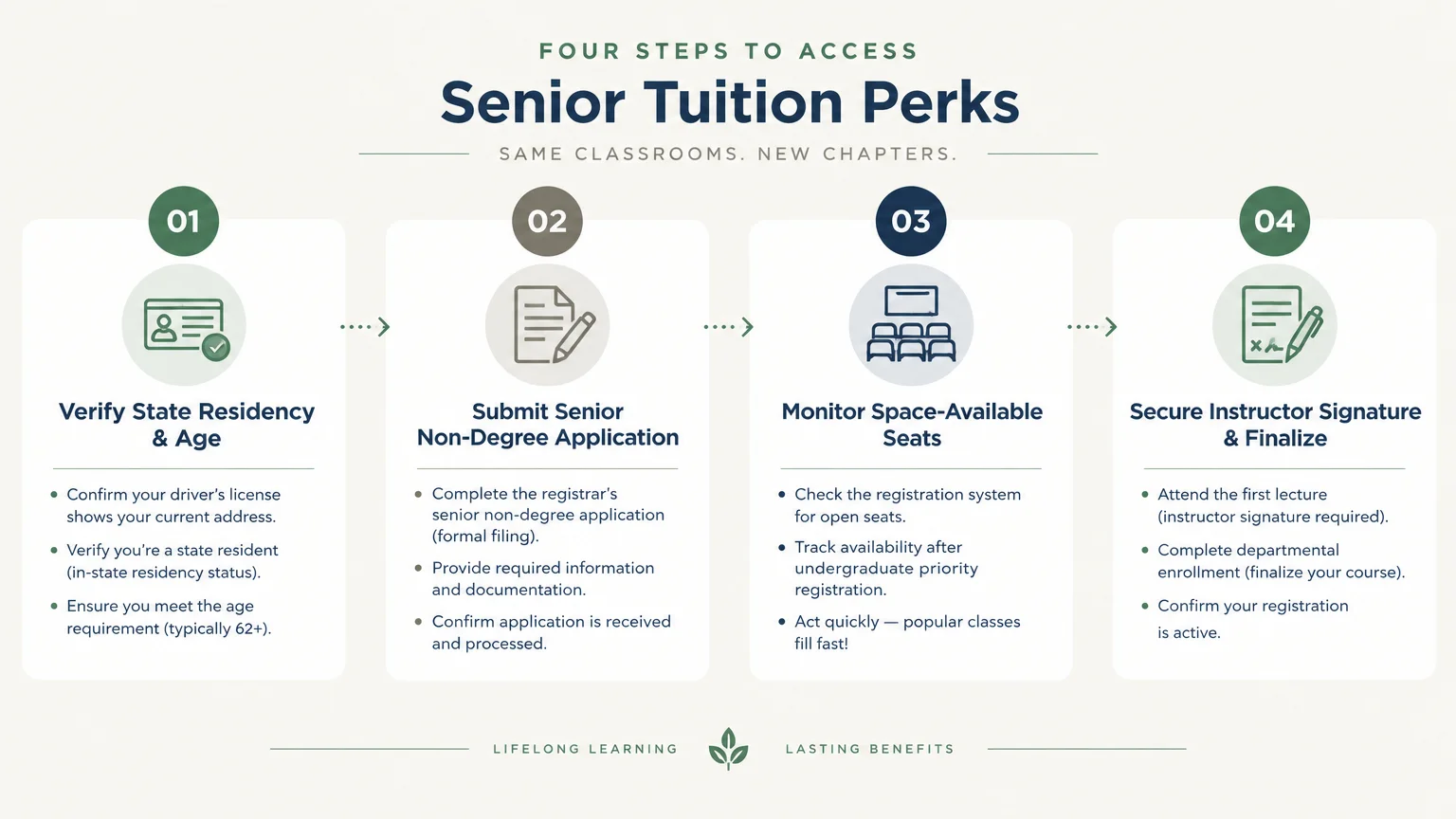
Navigating university administrative bureaucracies requires patience and early planning. Following a structured procedure helps you avoid administrative delays and secure your classroom seat smoothly.
- Verify your state residency status: Most universities require twelve consecutive months of legal state domicile before granting in-state fee remissions.
- Apply for non-degree or auditor admission: Submit an application through the registrar or continuing education office, identifying yourself as a lifelong learning applicant.
- Submit proof of age: Provide a valid state driver’s license, passport, or birth certificate to authenticate your qualification for the statutory waiver.
- Obtain departmental approvals: If auditing, contact professors early to request written permission to join their lecture rosters if seats remain.
- Register during the designated senior window: Complete your formal registration during the special space-available registration period.
- Pay remaining ancillary fees: Settle administrative, parking, and laboratory fees through the university cashier before the billing deadline.
Reach out directly to the university registrar’s office if your tuition invoice displays standard charges. Clerks frequently need to manually code your student account to apply senior legislative waivers correctly.

Protecting Your Retirement Budget When Relocating
Relocating to a college town requires balancing real estate costs against your tuition savings. Highly desirable university towns frequently experience tight housing markets and elevated local property taxes.
College rentals often cater heavily to students, which can inflate neighborhood noise and lease rates. Focus your home search on quiet outlying suburbs that still offer direct bus or van transit directly to campus.
Before purchasing real estate or signing long-term leases, analyze the overall cost of living. The Consumer Financial Protection Bureau (CFPB) advises seniors to account for total monthly housing outlays, utilities, and emergency reserves to prevent retirement budget strain.
Beware of moving scams and predatory housing developers targeting older adults. Thoroughly research property management companies, verify licensing credentials, and review municipal zoning rules before committing funds.
Renting for six months in your target town offers a practical trial run. You can experience the local seasons, evaluate medical care access, and audit classes before selling your primary home.
Frequently Asked Questions
Can I earn a full college degree using senior tuition waivers?
Yes, several states allow you to earn degrees through their tuition waiver policies. States like Georgia, Arkansas, and Kentucky permit credit-bearing degree coursework, provided you meet formal academic admission standards.
However, you must maintain satisfactory academic progress and complete all required prerequisite coursework. Schools that limit waivers strictly to course auditing, such as Florida and North Carolina, do not award academic degrees.
Do I have to take exams and write research papers when auditing?
Auditing students are generally exempt from mandatory exams, laboratory quizzes, and formal research papers. Your primary responsibility is attending lectures, listening to presentations, and completing readings for personal enrichment.
Some professors welcome auditor participation in classroom debates and discussions, while others prefer passive observation. Communicating clearly with your instructor on the first day helps set mutual expectations.
What happens if a class fills up before senior registration opens?
Because senior waivers operate on a space-available basis, tuition-paying degree students receive enrollment priority. If an introductory or popular class reaches maximum capacity, you cannot register under the statutory waiver.
You can improve your chances by creating a backup list of four or five alternate courses. Upper-level seminars and midday lectures often have plenty of empty seats compared to introductory prerequisite courses.
Do private universities offer these same tuition perks for seniors?
State statutes governing senior tuition waivers apply exclusively to public colleges and state university systems. Private colleges and universities are exempt from state-mandated tuition remission legislation.
Nevertheless, select private universities offer independent lifelong learning institutes or discounted audit fees for community retirees. Check with individual private continuing education departments to explore institutional programs.
Can out-of-state seniors qualify for these tuition waiver programs?
Virtually all statutory senior tuition waivers require legal residency within the host state. Out-of-state applicants must pay regular non-resident tuition rates until establishing legal domicile.
Establishing state domicile typically requires living in the state for twelve consecutive months, registering to vote, and transferring vehicle registrations. Always verify specific state residency statutes before planning your educational timeline.
For additional senior resources, visit Eldercare Locator, AARP and Alzheimer’s Association.
Disclaimer: The information in this article is for educational purposes only and is not intended to be a substitute for professional financial, legal, or medical advice. Always consult with a qualified expert for advice tailored to your personal situation.









Leave a Reply