

Helpful Resources for Seniors
Helpful Resources for Seniors Navigate life's next chapter with confidence
  • Home
  • Lifestyle
  • Well-Being
  • Finance

How to Avoid Hidden Fees on Senior Bank Accounts

September 8, 2025 · Finance

Reading glasses on an open book next to an armchair where a person is relaxing in the warm light of an evening lamp.

Actionable Strategies and Money-Saving Tips

You don’t have to accept bank fees as a fact of life. With a few proactive steps, you can significantly reduce or even eliminate them entirely. These finance tips for retirees are practical and can be put into action today.

An older woman talking with a bank representative at a desk in a modern bank branch.
Asking about special accounts for seniors at the bank.

1. Specifically Ask for a “Senior Checking Account”

Many banks and credit unions offer special accounts designed for customers over a certain age, usually 60 or 65. These accounts often come with valuable perks, such as waived monthly maintenance fees, free standard checks, and sometimes even free cashier’s checks. However, banks don’t always automatically enroll you in one when you reach the qualifying age. You have to ask for it. Call or visit your local branch and say, “I’d like to know if you offer a senior checking account or if my current account can be converted to one.”
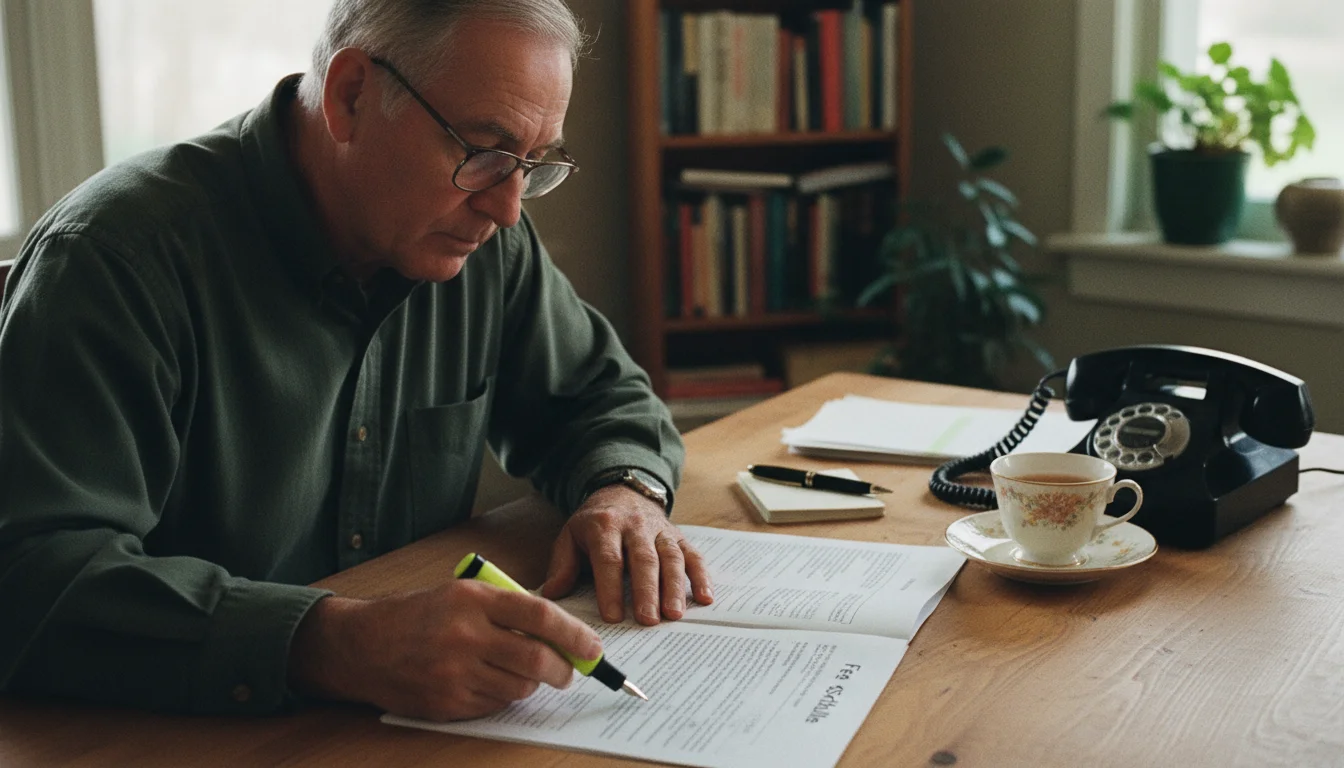
A senior man with glasses carefully highlights a 'Fee Schedule' document at his wooden desk.
Carefully scrutinizing the bank’s fee schedule for hidden details.

2. Get and Read Your Bank’s Fee Schedule

Every bank is required to have a document that lists every single potential fee they can charge you. It’s often called a “Fee Schedule” or “Account Terms and Conditions.” If you can’t find it online, call your bank and ask them to mail you a copy. It might seem like a boring document, but it’s your roadmap to avoiding charges. Look for the fees we discussed above and, most importantly, read the section that tells you how to get them waived.

An older couple at their kitchen table, intently reviewing an online bank statement on a tablet, with careful expressions.
Working together to keep an eye on their bank account balance.

3. Meet the Minimum Balance Requirement

One of the most common ways to avoid a monthly service fee is by maintaining a minimum balance. For example, a bank might waive its $12 monthly fee if you keep a minimum daily balance of $1,500 in your checking account. For some, this is easy. For others on a tight budget, it can be a challenge. If you choose this route, be vigilant. A single day below the threshold can trigger the fee. A good strategy is to keep a buffer of a few hundred dollars above the minimum, just in case of an unexpected expense.

A senior woman sits at a kitchen island, looking at a tablet screen displaying a generic banking app interface.
Staying on top of finances feels easy.

4. Set Up Direct Deposit

This is often the easiest way to get a free checking account. Banks want your primary business, and they reward customers who have their income deposited directly into their accounts. If you receive Social Security, a pension, or other retirement income, setting up direct deposit can often get that monthly fee waived, regardless of your balance. For official information on Social Security and Medicare, visit SSA.gov and Medicare.gov. Federal tax information is at the IRS.

Senior woman, mid-70s, in a cozy sunlit nook, calmly viewing her banking app on a tablet.
Checking bank statements online can be simple and convenient.

5. Go Paperless (If You’re Comfortable)

If you use a computer or smartphone and feel comfortable checking your statements online, opting out of paper statements is a quick way to save $2 to $5 a month. That’s $24 to $60 a year. Most banks make this very easy to do through their website or mobile app. If you still prefer a paper trail, you can often print the statements yourself from your online account at no charge.

An older woman with a kind smile receives cash from a grocery store cashier after a debit card transaction.
Getting cash back at the grocery store is a smart, fee-free way to grab money.

6. Be Strategic with Your Cash Withdrawals

Out-of-network ATM fees are completely avoidable. First, find out which ATMs are in your bank’s network—they are often listed on the bank’s website or app. Plan to only use those. An even better strategy is to get cash back when you’re paying with your debit card at the grocery store or pharmacy. It’s free and convenient. For example, if your bill is $23, you can ask for $40 cash back. Your account will be debited for $63, and you’ll walk away with your groceries and the cash you need, with no fee.

Senior man, late 60s, reviews online banking on laptop at kitchen table, focused on linked checking and savings accounts.
Keeping an eye on linked accounts can protect your finances.

7. Use Overdraft Protection Wisely

Overdraft fees are costly. The best defense is to keep a close eye on your account balance. As a backup, link your checking account to your savings account. This is called “overdraft protection.” If you overspend your checking account, the bank will automatically transfer money from your savings to cover the difference. There might be a small transfer fee (perhaps $10), but that is much better than a $35 overdraft penalty. Be careful not to confuse this with “overdraft coverage,” which is a high-interest loan the bank extends to you.

A senior woman listens attentively to a credit union employee at a counter in a bright, modern branch.
Getting personalized advice from a helpful credit union employee.

8. Explore Credit Unions and Online Banks

If your big national bank isn’t meeting your needs, don’t be afraid to look elsewhere. Credit unions are non-profit institutions owned by their members. Because they don’t have to generate profits for shareholders, they often offer accounts with no monthly fees, lower minimum balance requirements, and a more personal level of service. Similarly, online-only banks have very low overhead costs and pass those savings on to customers, often in the form of completely free checking and savings accounts with higher interest rates.

An older woman, mid-70s, sits at a kitchen table, calmly talking on a cordless phone with a notepad and pen nearby.
A calm phone call about bank fees can save you money.

9. Don’t Be Afraid to Call and Ask

If you get hit with a fee, especially for the first time, call your bank. Calmly explain the situation and ask if they would be willing to offer a one-time courtesy waiver. Banks value loyal, long-term customers and are often willing to waive a fee to keep you happy. You can also use this call to ask what you can do to avoid that fee in the future. A simple, polite phone call can save you $35 or more.



Pages: 1 2 3 4 5 6

Share this article

Facebook Twitter Pinterest LinkedIn Email

Leave a Reply Cancel reply

Your email address will not be published. Required fields are marked *

Search

Latest Posts

  • An ink and watercolor illustration of a retired couple chatting with a local at a coastal European cafe, enjoying a sunny morning. 15 Cheap European Retirement Havens Where You'll Have No Language Barrier
  • FBI’s World Cup Ticket Scam Warning FBI’s World Cup Ticket Scam Warning
  • A retiree in a gray cardigan sits at her sunlit kitchen table working on a laptop with a $1,000 earnings balance visible. 9 Smart Ways Retirees Are Earning Up to $1K Per Month From Home
  • A senior couple walks calmly through a bright, modern airport terminal filled with sunlight and plants. America's Best and Worst Airports for Travelers in 2026
  • A senior couple sits at their kitchen table, calmly reviewing a planning binder together in soft morning light. 8 Ways to Ease Burial Costs
  • A senior woman works on her laptop at a sunny kitchen table, representing a fulfilling second career in retirement. 10 Second Career Ideas for Retirees
  • A woman gently helping her elderly father button his sweater in a sunlit, authentic living room with a documentary photography aesthetic. 10 Programs Designed for Caregiving Support
  • Ink and watercolor illustration of a house key, a grocery basket, a lightbulb, and a stethoscope on a cream paper background. 6 Financial Aid Programs You May Qualify For (Check Here!)
  • A serene mixed-media collage featuring a pressed lily, vintage paper, and soft watercolor textures in sage and cream tones. 9 Charities That Help With Funeral Costs in 2026
  • An older man sitting peacefully in his sunlit living room, representing the comfort and dignity of aging in place independently. 5 Support Programs Designed for Seniors Living Alone

Newsletter

Get the latest posts delivered to your inbox.

Related Articles

A happy senior couple looking at a tablet in a bright, modern kitchen.

10 Things You Should Never Pay Full Price for After 60

Discover 10 things seniors should never pay full price for, including property taxes and cell…

Read More →
Make Money Online, budgeting mistake

8 Common Budgeting Mistakes That Wreck Retirement Dreams

An individual uses a calculator and notepad to avoid common budgeting mistakes that can derail…

Read More →
An older couple stands in front of a cozy condo, smiling; a large oak tree is visible in the background.

Personal Story: How I Downsized and Saved Thousands

For forty-two years, the house on Elm Street was more than just a house. It…

Read More →
A home office desk in daylight, with a financial planner, glasses, and a framed photograph of a happy older person.

How to Spot Investment Scams Targeting Seniors

Actionable Strategies and Money-Saving Tips Knowledge is your shield, and a set of practical habits…

Read More →
A smiling senior couple looking at a tablet in a sunny, modern living room.

8 Free Government Programs Most Seniors Don’t Know About

Discover 8 valuable, free government programs designed to help U.S. seniors cover healthcare, home repairs,…

Read More →
An older woman with glasses on her head intently studies complex medical bills at a sunlit kitchen table, a magnifying glass and notebook nearby.

How to Negotiate Medical Bills After Retirement

How to Negotiate Medical Bills After Retirement As you navigate retirement on a fixed income,…

Read More →
A sunlit home office desk with a budget planner, calculator, and a framed photo of a smiling senior woman.

Tax-Smart Retirement Withdrawals: What to Know

Table of Contents Introduction: Taking Control of Your Finances in Retirement Understanding the Financial Basics…

Read More →
A home office desk with a modern laptop and an old ledger, symbolizing the transition to new financial technology for seniors.

How to Leverage AI Tools to Manage Senior Finances

Table of Contents Introduction: Taking Control of Your Finances in Retirement Understanding the Financial Basics…

Read More →
A person sits at a desk reviewing financial documents, a calculator, and a budget spreadsheet.

The Financial Impact of Caring for a Spouse or Loved One

Becoming a caregiver for a spouse, partner, or parent is one of the most profound…

Read More →
Helpful Resources for Seniors Helpful Resources for Seniors

Navigate life's next chapter with confidence

Inedit Agency S.R.L.
Bucharest, Romania

contact@helpfulresourcesforseniors.com

Explore

  • Home
  • About Us
  • Editorial Policy
  • Privacy Policy
  • Terms and Conditions
  • Subscribe
  • Unsubscribe
  • Contact
  • Request to Know
  • Request to Delete
  • CA Private Policy

Categories

  • Finance
  • Lifestyle
  • Well-Being

© 2026 Helpful Resources for Seniors. All rights reserved.