

An unexpected medical bill, urgent home repair, or sudden rent increase can instantly disrupt a fixed retirement budget. When money runs dangerously low, you do not have months to wait for standard bureaucratic reviews. Several federal and local emergency assistance programs provide rapid cash, immediate food benefits, utility shut-off prevention, and rent relief for seniors in crisis. Whether you face delayed benefit checks or soaring prescription costs, vital lifelines exist to stabilize your finances within days or even hours. This comprehensive guide details the seven most reliable emergency assistance programs available to older adults, outlining exact eligibility rules, payout limits, and fast-track application steps so you can secure urgent support today.

How Emergency Financial Relief Works for Older Adults
Living on a fixed income creates unique vulnerabilities when unexpected expenses arise. A broken water heater, a sudden spike in prescription copays, or a landlord raising the rent can instantly deplete a modest savings account. For millions of older Americans relying entirely on monthly retirement checks, traditional credit cards or personal loans carry predatory interest rates that only worsen financial stress.
Emergency assistance programs operate differently from standard government aid. While traditional applications for social safety net programs often take thirty to ninety days to review, emergency relief mechanisms bypass standard queues to disburse crisis funds, stop evictions, restore utility connections, or provide emergency food. These programs recognize that delays in basic necessities can lead directly to acute medical emergencies and loss of independence.
Funding for these programs originates from federal, state, and private charitable endowments. Federal agencies allocate specialized crisis reserves to municipal agencies and local non-profits, allowing community case workers to issue immediate relief payments directly to landlords, utility companies, grocery merchants, or the applicants themselves. Understanding which agency manages each specific fund enables you to request expedited processing without wasting critical days on the wrong paperwork.
7 Critical Emergency Assistance Programs for Seniors
When you face an urgent financial shortfall, knowing precisely which program targets your immediate need is vital. The following seven initiatives represent the most reliable, government-backed crisis resources available to seniors across the United States.
1. Supplemental Security Income (SSI) Emergency Advance Payments (EAP)
If you are applying for Supplemental Security Income and experience an acute financial emergency, you do not have to wait for your application to finish the standard underwriting process. According to the Social Security Administration (SSA), new applicants who meet preliminary SSI eligibility and face an immediate threat to health or safety—such as an eviction notice, lack of food, or an imminent utility shut-off—can receive an Emergency Advance Payment.
This rapid payment provides up to the full federal monthly benefit rate ($994 for an individual; $1,491 for an eligible married couple in 2026). Social Security field offices process these payments immediately, often issuing a check or direct deposit on the spot. The agency then recovers the advance in small, manageable installments from your regular monthly SSI payments once standard approval finishes, ensuring you never face an unmanageable lump-sum repayment.
2. Social Security and SSI Immediate Payments (IP)
Current Social Security retirement, disability, or SSI beneficiaries sometimes face administrative payment delays, stolen checks, or banking errors that leave them with zero funds. When this occurs, local SSA field offices can issue an on-the-spot Immediate Payment (IP).
Field office managers have statutory authority to disburse up to $999 (and up to $2,000 under specific discretionary circumstances) directly to beneficiaries experiencing extreme financial hardship. To qualify, you must show that your regular benefit check was delayed or interrupted, and that you face an urgent crisis involving food, shelter, or vital medical care. You must visit a local Social Security office in person to request an Immediate Payment interview.
3. Expedited SNAP (Emergency Food Assistance)
Nutritional stability is critical for managing chronic conditions, yet food is often the first budget item cut during financial emergencies. The federal Supplemental Nutrition Assistance Program (SNAP) contains an emergency bypass provision governed by federal regulations (7 CFR § 273.2(i)) known as Expedited SNAP.
Under these rules, your local state social services agency must deliver your electronic benefit transfer (EBT) card with loaded funds within 7 calendar days of application if you meet any of these criteria:
- Your monthly gross income is less than $150 and your liquid assets (cash or checking balance) do not exceed $100.
- Your combined monthly housing rent/mortgage and utility bills exceed your total monthly gross income and liquid resources.
- You are a destitute migrant or seasonal farmworker with liquid resources below $100.
When applying, clearly state on your initial form that you are requesting expedited 7-day processing due to severe food hardship.
4. LIHEAP Crisis Intervention (Energy & Utility Relief)
Losing heat during freezing winter months or air conditioning during extreme summer heat waves poses severe health risks to older adults. The Low-Income Home Energy Assistance Program (LIHEAP) maintains a dedicated Crisis Assistance fund designed specifically to prevent or resolve life-threatening utility disconnections.
While standard LIHEAP grants process over several weeks to help offset heating and cooling bills, LIHEAP Crisis Assistance operates on an emergency timetable. By law, local administering agencies must resolve an active energy crisis within 48 hours, or within 18 hours if the situation is life-threatening (such as when medical equipment relies on electrical power). Eligibility caps are set federally at 150% of the Federal Poverty Guideline or 60% of your State Median Income, with statutory priority granted to households containing adults aged 60 and older.
5. Area Agencies on Aging (AAA) Crisis & Gap-Filling Funds
Established under Title III of the Older Americans Act, more than 600 Area Agencies on Aging operate across the United States. These local agencies manage flexible, emergency gap-filling relief funds specifically reserved for adults aged 60 and older. You can locate your regional office through the Eldercare Locator, a public service supported by the federal government.
Unlike rigid federal programs, AAA crisis grants feature flexible spending criteria. Case managers can authorize rapid micro-grants to pay for:
- Urgent home accessibility repairs (such as replacing broken wheelchair ramps or repairing leaking roofs).
- Emergency prescription drug refills and medical supplies.
- Temporary emergency home-delivered meals following a hospitalization.
- Short-term lodging or emergency transportation vouchers to medical appointments.
6. Medicare Extra Help (Part D Low-Income Subsidy)
Surging medication expenses frequently force seniors into immediate financial insolvency. According to program standards overseen by the Centers for Medicare & Medicaid Services (CMS), the Medicare Extra Help program—also known as the Part D Low-Income Subsidy (LIS)—provides comprehensive financial protection against high drug costs.
In 2026, qualifying seniors with annual incomes under $23,475 (or $31,725 for married couples) receive substantial relief:
- $0 Medicare Part D monthly premiums and $0 annual prescription deductibles.
- Capped copayments of no more than $5.10 for generic drugs and $12.65 for covered brand-name drugs.
- Complete elimination of catastrophic coverage cost-sharing for the remainder of the calendar year once spending thresholds are met.
Applying for Extra Help can be done online or via Social Security, and approval provides immediate relief at the pharmacy counter.
7. HUD Emergency Solutions Grants (ESG) & Eviction Prevention
Housing insecurity among seniors has risen sharply alongside market rents. The U.S. Department of Housing and Urban Development (HUD) funds local Continuum of Care (CoC) networks and municipal charities through Emergency Solutions Grants (ESG).
ESG funds provide emergency rental arrears payments directly to landlords to halt active eviction proceedings against seniors. If an older adult has already lost their housing, ESG provides rapid re-housing funds to cover security deposits, first month’s rent, moving costs, and short-term utility deposits. Accessing these funds typically begins by dialing 2-1-1 to connect with your municipal housing crisis intake coordinator.
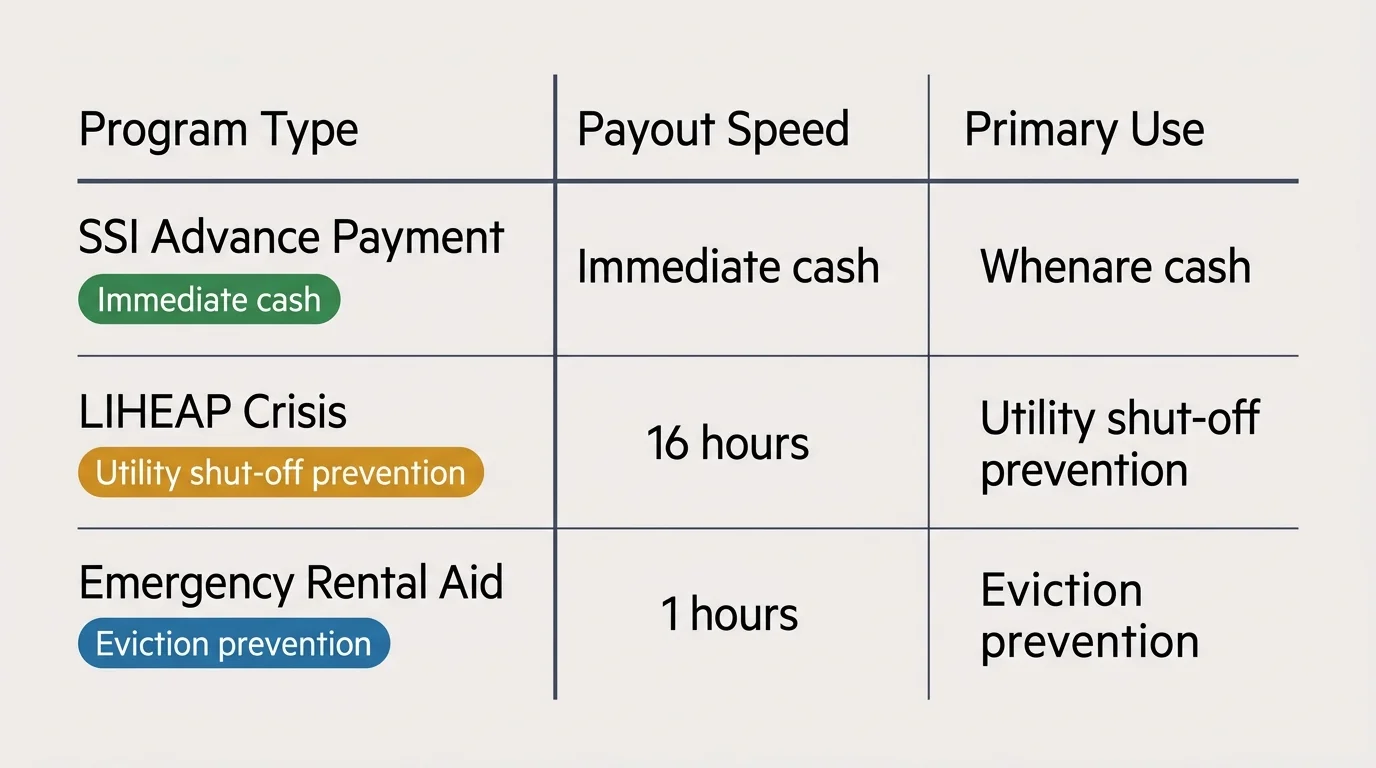
Emergency Relief Programs Comparison
Comparing program parameters helps you quickly determine which resource aligns with your immediate emergency. The table below outlines target areas, turnaround times, and application routes for each major initiative.
| Program Name | Primary Crisis Covered | Typical Turnaround | Income / Resource Limit | Where to Apply |
|---|---|---|---|---|
| SSI Emergency Advance Payment (EAP) | Immediate cash for pending SSI applicants | Same day to 48 hours | Meets standard SSI financial limits | Local SSA Field Office |
| SSA Immediate Payment (IP) | Delayed or missing Social Security checks | Same day | Existing beneficiary with delayed payment | Local SSA Field Office |
| Expedited SNAP | Severe food insecurity and hunger | 7 calendar days | Gross income <$150 and liquid assets ≤$100 | County Social Services Department |
| LIHEAP Crisis Assistance | Imminent utility shut-off or lack of fuel | 18 to 48 hours | ≤150% FPG or ≤60% State Median Income | Local Community Action Agency |
| AAA Gap-Filling Grants | Home repairs, medications, urgent needs | 2 to 5 business days | Age 60+ (need-based assessment) | Regional Area Agency on Aging (Eldercare Locator) |
| Medicare Extra Help | High prescription copays and deductibles | 1 to 2 weeks (immediate at pharmacy upon approval) | Income <$23,475 (single) / <$31,725 (married) | Social Security Administration / CMS |
| HUD Emergency Solutions Grants | Active eviction or immediate homelessness | 3 to 7 business days | Very low income / imminent eviction notice | Local CoC Intake / Dial 2-1-1 |
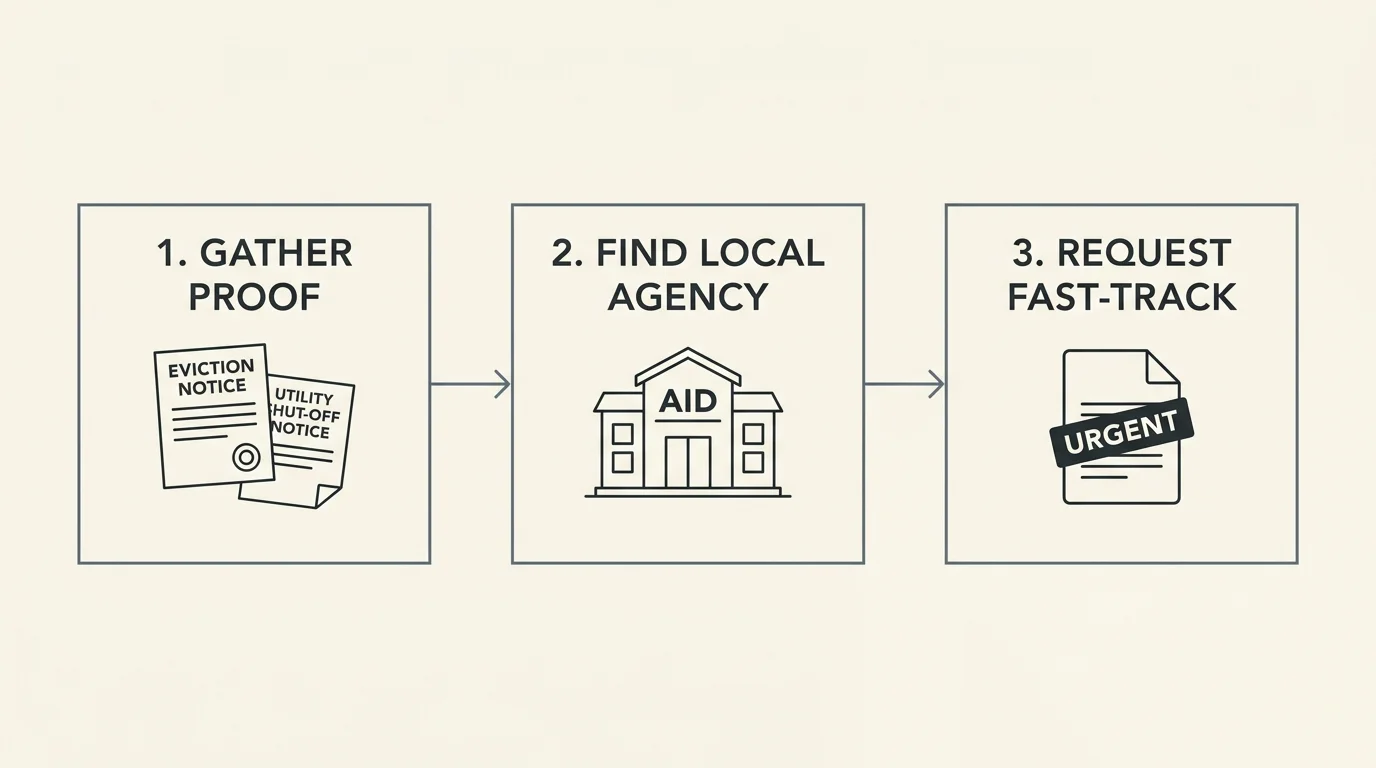
Step-by-Step Guide to Accessing Emergency Aid
When dealing with an active crisis, standard bureaucratic delays can be catastrophic. Preparing your documentation and taking decisive, organized steps ensures your application reaches the front of the review line.
- Compile an Emergency Documentation Packet: Place your essential documents in a single folder. You will need government-issued photo identification, proof of age (birth certificate or Medicare card), your most recent Social Security award letter, bank statements from the last two months, and written proof of the emergency (such as a formal utility shut-off notice, eviction summons, or unpaid medical bill).
- Screen for Comprehensive Benefits: Check broader program eligibility through Benefits.gov to ensure you do not overlook complementary state or county programs designed to assist low-income seniors.
- Contact Your Local Area Agency on Aging Immediately: Call 1-800-677-1116 to speak with your local senior coordinator. AAAs maintain localized crisis grants that do not appear on standard state welfare portals and can assign a case worker to assist with your paperwork.
- Dial 2-1-1 for Emergency Housing and Utility Dispatch: The nationwide 2-1-1 network connects directly with local charitable foundations, United Way chapters, and municipal ESG providers with active funding pools.
- Visit Your Local Social Security Field Office in Person: If your emergency involves delayed federal benefits or an urgent SSI crisis, do not rely on telephone customer service queues. Arrive at your nearest SSA office in the morning with your identification and proof of hardship to request an Immediate Payment or Emergency Advance interview directly.
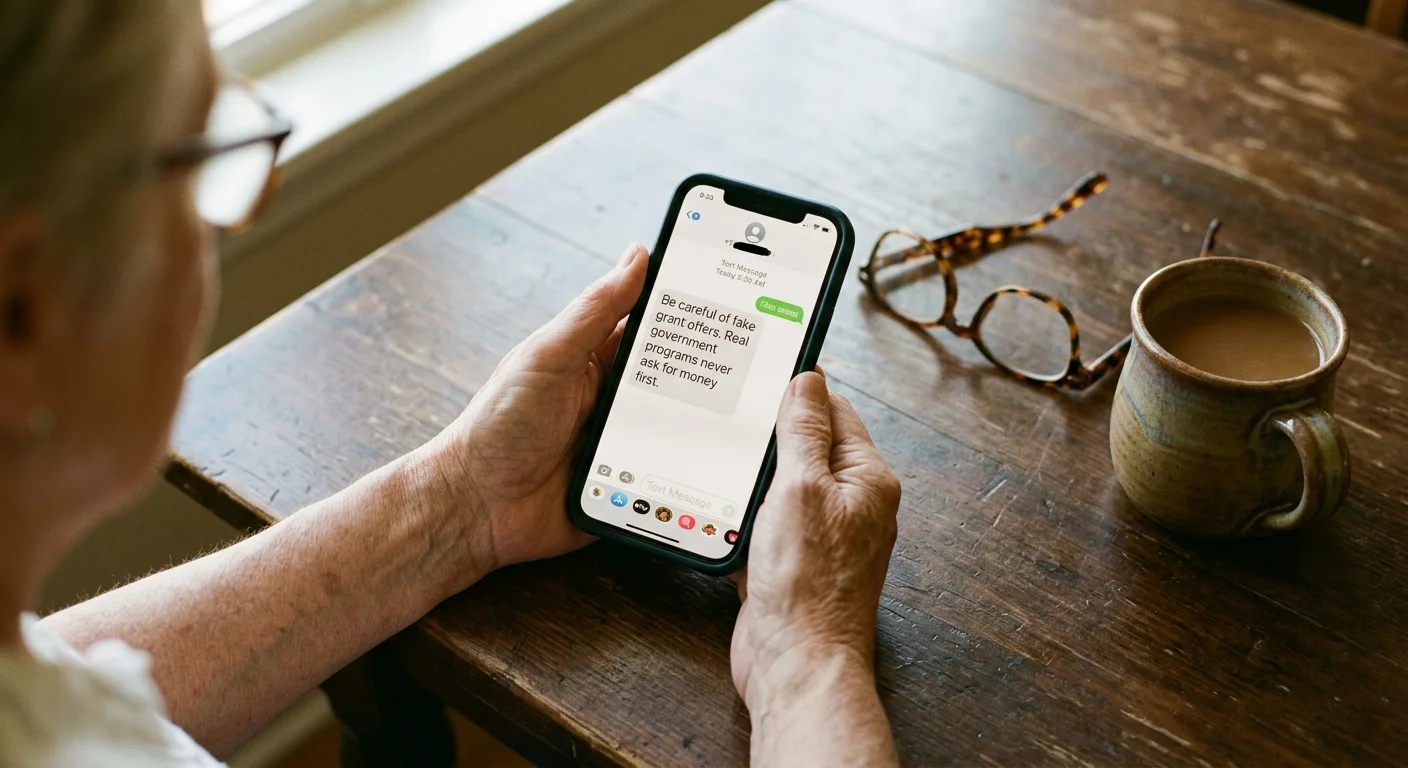
How to Avoid Emergency Assistance and Grant Scams
Financial distress makes individuals particularly vulnerable to predatory fraudsters. Scammers frequently target older adults searching for emergency relief by creating fake grant programs, impersonating government agencies, or promising guaranteed cash payouts.
According to consumer warnings published by the Consumer Financial Protection Bureau (CFPB), legitimate government relief programs never charge application fees, processing charges, or taxes in exchange for awarding aid. If an individual or website demands payment via gift cards, wire transfers, or cryptocurrency to unlock an emergency grant, it is always a scam.
Protect yourself by following these essential security rules:
- Never pay for access to government aid: All genuine federal, state, and county assistance programs are completely free to apply for.
- Verify agency callers independently: Government agencies like the Social Security Administration, Medicare, and HUD will never call you demanding your full Social Security number, banking passwords, or credit card details over the phone.
- Avoid third-party application brokers: Only submit personal information through official government portals (ending in .gov) or verified non-profit partners like your local Area Agency on Aging or United Way.
- Be skeptical of unsolicited grant offers: Legitimate agencies do not reach out via social media messages, text messages, or automated robocalls claiming you have won an unclaimed government relief grant.
Frequently Asked Questions
Can I receive emergency cash if I already receive monthly Social Security retirement benefits?
Yes. If your monthly Social Security check was delayed, interrupted by an administrative error, or stolen, you can visit your local Social Security field office to request an Immediate Payment of up to $999. If you need financial help due to rising living expenses rather than a missing check, you can apply for non-cash emergency relief through LIHEAP Crisis Assistance, Expedited SNAP, or Area Agency on Aging gap-filling grants.
How quickly will Expedited SNAP benefits appear on my EBT card?
By federal law, state agencies must process and issue Expedited SNAP benefits within 7 calendar days of your application date. If your gross monthly income is below $150 and your available cash is $100 or less, or if your rent and utility bills exceed your total monthly income, your application must receive this expedited priority.
Will emergency financial assistance reduce my regular Medicaid or SSI benefits?
In almost all cases, genuine emergency assistance grants, disaster relief payments, and energy assistance funds (like LIHEAP) are classified as non-countable income. They do not reduce your ongoing monthly SSI check or jeopardize your Medicaid coverage. However, you should maintain receipts showing that you spent cash advances immediately on your emergency needs rather than accumulating them in savings.
What should I do if my emergency application is denied?
If an agency denies your emergency request, you have the statutory right to request an expedited administrative appeal or fair hearing. Immediately contact your local Legal Aid office or Area Agency on Aging case worker, who can provide free legal advocacy and connect you with alternative private charitable funds while your appeal processes.
Can I apply for multiple emergency assistance programs at the same time?
Yes. You can simultaneously apply for Expedited SNAP for food, LIHEAP for heating or cooling, and emergency rental assistance through HUD ESG. Receiving aid from one emergency program does not disqualify you from receiving crisis relief from another, provided you meet each program’s respective eligibility rules.
For additional senior resources, visit
American Heart Association, Benefits.gov, National Institute on Aging (NIA), Centers for Disease Control and Prevention (CDC) and Medicare.gov.
Disclaimer: The information in this article is for educational purposes only and is not intended to be a substitute for professional financial, legal, or medical advice. Always consult with a qualified expert for advice tailored to your personal situation.









Leave a Reply