

Securing Medicare coverage for a mobility scooter can restore your physical independence and help you navigate your home safely. Medicare Part B covers these power-operated vehicles as durable medical equipment when you meet specific functional criteria.
The approval process requires careful documentation from your physician and an authorized medical equipment supplier. Understanding the federal guidelines protects you from unexpected out-of-pocket expenses and avoidable claim denials.
This comprehensive guide breaks down the nine essential Medicare coverage rules you must know. Learn how to navigate clinical evaluations, supplier requirements, and out-of-pocket costs with complete confidence.
In this guide10 sections
- 1. Understanding Power-Operated Vehicles and Part B Benefits
- 2. The Strict In-Home Medical Necessity Rule
- 3. The Step-by-Step Mobility Aid Hierarchy
- 4. Doctor Consultations and Face-to-Face Examinations
- 5. Home Assessment and Environmental Accessibility Requirements
- 6. Navigating Out-of-Pocket Costs and Coinsurance Rates
- 7. The 13-Month Capped Rental Process and Ownership Transfer
- 8. Ongoing Maintenance, Battery Replacement, and the 5-Year Rule
- 9. Medicare Advantage Network Rules and Prior Authorization
- Frequently Asked Questions

01 Understanding Power-Operated Vehicles and Part B Benefits
Medicare categorizes mobility scooters as power-operated vehicles under the broader umbrella of power mobility devices. These devices qualify as durable medical equipment under Original Medicare Part B.
According to the Centers for Medicare & Medicaid Services (CMS), durable medical equipment must serve a clear medical purpose. The equipment must also withstand repeated use inside your living environment.
Mobility scooters feature an electric drivetrain, a swiveling captain chair, and a central steering console known as a tiller. They offer an ideal solution for seniors who maintain adequate upper-body control but cannot walk safely across their home.
Understanding this formal classification helps you communicate clearly with your doctor and medical equipment supplier. It also ensures that your medical records align with federal reimbursement regulations.
- Designed specifically for long-term therapeutic use within a residential setting
- Equipped with three or four stable wheels and an electric motor
- Controlled by an upright handlebar tiller rather than an advanced electronic joystick
- Engineered to safely accommodate your specific body weight and postural needs
Unlike standard manual wheelchairs, scooters utilize battery power to eliminate the physical strain of manual wheel propulsion. This mechanical assistance preserves your remaining stamina for other personal tasks.
However, scooters demand more physical strength to steer than specialized power wheelchairs. If you cannot maintain upright posture or grip the handlebars, your physician must evaluate alternative mobility devices.
Medicare will only approve equipment that matches your precise physical abilities. Reviewing these mechanical distinctions early prevents submitting an application for the wrong category of equipment.

02 The Strict In-Home Medical Necessity Rule
Medicare enforces a strict policy requiring that mobility equipment be medically necessary inside your primary residence. Federal regulations do not authorize scooter coverage for community travel, outdoor leisure, or neighborhood shopping.
To secure coverage, you must prove that mobility limitations prevent you from completing essential daily tasks indoors. Medicare refers to these basic activities as Activities of Daily Living.
As noted by experts at the National Institute on Aging (NIA), maintaining independent personal care routines supports healthy aging at home. Your equipment must directly enable these private routines.
If Medicare reviewers conclude that you can walk safely indoors, they will deny your scooter claim. Stating during your exam that you want a scooter primarily for outdoor recreation guarantees an immediate claim denial.
- Transferring safely into and out of bed or a supportive living room chair
- Moving between the bedroom, bathroom, and kitchen without dangerous fall risks
- Standing long enough to prepare simple meals, wash dishes, or drink water
- Managing independent toilet hygiene and bathing routines securely
Your physician must detail how your physical condition impairs your ability to accomplish these routines on your own. Clinical charts must describe specific limitations, such as severe joint pain, muscle weakness, or extreme balance instability.
You must also prove that using the scooter inside your home will resolve these daily limitations. If your home layout prevents safe scooter use, Medicare cannot approve the device.
Keep your focus on in-home mobility whenever discussing your equipment needs with healthcare providers. This clear focus establishes the medical foundation necessary for approval.
03 The Step-by-Step Mobility Aid Hierarchy
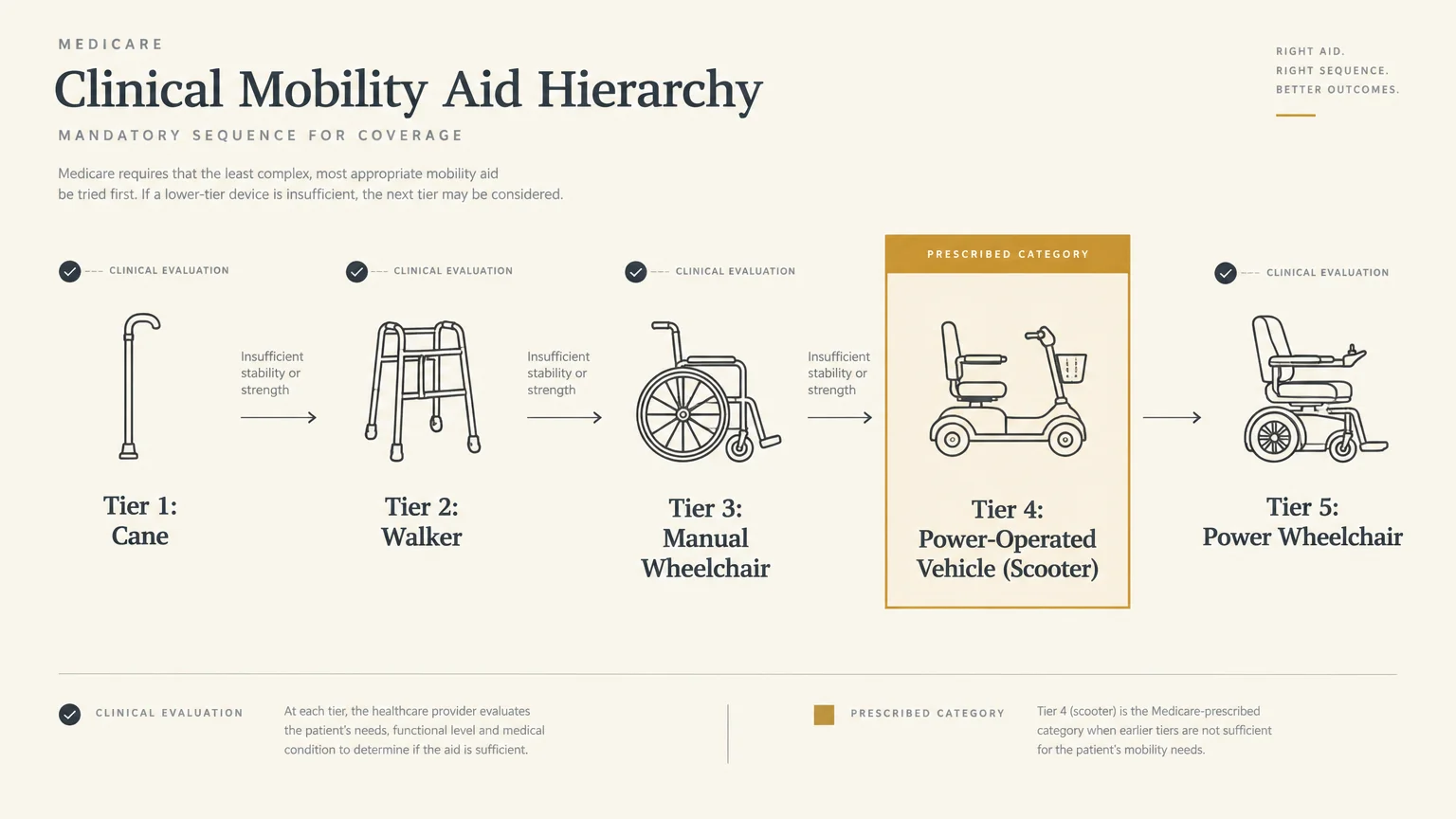
Medicare enforces a mandatory clinical progression known as the mobility aid hierarchy. Your physician must formally evaluate and eliminate less costly mobility devices before prescribing a motorized scooter.
This sequential evaluation ensures that you receive the most practical, cost-effective equipment suited to your functional limitations. Medicare will not pay for a motorized device if simpler equipment meets your needs safely.
- Canes and Crutches: Your physician must verify that a standard or quad cane does not provide sufficient balance support.
- Walkers and Rollators: Your medical notes must demonstrate that a rolling walker cannot prevent falls or relieve debilitating fatigue.
- Manual Wheelchairs: You must demonstrate insufficient upper-body strength, stamina, or coordination to propel a manual wheelchair across your home.
- Power-Operated Vehicles: You must possess sufficient trunk stability, grip strength, and cognitive awareness to control a scooter safely.
Each tier of this progression requires explicit clinical justification in your medical chart. Your doctor cannot simply check a box indicating that simpler devices do not work.
For example, your doctor might document that severe shoulder arthritis prevents manual wheelchair propulsion. Alternatively, your records could show that advanced cardiopulmonary disease causes debilitating breathlessness after rolling a walker just five feet.
If your physical evaluation reveals poor upper-body control or weak grip strength, you may fail the scooter criteria. In that situation, your doctor will evaluate you for an electric power wheelchair instead.
Understanding this progression allows you to provide precise feedback during your mobility examination. Clear descriptions of why simpler tools failed help your doctor build an airtight clinical record.

04 Doctor Consultations and Face-to-Face Examinations
Medicare requires an in-person, face-to-face mobility examination before any supplier can order your power-operated vehicle. Routine telehealth visits do not satisfy Medicare’s strict physical examination mandates for power mobility equipment.
This comprehensive evaluation must be conducted by a Medicare-enrolled physician, physician assistant, or nurse practitioner. Federal law specifically excludes podiatrists from ordering power mobility devices.
During the appointment, your healthcare provider examines your muscle strength, joint range of motion, and balance reflexes. They also assess your cognitive judgment and visual capability to operate motorized equipment safely.
Following the examination, your clinician prepares a detailed Standard Written Order. This official legal order must reach your medical equipment supplier before the scooter can be delivered.
- Detailed physical assessment measuring joint mobility, spinal stability, and grip strength
- Comprehensive history of previous fall events, near-misses, and walking instability
- Clinical explanations detailing why canes, walkers, and manual wheelchairs are ineffective
- Cognitive evaluation confirming that you can safely operate speed and directional controls
- A signed and dated Standard Written Order that contains all required federal elements
Schedule your evaluation at a time of day when your mobility symptoms are typical of your daily routine. This scheduling approach allows your physician to observe your authentic physical limitations.
Bring any current walking aids, such as canes or rollators, to your face-to-face appointment. Demonstrating your difficulty with these devices in person gives your provider immediate clinical evidence.
Ensure your physician submits their full clinical chart notes alongside the written prescription. Missing clinical notes represent one of the most common reasons for supplier processing delays.
05 Home Assessment and Environmental Accessibility Requirements
Medicare mandates a formal home environmental evaluation before authorizing coverage for a power-operated vehicle. Either your prescribing healthcare practitioner or a certified medical equipment supplier must conduct this accessibility inspection.
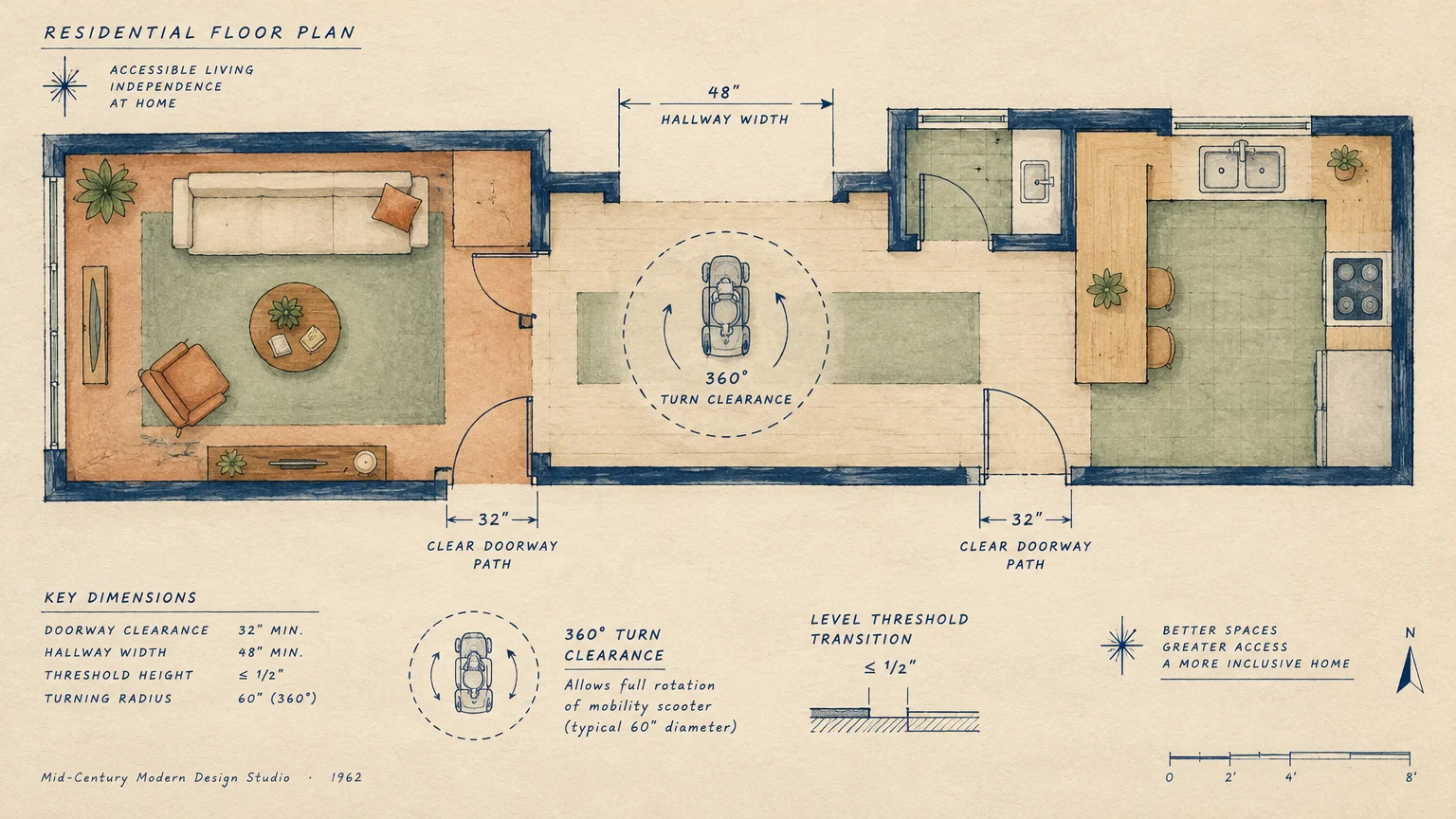
The inspector evaluates your primary residence to ensure your doorways, hallways, and living spaces can accommodate the scooter. A scooter cannot resolve daily mobility challenges if it cannot fit through your interior doors.
If you encounter physical barriers inside your home, community resources may offer helpful guidance. You can contact the Eldercare Locator to identify local home modification programs and support services.
The assessment verifies that you have adequate turning clearance in your bedroom, bathroom, and kitchen. The surveyor also checks whether your home provides safe access to grounded electrical outlets for recharging.
- Interior doorways wide enough to accommodate the width of the scooter chassis
- Smooth transitions between differing floor materials without hazardous threshold barriers
- Clear turning radius inside tight spaces such as bathrooms, kitchens, and hallways
- Dedicated, dry indoor storage space equipped with an accessible charging outlet
Thick pile carpeting, narrow hallways, or sunken rooms can create significant navigation problems. If the environmental inspection identifies impassable physical obstacles, Medicare will withhold equipment approval until issues are resolved.
Medicare does not pay for residential renovations, such as doorway widening or indoor ramp construction. Beneficiaries must complete and finance any necessary structural home modifications independently.
Work closely with your supplier during the home visit to map out clear navigation routes. Verifying these pathways ahead of delivery ensures a smooth transition to motorized mobility.
06 Navigating Out-of-Pocket Costs and Coinsurance Rates
Understanding the cost-sharing structure of Original Medicare Part B protects your personal savings from unexpected bills. In 2026, the standard monthly Part B premium is $202.90.
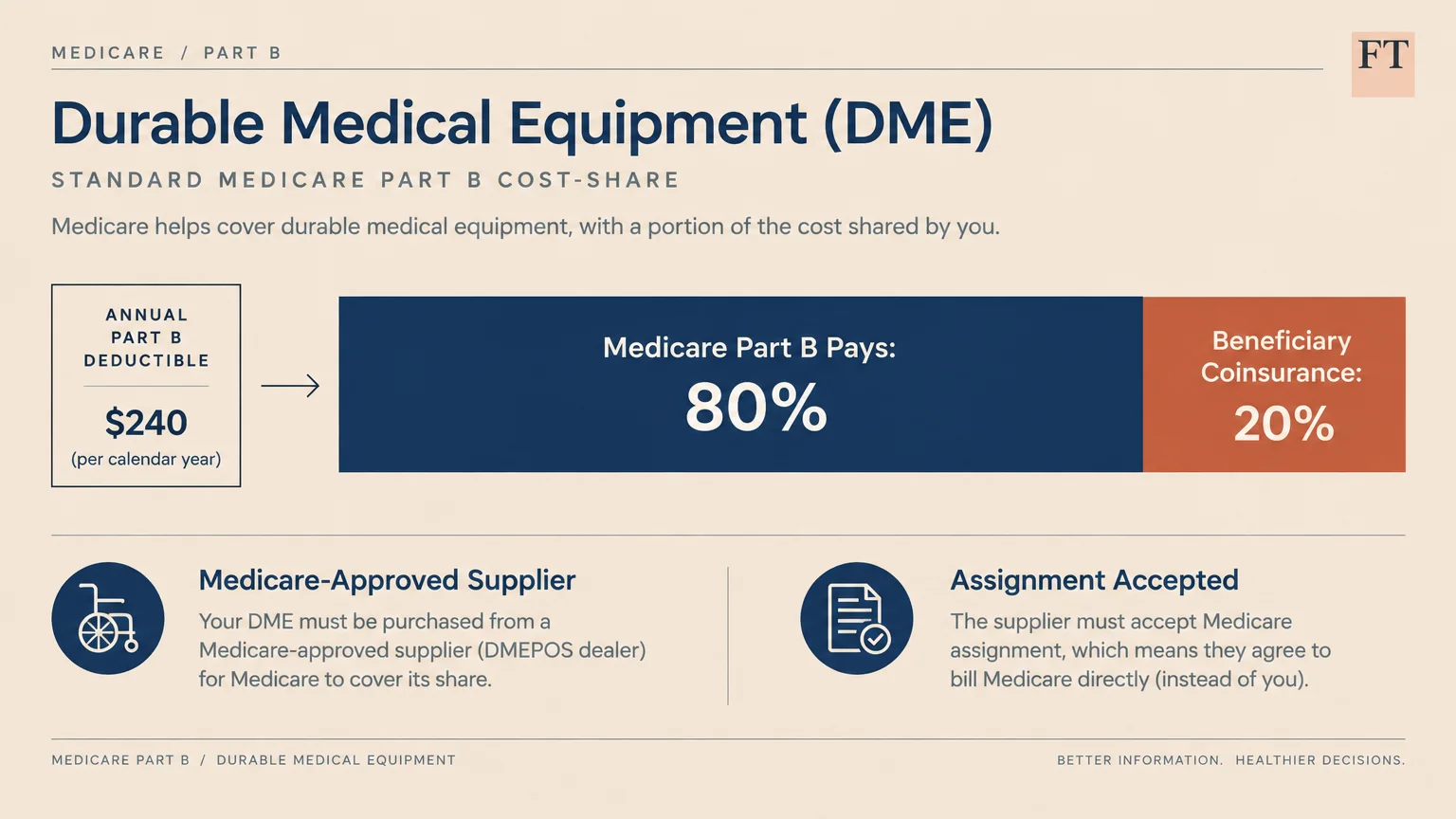
Before Medicare begins paying for durable medical equipment, you must satisfy your annual Part B deductible of $283. Once you meet this deductible, Medicare covers 80 percent of the approved equipment cost.
According to Medicare.gov, you remain responsible for the remaining 20 percent coinsurance amount. If you maintain a supplemental Medigap policy, that secondary coverage generally pays your 20 percent share.
To avoid unexpected expenses, ensure your doctor and equipment supplier are enrolled in Medicare and accept assignment. Participating suppliers who accept assignment agree to accept the Medicare-approved amount as payment in full.
Non-participating suppliers who do not accept assignment may charge extra fees above federal reimbursement limits. Always confirm assignment terms in writing before accepting delivery of your scooter.
| Expense Category | 2026 Medicare Amount | Your Financial Responsibility |
|---|---|---|
| Standard Monthly Premium | $202.90 per month | Paid monthly to maintain Part B coverage |
| Annual Medical Deductible | $283 once per year | 100% out-of-pocket until met |
| Equipment Coinsurance | 80% covered by Medicare | 20% out-of-pocket (or covered by Medigap) |
| Supplier Surcharges | $0 if supplier accepts assignment | Unlimited if supplier does not accept assignment |
If you carry a Medicare Supplement plan such as Plan G or Plan N, check your benefits before ordering. These policies typically cover the entire 20 percent coinsurance once you pay your Part B deductible.
Never sign an equipment delivery receipt without reading the financial disclosures carefully. Protecting yourself from unassigned billing ensures your new scooter remains genuinely affordable.
07 The 13-Month Capped Rental Process and Ownership Transfer
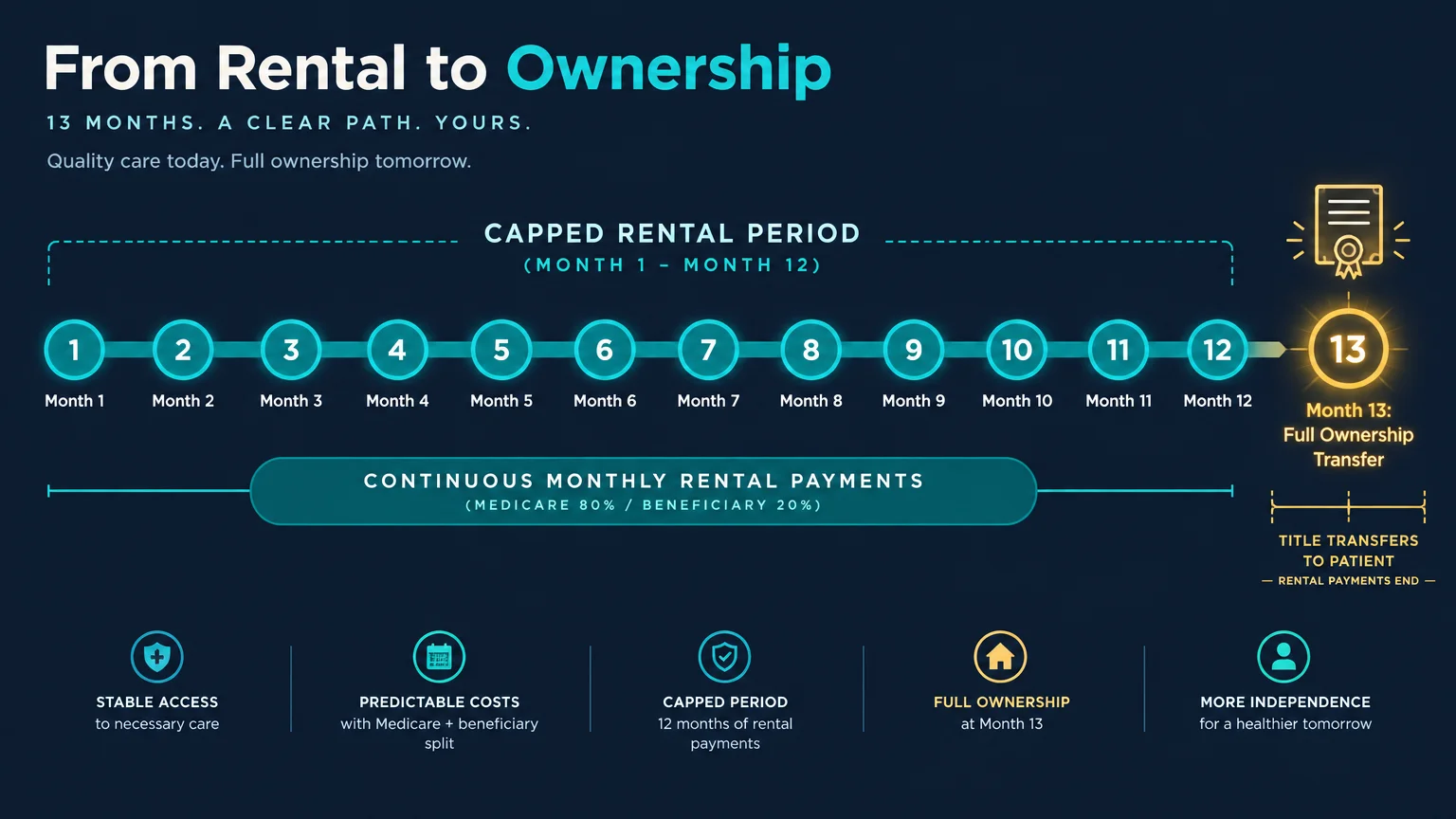
Medicare rarely purchases a mobility scooter outright through an upfront, lump-sum payment. Instead, the program reimburses power-operated vehicles through a structured 13-month capped rental agreement.
Under this system, Medicare issues monthly rental reimbursements to your equipment supplier for 13 continuous months. You remain responsible for paying your 20 percent coinsurance portion toward each monthly fee.
During these 13 rental months, the medical equipment supplier retains legal title to the scooter. Because the supplier owns the machine, they must provide all routine servicing and repairs at no added cost.
On the first day of the fourteenth month, full legal ownership of the scooter transfers to you. After this transfer takes place, the supplier no longer provides complimentary routine maintenance.
- Months 1 through 3: Medicare pays a higher monthly rental rate while you adjust to the device in your home.
- Months 4 through 13: Medicare pays a reduced monthly rental fee while the supplier remains responsible for upkeep.
- Month 14 and Beyond: Equipment ownership transfers entirely to you, concluding Medicare rental reimbursements.
If your medical necessity changes during the rental period, the supplier will retrieve the equipment. This capped rental mechanism prevents Medicare from buying permanent machinery for temporary health conditions.
If you change health plans or move during the 13-month window, notify your supplier immediately. Unreported changes can interrupt rental payments and disrupt your path toward permanent ownership.
Keep copies of every monthly rental statement throughout the 13-month timeline. These documents verify your ongoing payments and prove your eventual equipment ownership status.
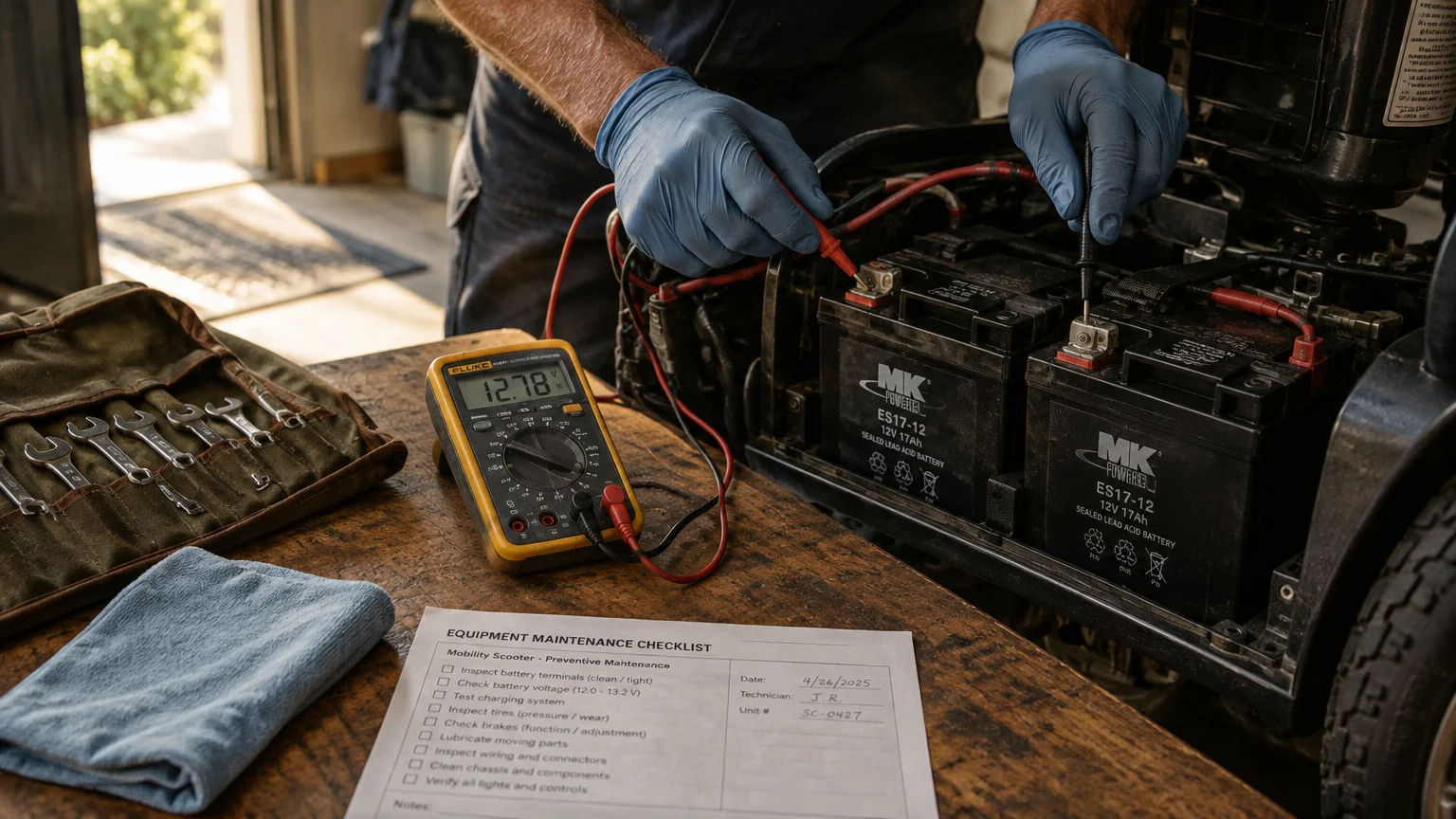
08 Ongoing Maintenance, Battery Replacement, and the 5-Year Rule
Once you gain full legal ownership of your scooter, ongoing upkeep becomes your personal responsibility. Fortunately, Medicare Part B helps pay for necessary repairs, replacement parts, and batteries for equipment you own.
Medicare covers 80 percent of approved repair expenses and replacement batteries after you meet your Part B deductible. You must hire a Medicare-enrolled repair provider who accepts assignment to receive this assistance.
Medicare establishes a five-year reasonable useful lifetime for all power-operated mobility devices. The program will not approve a replacement scooter until five full years have elapsed from your initial delivery.
Medicare makes narrow exceptions if your equipment is lost, stolen, or destroyed in a natural disaster or accident. To qualify for early replacement, you must supply supporting police reports or insurance adjustor records.
- Replacement batteries are covered when diagnostic testing proves they no longer hold a functional daily charge
- Labor charges for repairs are covered when performed by a Medicare-approved technician
- Repairs must remain more cost-effective than purchasing a completely new replacement device
- Unapproved performance modifications or aesthetic upgrades will not receive Medicare reimbursement
If your physical condition changes significantly before five years pass, Medicare may evaluate an equipment upgrade. For instance, if your condition worsens, your doctor can request a power wheelchair instead.
Establish a regular maintenance habit to keep your scooter operating reliably across its five-year lifespan. Regularly inspecting tire pressure and cleaning electrical connections prevents unexpected mechanical breakdowns.
Store all repair orders and battery replacement receipts in an organized file at home. This paperwork simplifies future claims and proves continuous medical use of your equipment.

09 Medicare Advantage Network Rules and Prior Authorization
If you enroll in a Medicare Advantage plan, a private insurer manages your Part B benefits. Federal law requires Medicare Advantage plans to offer coverage that matches or exceeds Original Medicare standards.
However, private insurance plans enforce distinct utilization rules and restricted provider networks. Most Medicare Advantage plans mandate strict prior authorization before approving any power mobility device.
You must obtain your mobility scooter from a medical supplier contracted within your plan’s specific network. Ordering from an out-of-network vendor often results in total claim denial and steep out-of-pocket bills.
Cost-sharing rules also differ under Medicare Advantage compared to traditional Medicare guidelines. Instead of paying a 20 percent coinsurance fee, your plan may charge flat copayments for monthly rentals.
- Contact your plan administrator before scheduling any mobility consultations or home inspections
- Verify whether your plan requires an evaluation by an in-network physical therapist
- Obtain written confirmation of prior authorization approval before accepting equipment delivery
- Review your plan’s specific grievance and appeals timelines if coverage is initially denied
If your Medicare Advantage plan denies your scooter request, you have the legal right to appeal. Most initial denials stem from missing clinical documentation rather than lack of true medical necessity.
Collaborate with your doctor to submit supplemental chart notes during the formal appeal process. Providing detailed physical therapy notes significantly improves the likelihood of overturning an initial denial.
Always review your plan’s annual Evidence of Coverage document every autumn. Monitoring network adjustments prevents unexpected surprises when you require equipment servicing or replacement parts.
Frequently Asked Questions
Can I use my Medicare-covered scooter outside for grocery shopping or errands?
Medicare approves mobility scooters solely for medical necessity inside your personal residence. While you may occasionally ride your scooter outside, Medicare will deny your application if outdoor use is your stated purpose.
What happens if my doctor prescribes a scooter but Medicare denies the claim?
You have the legal right to appeal any Medicare equipment coverage denial. Work with your physician to submit additional clinical chart notes that clarify your in-home functional limitations and walking risks.
Does Medicare cover lightweight folding travel scooters?
Medicare rarely covers lightweight travel or folding scooters because they are designed primarily for portable community use. Covered scooters must meet rigorous durability standards designed for daily residential use.
How do I verify that my equipment supplier accepts Medicare assignment?
You can use the supplier directory on the official Medicare website to locate participating providers. Always call the supplier directly to confirm that they accept assignment for power mobility equipment before scheduling visits.
Will Medicare pay for a vehicle lift or ramp to transport my mobility scooter?
Medicare does not cover automotive vehicle lifts, trailer hitches, or exterior vehicle carriers. The program considers these items convenience accessories rather than medically necessary equipment for in-home care.
For additional senior resources, visit
Medicare.gov, National Institute of Mental Health (NIMH), National Institutes of Health (NIH), Centers for Medicare & Medicaid Services (CMS) and Social Security Administration (SSA).
Disclaimer: The information in this article is for educational purposes only and is not intended to be a substitute for professional financial, legal, or medical advice. Always consult with a qualified expert for advice tailored to your personal situation.