Living on a fixed income often forces you to stretch every dollar across rising household expenses. Millions of older adults qualify for state programs for seniors that deliver direct cash, utility credits, and property tax refunds.
These initiatives protect your hard-earned retirement savings and preserve your independence. You can secure meaningful financial relief each month once you know which options match your household situation.
From housing rebates to caregiver stipends, substantial money for seniors goes unclaimed every single year. This guide details nine proven programs and explains exactly how you can claim your share.
In this guide10 sections
- Understanding State Assistance for Seniors
- 1. State Property Tax and Rent Rebate Programs
- 2. State Supplemental Security Income Add-Ons
- 3. Medicare Savings Programs That Restore Monthly Income
- 4 and 5. State Nutrition Support and Farmers Market Vouchers
- 6 and 7. Utility Bill Grants and Weatherization Assistance
- 8 and 9. Medicaid Caregiver Stipends and In-Home Support
- Application Pitfalls and Common Scams to Avoid
- How to Claim Your State Senior Benefit Programs
- Frequently Asked Questions

Understanding State Assistance for Seniors
Federal benefits like Social Security provide an essential foundation, yet local living costs vary widely across the country. State assistance for seniors bridges that gap by offering targeted financial relief tailored to local economic conditions.
Many older adults assume that a modest pension or homeownership automatically disqualifies them from assistance. State rules differ significantly from federal guidelines, often featuring higher income ceilings and generous asset exemptions.
State agencies distribute these funds through direct bank deposits, physical checks, property tax reductions, and electronic benefit transfer cards. In almost all instances, state rebates seniors receive do not count as taxable income.
According to research highlighted by Benefits.gov, billions of dollars in public benefits go unused every year simply because eligible individuals never apply.
Taking the time to investigate your state-level rights ensures that you do not leave vital financial support on the table. Every dollar saved on utilities, food, or taxes is a dollar that stays in your pocket.
01 State Property Tax and Rent Rebate Programs
Property taxes represent one of the heaviest financial burdens for older homeowners who live on fixed retirement incomes. Rising home valuations can drive annual tax assessments far beyond what your budget can comfortably accommodate.
No state eliminates property taxes entirely for all seniors, but many operate circuit breaker programs. These initiatives trigger tax relief or cash refunds when your tax bill exceeds a specific portion of your income.
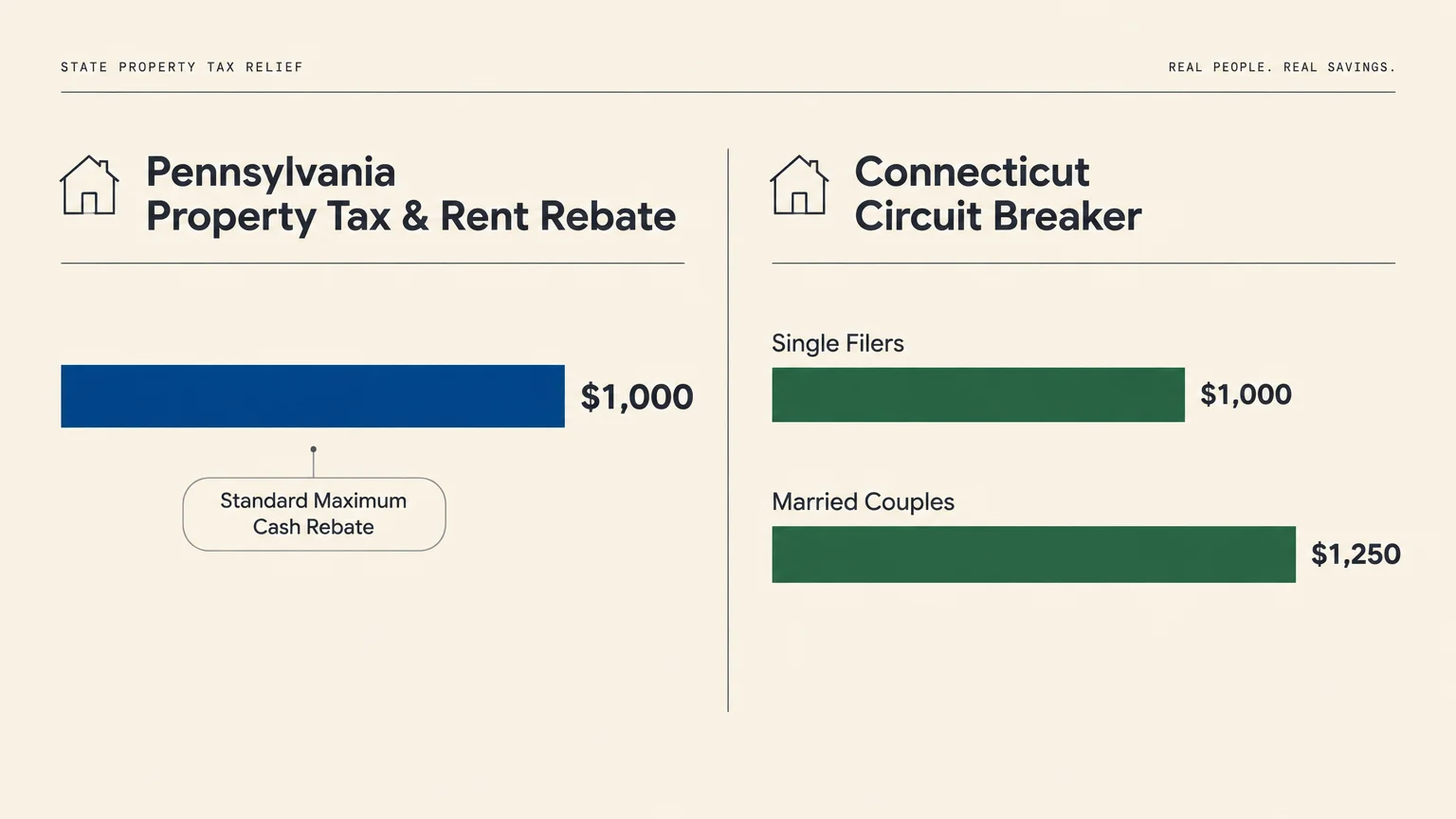
Pennsylvania operates one of the most prominent relief efforts through its Property Tax and Rent Rebate Program. Eligible older adults and residents with disabilities can receive standard cash rebates of up to $1,000.
Connecticut provides an Elderly and Disabled Circuit Breaker that delivers up to $1,000 for single filers and $1,250 for married couples. The state establishes income limits of $46,300 for individuals and $56,500 for married households.
New Jersey integrates multiple relief layers through programs like ANCHOR, Senior Freeze, and Stay NJ. Residents complete the consolidated Form PAS-1 application, which carries an established filing deadline of November 2, 2026.
Renters also qualify for many circuit breaker programs because state governments recognize that rental payments indirectly cover property taxes. A designated percentage of your total annual rent counts toward your calculated cash rebate.
| State Program | Maximum Benefit | Target Eligibility | Application Details |
|---|---|---|---|
| Pennsylvania Property Tax/Rent Rebate | Up to $1,000 | Homeowners and renters age 65+ (or widows age 50+) | Annual state Department of Revenue filing |
| Connecticut Circuit Breaker | $1,000 single / $1,250 married | Income up to $46,300 (single) or $56,500 (married) | Filed through local municipal assessor |
| New Jersey Combined Relief | Varies by income and taxes paid | Homeowners and renters meeting state tenure rules | Combined Form PAS-1 due November 2, 2026 |
To qualify for these property tax credits, you generally must be at least 61 to 65 years old. You will need to submit proof of paid property taxes or a signed rent certificate from your landlord.
02 State Supplemental Security Income Add-Ons
Supplemental Security Income provides crucial federal financial support to low-income older adults who are age 65 or older. What many recipients overlook is that state governments frequently add their own monthly cash payment on top.
Following a recent 2.8% cost-of-living adjustment, the maximum federal base payment is $994 per month for an individual and $1,491 per month for an eligible couple. Federal countable resource limits remain set at $2,000 for individuals and $3,000 for couples.
Forty-four states and Washington, D.C. provide extra cash supplements to bolster this federal baseline. These state benefit programs recognize that federal allotments alone cannot meet real-world housing and living expenses.
In twelve jurisdictions—including California, Delaware, Hawaii, Iowa, Michigan, Montana, Nevada, New Jersey, Pennsylvania, Rhode Island, Vermont, and Washington, D.C.—the state payment arrives combined within your standard monthly payment.
According to guidance from the Social Security Administration (SSA), the federal government administers these combined payments on behalf of participating states to streamline delivery.
The remaining thirty-three participating states manage and distribute their supplemental cash payments independently through their own social services departments. If you live in an independently administered state, you must submit a separate application to receive the funds.
Payment amounts vary significantly depending on where you reside and your living arrangements. For example, Michigan distributes a modest quarterly payment of $14, while California adds up to $239.94 each month for an independent individual.
Massachusetts offers one of the most generous state supplements, providing up to $454 per month for qualifying seniors living independently. Contact your state health and human services agency to ensure you receive both federal and state disbursements.
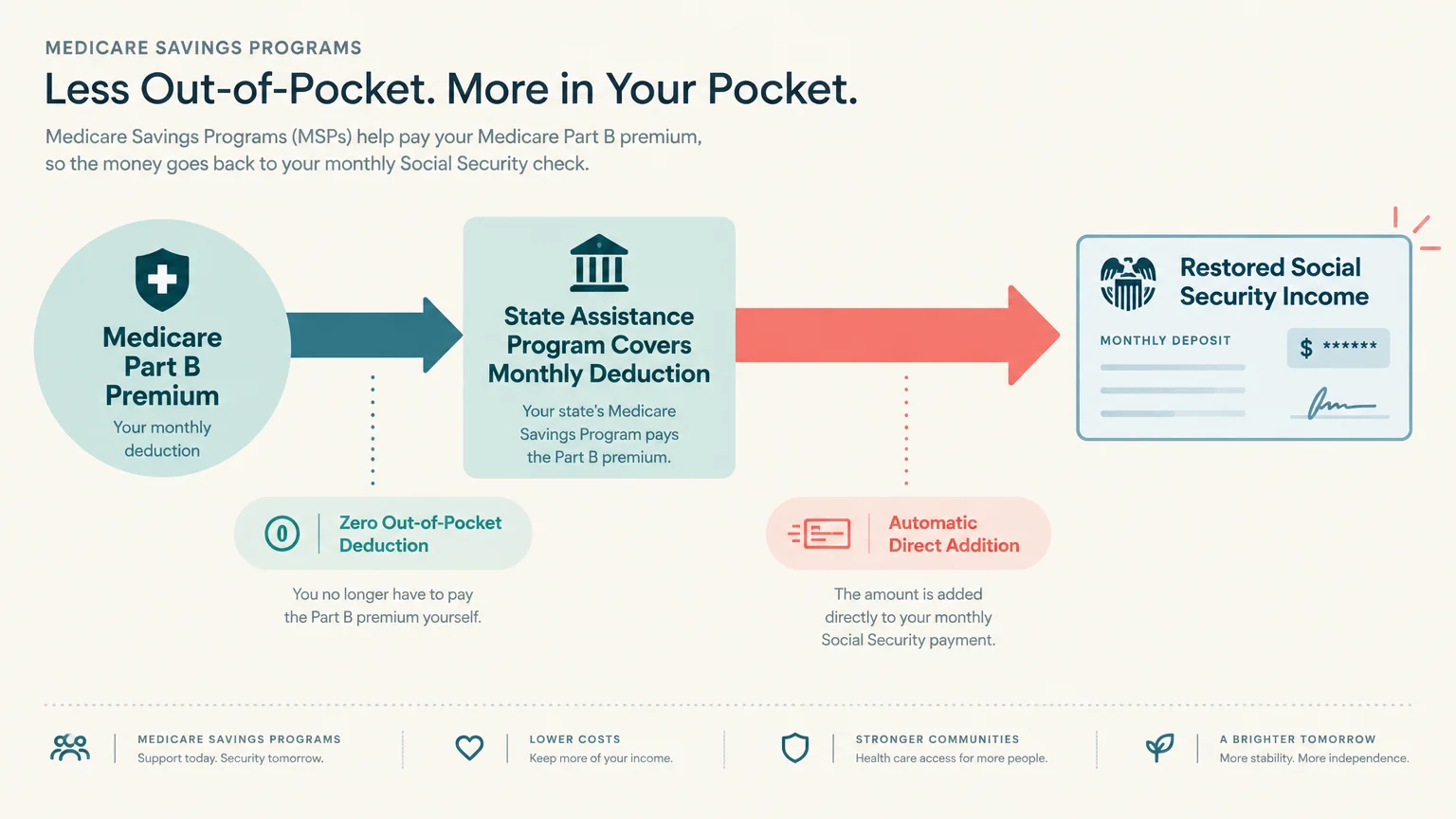
03 Medicare Savings Programs That Restore Monthly Income
If you receive Medicare, your monthly Part B premium gets deducted straight from your Social Security check before the funds reach your account. State-administered Medicare Savings Programs eliminate that deduction, putting hundreds of dollars back into your budget.
Under standards published by the Centers for Medicare & Medicaid Services (CMS), the standard Medicare Part B monthly premium is $202.90. Having your state pay this charge saves you $2,434.80 every single year.
Medicare Savings Programs operate through state Medicaid departments and feature three primary tiers for low-income seniors. Each tier offers substantial financial relief based on your monthly household income and countable assets.
- Qualified Medicare Beneficiary (QMB): Covers Part B premiums, Part A premiums, deductibles, and coinsurance for individuals earning up to $1,350 per month ($1,824 for couples).
- Specified Low-Income Medicare Beneficiary (SLMB): Covers your complete Part B premium for individuals earning up to $1,616 per month ($2,184 for couples).
- Qualifying Individual (QI): Covers the standard Part B premium for individual incomes up to $1,816 per month ($2,455 for couples).
Standard federal asset guidelines cap countable resources at $9,950 for individuals and $14,910 for married couples across all three tiers. However, states retain the legal authority to relax or eliminate these restrictive asset tests entirely.
California expanded access by raising its individual asset limit to $130,000, allowing more seniors with modest savings to qualify. New York established higher income thresholds, allowing single applicants to earn up to $1,856 for QMB and $2,494 for QI.
Enrolling in any Medicare Savings Program automatically qualifies you for federal Part D Extra Help. This extra benefit caps your prescription drug copayments at just $5.10 for generic drugs and $12.65 for brand-name medications.

4 and 5. State Nutrition Support and Farmers Market Vouchers
Access to nutritious food directly impacts chronic disease management and overall vitality as you age. Two complementary state-managed food programs provide vital purchasing power without draining your personal bank account.
The Supplemental Nutrition Assistance Program represents program number four on our list. Administered by state agencies under federal rules, it provides monthly funds on an electronic card to purchase groceries at authorized retailers.
Under current fiscal guidelines, the maximum monthly benefit reaches $306 for a one-person household and $562 for a two-person household. Even households that qualify for minimal assistance receive a guaranteed minimum monthly benefit of $25.
The program defines older adults as individuals age 60 or older and grants them special eligibility advantages. Households with an older adult enjoy a higher countable asset ceiling of $4,750 compared to standard applicants.
Older adults can also deduct verified, out-of-pocket medical expenses exceeding $35 per month from their gross income during eligibility reviews. Deducting doctor copays, dental bills, and prescription costs significantly increases your monthly cash food allotment.
Despite these generous accommodations, participation among eligible older adults remains remarkably low nationwide. Research confirms that only 38% of eligible seniors enroll in SNAP, meaning roughly five million older adults miss out on vital grocery money.
Program number five is the Senior Farmers’ Market Nutrition Program, funded by the federal Farm Bill and operated across 57 state and tribal agencies. This initiative distributes seasonal vouchers or electronic benefit cards specifically to purchase fresh, locally grown produce.
To qualify, you must be at least 60 years old with an annual income at or below 185% of the federal poverty level. That income threshold equals $29,526 per year for a single individual and $40,034 for a two-person household.
Benefit amounts generally range between $20 and $50 annually per participant. Pennsylvania distributes $25, Maryland issues $35, and states like Ohio and California provide the full $50 allowance.
State agencies distribute these nutrition benefits during spring and summer through local senior centers and aging offices. Keep in mind that these seasonal vouchers expire on November 30 each year, so you should spend them promptly.
6 and 7. Utility Bill Grants and Weatherization Assistance
Extreme summer heat and bitter winter cold present serious health hazards to older Americans. Two state-administered programs work together to lower your ongoing energy bills and protect your household cash reserves.
Program number six is the Low Income Home Energy Assistance Program, known widely as LIHEAP. This federally financed, state-operated initiative provides direct seasonal grants to offset heating and cooling expenses.
States pay these cash grants directly to utility providers to credit your account, though some states issue checks directly to fuel-oil consumers. The program also provides emergency cash relief if you face an imminent heating shutoff or broken furnace.
Many states establish priority early application windows exclusively for seniors age 60 and older before general public enrollment begins. For instance, Illinois opens applications on October 1, 2026, for seniors, while Pennsylvania opens its primary heating window on November 2, 2026.
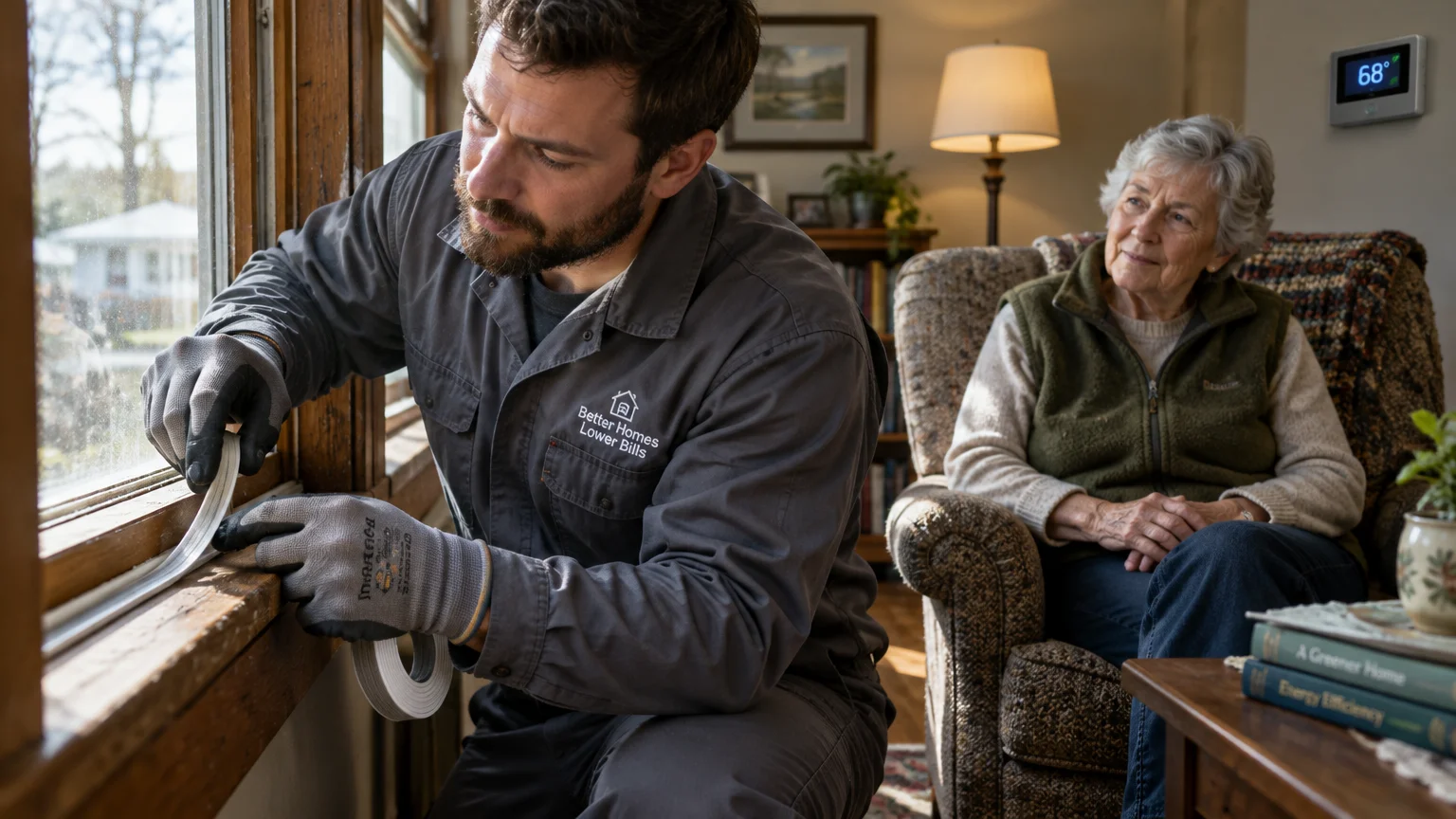
Program number seven is the Weatherization Assistance Program, funded by the Department of Energy and administered through local community action agencies. Unlike temporary utility grants, weatherization delivers permanent home improvements that permanently suppress high utility bills.
Qualifying households receive completely free energy upgrades valued at an average subsidy of $6,500 to $7,500 per residence. Services include professional air sealing, attic insulation, duct repair, and heating system tune-ups or replacements.
Department of Energy national evaluations confirm that weatherized households save an average of $372 per year on annual energy costs. That lasting reduction creates dependable breathing room in your monthly household budget.
Eligibility covers homeowners and renters earning at or below 200% of the federal poverty guidelines. If you already receive SSI, SNAP, or LIHEAP, your state automatically qualifies you for weatherization assistance with priority scheduling for seniors.

8 and 9. Medicaid Caregiver Stipends and In-Home Support
Many older adults need personal assistance with daily tasks such as bathing, meal preparation, medication reminders, and housekeeping. When family members provide that care, they often shoulder severe economic stress to keep their loved ones out of nursing institutions.
Program number eight involves Medicaid Consumer-Directed Care, commonly known as Cash and Counseling. All 50 states and Washington, D.C. operate at least one Home and Community-Based Services waiver offering consumer direction.
Instead of dispatching an unfamiliar agency worker to your house, the state allocates a designated monthly caregiving budget to you directly. You act as the employer, allowing you to hire, schedule, and pay the caregiver of your choice.
Most states permit participants to hire their adult children, siblings, or trusted friends, and several states allow legally married spouses to receive pay. The standard financial eligibility ceiling for these waivers is $2,982 per month with a $2,000 countable asset cap.
Program number nine is Structured Family Caregiving, an innovative model designed for older adults who require around-the-clock supportive care. This program pays a tax-free daily or monthly cash stipend directly to a live-in family caregiver.
In addition to financial compensation, the program provides professional health coaching and regular respite services to prevent caregiver exhaustion. It offers critical support for families managing progressive memory conditions like Alzheimer’s disease.
Eleven states currently offer Structured Family Caregiving: Connecticut, Georgia, Indiana, Louisiana, Massachusetts, Missouri, Nevada, North Carolina, Ohio, Rhode Island, and South Dakota. North Dakota operates an equivalent care program known as Family Personal Care.
These care stipends provide vital relief considering that family caregivers spend an average of $7,200 annually out of pocket on caregiving expenses. To locate participating agencies in your area, contact the Eldercare Locator for localized support.

Application Pitfalls and Common Scams to Avoid
Navigating state benefit systems requires caution because deceptive actors frequently target vulnerable older adults searching for financial support. Legitimate state agencies never demand application fees, processing charges, or gift card payments to release your benefits.
According to consumer alerts published by the Consumer Financial Protection Bureau (CFPB), scammers create fraudulent websites and send unsolicited text messages claiming you won an unreleased government grant. These solicitations exist solely to steal your Social Security number and private banking credentials.
Beyond external fraud, simple administrative missteps can cause state workers to deny your legitimate claims. Review the primary mistakes applicants make before you prepare your paperwork:
- Failing to report medical deductions: Forgetting to document recurring prescription, dental, and medical equipment expenses artificially inflates your countable income on SNAP applications.
- Assuming home equity disqualifies you: Most state assistance programs exclude your primary home and one personal vehicle from asset calculations.
- Missing recertification deadlines: State programs require annual or biannual renewals; ignoring renewal mailings abruptly terminates your monthly payments.
- Paying third-party filing services: Private companies often charge hundreds of dollars to submit forms that public agencies and Area Agencies on Aging complete for free.
If an unknown caller offers guaranteed approval for state money in exchange for an upfront processing payment, hang up immediately. Always verify program authenticity by contacting your state agency directly through an official state government portal.
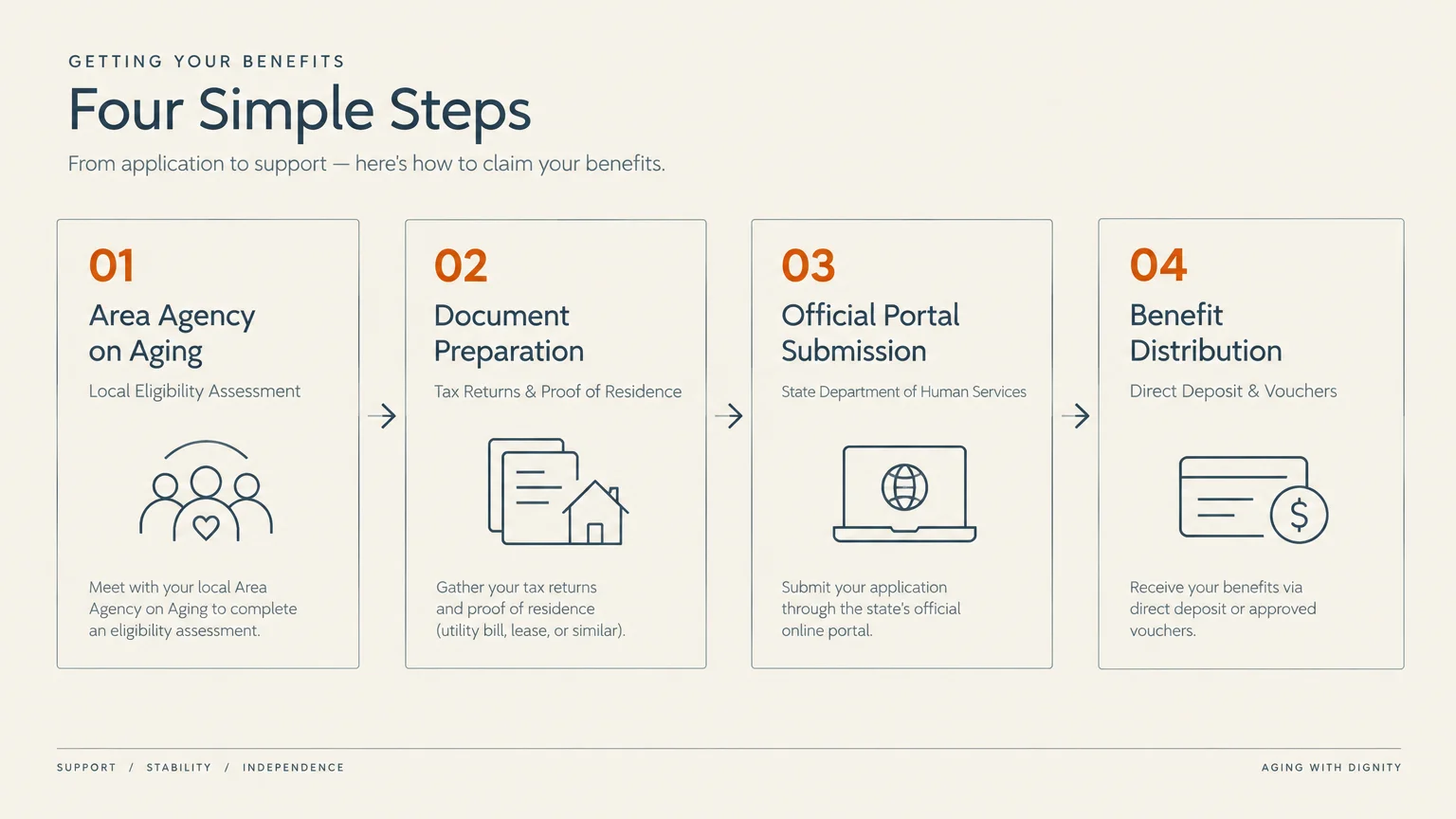
How to Claim Your State Senior Benefit Programs
Applying for multiple state relief programs might feel daunting, but breaking the process into orderly steps makes it entirely manageable. Follow this proven four-step strategy to organize your submissions and claim the maximum funds available.
- Assemble your financial records: Gather your recent Social Security benefit verification letter, pension statements, bank statements from the past three months, real estate tax receipts, and monthly utility invoices.
- Connect with your local Area Agency on Aging: These federally mandated, local agencies employ trained benefits counselors who evaluate your eligibility across all nine state programs without charging any fees.
- Leverage categorical eligibility: Applying for one program often unlocks fast-track access to others; for example, qualifying for SSI or SNAP frequently guarantees automatic acceptance into LIHEAP and Weatherization.
- Maintain an application binder: Record the date you submitted each application, keep photocopies of every document, and note the names of any state caseworkers you speak with over the telephone.
Give state agencies adequate time to process your materials, which typically takes between thirty and forty-five business days. If a caseworker requests additional documentation to verify your identity or income, submit the requested paperwork immediately to prevent processing delays.
Frequently Asked Questions
Will receiving state financial assistance reduce my Social Security retirement benefit?
No, state rebates, energy grants, nutrition benefits, and property tax refunds have no impact on your earned Social Security retirement payments. Social Security benefits are governed by federal earnings records and cannot be reduced by state-level welfare or rebate programs.
Can I receive state property tax rebates if I rent my home?
Yes, many state circuit breaker laws explicitly permit renters to file for annual cash rebates. Lawmakers recognize that landlords incorporate property taxes into monthly rent charges, allowing you to claim a set percentage of your rent as paid property taxes.
What happens if my household income is slightly above the eligibility cutoff?
Do not assume you are completely ineligible before accounting for state-allowed deductions. Deducting out-of-pocket health insurance premiums, recurring prescription copayments, and medical supplies can successfully reduce your countable income below the required threshold.
Do I have to pay state or federal income taxes on these relief funds?
The vast majority of state senior benefit distributions—including SNAP food allotments, LIHEAP energy subsidies, and property tax circuit breaker refunds—are completely exempt from income taxes. Caregiver stipends paid under Structured Family Caregiving are also tax-free under federal foster care rules.
Can family members help me fill out state program applications?
Yes, you can legally designate an adult child, relative, or trusted advocate as an authorized representative on state benefit applications. This formal designation allows your representative to speak with agency caseworkers, submit required verification forms, and manage your annual benefit renewals.
For additional senior resources, visit
American Heart Association, Benefits.gov, National Institute on Aging (NIA), Centers for Disease Control and Prevention (CDC) and Medicare.gov.
Disclaimer: The information in this article is for educational purposes only and is not intended to be a substitute for professional financial, legal, or medical advice. Always consult with a qualified expert for advice tailored to your personal situation.