

Supporting an aging parent often brings significant personal and financial strain. Fortunately, federal tax rules offer valuable tax breaks that can save you thousands of dollars each year.
You can lower your tax bill by claiming your parent as a dependent, deducting qualifying medical expenses, or claiming caregiver credits. Knowing these IRS provisions puts hard-earned money back into your budget.
Recent legislative updates under the One Big Beautiful Bill Act create new financial relief opportunities for families. Reviewing these rules ensures you never leave vital tax benefits on the table.
In this guide9 sections
- Claiming Your Parent as a Dependent: The Basic Rules
- Multiple Support Agreements: Teaming Up with Siblings
- Tax Credits for Caregivers: ODC and Dependent Care
- Deducting Parental Medical Expenses on Schedule A
- Long-Term Care Premiums and Assisted Living Deductions
- Filing Status Upgrades: Head of Household Advantages
- Pre-Tax Accounts and the Enhanced Senior Deduction
- Costly Tax Mistakes Caregivers Should Avoid
- Frequently Asked Questions
Claiming Your Parent as a Dependent: The Basic Rules
Claiming an aging parent on your tax return can unlock major savings. To secure these benefits, you must demonstrate to the IRS that your mother or father qualifies as your dependent relative.
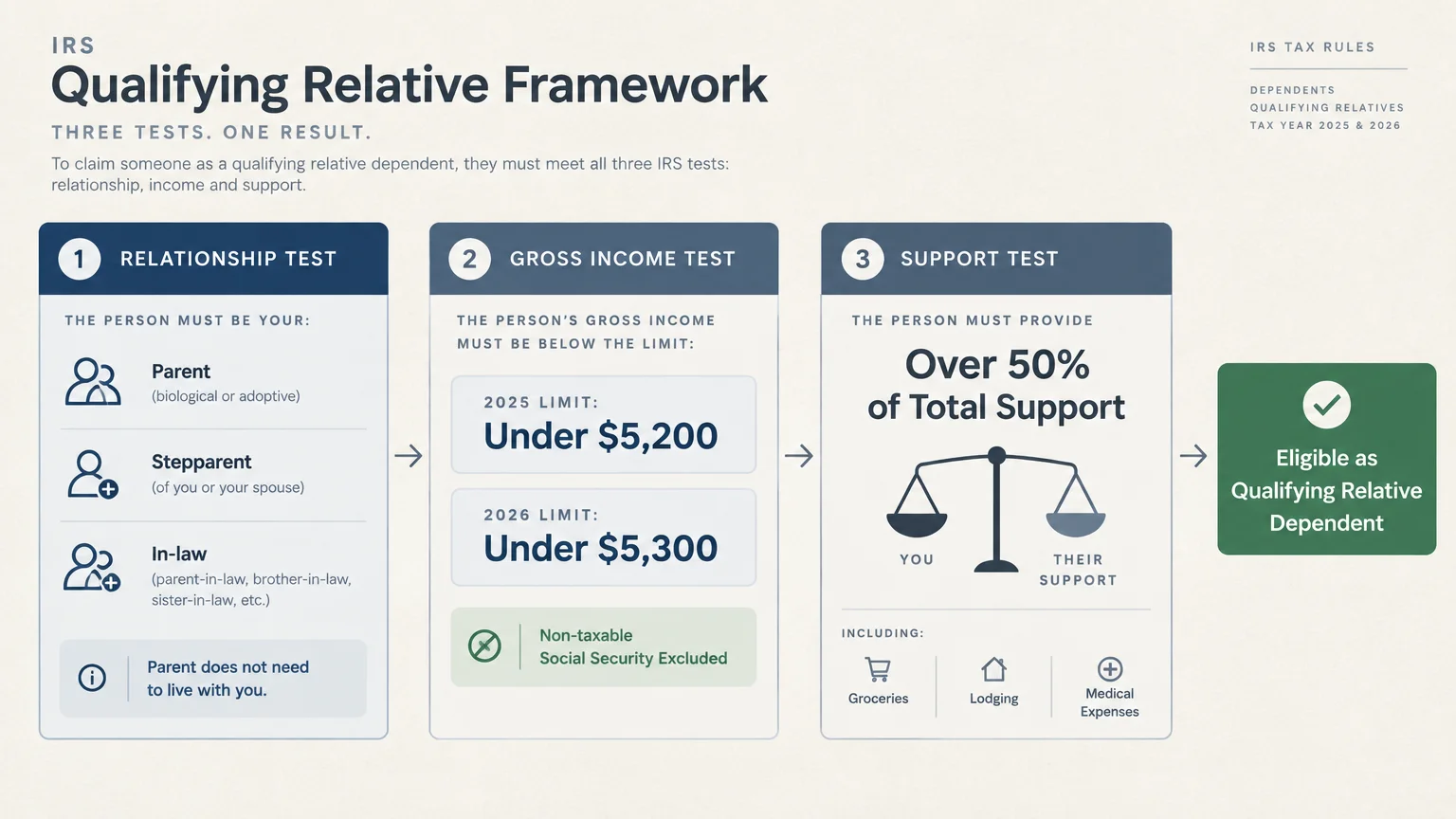
The IRS uses specific guidelines to define a qualifying relative. You must satisfy three core conditions: the relationship requirement, the gross income test, and the financial support test.
Biological parents, adoptive parents, stepparents, and even mothers-in-law or fathers-in-law satisfy the relationship requirement. You never have to worry about proving that a direct parent is a qualified relative.
Crucially, parents do not need to live under your roof to qualify. Your parent can reside in their own home, an assisted living community, or a nursing facility.
The gross income test requires your parent’s taxable gross income to remain below a strict threshold. For the 2025 tax year, their gross income must be less than $5,200.
This threshold increases slightly for the 2026 tax year, rising to $5,300 under IRS Revenue Procedure adjustments. Gross income includes wages, taxable interest, dividends, and taxable pension payouts.
Fortunately, non-taxable Social Security benefits do not count toward this gross income ceiling. If your mother lives entirely on non-taxable Social Security, she easily satisfies this income benchmark.
The support test demands that you provide more than 50% of your parent’s total financial support during the calendar year. You must compare what you spent against what your parent paid for their own needs.
Support includes essential life necessities such as groceries, lodging, medical care, clothing, utilities, and transportation. You calculate lodging by taking the fair market rental value of the living space you provide.
| Test Requirement | 2025 Threshold | 2026 Threshold | Key Exception |
|---|---|---|---|
| Gross Income Test | Under $5,200 | Under $5,300 | Excludes non-taxable Social Security benefits |
| Financial Support Test | Over 50% of total support | Over 50% of total support | Can use Multiple Support Agreement if sharing costs |
| Residency Requirement | No residency requirement | No residency requirement | Parents do not need to live with you |
Under the One Big Beautiful Bill Act (OBBBA), personal exemption deductions remain set at $0. Even so, establishing your parent as a dependent qualifies you for other lucrative tax credits and filing statuses.

Multiple Support Agreements: Teaming Up with Siblings
Family caregiving is rarely a solo endeavor. When adult children share the financial burden of supporting an elderly parent, no single sibling might hit the 50% support mark alone.
The IRS provides a flexible solution called a Multiple Support Agreement. This rule allows a group of family members to combine their financial contributions to claim a dependent.
To qualify, the collective family group must provide more than 50% of the parent’s total living costs for the year. Each person in the group must otherwise meet the requirements to claim the dependent.
Any individual family member who contributes more than 10% of the parent’s overall support can claim the parent as a dependent. The siblings must formally agree on who receives the tax break for that year.
To execute this agreement, the other contributing family members must sign IRS Form 2120, known as the Multiple Support Declaration. The claiming taxpayer keeps these signed copies and files the form with their return.
Families often rotate the claim each year among contributing siblings. This rotation shares the tax savings equitably while giving each child an opportunity to lower their tax liability.
Research published by AARP highlights that family caregivers spend substantial portions of their personal income on out-of-pocket care. Coordinating through Form 2120 prevents those expenses from going unnoticed at tax time.
- Calculate the parent’s total annual living expenses across housing, healthcare, and food.
- Add together the financial contributions of all contributing siblings.
- Confirm that the sibling group covered more than half of the overall living costs.
- Select the sibling who provided at least 10% of the support to take the dependent claim.
- Collect signed copies of IRS Form 2120 from every other sibling contributing over 10%.
Keep organized records of bank transfers, grocery bills, and medical payments. Clear documentation protects all siblings in the event of an IRS inquiry.
Tax Credits for Caregivers: ODC and Dependent Care
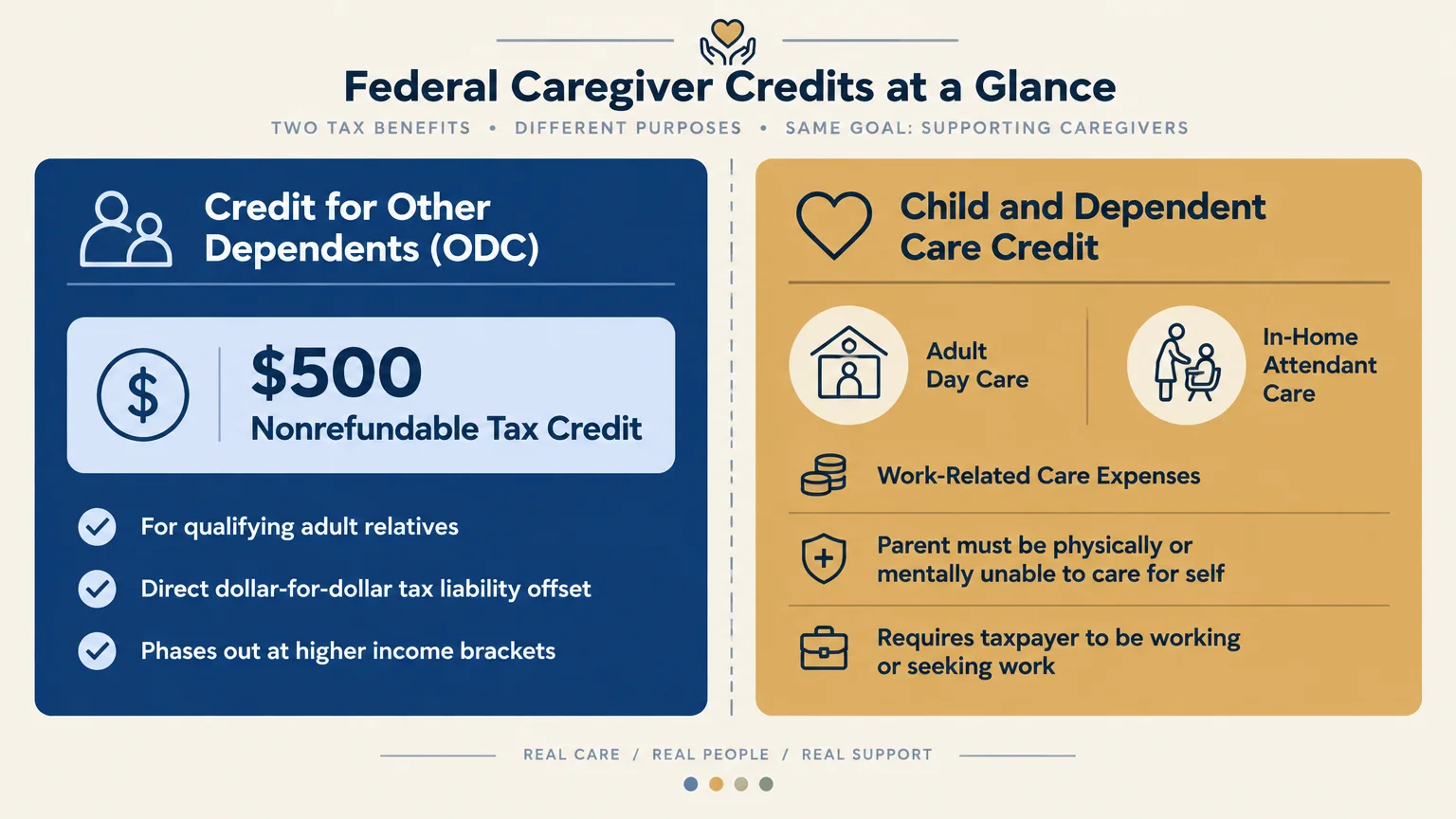
Tax credits provide dollar-for-dollar reductions of your final tax bill, making them far more powerful than ordinary income deductions. Caregivers can explore two major federal credits for their elderly parents.
The first option is the Credit for Other Dependents (ODC). This credit offers up to $500 for each qualifying dependent who does not qualify for the Child Tax Credit.
You can claim the $500 credit if you successfully qualify your parent as a dependent under the relative rules. The credit is non-refundable, meaning it can reduce your tax liability to zero but will not trigger a refund check.
Income phaseouts apply to higher-earning taxpayers claiming the ODC. The credit begins phasing out at a Modified Adjusted Gross Income (MAGI) of $200,000 for single filers and $400,000 for married couples filing jointly.
The second option is the Child and Dependent Care Credit. This credit targets families who pay for professional caregiving services so they can remain employed or look for work.
To use this credit for an aging parent, strict conditions apply. Your parent must have lived in your primary residence for more than half the calendar year.
Your parent must also be physically or mentally incapable of self-care. Eligible expenses include adult day care programs, in-home care companions, and specialized day camps.
The allowable expense limit is $3,000 for one qualifying individual, or up to $6,000 for two or more individuals. The actual credit represents a percentage of your eligible care expenses.
For the 2025 tax year, the credit percentage ranges from 20% to 35% of eligible expenses, based on your Adjusted Gross Income (AGI). Higher earners receive the minimum 20% rate, resulting in a maximum $600 credit.
Starting in the 2026 tax year, the OBBBA expands the credit rate range to between 20% and 50% of qualifying expenses. Taxpayers with an AGI under $15,000 will access the maximum 50% credit rate, yielding up to $1,500 in savings.

Deducting Parental Medical Expenses on Schedule A
Medical bills represent one of the heaviest financial weights for caregivers. If you pay healthcare expenses on your parent’s behalf, you might be able to deduct those costs on IRS Schedule A.
To deduct these costs, you must itemize your deductions rather than taking the standard deduction. Furthermore, you can only deduct unreimbursed medical expenses that exceed 7.5% of your Adjusted Gross Income.
Consider an example where your AGI is $80,000. Under the 7.5% rule, the first $6,000 of family medical expenses is not deductible; you can only deduct medical expenses that exceed that $6,000 floor.
Caregivers frequently overlook a crucial rule known as the “medical dependent” exception. This IRS provision permits you to deduct your parent’s healthcare expenses even if you cannot claim them as a dependent.
If your parent failed the gross income test because they earned $5,200 or more, you can still deduct their medical costs. You only need to prove that you provided more than 50% of their financial support during the year.
Deductible medical expenses cover a surprisingly broad spectrum of care. You can include doctor visits, prescription drugs, dental procedures, eyeglasses, hearing aids, and diagnostic imaging tests.
You can also deduct the mileage accrued while driving your parent to medical treatments and pharmacies. For 2025, the medical standard mileage rate is 21 cents per mile.
For the 2026 tax year, the IRS implemented a split rate. You can deduct 20.5 cents per mile from January 1 through June 30, and 23.5 cents per mile from July 1 through December 31.
- Hospital stays and surgical procedures not covered by insurance.
- Prescription medications and insulin supplies.
- Home modifications designed specifically for medical accessibility, such as ramps and walk-in tubs.
- Medical transportation, parking fees, and toll charges related to healthcare appointments.
- Specialized medical equipment, including wheelchairs, oxygen tanks, and diabetic monitors.
According to Medicare.gov, original Medicare does not cover routine dental exams, hearing aids, or long-term custodial care. When you cover these gaps for your parent, keep every receipt to support your medical deduction.

Long-Term Care Premiums and Assisted Living Deductions
As health conditions advance, older adults often require specialized care communities. The costs for assisted living and memory care facilities can be staggering, but portions of these bills are tax-deductible.
The deductibility of assisted living depends heavily on your parent’s health status and the primary reason for their admission. If your parent stays in a facility primarily for medical treatment, the entire cost can be deductible.
This includes meals, lodging, and custodial care provided by the community. To qualify, a licensed healthcare practitioner must certify that your parent is “chronically ill.”
A chronic illness certification means your parent cannot perform at least two activities of daily living (ADLs) without substantial assistance. These activities include eating, dressing, bathing, toileting, and transferring.
Severe cognitive impairments, such as Alzheimer’s disease or vascular dementia, also meet this medical threshold. If your parent is not certified as chronically ill, only the direct medical care portion of the monthly bill qualifies.
In that situation, ordinary room and board do not qualify as medical deductions. The facility must provide an itemized monthly breakdown detailing the specific healthcare services provided.
Premiums paid for qualified long-term care (LTC) insurance policies are also treated as deductible medical expenses. However, the IRS imposes annual age-based deduction limits on these premium payments.
| Age of the Insured Individual | 2025 Maximum Deduction | 2026 Maximum Deduction |
|---|---|---|
| Age 51 through 60 | $1,800 | $1,860 |
| Age 61 through 70 | $4,810 | $4,960 |
| Age 71 and older | $6,020 | $6,200 |
If you pay your parent’s LTC premiums directly, you can combine these eligible amounts with other family medical expenses. For per-diem LTC insurance contracts, the non-taxable daily benefit is capped at $430 per day in 2026.
Filing Status Upgrades: Head of Household Advantages
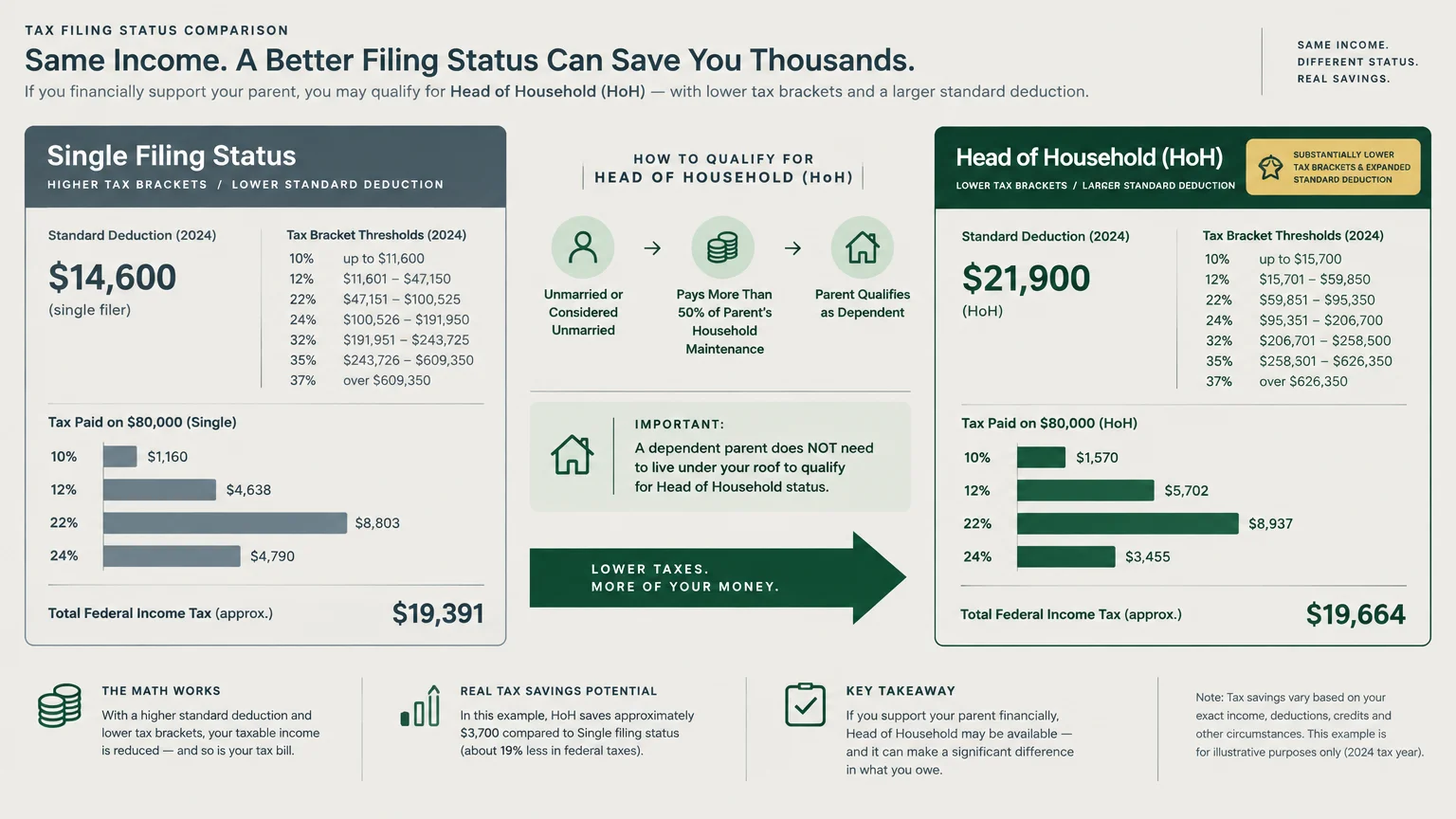
Your tax filing status dictates the size of your standard deduction and the tax brackets applied to your earnings. Single caregivers often miss an opportunity to change their status from Single to Head of Household.
Head of Household status provides significantly wider tax brackets, allowing more of your income to be taxed at lower rates. It also offers a substantially larger standard deduction than the Single filing status.
To use Head of Household status based on a parent, you must be unmarried or considered unmarried by the IRS. You must also pay more than half the cost of maintaining a household for that parent for the entire year.
Remarkably, the IRS does not require your parent to live in your personal residence. This special rule applies exclusively to parents; other dependent relatives must live with you.
You can qualify if you pay more than half the upkeep costs for your parent’s home, apartment, or assisted living room. Qualifying costs include rent, property taxes, home insurance, utility bills, repairs, and shared household food.
Upkeep costs do not include clothing, medical treatment, prescription drugs, life insurance, or transportation. You must isolate physical household maintenance costs to satisfy this legal requirement.
| Filing Status | 2025 Standard Deduction | 2026 Standard Deduction |
|---|---|---|
| Single or Married Filing Separately | $15,750 | $16,100 |
| Head of Household | $23,625 | $24,150 |
| Married Filing Jointly | $31,500 | $32,200 |
Moving from Single to Head of Household in 2025 increases your standard deduction by $7,875. In 2026, that difference climbs to $8,050.
Before selecting Head of Household, calculate whether itemizing medical deductions yields a larger tax reduction. You should always claim whichever option shields the greatest amount of income from taxation.

Pre-Tax Accounts and the Enhanced Senior Deduction
Employer-sponsored pre-tax accounts provide immediate relief for family caregiving costs. Utilizing these accounts reduces your gross taxable income before federal and state taxes are calculated.
A Dependent Care Flexible Spending Account (FSA) allows you to set aside pre-tax dollars for adult day care. You can use these funds if your parent lives with you and requires supervision while you work.
For the 2025 tax year, the annual contribution ceiling for a Dependent Care FSA is $5,000 for single filers and married couples filing jointly. Starting in 2026, the OBBBA increases this annual contribution limit to $7,500.
You can also use your own Health Savings Account (HSA) or Health Care FSA to pay for your parent’s medical bills. To do this legally, your parent must qualify as your tax dependent or medical dependent.
For 2025, Health FSA contributions are capped at $3,300, rising to $3,400 in 2026. HSA limits are $4,300 for self-only coverage and $8,550 for family plans in 2025, rising to $4,400 and $8,750 respectively in 2026.
Caregivers age 55 and older can contribute an additional $1,000 annual catch-up payment to their HSA. Using these funds to pay for your parent’s prescription drugs or medical supplies avoids income taxes entirely.
Important changes also apply to your parent’s own tax return under the OBBBA. For tax years 2025 through 2028, the law introduces an Enhanced Senior Deduction of $6,000 per person age 65 or older.
Married couples where both spouses are 65 or older can claim a combined $12,000 deduction. This deduction is available whether your parent itemizes or takes the standard deduction.
The Enhanced Senior Deduction phases out when Modified AGI exceeds $75,000 for single filers and $150,000 for joint filers. This benefit applies in addition to the traditional senior standard deduction bump.
For the 2026 tax year, the traditional additional standard deduction for seniors is $2,050 for single or Head of Household filers. Married seniors filing jointly receive an additional $1,650 per qualifying spouse.
Families can also seek state and local support through community programs. Connecting with the Eldercare Locator connects you directly to local Area Agencies on Aging that provide respite care and nutrition support.
Costly Tax Mistakes Caregivers Should Avoid
Navigating caregiver tax provisions can be complex, and errors can trigger audits or costly penalties. Avoiding common missteps ensures your tax filings remain smooth and legally compliant.
One widespread error involves failing to track fair rental value accurately. When calculating whether you provide over 50% support, you must determine what your parent’s room or living space would rent for on the open market.
If you own your home mortgage-free, you cannot count mortgage payments toward support. Instead, calculate the home’s fair market rental value, divide it by total occupants, and attribute that share to your parent’s support.
Another common mistake is confusing gift giving with financial support. Handing your parent cash does not automatically establish tax support unless you can demonstrate that the money purchased essential living needs.
Never claim the Child and Dependent Care Credit for a parent who does not reside in your primary home. The IRS strictly enforces the six-month cohabitation rule for this specific care credit.
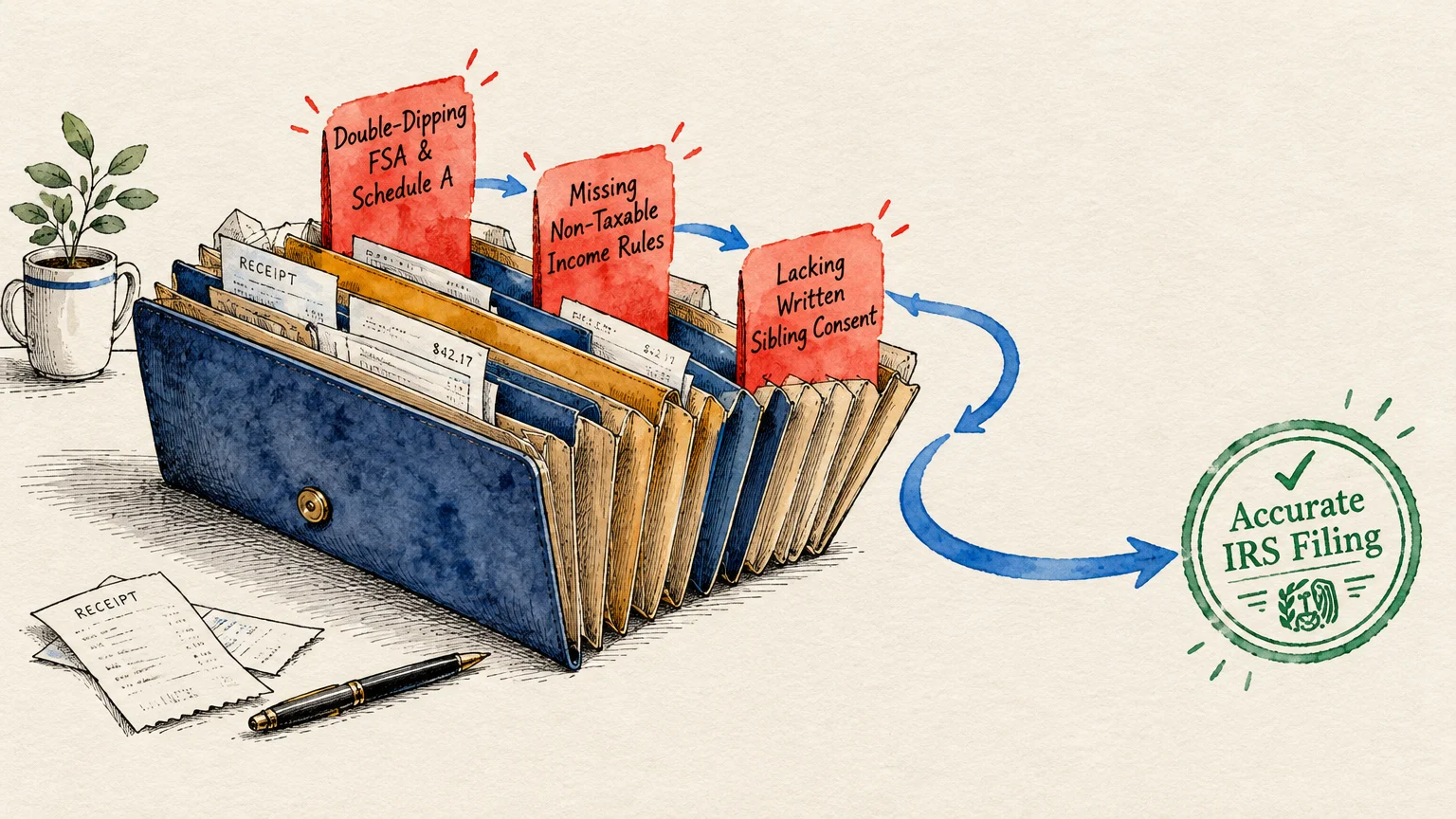
Similarly, do not double-dip on medical costs by claiming deductions for expenses paid with tax-free funds. You cannot deduct expenses that were paid using pre-tax HSA or FSA disbursements.
Families often fail to review external public benefit guidelines before claiming a parent. Claiming an aging parent on your tax return might inadvertently affect their eligibility for Medicaid or SNAP benefits.
According to program guides on Benefits.gov, income calculations for public programs evaluate household size and dependency statuses differently than the IRS. Always confirm how your tax filing affects your parent’s ongoing healthcare benefits.
- Failing to collect signed Form 2120 agreements from siblings before claiming a parent.
- Deducting long-term care insurance premiums that exceed the IRS age-based limits.
- Omitting the parent’s non-taxable Social Security benefits when calculating total living support.
- Claiming Head of Household status without paying more than half the total costs of maintaining the home.
- Neglecting to obtain written medical certifications for assisted living custodial deductions.
Maintain a dedicated folder with receipts, bank records, and medical letters for at least three years. Clear documentation is your greatest defense against tax audits.
Frequently Asked Questions
Can I claim my parent as a dependent if they receive Social Security?
Yes, you can claim your parent even if they receive Social Security benefits. Non-taxable Social Security is excluded from the gross income limit ($5,200 in 2025 and $5,300 in 2026).
However, your parent must use those benefits for support. If they spend their Social Security on their own needs, you must contribute a greater amount to exceed the 50% support requirement.
Does my parent have to live with me for me to deduct their medical expenses?
No, your parent does not have to live with you to qualify for medical expense deductions. They can live in their own private house, an apartment, or a residential facility.
You only need to prove that you paid the medical expenses directly and provided more than half of their overall living support during that tax year.
What happens if my siblings and I split our mother’s care equally?
If no single person pays more than 50% of the support, your family can use a Multiple Support Agreement via IRS Form 2120. The sibling group must collectively cover over 50% of her support.
Any sibling who contributes more than 10% can claim her as a dependent, provided the other contributing siblings sign the form waiving their right to claim her for that year.
Can I deduct the cost of modifying my home for an elderly parent?
Yes, you can deduct home improvements constructed specifically to accommodate an aging parent’s physical medical conditions. Deductible upgrades include wheelchair ramps, handrails, widened doorways, and specialized stair lifts.
You can only deduct the portion of the expense that exceeds any increase in your home’s overall market value. Upgrades that do not add value to the home are fully deductible as medical expenses.
Can I claim the Child and Dependent Care Credit if my parent lives in assisted living?
No, you cannot claim the Child and Dependent Care Credit for a parent residing in assisted living. IRS rules require the dependent to live in your primary home for more than half the year.
You can, however, explore deducting the medical portion of the assisted living fees on Schedule A as an itemized medical deduction.
For additional senior resources, visit
National Institutes of Health (NIH), Centers for Medicare & Medicaid Services (CMS) and Social Security Administration (SSA).
Disclaimer: The information in this article is for educational purposes only and is not intended to be a substitute for professional financial, legal, or medical advice. Always consult with a qualified expert for advice tailored to your personal situation.