
You worked hard to build your retirement nest egg, but taking extra withdrawals can trigger unexpected healthcare costs. Additional taxable income often pushes your Medicare premiums into expensive government surcharges.
Fortunately, strategic planning protects your monthly budget from these automatic rate increases. You can collect substantial cash from specific financial sources without adding a single dollar to your Medicare tally.
Understanding these rules helps you avoid costly traps and enjoy true financial peace of mind. Here are nine dependable income streams that keep your healthcare bills low while funding your retirement.
In this guide9 sections
- Understanding Medicare IRMAA and How Income Triggers Surcharges
- How Medicare Calculates Your Modified Adjusted Gross Income
- 2026 Medicare Part B and Part D Surcharge Brackets
- Tax-Free Retirement and Health Accounts That Protect Your Premiums
- Housing and Equity Streams That Avoid Surcharges
- Insurance, Annuity Principal, and Brokerage Basis
- Gifts, Inheritances, and Longevity Contracts
- Common Pitfalls, Municipal Bond Traps, and SSA-44 Appeals
- Frequently Asked Questions
Understanding Medicare IRMAA and How Income Triggers Surcharges
Most seniors expect stable healthcare expenses in retirement, yet Medicare Part B and Part D monthly rates can change. The government uses an extra charge called the Income-Related Monthly Adjustment Amount (IRMAA).
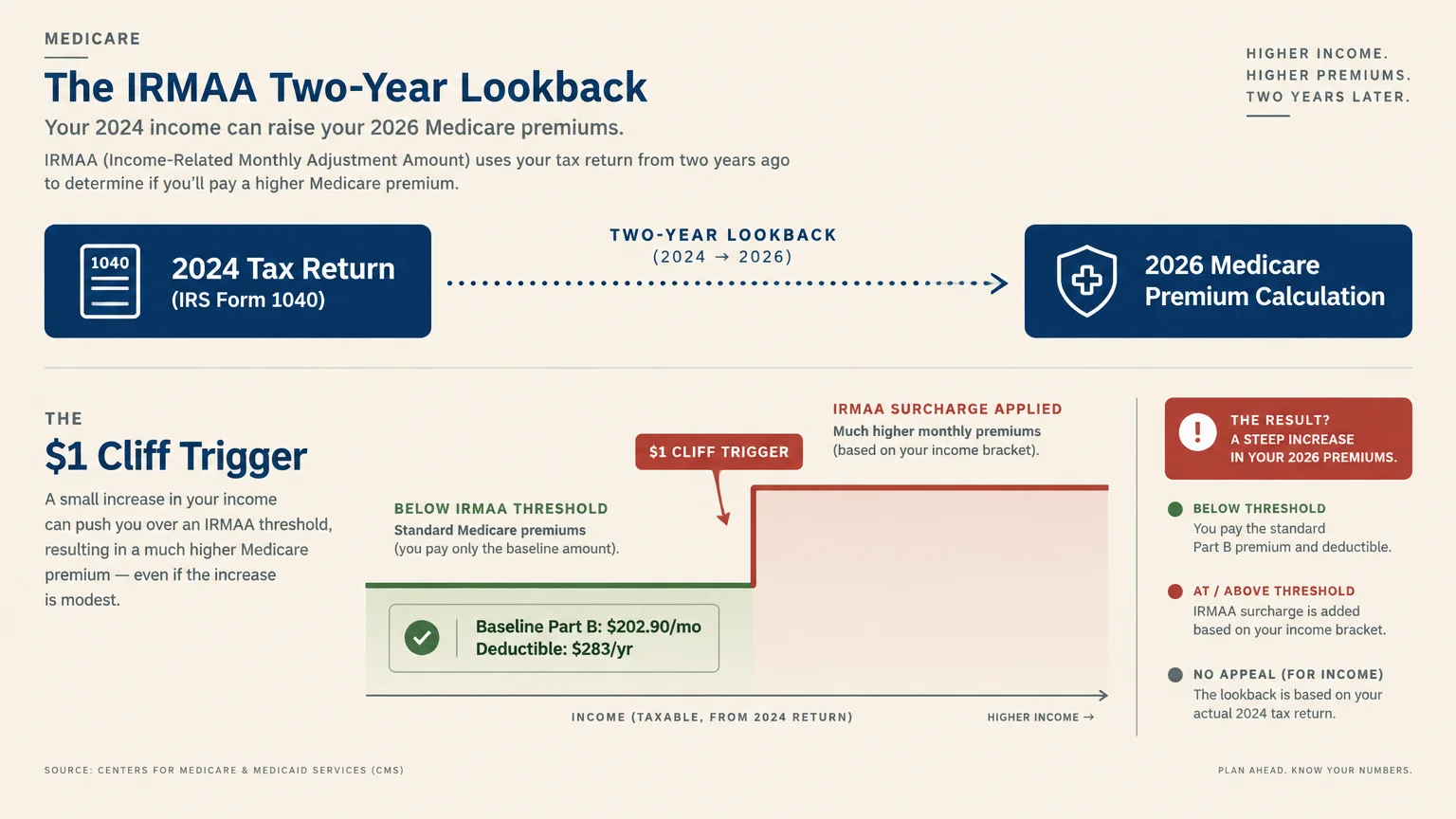
This fee penalizes individuals who report earnings above statutory baseline thresholds. The standard monthly Part B premium for 2026 is $202.90, alongside an annual Part B deductible of $283.
According to the Centers for Medicare & Medicaid Services (CMS), higher earners must pay additional surcharges on top of standard rates. These surcharges apply to both medical doctor visits and prescription drug coverage.
Medicare uses a strict two-year lookback rule to determine what you owe each month. For instance, your 2026 Medicare premiums depend directly on the income reported on your 2024 federal tax return.
Similarly, financial moves you execute during 2026 will decide your premium surcharges for the 2028 calendar year. Planning two years ahead keeps your healthcare costs predictable and protects your cash flow.
IRMAA functions as a cliff penalty rather than a progressive tax bracket. If you exceed a single income tier by just $1, you trigger the full surcharge for twelve full months.
This penalty can easily add hundreds or thousands of dollars to your annual healthcare expenses. Identifying income that won’t raise Medicare premiums preserves your savings and prevents unpleasant financial surprises.
How Medicare Calculates Your Modified Adjusted Gross Income
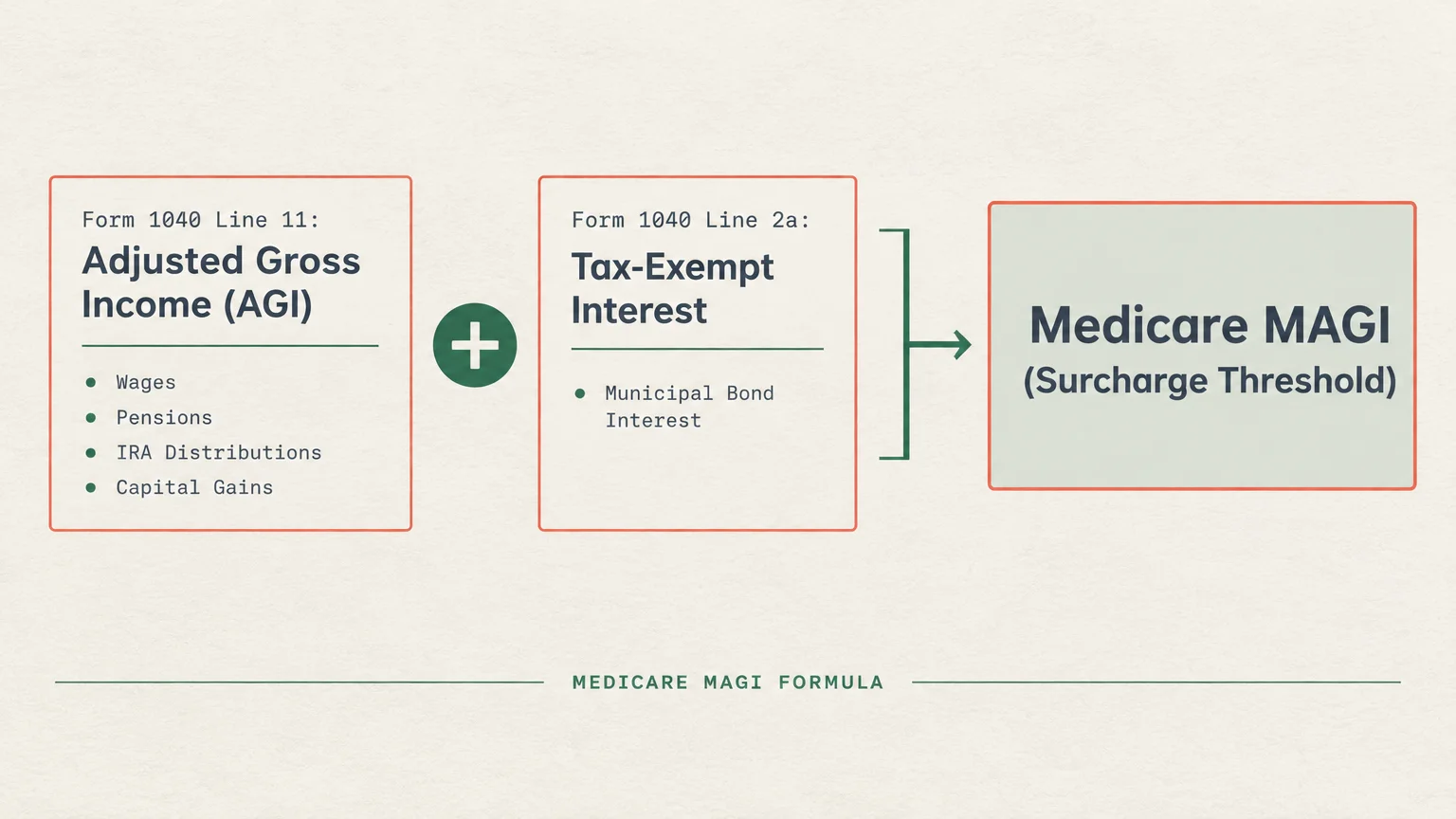
The government relies on a specific formula called Modified Adjusted Gross Income (MAGI) to evaluate your earnings. Medicare calculates your MAGI by combining two distinct figures from your federal Form 1040.
First, officials take your standard Adjusted Gross Income (AGI) from Line 11 of your tax return. This number includes wages, pensions, traditional IRA distributions, taxable Social Security benefits, and realized capital gains.
Next, the Social Security Administration adds back any tax-exempt interest income recorded on Form 1040 Line 2a. This calculation determines your final IRMAA income for premium surcharges.
Many seniors mistakenly assume all tax-free earnings remain invisible to Medicare officials. Municipal bond interest is tax-exempt at the federal level, yet Medicare requires that you add it back into MAGI.
Therefore, municipal bond interest can unintentionally force you over an IRMAA bracket threshold. Genuine protection requires utilizing cash flow sources that bypass both Line 11 and Line 2a entirely.
When you draw from non-MAGI sources, your reported tax return income remains comfortably low. This simple distinction helps retirees enjoy generous cash flow while maintaining standard baseline premiums.
2026 Medicare Part B and Part D Surcharge Brackets
Knowing the exact income thresholds allows you to plan your annual withdrawals with surgical precision. The government adjusts these brackets periodically to account for national inflation benchmarks.
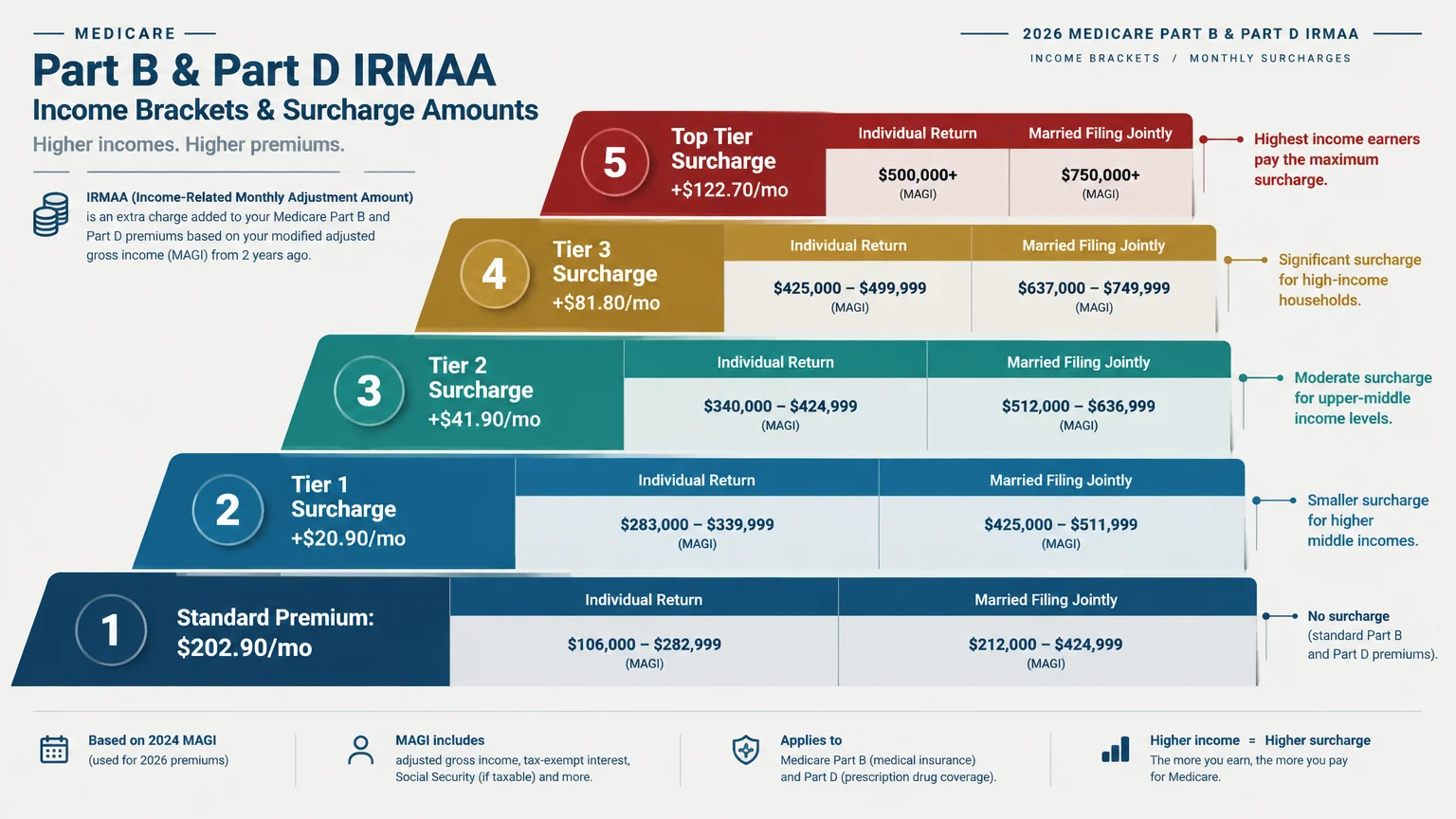
For the 2026 tax year, IRMAA surcharges begin when single filers exceed $109,000 in MAGI. Married couples filing jointly can earn up to $218,000 before encountering their first rate hike.
According to Medicare.gov, beneficiaries who exceed these starting thresholds pay tiered surcharges throughout the year. The table below outlines the 2026 Part B and Part D surcharge tiers.
| Filing Status: Single | Filing Status: Married Joint | Total 2026 Part B Premium | Part B Surcharge | Part D Surcharge |
|---|---|---|---|---|
| $109,000 or less | $218,000 or less | $202.90 | $0.00 | $0.00 |
| $109,001 to $137,000 | $218,001 to $274,000 | $284.10 | +$81.20 | +$14.50 |
| $137,001 to $171,000 | $274,001 to $342,000 | $405.80 | +$202.90 | +$37.50 |
| $171,001 to $205,000 | $342,001 to $410,000 | $527.50 | +$324.60 | +$60.40 |
| $205,001 to $499,999 | $410,001 to $749,999 | $649.20 | +$446.30 | +$83.30 |
| $500,000 or more | $750,000 or more | $689.90 | +$487.00 | +$91.00 |
Married individuals who file separate tax returns face significantly harsher thresholds if they lived together during the year. For these filers, income between $109,001 and $390,999 triggers a monthly Part B premium of $649.20.
Separate filers earning $391,000 or more jump straight to the maximum Part B rate of $689.90. Structuring your withdrawals to avoid IRMAA protects both spouses from steep monthly penalties.
Tax-Free Retirement and Health Accounts That Protect Your Premiums
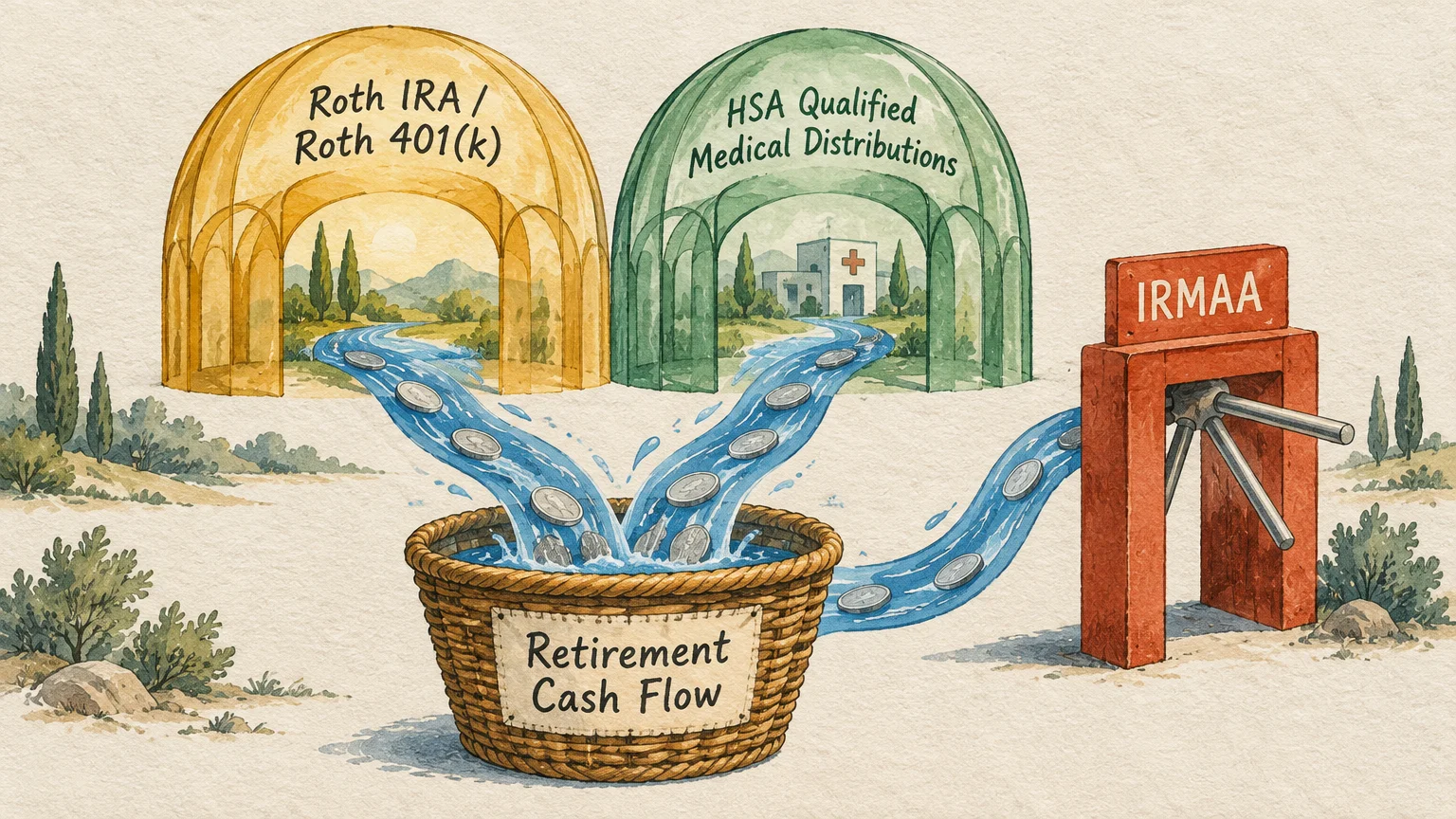
Your choice of retirement accounts plays a massive role in managing your reported taxable income. Certain tax-sheltered accounts provide complete immunity from Medicare premium calculations.
1. Qualified Roth Distributions (Roth IRAs and Roth 401(k)s)
Qualified Roth distributions represent the premier form of tax free income retirees can utilize. Because you contributed after-tax dollars during your working years, withdrawals come out completely tax-free.
To qualify, you must be at least age 59½ and satisfy the statutory five-year holding rule. Qualified withdrawals never appear on Form 1040 Line 11 and never enter your MAGI calculation.
Furthermore, under recent rules from the SECURE 2.0 Act, employer Roth 401(k) accounts no longer require lifetime distributions. You can leave money inside your Roth accounts or withdraw large sums without risking an IRMAA spike.
2. Health Savings Account (HSA) Distributions
Health Savings Accounts deliver an exceptional triple-tax advantage for retirees managing recurring medical bills. Contributions go in pre-tax, investments grow without taxation, and qualified withdrawals remain entirely tax-free.
When you spend HSA funds on eligible medical costs, that money never touches your Form 1040. You can withdraw thousands of dollars from an HSA without increasing your Medicare premiums income calculation.
Retirees can use HSA distributions to pay Medicare Part B premiums, Part D drug premiums, and Medicare Advantage costs. However, tax regulations prohibit using HSA distributions to pay private Medigap supplemental insurance premiums.
Keep in mind that you cannot contribute new dollars to an HSA once enrolled in Medicare Part A or Part B. If you withdraw HSA money for non-medical reasons after age 65, that cash becomes taxable income.
3. Qualified Charitable Distributions (QCDs)
Retirees with substantial traditional IRA balances often face mandatory Required Minimum Distributions (RMDs) starting at age 73. These distributions count as taxable income and frequently push retirees into higher Medicare brackets.
A Qualified Charitable Distribution allows IRA owners age 70½ and older to transfer money directly to a qualified 501(c)(3) charity. The money satisfies your annual RMD obligation without ever entering your gross income.
For 2026, the IRS inflation-adjusted QCD limit is $111,000 per individual, or $222,000 for married couples filing jointly. This donation never touches Form 1040 Line 11, shielding your Medicare bill completely.
Retirees can also take advantage of a one-time lifetime transfer of up to $55,000 to fund split-interest charitable gifts. This includes charitable gift annuities and charitable remainder trusts, providing both philanthropic impact and IRMAA protection.

Housing and Equity Streams That Avoid Surcharges
Real estate often represents a retiree’s single largest asset. Accessing home equity can provide substantial liquidity without distorting your Medicare premium brackets.
4. Primary Residence Home Sale Gain Exclusion (IRC Section 121)
Downsizing your family home can free up substantial cash for retirement living expenses. Under Internal Revenue Code Section 121, you can exclude significant home sale profits from your taxable income.
Single taxpayers can exclude up to $250,000 in capital gains, while married couples filing jointly can exclude up to $500,000. To qualify, you must have owned and occupied the property as your primary residence for two of the past five years.
The excluded capital gain does not appear on your federal income tax return. Because the profit bypasses your AGI, Medicare never adds it into your IRMAA calculation.
However, any capital gain exceeding these statutory thresholds will count toward your MAGI. If you anticipate a gain above $500,000, consult an advisor to prepare for potential two-year lookback surcharges.
5. Reverse Mortgage Proceeds (HECMs)
Home Equity Conversion Mortgages (HECMs) allow homeowners age 62 and older to convert housing equity into cash. The IRS treats reverse mortgage proceeds as loan advances rather than earned or investment income.
Because loan advances do not constitute taxable earnings, they never appear on Form 1040. You can receive monthly tenure payments or a lump-sum line of credit without impacting your Medicare rate.
For 2026, the Federal Housing Administration established a national HECM maximum lending limit of $1,209,750. This generous ceiling allows eligible homeowners to access significant tax-free funds for long-term retirement care.
According to the Consumer Financial Protection Bureau (CFPB), borrowers should evaluate fees and interest rates before signing a reverse mortgage agreement. Used prudently, these proceeds deliver vital liquidity while keeping your healthcare surcharges at zero.

Insurance, Annuity Principal, and Brokerage Basis
Strategic asset liquidation from standard investment products offers another reliable path to low healthcare costs. Focusing on your original capital prevents taxable earnings from driving up your Medicare bills.
6. Cash Value Life Insurance Loans and Basis Withdrawals
Permanent life insurance policies, such as whole life or universal life, accumulate cash value over time. You can withdraw your money up to your total cost basis completely tax-free.
Your cost basis equals the total dollar amount you paid into the policy through premium payments. Because the IRS views basis distributions as a return of your own capital, they bypass your tax return.
Once you withdraw your cost basis, you can take policy loans against the remaining cash value. Policy loans are not considered income and do not affect your Medicare calculations.
To preserve this tax-free status, you must ensure the policy remains active until your death. Allowing a heavily borrowed policy to lapse can trigger massive taxable income and sudden Medicare premium hikes.
7. Non-Taxable Portion of Non-Qualified Annuities
Many seniors purchase non-qualified commercial annuities using money that has already been taxed. When you annuitize this contract, the IRS applies an exclusion ratio to determine your tax liability.
The exclusion ratio divides each regular payment into two distinct components: taxable interest earnings and non-taxable principal return. The portion representing your original principal is completely excluded from your MAGI.
Only the interest portion enters Form 1040 Line 11 to become part of your taxable income. Structuring an annuity with a high cost basis shields a large percentage of your monthly income from Medicare review.
8. Return of Principal and Cost Basis from Taxable Brokerage Accounts
When you sell investments in a standard brokerage account, you only pay taxes on realized net profits. The original purchase price of your investment represents your non-taxable cost basis.
For example, selling $50,000 worth of stock with a $40,000 cost basis generates only $10,000 in taxable capital gains. The remaining $40,000 is a return of principal that Medicare never includes in your MAGI.
Withdrawing cash from regular savings, checking accounts, or money market funds carries no tax footprint. These simple cash withdrawals allow you to meet retirement spending goals while keeping reported income extremely low.
Additionally, you can use capital losses to actively drive down your MAGI. Taxpayers can deduct up to $3,000 in net capital losses ($1,500 for married filing separately) against ordinary income each year.

Gifts, Inheritances, and Longevity Contracts
Receiving wealth from family or deferring mandatory distributions provides additional opportunities to keep Medicare costs low. These special financial tools protect your budget while reinforcing long-term security.
9. Gifts, Inheritances, and Qualifying Longevity Annuity Contracts (QLACs)
Direct cash gifts from family members are completely non-taxable to the recipient. For 2026, an individual can give away up to $19,000 per recipient without filing a federal gift tax return.
Even if a gift exceeds $19,000, the donor bears reporting obligations, never the recipient. Gifts you receive never appear on Form 1040 and cannot raise your Medicare Part B or Part D premiums.
Similarly, direct cash inheritances, life insurance death benefits, and inherited real estate escape income taxation. These funds do not increase your MAGI, allowing you to deposit inheritance money safely.
However, inherited pre-tax retirement accounts remain subject to income taxes under the mandatory ten-year distribution rule. Withdrawing money from an inherited traditional IRA will elevate your MAGI and potentially trigger IRMAA surcharges.
To reduce future mandatory income, consider purchasing a Qualifying Longevity Annuity Contract (QLAC). You can transfer up to $210,000 from a traditional IRA into a QLAC during 2026.
Money placed in a QLAC is excluded from your annual RMD calculations until payments begin, as late as age 85. Deferring these distributions keeps your annual MAGI suppressed during your early retirement years.
Common Pitfalls, Municipal Bond Traps, and SSA-44 Appeals
Avoiding Medicare surcharges requires constant vigilance regarding how different income types interact on your tax return. A single miscalculation can disrupt your monthly budget two years later.
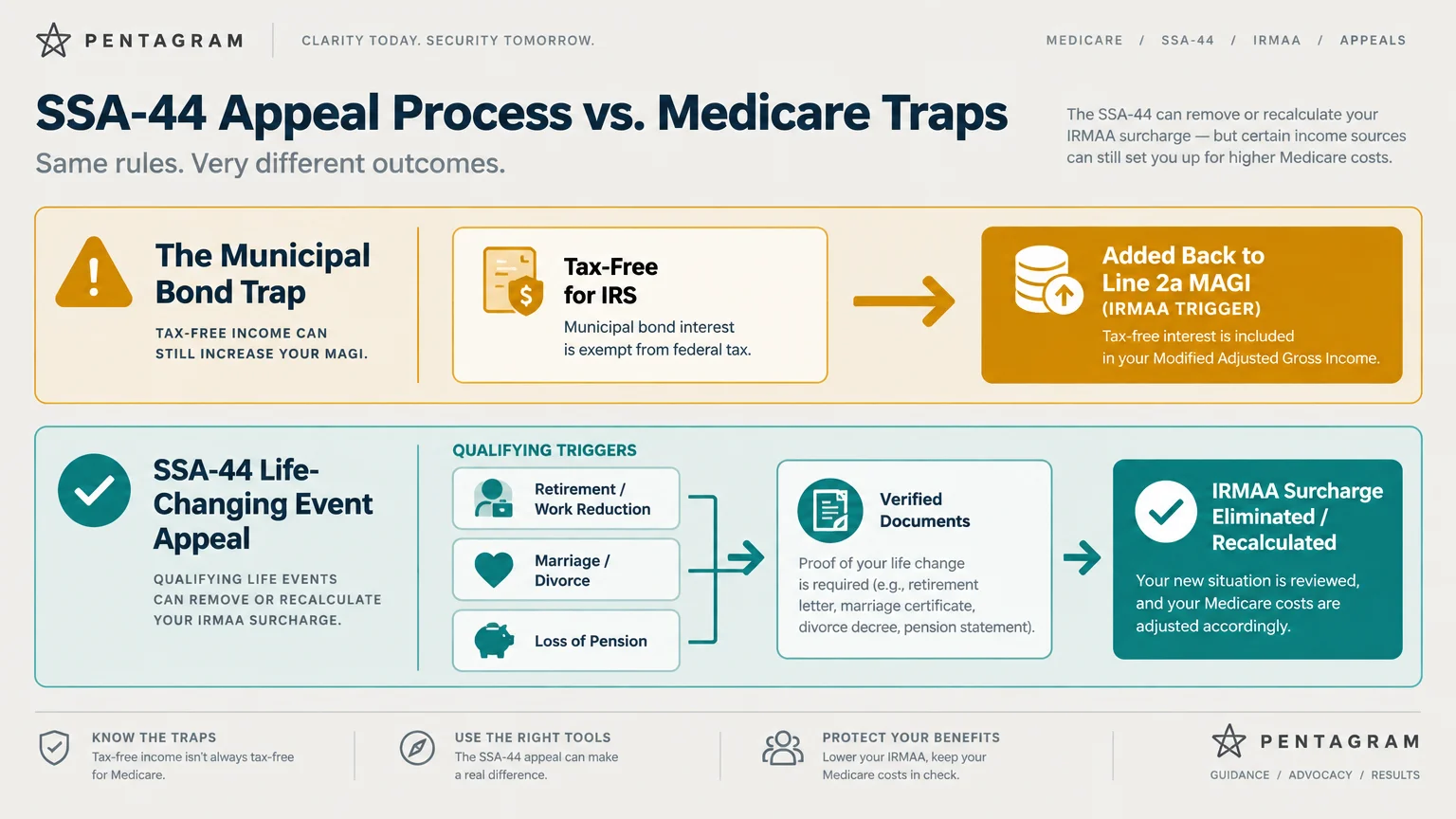
The municipal bond trap remains the most common error among high-net-worth retirees. While municipal bond interest escapes federal income taxes, the IRS requires reporting it on Form 1040 Line 2a.
Medicare systematically adds this tax-exempt interest directly back into your AGI. Holding municipal bonds can push your total MAGI past an IRMAA cliff without your knowledge.
Large, one-time Roth IRA conversions can also cause unexpected Medicare premium increases. While converting traditional retirement funds to Roth accounts provides long-term tax freedom, the converted balance counts as income.
This conversion income elevates your MAGI for that specific tax year. Beneficiaries must prepare for higher Medicare bills two years down the road when undertaking substantial conversions.
If your income drops significantly due to a major life change, you do not have to accept higher premiums. You can petition the government for a reduction using Form SSA-44.
According to the Social Security Administration (SSA), you can file an appeal based on eight specific qualifying events:
- Marriage
- Divorce or annulment
- Death of a spouse
- Work stoppage (complete retirement)
- Work reduction (transitioning to part-time employment)
- Loss of income-producing property due to natural disaster, fraud, or theft
- Loss of employer pension plan benefits
- Receipt of a financial settlement from an employer due to bankruptcy or closure
To file successfully, submit Form SSA-44 along with documentation proving the qualifying event and your reduced income. Acceptable proof includes a letter from your former employer or your most recent tax transcript.
Keep in mind that the Social Security Administration rejects appeals based on ordinary market fluctuations or one-time capital gains. Home sales and voluntary Roth conversions do not qualify for life-changing event relief.
Frequently Asked Questions
Does Social Security count toward the Medicare IRMAA calculation?
Only the taxable portion of your Social Security benefits counts toward your Medicare MAGI calculation. Up to 85% of your benefits become taxable if your provisional income exceeds statutory IRS thresholds.
What happens if my income exceeds an IRMAA bracket by only one dollar?
Exceeding an IRMAA threshold by a single dollar triggers the full surcharge for that bracket tier. You will pay the higher monthly premium for all twelve months of the coverage year.
Can I appeal my IRMAA surcharge if my income dropped because I retired?
Yes, retiring qualifies as an official work stoppage under Social Security Administration guidelines. You can file Form SSA-44 to request that officials recalculate your premiums using your current estimated income.
Are withdrawals from my Traditional 401(k) or IRA safe from IRMAA?
No, distributions from traditional retirement plans count as ordinary taxable income on Form 1040 Line 11. These regular withdrawals directly increase your MAGI and can push you into an IRMAA surcharge bracket.
Does selling stocks at a loss help reduce my Medicare MAGI?
Yes, net capital losses offset capital gains and can reduce other taxable ordinary income by up to $3,000 annually. This deduction lowers your AGI and helps you stay below critical IRMAA threshold limits.
For additional senior resources, visit
Medicare.gov, National Institute of Mental Health (NIMH), National Institutes of Health (NIH), Centers for Medicare & Medicaid Services (CMS) and Social Security Administration (SSA).
Disclaimer: The information in this article is for educational purposes only and is not intended to be a substitute for professional financial, legal, or medical advice. Always consult with a qualified expert for advice tailored to your personal situation.