

Planning for senior housing requires clear numbers and realistic financial expectations. The national median assisted living monthly cost ranges between $5,419 and $6,200, but prices swing dramatically depending on where you reside.
Moving across state lines—or even into an adjacent county—can save your family tens of thousands of dollars each year. Understanding regional rate trends gives you the leverage to budget effectively and protect your savings.
This comprehensive guide breaks down the latest assisted living prices across all fifty states. You will discover practical ways to fund care, avoid hidden contract fees, and protect your hard-earned retirement nest egg.
In this guide8 sections
- National Assisted Living Costs Overview
- Assisted Living Cost by State Breakdown
- What Drives Senior Living Prices?
- Comparing Assisted Living to Other Care Options
- How to Pay for Senior Care and Long-Term Support
- Hidden Fees and Contract Pitfalls to Avoid
- Practical Steps to Lower Your Monthly Costs
- Frequently Asked Questions

National Assisted Living Costs Overview
Senior living costs rose steadily over the past year. Data from the CareScout Cost of Care Survey shows the national median cost for a private one-bedroom unit reached $6,200 per month, or $74,400 annually.
This benchmark reflects a 5% increase compared to the prior year. Meanwhile, entry-level studio apartments average roughly $5,419 per month according to recent move-in reports.
Your choice of apartment layout creates a noticeable pricing difference. Private one-bedroom apartments typically cost $900 to $1,200 more each month than basic studio layouts.
High occupancy rates across senior living communities continue to drive these prices upward. National senior housing occupancy reached 89.1% in late 2025 and crossed 90% in 2026.
When facilities operate near full capacity, administrators rarely offer promotional move-in discounts. You will encounter tighter waitlists and firmer monthly base rates in popular communities.
Assisted Living Cost by State Breakdown
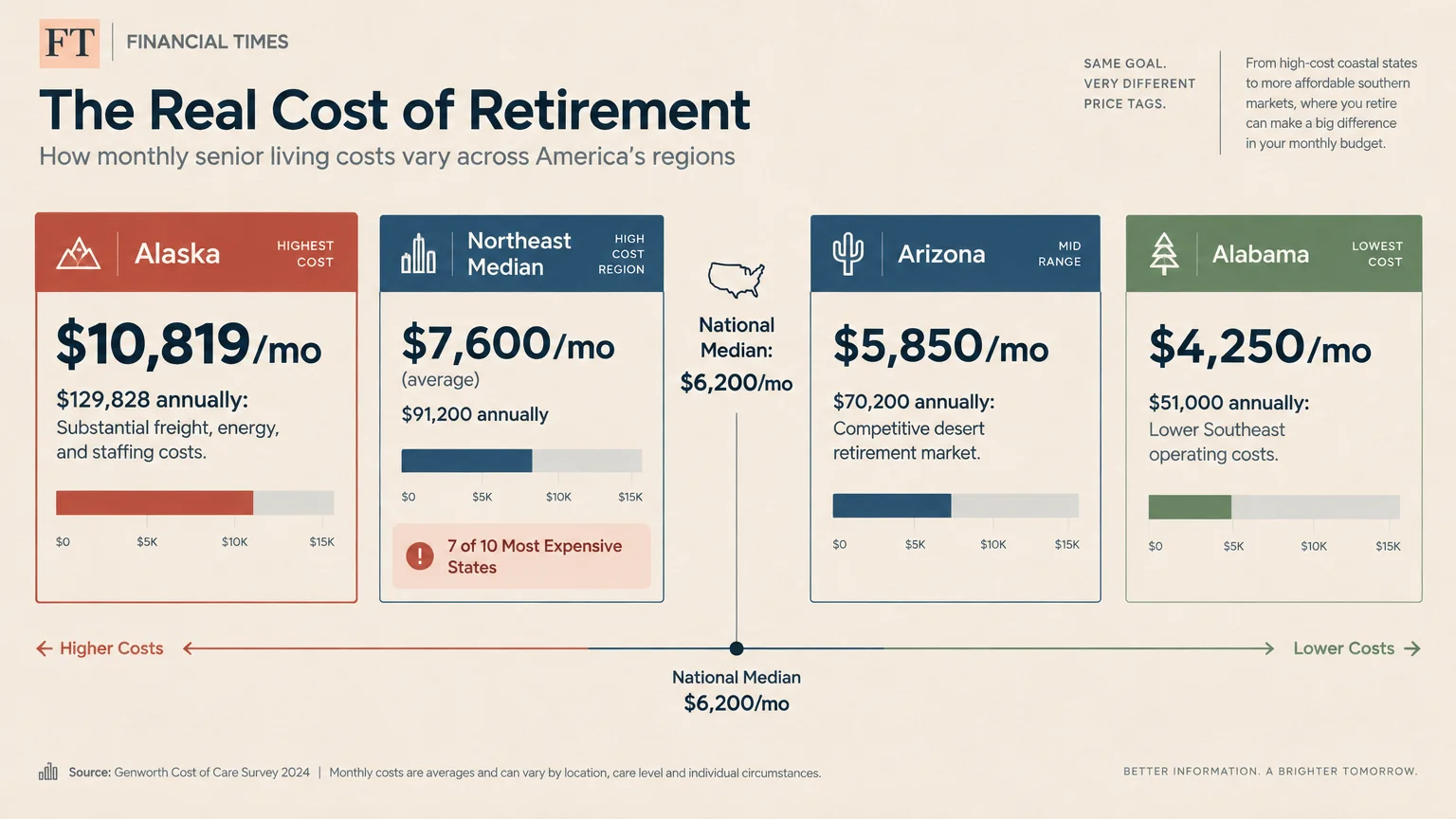
Where you live plays the single largest role in your monthly assisted living cost. Facilities in high-cost states charge more than double the rates found in lower-cost rural areas.
Seven of the ten most expensive states are located in the Northeast. High property values, strict licensing mandates, and competitive wage requirements push monthly fees upward in this region.
Conversely, six of the lowest-cost states sit in the Southeast. Milder real estate costs and lower overall operational expenses keep assisted living prices significantly lower for local residents.
The table below details estimated monthly and annual costs across all fifty states. Use these state-level benchmarks to assess where your home state ranks nationally.
| State | Estimated Monthly Median | Estimated Annual Cost | Regional Cost Context |
|---|---|---|---|
| Alabama | $4,250 | $51,000 | Lower Southeast regional operating costs |
| Alaska | $10,819 | $129,828 | Substantial freight, energy, and staffing costs |
| Arizona | $5,850 | $70,200 | Competitive desert retirement communities |
| Arkansas | $4,100 | $49,200 | Among the most affordable states nationwide |
| California | $6,950 | $83,400 | High coastal labor and real estate markets |
| Colorado | $6,400 | $76,800 | Moderate to high Mountain West pricing |
| Connecticut | $8,500 | $102,000 | Northeast corridor high-cost healthcare market |
| Delaware | $7,200 | $86,400 | Mid-Atlantic suburban pricing baseline |
| Florida | $5,500 | $66,000 | High facility density moderates pricing |
| Georgia | $4,600 | $55,200 | Affordable rates outside metropolitan Atlanta |
| Hawaii | $12,000 | $144,000 | Highest overall senior care rates nationally |
| Idaho | $5,400 | $64,800 | Growing Northwest market with moderate fees |
| Illinois | $5,900 | $70,800 | Higher costs centered around Chicago suburbs |
| Indiana | $5,350 | $64,200 | Lower Midwest living and housing expenses |
| Iowa | $5,200 | $62,400 | Stable agricultural heartland care pricing |
| Kansas | $5,300 | $63,600 | Midwestern affordability and steady rates |
| Kentucky | $4,550 | $54,600 | Lower operational overhead across rural areas |
| Louisiana | $4,450 | $53,400 | Gulf Coast regional affordability |
| Maine | $7,800 | $93,600 | High heating and northern staffing expenses |
| Maryland | $6,800 | $81,600 | Suburban Washington corridor wage pressure |
| Massachusetts | $9,600 | $115,200 | Third highest state cost nationally |
| Michigan | $5,550 | $66,600 | Competitive Great Lakes senior housing market |
| Minnesota | $6,100 | $73,200 | High nurse-to-resident care standards |
| Mississippi | $4,715 | $56,580 | Lowest overall state median benchmark |
| Missouri | $4,950 | $59,400 | Below-average Midwest operational costs |
| Montana | $5,900 | $70,800 | Rural Mountain West distribution expenses |
| Nebraska | $5,450 | $65,400 | Balanced central plains economic profile |
| Nevada | $5,750 | $69,000 | High growth across Las Vegas and Reno |
| New Hampshire | $8,900 | $106,800 | New England high real estate values |
| New Jersey | $8,800 | $105,600 | Dense suburban high property tax burdens |
| New Mexico | $5,500 | $66,000 | Moderate Southwest regional pricing |
| New York | $8,100 | $97,200 | Substantial spread between upstate and metro |
| North Carolina | $5,250 | $63,000 | Rapidly expanding mid-Atlantic senior sector |
| North Dakota | $5,600 | $67,200 | Tight northern healthcare labor pool |
| Ohio | $5,400 | $64,800 | Broad network of competitive providers |
| Oklahoma | $4,750 | $57,000 | Affordable land and operational expenses |
| Oregon | $6,800 | $81,600 | Strict Pacific Northwest regulatory guidelines |
| Pennsylvania | $6,250 | $75,000 | Moderate mid-Atlantic urban and rural split |
| Rhode Island | $8,700 | $104,400 | Small coastal market with premium land values |
| South Carolina | $4,900 | $58,800 | Coastal communities offset cheaper inland areas |
| South Dakota | $5,150 | $61,800 | Affordable northern plains facilities |
| Tennessee | $4,850 | $58,200 | Favorable tax structure and lower labor costs |
| Texas | $5,666 | $67,992 | Large state market with balanced medians |
| Utah | $5,350 | $64,200 | Moderate Mountain West community pricing |
| Vermont | $8,600 | $103,200 | Small rural facilities with high fixed costs |
| Virginia | $6,450 | $77,400 | Significant rate premium in northern counties |
| Washington | $7,350 | $88,200 | High municipal minimum wage standards |
| West Virginia | $4,900 | $58,800 | Low regional living costs throughout Appalachia |
| Wisconsin | $5,800 | $69,600 | Upper Midwest healthcare labor pressures |
| Wyoming | $6,100 | $73,200 | Low population density and staffing challenges |
As the data illustrates, Hawaii ranks as the most expensive state with an estimated monthly median of $12,000. Alaska follows closely behind at $10,819 per month.
Massachusetts represents the priciest mainland state, averaging $9,600 monthly or $115,200 per year. In contrast, Mississippi offers the lowest median cost at $4,715 per month.
Large populous states feature substantial internal variation. California averages between $6,900 and $7,000 monthly, Texas sits at $5,666, and Florida averages $5,500 per month.
According to research from AARP, evaluating state-level rate variations early allows older adults to budget retirement asset withdrawals far more accurately.
What Drives Senior Living Prices?
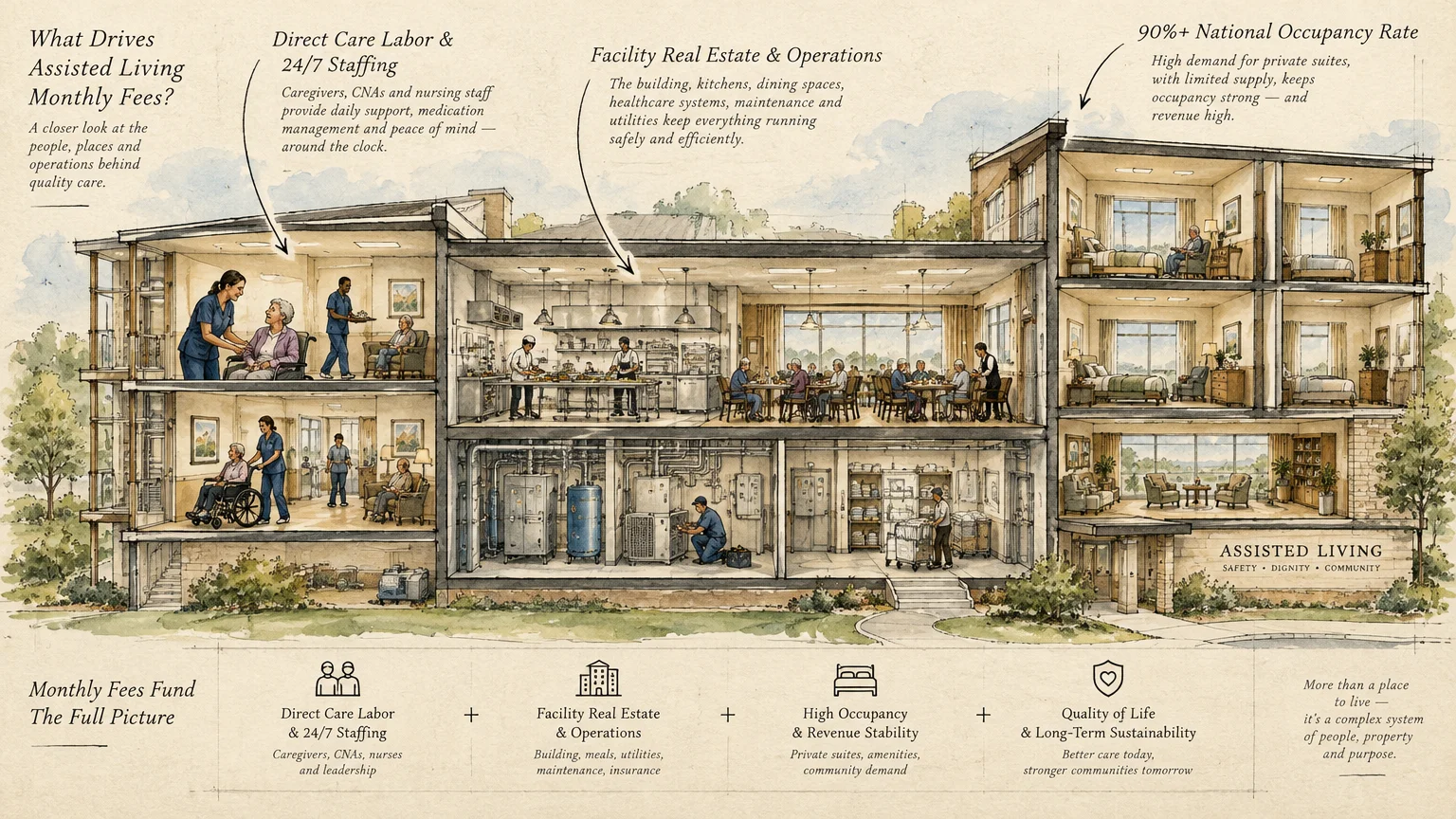
Assisted living prices do not simply reflect apartment square footage. A wide array of operational and regulatory factors shapes the final invoice you receive each month.
Local real estate values establish the baseline physical cost for any community. Facilities constructed in dense metropolitan areas must charge higher base rents to service their property debt and real estate taxes.
Labor expenses represent the largest ongoing operational budget item for senior residences. Certified nursing assistants, licensed nurses, dining staff, and housekeepers require competitive wages that mirror local economic conditions.
Your personal medical and physical needs also alter your monthly statement. Most assisted living communities separate billing into two distinct categories: base room rent and personal care services.
Care fees cover assistance with activities of daily living (ADLs). These routine personal tasks include bathing, dressing, medication management, mobility transfers, and personal grooming.
Communities routinely employ tiered pricing models. As your physical needs increase, your facility conducts a reassessment and moves you into higher, more expensive care tiers.
Comparing Assisted Living to Other Care Options
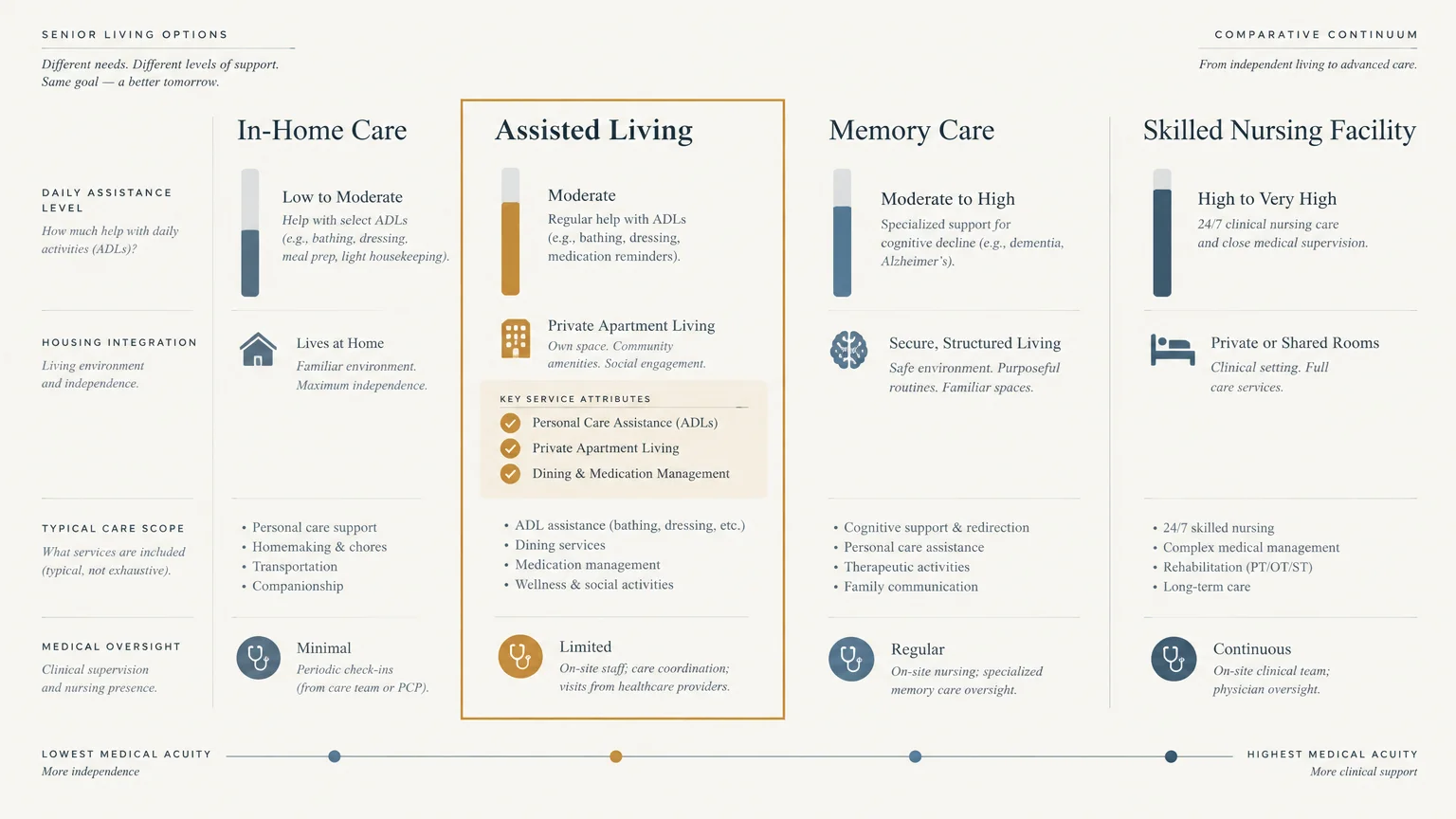
Evaluating senior living costs requires comparing assisted living against alternative care environments. Each setting provides distinct levels of supervision, medical oversight, and household assistance.
Many seniors prefer aging in place using non-medical home caregivers. Recent surveys report a national median home care rate of $35 per hour.
Hiring a private caregiver for 44 hours per week costs approximately $6,673 per month, or $80,080 annually. That makes full-time home care roughly $5,680 more expensive per year than assisted living.
Memory care communities provide specialized environments for individuals experiencing Alzheimer’s disease or dementia. These secured wings require higher staff-to-resident ratios and specialized sensory programming.
National median memory care costs range from $6,450 to $8,019 per month. You should expect memory care services to add 20% to 30% onto standard assisted living rates.
Skilled nursing facilities offer intensive around-the-clock medical attention. Semi-private nursing home rooms average $9,581 monthly, while private rooms reach $10,798 per month.
If you require only daytime supervision, adult day health care averages $95 per day, or $24,700 annually. You can research community adult day centers through the Eldercare Locator.
Independent living communities offer the most affordable residential option, averaging $3,065 to $3,200 monthly. However, independent living includes meal plans and activities without any personal custodial care.

How to Pay for Senior Care and Long-Term Support
Paying for senior living requires a thoughtful combination of private savings, pension income, and government assistance programs. Understanding program boundaries protects you from making inaccurate financial assumptions.
Many families mistakenly assume federal healthcare covers senior housing. According to Medicare.gov, Medicare does not cover assisted living room and board or non-medical custodial care.
State Medicaid programs can help pay for personal care services through Home and Community-Based Services (HCBS) waivers. However, Medicaid never pays for monthly room and board charges in assisted living.
To qualify for Medicaid waivers, you must satisfy strict financial limits. In 2026, the federal long-term care monthly income cap is $2,982, with an individual asset limit of $2,000.
California operates under distinct guidelines, having reinstated its individual Medi-Cal asset limit at $130,000 in 2026. Consult an elder law attorney to navigate your state’s specific eligibility rules.
Wartime veterans and surviving spouses can access the Department of Veterans Affairs Aid and Attendance benefit. This monthly pension provides substantial tax-free funds to offset assisted living costs.
For 2026, a single qualifying veteran can receive up to $2,424 per month, or $29,093 annually. A married veteran with a dependent spouse qualifies for up to $2,874 per month.
A surviving spouse of a veteran can receive up to $1,558 monthly. Two married qualifying veterans can access up to $3,845 per month, subject to the $163,699 net worth ceiling.
Private long-term care insurance policies can also bridge financial gaps. Review your policy’s elimination period and daily payout maximums before finalizing any community contracts.
Hidden Fees and Contract Pitfalls to Avoid
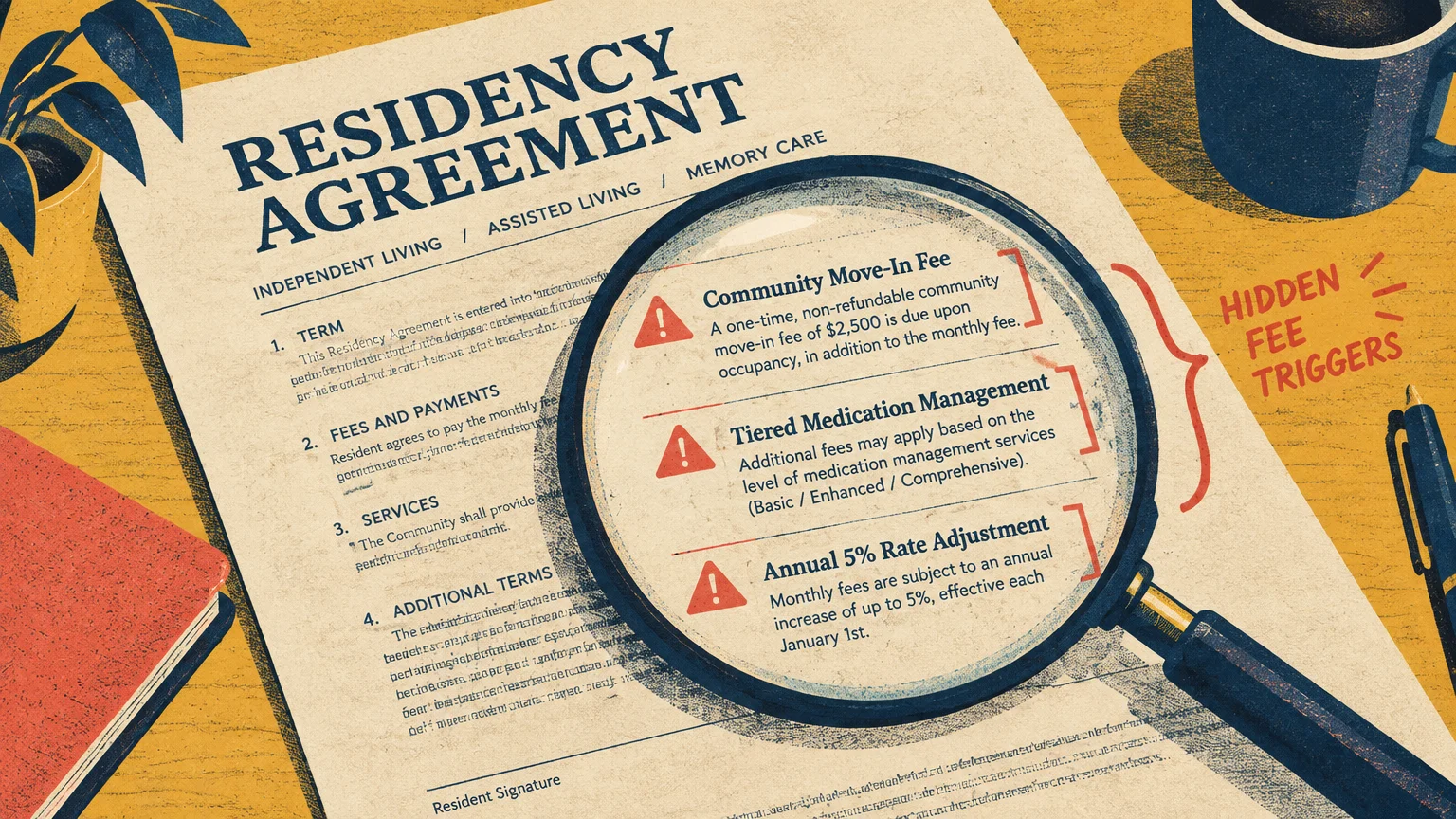
Residency agreements often contain auxiliary fees that substantially increase your final invoice. Scrutinizing contracts prior to signing prevents frustrating surprises on your monthly statements.
Most assisted living facilities charge an upfront community move-in fee. These non-refundable charges range from $2,000 to $6,000 and ostensibly cover administrative paperwork and apartment reconditioning.
Watch out for rapid care-level creep shortly after settling in. Facilities frequently re-evaluate new residents after thirty days, which can abruptly elevate your care tier and monthly bill.
A la carte service fees can inflate your monthly statements without warning. Communities frequently assess extra charges for medication reminders, meal delivery to apartments, or escort services to activities.
Medication administration charges often add between $300 and $800 each month. Always request a comprehensive written itemized fee schedule before executing a binding residency agreement.
According to the Consumer Financial Protection Bureau, seniors should carefully examine contract discharge clauses. Communities retain the right to discharge residents whose physical or cognitive needs exceed local licensing limits.
Practical Steps to Lower Your Monthly Costs
You can implement several practical strategies to reduce your monthly senior living expenses. Thoughtful negotiation and flexible choices will help preserve your retirement resources.
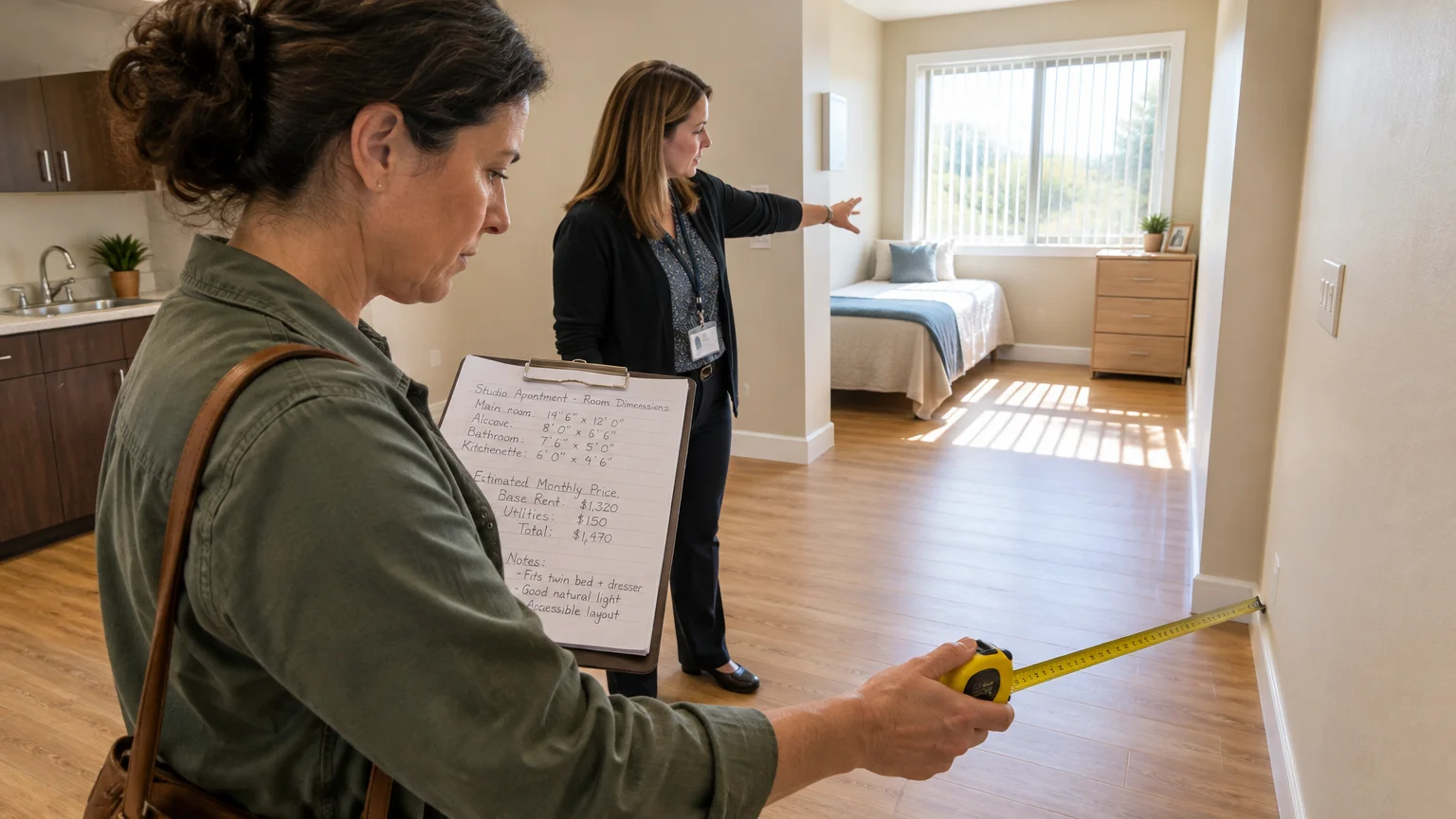
Consider selecting a shared companion suite instead of a private apartment. Sharing a room with a compatible peer frequently slashes your monthly room rate by 20% to 30%.
Broaden your search radius to include secondary markets or neighboring counties. Communities situated fifteen miles outside central metropolitan areas frequently offer lower rates for comparable accommodations.
Time your negotiations toward the end of calendar months or financial quarters. Sales directors face occupancy quotas and often agree to discount or waive community move-in fees.
Re-evaluate your care plan twice each year alongside facility nursing staff. If physical therapy restored your independence with dressing or bathing, ensure administrative staff downgrades your billing tier.
Purchase personal supplies and incontinence products independently in bulk. Assisted living facilities routinely place hefty surcharges on hygiene supplies purchased through internal community pantries.
Frequently Asked Questions
Does Medicare pay for any part of assisted living?
Medicare never pays for assisted living room, board, or non-medical custodial care. It only covers skilled medical visits, doctor appointments, and rehabilitative therapy services provided while you live there.
Can an assisted living community raise my monthly rent?
Yes, senior communities can raise base rates and care tier fees. Most residency agreements permit annual rate increases ranging from 3% to 8%, provided the community issues thirty to sixty days advance notice.
What happens when private funds run out in assisted living?
If you exhaust your personal savings, you may qualify for state Medicaid waiver assistance. However, if your current community does not participate in Medicaid, you must relocate to an accepting facility.
How much more does memory care cost than assisted living?
Memory care generally costs 20% to 30% more than traditional assisted living. Monthly rates range from $6,450 to $8,019 due to secured perimeter environments and specialized dementia staffing ratios.
Are monthly assisted living expenses tax-deductible?
A portion of your assisted living fees may qualify as deductible medical expenses if a physician certifies your care plan. Consult a qualified certified public accountant to assess your family situation.
For additional senior resources, visit
National Institute on Aging (NIA), Centers for Disease Control and Prevention (CDC), Medicare.gov, National Institute of Mental Health (NIMH) and National Institutes of Health (NIH).
Disclaimer: The information in this article is for educational purposes only and is not intended to be a substitute for professional financial, legal, or medical advice. Always consult with a qualified expert for advice tailored to your personal situation.