

Routine dental exams and new eyeglasses protect your health, but Original Medicare rarely pays for everyday oral or optical visits. You can still protect your fixed income while receiving high-quality treatment through specialized assistance programs.
Navigating out-of-pocket costs requires knowing exactly where community clinics, federal rules, and national charities step in. Multiple reliable resources provide free cleanings, restorative dental care, eye exams, and prescription lenses across the country.
This guide reveals ten trustworthy dental and vision resources designed to bridge Medicare coverage gaps without draining your savings.
In this guide9 sections
- Understanding Original Medicare Coverage Limits
- Nonprofit Dental Assistance Programs
- Charitable and Low-Cost Vision Programs
- Medicare Advantage Supplemental Plans
- Medicaid, PACE, and Dual-Eligible Coverage
- Clinical Schools and Medically Necessary Exceptions
- Local Aging Agencies and Community Grants
- Avoiding Dental and Vision Scams Targeting Seniors
- Frequently Asked Questions
Understanding Original Medicare Coverage Limits
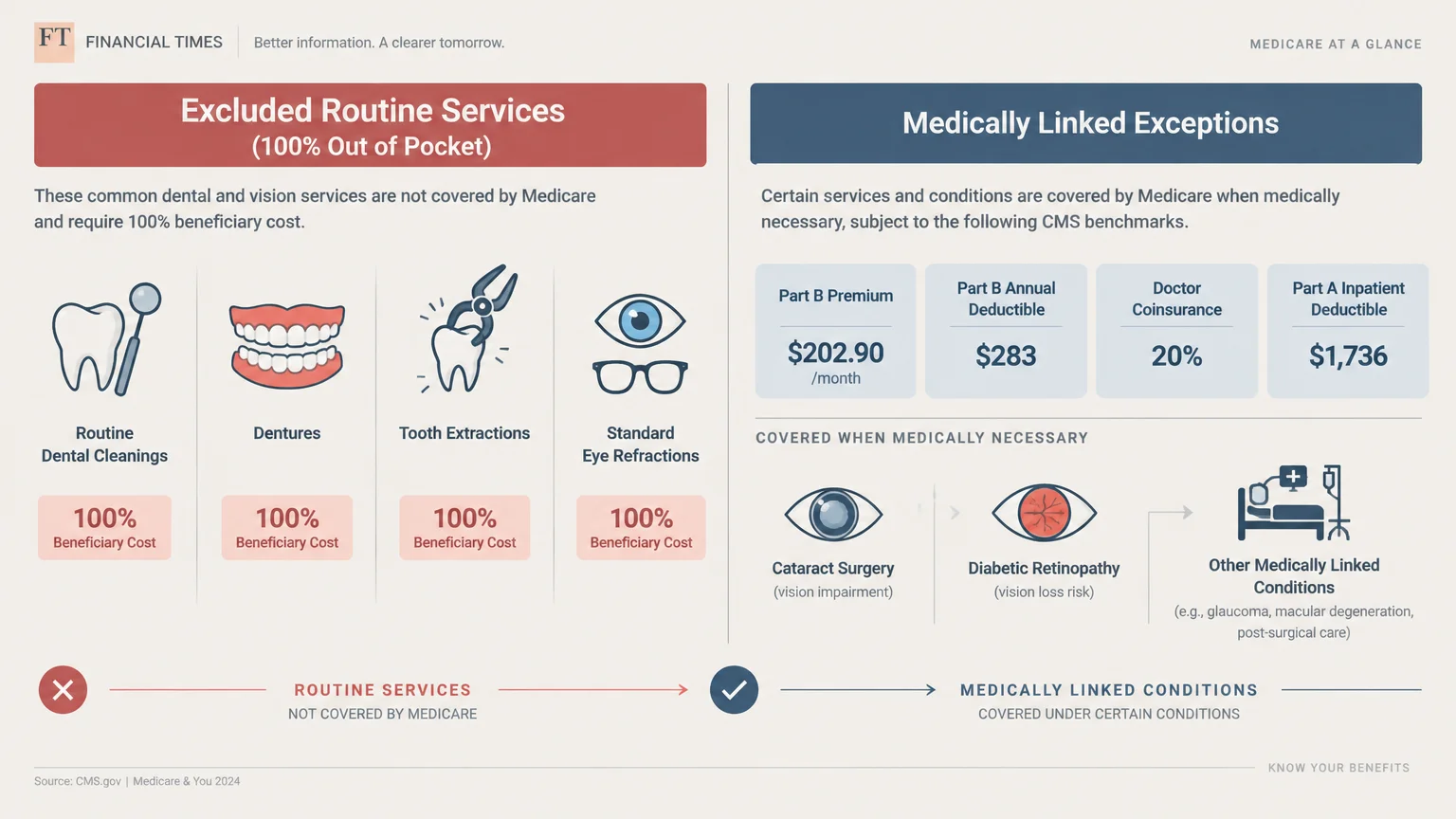
Many seniors assume Medicare works like private job-based health insurance. Unfortunately, Original Medicare excludes routine cleanings, fillings, dentures, tooth extractions, and standard eye refractions.
Congress excluded routine dental and optical care when creating the Medicare program in 1965. Lawmakers viewed these appointments as routine maintenance rather than major medical emergencies.
Neglecting oral and optical care carries severe physical consequences. According to Centers for Disease Control and Prevention (CDC), untreated oral infections and worsening vision impairment directly increase fall risks and complicate chronic conditions.
When Medicare Part B does cover an approved service, financial rules apply. Beneficiaries must manage the standard Part B monthly premium of $202.90.
You must also satisfy the annual Part B deductible of $283 before coverage begins. After reaching that threshold, you generally pay a 20% coinsurance for doctor services.
Inpatient hospital stays fall under Medicare Part A rules. If an acute oral or eye condition requires hospitalization, you face an inpatient deductible of $1,736 per benefit period.
Original Medicare limits vision coverage to specific medical conditions. Part B covers annual glaucoma screenings for high-risk individuals, diabetic retinopathy exams, and treatments for age-related macular degeneration.
Part B also covers cataract surgery to replace clouded natural lenses with artificial implants. Following cataract surgery, Medicare covers one pair of standard eyeglasses or contact lenses.
| Service Type | Original Medicare Standard Rule | What You Pay |
|---|---|---|
| Routine Dental Exams & Cleanings | Not covered under Part A or Part B | 100% out of pocket |
| Fillings, Dentures, & Implants | Not covered under Part A or Part B | 100% out of pocket |
| Medically Linked Dental Work | Covered under CMS clinical exceptions | 20% coinsurance after Part B deductible |
| Routine Eye Exams & Glasses | Not covered under Part A or Part B | 100% out of pocket |
| Cataract Surgery & Follow-up Pair | Covered under Medicare Part B | 20% coinsurance after Part B deductible |
| Inpatient Dental Emergency | Covered under Medicare Part A | $1,736 deductible per benefit period |
Because these exclusions create costly gaps, you need external assistance networks. The following resources connect you directly to affordable, high-standard dental and vision care.
Nonprofit Dental Assistance Programs
Charitable organizations understand that oral health deeply influences systemic health. These programs provide vital dental resources medicare recipients rely on when private treatment feels unaffordable.
1. Dental Lifeline Network (Donated Dental Services)
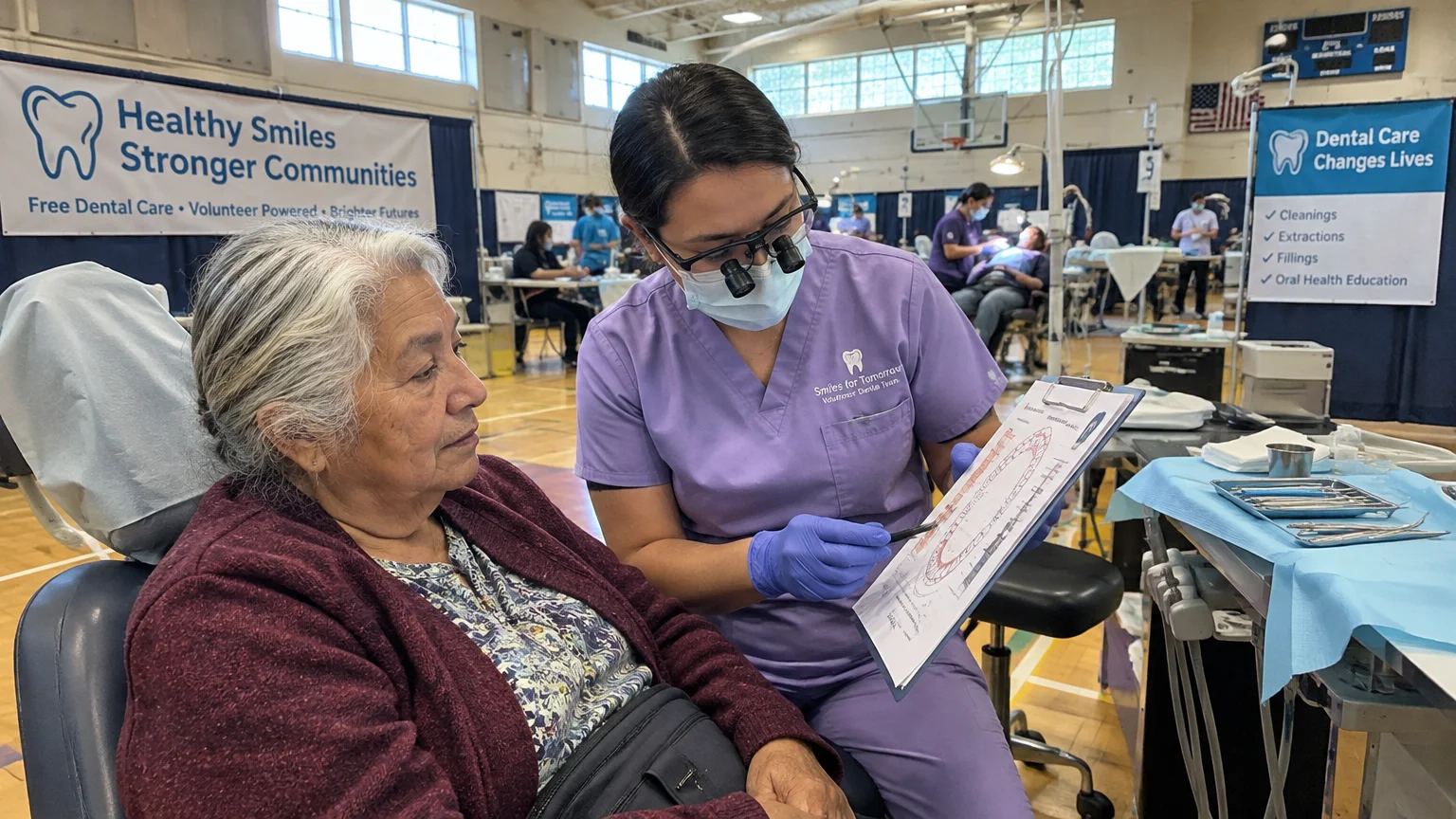
The Dental Lifeline Network operates the Donated Dental Services (DDS) program across all 50 states. This organization coordinates a compassionate network of 15,000 volunteer dentists and 3,600 dental laboratories.
Volunteer clinicians provide comprehensive, free dental care seniors can use for complex problems. Dentists handle crowns, bridges, surgical extractions, and dentures in their private offices.
DDS restricts assistance to individuals who cannot afford treatment and meet specific vulnerability standards. You must be age 65 or older, have a permanent disability, or be medically fragile.
The program does not cover cosmetic treatments or dental implants. Because demand is high, many state chapters maintain waitlists that periodically open and close throughout the year.
You can apply by visiting the program website to download your state application. You must submit verification of household income, medical diagnoses, and housing expenses.
2. Federally Qualified Health Centers (FQHCs)
Federally Qualified Health Centers receive federal funding to deliver primary, preventive, and specialty care. These community health clinics welcome older adults regardless of insurance status or ability to pay.
FQHC clinics charge patients on a sliding fee scale. The clinic calculates your bill strictly using current Federal Poverty Level guidelines and household size.
If you live solely on a monthly Social Security check, you qualify for the lowest fee tier. This sliding scale makes expensive procedures like root canals and deep cleanings manageable.
Many centers house on-site dental suites equipped with modern digital imaging technology. You can locate your nearest community clinic by searching the federal Health Resources and Services Administration directory.
Call the center directly and request an appointment with their billing intake specialist. Bring proof of your monthly income and current medication list to secure the lowest fee tier.

Charitable and Low-Cost Vision Programs
Preserving your sight helps you maintain personal independence and enjoy everyday activities. When you need vision care medicare denies, several nonprofit foundations step forward.
3. EyeCare America
EyeCare America is a public service initiative run by the Foundation of the American Academy of Ophthalmology. Supported by the Knights Templar Eye Foundation, the program relies on over 2,750 volunteer ophthalmologists.
The initiative recently changed its rules to broaden public access. EyeCare America officially lowered its minimum eligibility age from 65 down to 18 and older.
Qualified applicants receive a comprehensive medical eye exam at no out-of-pocket cost. The volunteer doctor checks for cataracts, glaucoma, macular degeneration, and other serious optical conditions.
To qualify, you must be a U.S. citizen or legal resident. You must not have seen an ophthalmologist in three or more years.
You cannot participate if you belong to an HMO or receive eye care through the Veterans Health Administration. The program accepts Traditional Medicare as payment in full and waives all copayments.
EyeCare America focuses entirely on diagnosing medical eye diseases. The program does not cover routine eyeglass refractions, prescription lenses, or surgical facility fees.
4. VSP Eyes of Hope
VSP Eyes of Hope provides low cost eye exams seniors require when purchasing new prescription glasses. The charity operates through electronic gift certificates and mobile vision vans across the nation.
Recipients receive a no-cost comprehensive eye exam alongside a complete pair of standard prescription eyeglasses. Participating private eye doctors accept the certificate just like standard commercial insurance.
To qualify, your family household income cannot exceed 200% of the Federal Poverty Level. You must not have routine vision coverage through another private policy or government program.
Because Original Medicare excludes routine vision exams, standard Medicare recipients satisfy this insurance requirement. You may use this charitable benefit once every 12 months.
VSP distributes these certificates through local community partners like the Salvation Army and community health centers. Ask your local social services office or senior center director to request a certificate on your behalf.
Note that other well-known charities operate under strict exclusions. For instance, Mission Cataract USA excludes anyone with Medicare coverage because Part B already pays for cataract surgeries.
Medicare Advantage Supplemental Plans
Private insurance carriers offer alternative pathways to acquire dental and vision protection. Understanding plan structures lets you maximize benefits while avoiding unexpected out-of-pocket surprises.
5. Medicare Advantage (Part C) Supplemental Coverage
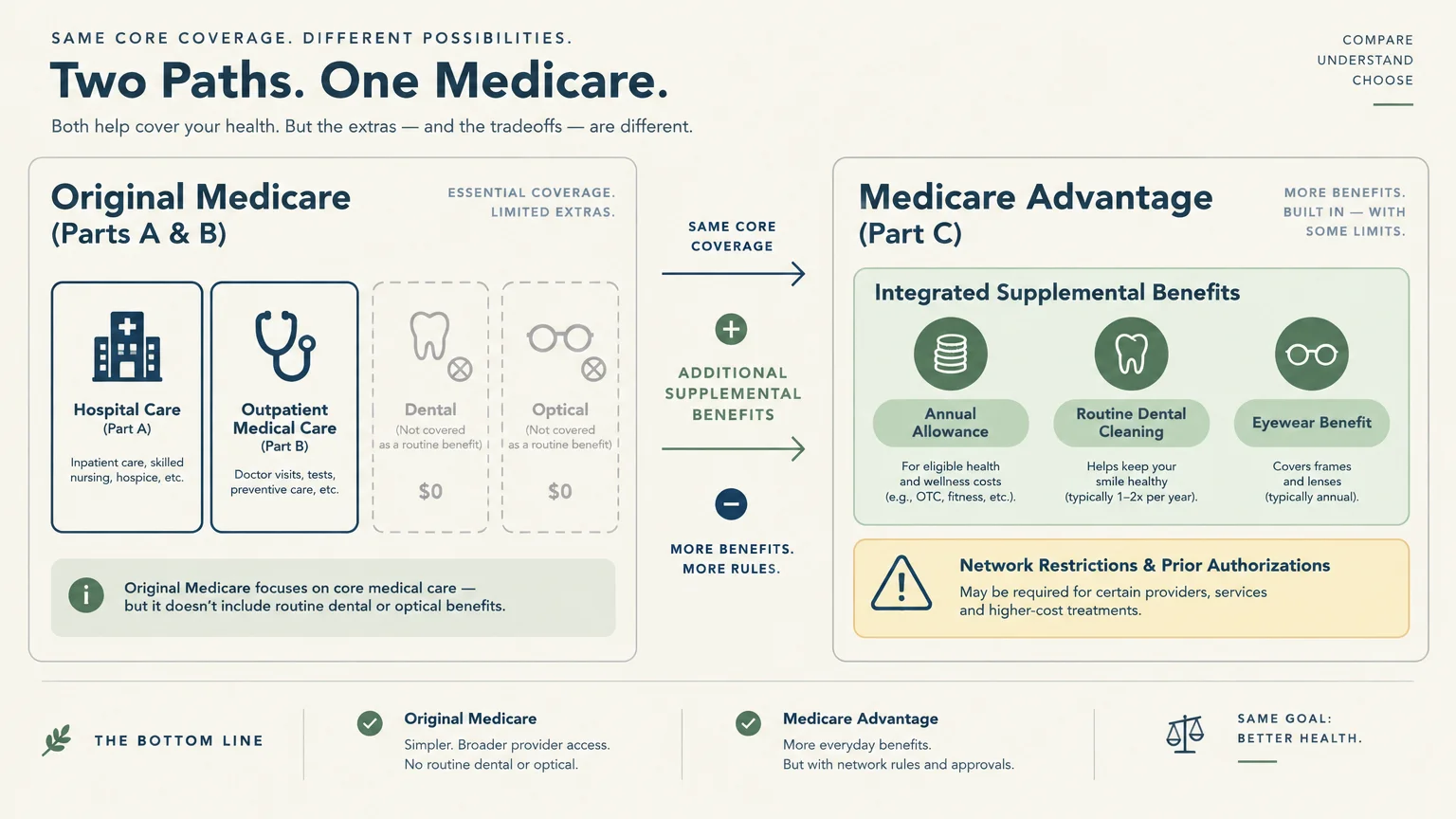
Medicare Advantage plans contract with the federal government to administer Part A and Part B benefits. These private plans frequently bundle dental, optical, and hearing perks into one policy.
Enrolling in a private plan represents a major trend among older Americans. Approximately 51% of all Medicare beneficiaries—over 36 million individuals—are enrolled in Medicare Advantage plans.
Data shows that more than 99% of individual Medicare Advantage enrollees have access to vision benefits. Furthermore, 98% of enrollees belong to plans that offer some level of medicare dental coverage.
Insurers often offer these packages with attractive pricing models. Roughly 67% of Medicare Advantage prescription drug plans charge a $0 supplemental monthly premium beyond the base Part B premium.
Despite these perks, you must examine plan details with extreme caution. Supplemental dental coverage frequently caps annual benefits at $1,000 to $2,000 per year.
Once you reach that annual maximum, you must pay all subsequent dental costs entirely on your own. Plans also enforce strict provider networks that restrict your choice of dentists.
Market dynamics change every year, requiring annual vigilance. Approximately 3.2 million Medicare Advantage enrollees recently faced plan disruptions as private carriers exited unprofitable service areas.
These market departures left 193 mostly rural counties with zero Medicare Advantage drug plan options. Check provider networks carefully before switching plans to keep your trusted clinicians.
You can switch or enroll during the annual Open Enrollment Period running from October 15 to December 7. Use the online plan comparison portal at Medicare.gov to review dentists and eyewear allowances.

Medicaid, PACE, and Dual-Eligible Coverage
Seniors with limited income and personal assets can access coordinated care models. These comprehensive programs eliminate financial friction by blending federal and state funding streams.
6. Program of All-Inclusive Care for the Elderly (PACE)
The Program of All-Inclusive Care for the Elderly delivers complete medical, dental, and social support. PACE allows frail seniors to receive comprehensive treatment while continuing to live safely at home.
PACE covers complete dental cleanings, restorative fillings, dentures, routine eye exams, and prescription eyeglasses. You pay no deductibles or copayments for any approved service delivered by the PACE care team.
To qualify, you must be age 55 or older. Your state must officially certify that you meet the clinical criteria for a nursing home level of care.
You must also live safely in the community with support and reside within a designated PACE service area. The program currently operates in 34 states and Washington, D.C.
Financial accessibility remains exceptionally high for participants. Approximately 80.5% of all PACE enrollees are dually eligible for both Medicare and state Medicaid.
Dual-eligible participants pay no monthly premium for the long-term care portion of the PACE benefit. If you do not qualify for Medicaid, you may pay a monthly private fee to join.
7. Dual Eligible Special Needs Plans (D-SNPs)
If you qualify for both Medicare and full Medicaid, you can enroll in a Dual Eligible Special Needs Plan. These specialized plans coordinate benefits between state and federal programs.
D-SNPs usually provide significantly higher dental allowances than standard commercial plans. Many plans provide quarterly allowances on prepaid debit cards to buy dental supplies and pay for clinical care.
State Medicaid programs also offer standalone adult dental benefits, though coverage scopes vary widely by state. Some states fund comprehensive dental treatments, while others restrict coverage to emergency tooth extractions.
Contact your local Medicaid agency to review your state’s adult dental benefit schedule. Pairing Medicaid with a D-SNP creates a powerful financial shield against high restorative costs.
Clinical Schools and Medically Necessary Exceptions
Academic institutions and specialized Medicare rules offer two often-overlooked routes to affordable care. Both pathways deliver high-caliber clinical treatments at deep discounts or through direct Medicare billing.
8. University Dental and Optometry Clinics
Dental and optometry schools train the next generation of licensed healthcare professionals. These university clinics open their doors to local seniors looking for affordable care.
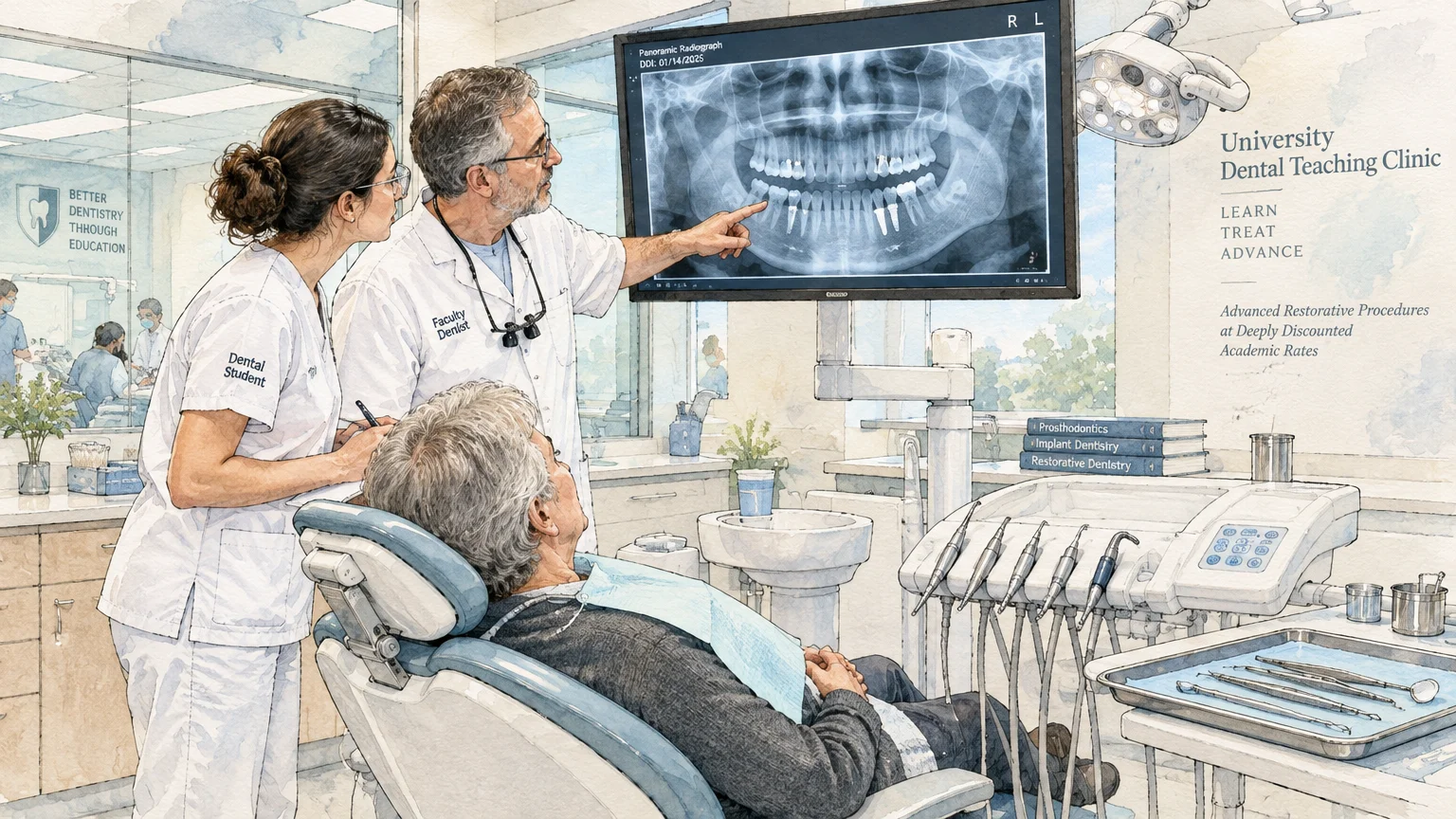
Student clinicians deliver routine exams, fillings, root canals, dentures, and optical exams under close faculty supervision. Every procedure is evaluated step-by-step by licensed, experienced dental professors.
Because appointments involve educational assessments, visits take longer than appointments at private dental practices. However, clinical fees generally run 30% to 60% below standard private rates.
If your dental needs require advanced surgical expertise, universities also operate postgraduate specialty clinics. Resident dentists in these clinics already hold licenses and are completing advanced specialty training.
Optometry schools offer similar academic clinics with heavily discounted visual refractions and hardware fees. Contact your state university health science center to request an initial patient screening.
9. CMS Medically Necessary Dental Exceptions
Federal regulations permit Medicare to pay for dental treatments under strict, life-saving conditions. Under official rules published by the Centers for Medicare & Medicaid Services (CMS), coverage applies when oral treatment is inextricably linked to covered medical procedures.
Federal regulation 42 C.F.R. 411.15(i) outlines these specific medical exceptions.
Medicare covers dental exams and infection eradication prior to organ transplants and kidney transplants.
Coverage also covers dental exams and treatments before cardiac valve replacements and heart procedures. Eliminating oral bacteria protects replacement valves and newly transplanted organs from deadly systemic infections.
Medicare covers oral oncology treatments associated with chemotherapy, radiation, and head or neck cancer resections. It also covers treating oral infections prior to or during Medicare-covered dialysis for End-Stage Renal Disease.
When you qualify under these rules, Part B covers the dental service. You pay your standard 20% coinsurance after meeting the $283 annual deductible.
Your physician and dental surgeon must coordinate paperwork carefully to document medical necessity. They must submit detailed diagnostic clinical notes proving the dental procedure directly enables the medical treatment.
Local Aging Agencies and Community Grants
Local community organizations provide personalized navigational help for older adults. When national programs seem overwhelming, local advocates step in to coordinate regional aid.
10. Area Agencies on Aging and Eldercare Support
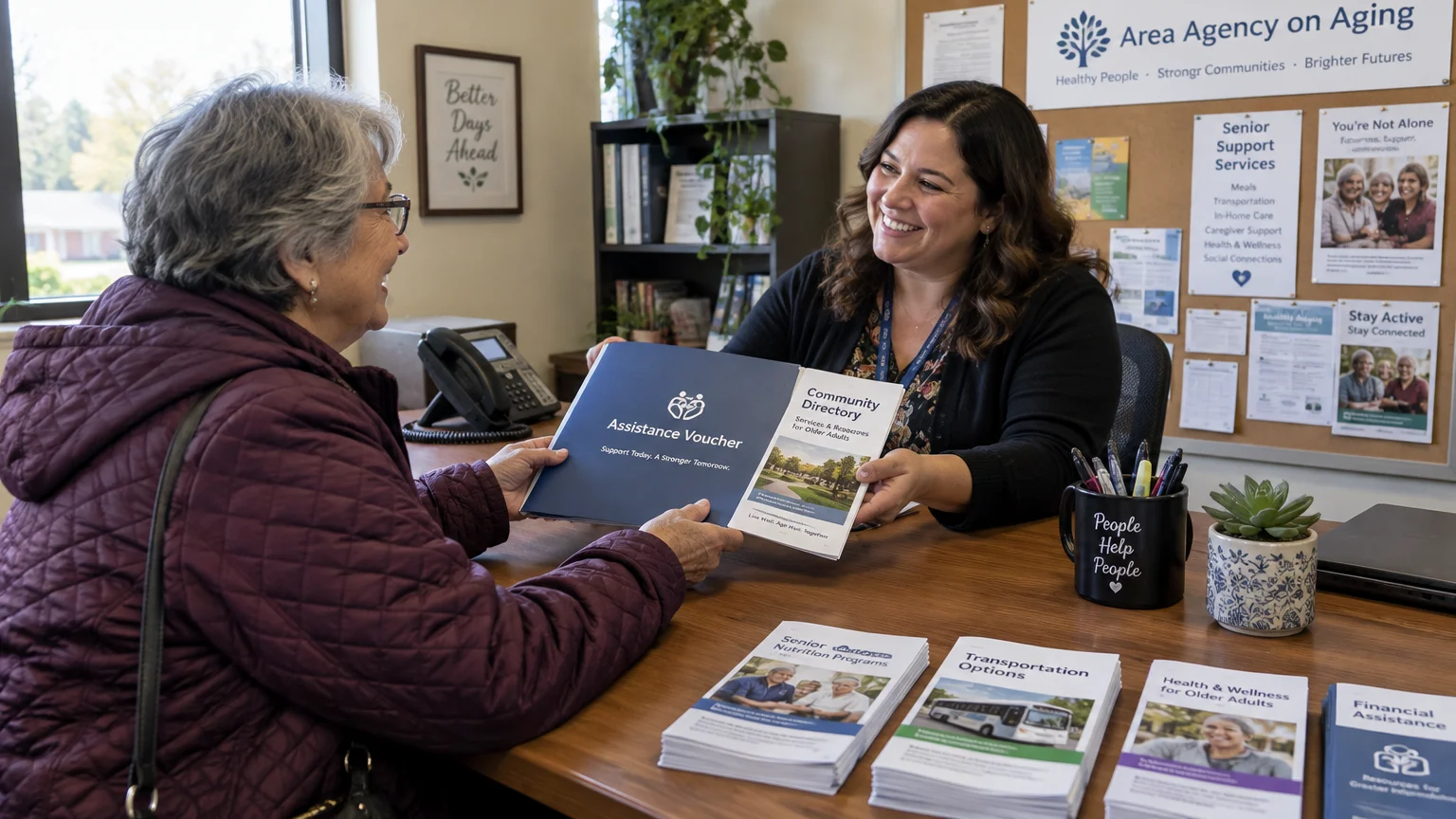
The federal Older Americans Act funds a nationwide network of Area Agencies on Aging. These agencies connect older adults directly with regional resources, transportation, and healthcare funding.
Many local agencies partner with charitable foundations to distribute vision and dental vouchers. These vouchers cover small copayments, new reading glasses, or emergency dental extractions.
Agencies also deploy trusted case managers who visit your home to assess your needs. They can help you apply for local philanthropic grants that subsidize the cost of dentures.
To find your regional office, reach out to the Eldercare Locator, a public service provided by the U.S. Administration for Community Living. Operators connect you directly with local aging specialists in your home county.
Local senior centers also coordinate visits from mobile dental and optical vans. These mobile units visit rural senior centers to deliver on-site examinations without demanding long travel times.
Ask your local agency representative about municipal community development block grants. Some cities set aside dedicated municipal funds to help low-income retirees repair old dental prosthetics.
Avoiding Dental and Vision Scams Targeting Seniors
Financial predators frequently target older adults searching for affordable healthcare. Understanding deceptive marketing practices protects your personal finances and identity.
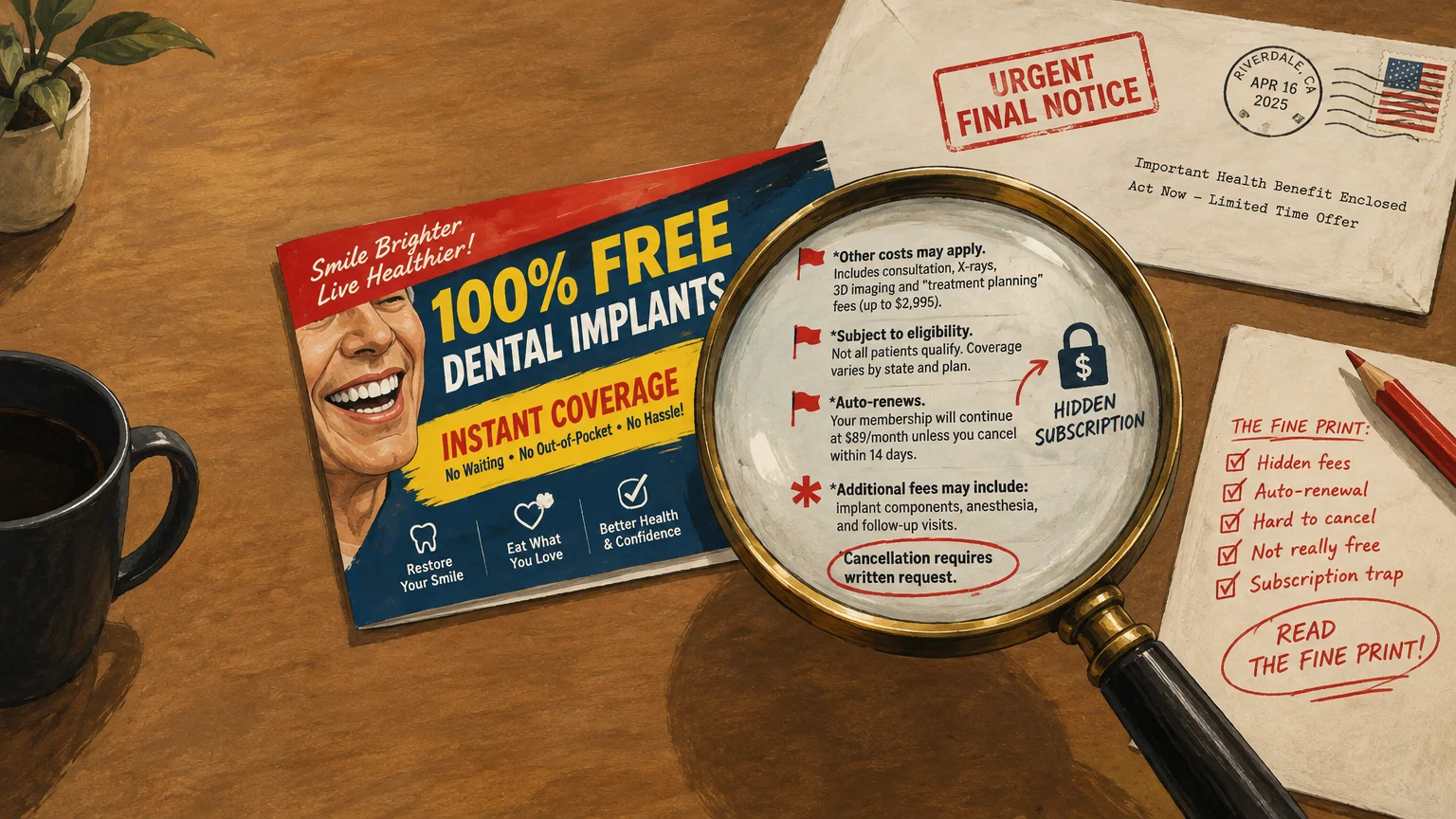
Be extremely wary of commercial dental discount cards sold over the telephone or television. These cards do not provide insurance coverage of any kind.
Discount clubs charge recurring monthly subscription fees in exchange for supposed clinic discounts. Many local dentists refuse to honor these discount networks when you present the card.
Watch out for deceptive private marketing during the fall Medicare enrollment season. Dishonest brokers sometimes promise unlimited free dental implants to trick seniors into switching plans.
These dishonest pitches frequently enroll seniors into plans that drop their trusted primary care physicians. Always demand written benefit explanations before consenting to change your Medicare policy.
Never share your Medicare number, Social Security number, or banking details with unsolicited callers. Legitimate government agencies and nonprofit foundations never call unannounced demanding immediate payment for assistance.
If you suspect an enrollment scam, report the interaction immediately to your state Senior Medicare Patrol. These volunteer monitors investigate fraud and protect beneficiaries from predatory sales tactics.
Frequently Asked Questions
Does Original Medicare pay for dentures or dental implants?
No, Original Medicare does not cover routine dentures or dental implants. You must pay 100% out of pocket unless you have a Medicare Advantage plan, Medicaid, or charitable assistance.
How often does Medicare cover eyeglasses after cataract surgery?
Medicare Part B covers one standard pair of eyeglasses or contact lenses following cataract surgery with an intraocular lens implant. You remain responsible for the 20% coinsurance after meeting your Part B deductible.
Can I get free dental care if I only receive Social Security?
Yes, low-income seniors can seek no-cost treatment through the Dental Lifeline Network or sliding-scale fees at Federally Qualified Health Centers. Qualifications depend on your household income and local clinic funding.
Why did EyeCare America lower its eligibility age to 18?
EyeCare America expanded access thanks to dedicated funding from the Knights Templar Eye Foundation. This rule change allows adults of all ages to receive critical medical eye evaluations from volunteer ophthalmologists.
What should I do if my Medicare Advantage plan drops its dental benefits?
You can review and change your coverage during the annual Open Enrollment Period from October 15 to December 7. Use the Medicare plan finder tool to select a replacement policy that includes comprehensive dental care.
For additional senior resources, visit
Benefits.gov, National Institute on Aging (NIA), Centers for Disease Control and Prevention (CDC), Medicare.gov and National Institute of Mental Health (NIMH).
Disclaimer: The information in this article is for educational purposes only and is not intended to be a substitute for professional financial, legal, or medical advice. Always consult with a qualified expert for advice tailored to your personal situation.