

Maintaining crisp, clear eyesight should never depend on the size of your monthly retirement check. If you live on a fixed income and struggle to afford routine eye exams, prescription glasses, or critical medical treatments like cataract surgery, several national charitable programs provide comprehensive vision care at zero out-of-pocket cost. Because Original Medicare excludes routine vision exams and basic eyeglasses, navigating eye care expenses can quickly become overwhelming for older adults. Fortunately, reputable nonprofit organizations, volunteer ophthalmology networks, and federal health clinics offer dedicated vision care programs low income seniors can access immediately to safeguard their sight and preserve independence.
Why Regular Vision Care Is Crucial for Older Adults
Your eyes change naturally as you age, but uncorrected vision problems directly threaten your safety, mobility, and everyday independence. According to research from the Centers for Disease Control and Prevention (CDC), vision impairment ranks among the top contributors to accidental falls and household injuries among older adults. When you cannot see steps clearly, identify tripping hazards, or read fine print on prescription medication bottles, minor vision loss rapidly escalates into a serious health risk.
Furthermore, major age-related eye conditions develop quietly without causing early pain or obvious warning signs. The National Institute on Aging (NIA) emphasizes that conditions such as age-related macular degeneration, glaucoma, diabetic retinopathy, and cataracts require professional dilated eye examinations for timely detection. Leaving these conditions unmanaged leads to irreversible vision loss; however, early medical intervention halts or significantly slows disease progression.
Financial constraints often force seniors to postpone necessary doctor visits, replace cracked lenses with cheap drugstore magnifiers, or endure blurry eyesight. You do not have to jeopardize your health because of budget limits. Utilizing free eye exams for seniors and targeted charitable vision assistance ensures you receive expert clinical care without draining your monthly living expenses.
Understanding Medicare Limitations and Hidden Vision Benefits
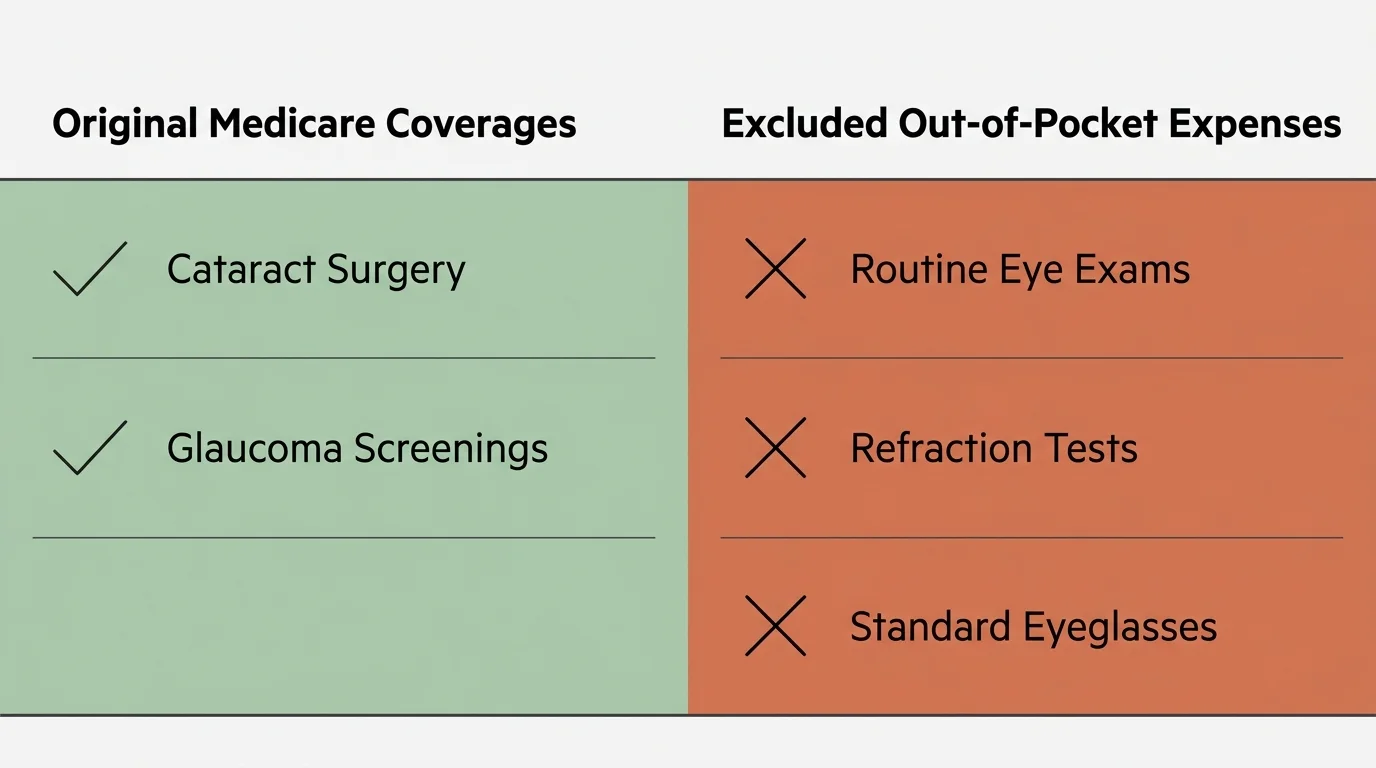
Many seniors mistakenly assume that enrolling in Medicare guarantees complete vision coverage. In reality, Original Medicare (Part A and Part B) excludes routine vision care, refraction tests to determine your eyeglass prescription, and standard eyeglasses or contact lenses. If you visit an optometrist solely for an annual prescription checkup, you must pay the entire bill out-of-pocket unless you possess supplemental insurance or qualify for charitable relief.
Despite these routine exclusions, Medicare Part B covers specific, medically necessary vision services. Understanding these exceptions helps you maximize your benefits before seeking outside charitable grants:
- Post-Cataract Eyewear: After you undergo cataract surgery involving the insertion of an intraocular lens, Medicare Part B covers one pair of standard eyeglasses with basic frames or one set of contact lenses from an enrolled supplier. You remain responsible for the standard Part B deductible and 20% coinsurance.
- Annual Glaucoma Screenings: Medicare covers an annual dilated glaucoma exam if you face high risk for the disease. Qualifying criteria include having diabetes, a documented family history of glaucoma, being an African American aged 50 or older, or being a Hispanic American aged 65 or older.
- Diabetic Retinopathy Examinations: If you manage diabetes, Part B covers an annual dilated eye exam performed by a state-authorized eye doctor to monitor and treat diabetic retinopathy.
- Macular Degeneration Diagnostics and Treatment: Medicare covers diagnostic tests and injectable therapeutic medications for age-related wet macular degeneration.
Review the official guidelines on Medicare.gov to confirm your specific coverage status and identify enrolled providers who accept Medicare assignment before scheduling specialized medical appointments.

Top 8 Free Vision Care Programs for Low-Income Seniors
When Medicare or private insurance leaves gaps in your care, several dedicated charitable and federally funded initiatives step forward. Explore these eight trusted, high-impact vision care programs designed specifically for low-income seniors.
1. EyeCare America (American Academy of Ophthalmology)
EyeCare America operates as one of the most comprehensive public service programs in the United States. Backed by thousands of volunteer ophthalmologists, this program provides comprehensive medical eye examinations and up to one year of follow-up care at zero out-of-pocket cost.
The program features two main initiatives: the Seniors Program (for individuals aged 65 and older who have not seen an ophthalmologist in three or more years) and the Glaucoma Program (for individuals who are uninsured or underinsured and at elevated risk for glaucoma). Volunteer doctors bill your insurance if available, but they accept whatever payment the insurance provides and forgive all remaining copayments, deductibles, or out-of-pocket balances. If you have no insurance, the exam remains completely free. Note that EyeCare America focuses on medical eye health and does not cover routine eyeglasses or refractive prescriptions.
2. New Eyes for the Needy
New Eyes for the Needy addresses the urgent need for basic corrective eyewear. This historic nonprofit provides e-vouchers that cover the entire cost of a brand-new pair of basic prescription eyeglasses (single vision or lined bifocals).
To qualify, your household income must sit at or below 250% of the Federal Poverty Level (FPL), and you must show that you lack other financial resources or insurance programs to pay for glasses. You must also provide a current, valid prescription obtained within the last 24 months that includes your exact pupillary distance (PD) measurement. Once approved, you order your custom glasses directly through an authorized online optical portal, and the organization ships them straight to your home.
3. VSP Eyes of Hope
VSP Vision Care operates the Eyes of Hope initiative, providing low income eye care assistance through gift certificates and mobile vision clinics. These certificates cover the full cost of a comprehensive eye examination and basic prescription eyewear through private eye doctors participating in the vast VSP network.
Qualifications require a household income up to 200% of the Federal Poverty Level, lack of vision insurance coverage through private policies or government programs, and no receipt of VSP charitable aid within the preceding 12 months. Because VSP distributes certificates primarily through local community partners, you can request a voucher through local social service agencies, community health clinics, or charitable aging organizations.
4. Operation Sight (ASCRS Foundation)
Cataracts cloud the natural lens of your eye, creating hazy vision that glasses cannot fix. When surgery becomes essential but costs stand in your way, Operation Sight delivers relief. Founded by the American Society of Cataract and Refractive Surgery (ASCRS) Foundation, this nationwide network matches low-income, uninsured, or underinsured seniors with volunteer ophthalmic surgeons who perform free cataract surgeries.
To qualify, you must possess a formal medical diagnosis of cataracts affecting your daily activities, have a household income at or below 200% to 250% of the FPL, and lack adequate insurance coverage. Operation Sight covers the surgeon’s fee, facility costs, pre-operative evaluations, and post-operative follow-up visits.
5. Mission Cataract USA
Mission Cataract USA coordinates volunteer eye surgeons, surgical centers, and nurses across the country to provide free cataract surgery to individuals of all ages who have nowhere else to turn. Many participating practices designate specific days each year to perform surgeries entirely free of charge.
Eligibility requires that you suffer from uncorrectable vision loss due to cataracts that interferes with your daily living, and that you have no Medicare, Medicaid, third-party insurance, or personal financial means to afford the procedure. Local participating clinics screen applicants directly and schedule surgical procedures based on regional provider availability.
6. Lions Clubs International Vision Assistance
Lions Clubs International maintains an enduring legacy of supporting blind and visually impaired individuals worldwide. Local Lions Club chapters across all 50 states partner with neighborhood optometrists and opticians to provide direct, grassroots financial assistance to low-income seniors.
Services vary by local club chapter but frequently include vouchers for free clinical eye exams, funding for brand-new prescription lenses, and the distribution of refurbished or recycled reading glasses. Because chapters operate independently, you contact your nearest local Lions Club directly to ask about their specific application process and community vision budget.
7. HRSA Federally Qualified Health Centers (FQHCs)
The Health Resources and Services Administration (HRSA) funds thousands of Community Health Centers nationwide under Section 330 of the Public Health Service Act. These centers deliver comprehensive primary care, and many locations maintain dedicated on-site optometry clinics or partner with local vision specialists.
FQHCs charge for services on a federally regulated sliding fee scale based strictly on your annual income and family size. If your income falls below 100% of the Federal Poverty Guidelines, you generally receive vision exams and diagnostic screenings for free or for a nominal administrative fee (often $0 to $20). These centers never turn patients away based on an inability to pay.
8. State Medicaid and Area Agencies on Aging Programs
While Medicare restricts vision coverage, Medicaid programs funded jointly by federal and state governments often include comprehensive adult vision benefits. Depending on your state of residence, Medicaid covers annual routine eye exams, diagnostic testing, frame allowances, and single or bifocal lenses.
If you are dual-eligible (enrolled in both Medicare and Medicaid), your Medicaid benefit can cover routine refractions and glasses that Medicare excludes. You can explore available state assistance and public benefit options by searching Benefits.gov, or by contacting your local Area Agency on Aging for localized vision vouchers and community foundation grants.
Comparison of Free and Low-Cost Vision Programs
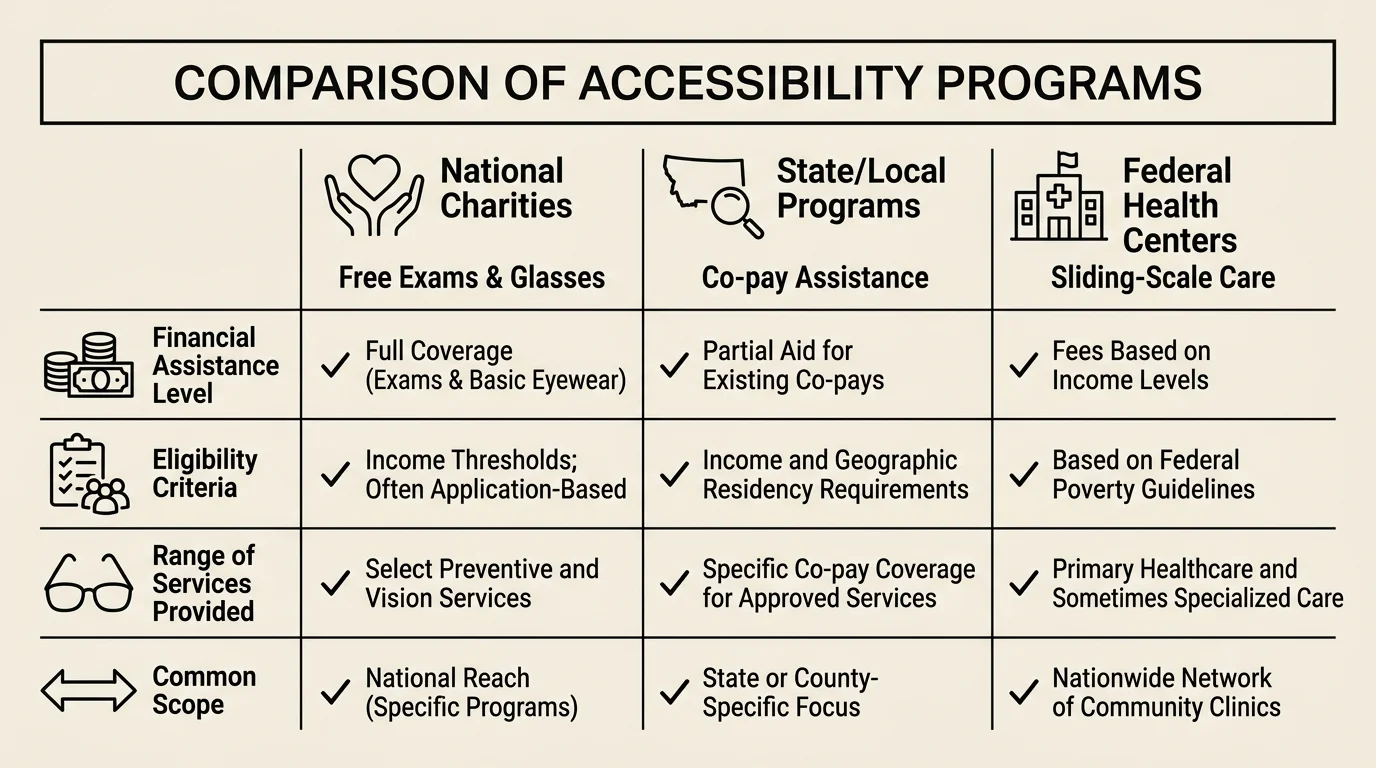
Navigating different vision care programs low income families rely on requires matching your specific medical need with the right provider network. The table below outlines services, income thresholds, and target benefits across the top options.
| Program Name | Primary Services Covered | Income Limit / Eligibility | Key Requirement |
|---|---|---|---|
| EyeCare America | Medical eye exams, glaucoma/macular checks, 1-year care | Age 65+ (or high risk); uninsured or without recent exam | Has not seen an ophthalmologist in 3+ years; no HMO/VA coverage |
| New Eyes for the Needy | Free basic prescription eyeglasses via e-voucher | Household income ≤ 250% Federal Poverty Level | Requires valid prescription (within 24 mos) with pupillary distance |
| VSP Eyes of Hope | Comprehensive exam + complete basic prescription glasses | Household income ≤ 200% Federal Poverty Level | Must apply through community partner; no vision insurance |
| Operation Sight | Free cataract surgery, facility fees, pre/post-op care | Household income ≤ 200%–250% Federal Poverty Level | Diagnosed cataracts impairing daily function; uninsured/underinsured |
| Mission Cataract USA | Free cataract extraction and lens implant surgery | Extreme financial need with debilitating cataracts | No Medicare, Medicaid, or private insurance coverage |
| Lions Clubs International | Exam vouchers, prescription glasses, reading glasses | Varies by local community chapter; low-income focus | Must contact your local municipal or county club chapter |
| HRSA Community Clinics | Vision exams, disease screening, sliding fee scale care | Sliding scale; $0 to nominal fees for income < 100% FPL | Open to all community residents regardless of insurance status |
| Medicaid / State Vision | Routine eye exams, corrective lenses, frame allowances | State Medicaid income thresholds (varies by state) | Must meet state residency and financial eligibility criteria |

How to Prepare Your Application and Gather Documentation
Applying for charitable vision assistance proceeds much faster when you gather your verification documents before starting the paperwork. Most organizations operate with small administrative teams and prioritize complete, well-documented applications.
- Gather Proof of Income: Collect your most recent Social Security Benefit Verification letter (SSA-1099), recent tax return (Form 1040), or pension statement. If you have no reportable income, prepare a written declaration of financial support.
- Obtain Your Current Prescription: Charitable glasses programs like New Eyes require an unexpired prescription dated within the past 24 months. If your prescription expired, schedule a free exam through an FQHC, EyeCare America, or a local community clinic first.
- Request Your Pupillary Distance (PD): The pupillary distance is the exact distance in millimeters between the centers of your pupils. Eye doctors often omit this number from standard prescription slips. Request this measurement directly during your exam or have a trusted family member help you measure it using a millimeter ruler so your voucher glasses fit correctly.
- Secure Government Identification: Have a valid state ID card, driver’s license, or U.S. passport ready to verify your age, residency, and legal status.
- Connect with a Sponsoring Social Worker: Certain initiatives, such as VSP Eyes of Hope, prefer or require applications submitted by an authorized case manager, local charitable clinic worker, or community health advocate. Reach out to your local senior center if you need help submitting the application online.

Avoiding Vision Care Scams and Costly Pitfalls
Unfortunately, dishonest actors frequently target older adults searching for affordable healthcare online. Protecting your personal identity and finances requires vigilance when evaluating free or heavily discounted vision offers.
- Never Pay Upfront Processing Fees for “Free” Grants: Legitimate charitable vision programs—including all programs listed in this guide—never charge application fees, verification charges, or shipping fees for voucher distribution. If a website asks for your credit card number to process a “free senior vision voucher,” immediately close the page.
- Guard Your Medicare and Social Security Numbers: Never share your Medicare number or Social Security number over the telephone with unsolicited callers claiming to represent government vision initiatives. Medicare representatives do not call seniors unexpectedly to offer free eyeglasses or vision equipment.
- Beware of Deceptive “Free Glasses” Retail Schemes: Many commercial online eyewear retailers advertise “free frames for seniors,” only to add expensive lens coating fees, high handling charges, and mandatory subscription add-ons at checkout. Stick with vetted nonprofit voucher programs.
- Distinguish Between Vision Exams and Eyeglass Coverage: Avoid assuming that a free clinical eye exam automatically includes a free pair of glasses. Programs like EyeCare America excel at medical diagnostics and surgical referrals but do not dispense optical frames. Pairing an EyeCare America medical exam with a New Eyes for the Needy optical voucher gives you complete care without unexpected bills.
Frequently Asked Questions
Does Original Medicare pay for routine eye exams and eyeglasses?
No. Original Medicare (Part A and Part B) does not cover routine annual eye exams for vision correction, refraction tests, or standard eyeglasses and contact lenses. However, Medicare Part B does cover medically necessary diagnostic exams for glaucoma, diabetic retinopathy, and wet macular degeneration, as well as one standard pair of glasses or contact lenses following cataract surgery with an intraocular lens implant.
How can I get free cataract surgery if I lack health insurance?
If you lack Medicare, Medicaid, or private insurance and cannot afford cataract surgery, you can apply to nonprofit surgical programs such as Operation Sight (managed by the ASCRS Foundation) or Mission Cataract USA. These organizations match eligible low-income patients with volunteer ophthalmic surgeons who perform the procedure, lens implantation, and follow-up care at no charge.
How do I obtain my pupillary distance measurement for glasses vouchers?
Your pupillary distance (PD) measurement ensures the optical centers of your prescription lenses align properly with your eyes. While eye care professionals frequently leave this measurement off your prescription card, you have the right to request it during your examination. Alternatively, optical staff at community health centers or optical retailers can measure it quickly using a pupilometer, or you can measure it accurately at home using a standard millimeter ruler and a mirror.
Can I apply for multiple vision assistance programs simultaneously?
Yes. Many seniors successfully pair programs that specialize in different areas of vision health. For instance, you can use EyeCare America or an HRSA Community Health Center to receive a comprehensive medical eye evaluation at no cost, and then submit your resulting prescription to New Eyes for the Needy to obtain a free pair of prescription eyeglasses.
How often can I receive free glasses through charitable voucher programs?
Charitable eyeglass voucher initiatives generally allow you to receive assistance once every 12 to 24 months. For example, VSP Eyes of Hope permits eligible individuals to apply for a new voucher every 12 months, provided they continue meeting household income guidelines and lack private vision insurance coverage.
For additional senior resources, visit
Consumer Financial Protection Bureau (CFPB), Administration for Community Living (ACL), Eldercare Locator and AARP.
Disclaimer: The information in this article is for educational purposes only and is not intended to be a substitute for professional financial, legal, or medical advice. Always consult with a qualified expert for advice tailored to your personal situation.









Leave a Reply