

Retirement changes your daily routine, but it also transforms how the IRS treats your income. You can claim specific senior tax breaks that workers under 65 simply cannot touch.
These exclusive rules reduce your taxable income and help protect your hard-earned retirement nest egg. Claiming them ensures you keep more money in your pocket every tax season.
From larger standard deductions to substantial healthcare write-offs, older Americans qualify for distinct tax advantages. Here are eight powerful tax deductions for retirees that younger filers cannot claim.
1. The Larger Standard Deduction for Age 65 and Older
The federal government provides a larger standard deduction once you reach age 65. Under Internal Revenue Code Section 63(f), older adults qualify for extra tax relief simply based on age.
Younger filers must settle for the base standard deduction. However, you can claim this extra standard deduction over 65 regardless of whether you have retired or are still working.
The IRS considers you 65 on the day before your 65th birthday. If your 65th birthday falls on January 1, you qualify for the higher deduction for the prior tax year.
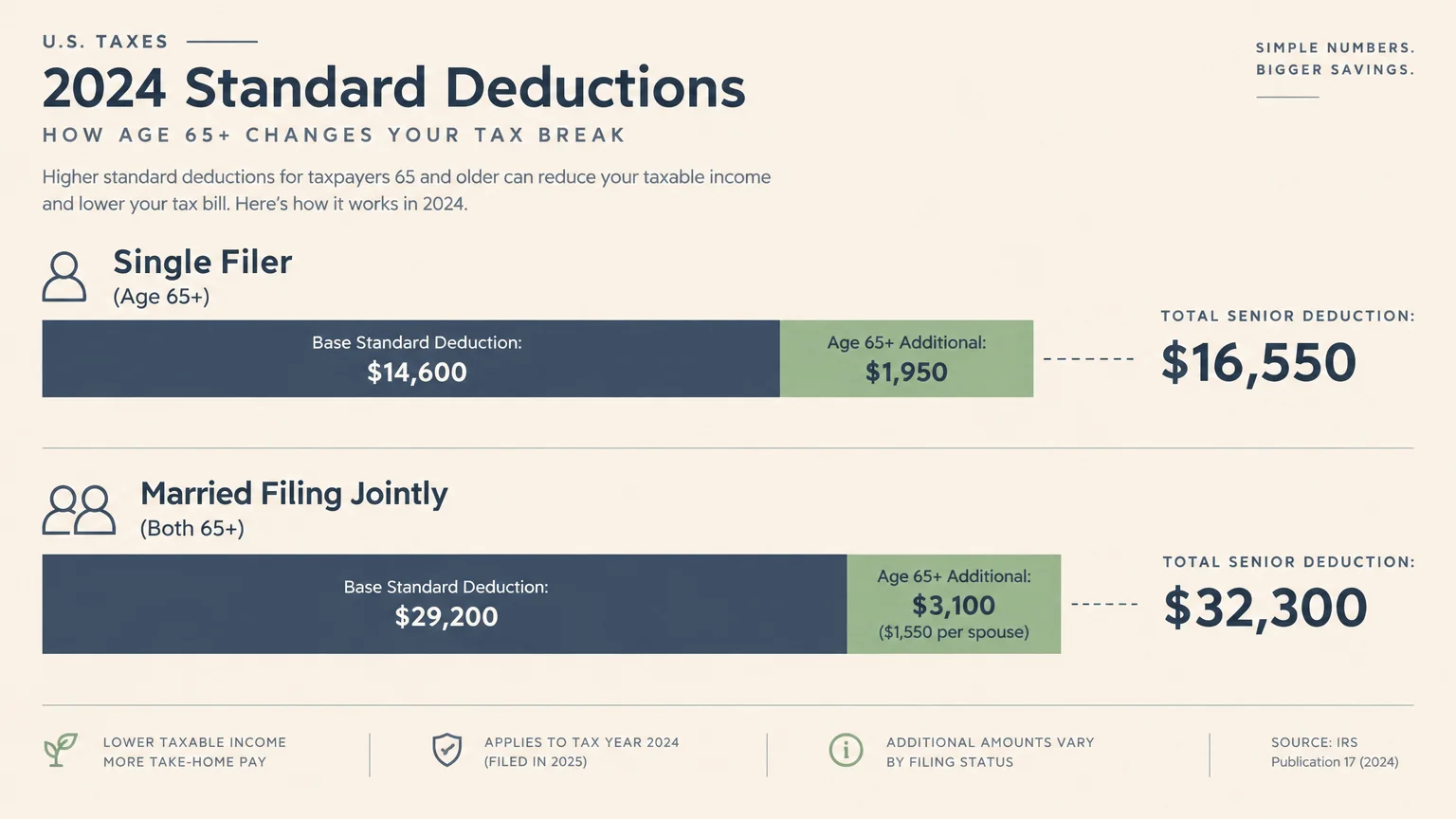
For tax year 2024, single filers aged 65 and older receive an extra $1,950. Married couples filing jointly receive $1,550 per qualifying spouse, or $3,100 if both partners are 65 or older.
In tax year 2025, the additional deduction rises to $2,000 for single filers and $1,600 per spouse. For 2026, it increases further to $2,050 for singles and $1,650 per spouse.
This deduction provides automatic savings without requiring you to track receipts. It directly reduces your taxable income, sheltering more of your Social Security or pension benefits from taxation.
| Tax Year | Filing Status | Base Standard Deduction | Additional Age 65+ Deduction | Total Senior Standard Deduction |
|---|---|---|---|---|
| 2024 | Single | $14,600 | $1,950 | $16,550 |
| 2024 | Married Filing Jointly (Both 65+) | $29,200 | $3,100 | $32,300 |
| 2025 | Single | $15,000 | $2,000 | $17,000 |
| 2025 | Married Filing Jointly (Both 65+) | $30,000 | $3,200 | $33,200 |
| 2026 | Single | $15,450 | $2,050 | $17,500 |
| 2026 | Married Filing Jointly (Both 65+) | $30,900 | $3,300 | $34,200 |
Claiming this adjustment requires checking the appropriate age box on Form 1040. Tax preparation software handles this step automatically when you enter your birthdate.

2. Higher Limits on Long-Term Care Insurance Premiums
Long-term care insurance policies protect your assets against the catastrophic expenses of extended nursing care. Younger policyholders can deduct only a fraction of their premium costs on their taxes.
Under Internal Revenue Code Section 213(d)(10), the IRS allows deductible premium amounts to scale upward dramatically with age. Retirees receive substantial write-offs compared to workers in their thirties or forties.
For example, a 40-year-old filer can deduct only up to $470 in 2024 and $480 in 2025. In contrast, filers aged 61 to 70 can deduct up to $4,710 in 2024 and $4,810 in 2025.
Once you reach age 71, your deductible cap increases to $5,880 for 2024, $6,020 for 2025, and $6,200 for 2026. This tier offers more than twelve times the deduction allowed for young adults.
These eligible premiums count toward your itemized medical expense deduction. You can deduct medical expenses that exceed 7.5% of your Adjusted Gross Income (AGI).
Because retirees often have lower AGI than when they worked full-time, crossing that 7.5% threshold becomes much easier. Both spouses can combine their age-based allowances on a joint return.
| Attained Age Before Close of Tax Year | 2024 Deduction Limit | 2025 Deduction Limit | 2026 Deduction Limit |
|---|---|---|---|
| Age 40 or younger | $470 | $480 | $500 |
| Age 41 to 50 | $880 | $900 | $930 |
| Age 51 to 60 | $1,760 | $1,800 | $1,860 |
| Age 61 to 70 | $4,710 | $4,810 | $4,960 |
| Age 71 and older | $5,880 | $6,020 | $6,200 |
If both spouses have qualified policies and are over age 70, their combined deduction limit exceeds $12,000 in 2025. That creates a powerful tax shield against taxable pension or investment income.

3. Qualified Charitable Distributions (QCDs)
Giving to charity offers generous tax perks, but younger workers must itemize deductions to claim them. Retirees aged 70½ or older possess a far superior tool called a Qualified Charitable Distribution.
A QCD allows you to send money directly from a traditional IRA to an eligible 501(c)(3) charity. The donated amount bypasses your Adjusted Gross Income completely.
Because the distribution never touches your income, it keeps your AGI artificially low. A lower AGI can reduce your Medicare Part B surcharges and lessen taxes on Social Security benefits.
Younger workers cannot execute a QCD under any circumstances. Even retirees in their early sixties must wait until reaching the exact age threshold of 70½.
Under the SECURE 2.0 Act, the IRS indexes annual QCD limits for inflation. You can transfer up to $105,000 in 2024, $108,000 in 2025, and $111,000 in 2026.
Married couples where both spouses maintain traditional IRAs can donate double those caps. In 2025, a couple can direct up to $216,000 tax-free toward qualified charities.
Best of all, your QCD counts toward satisfying your Required Minimum Distribution (RMD) for the year. You meet federal withdrawal mandates without adding a dime to your taxable income.
To execute a QCD properly, instruct your IRA custodian to send the check directly to the charity. If the funds pass through your personal checking account first, you lose the exclusion.
4. Medicare Part B, Part D, and Supplemental Premiums
Younger filers cannot access Medicare unless they have specific long-term disabilities. Once you turn 65, your Medicare coverage unlocks several valuable retirement tax deductions.
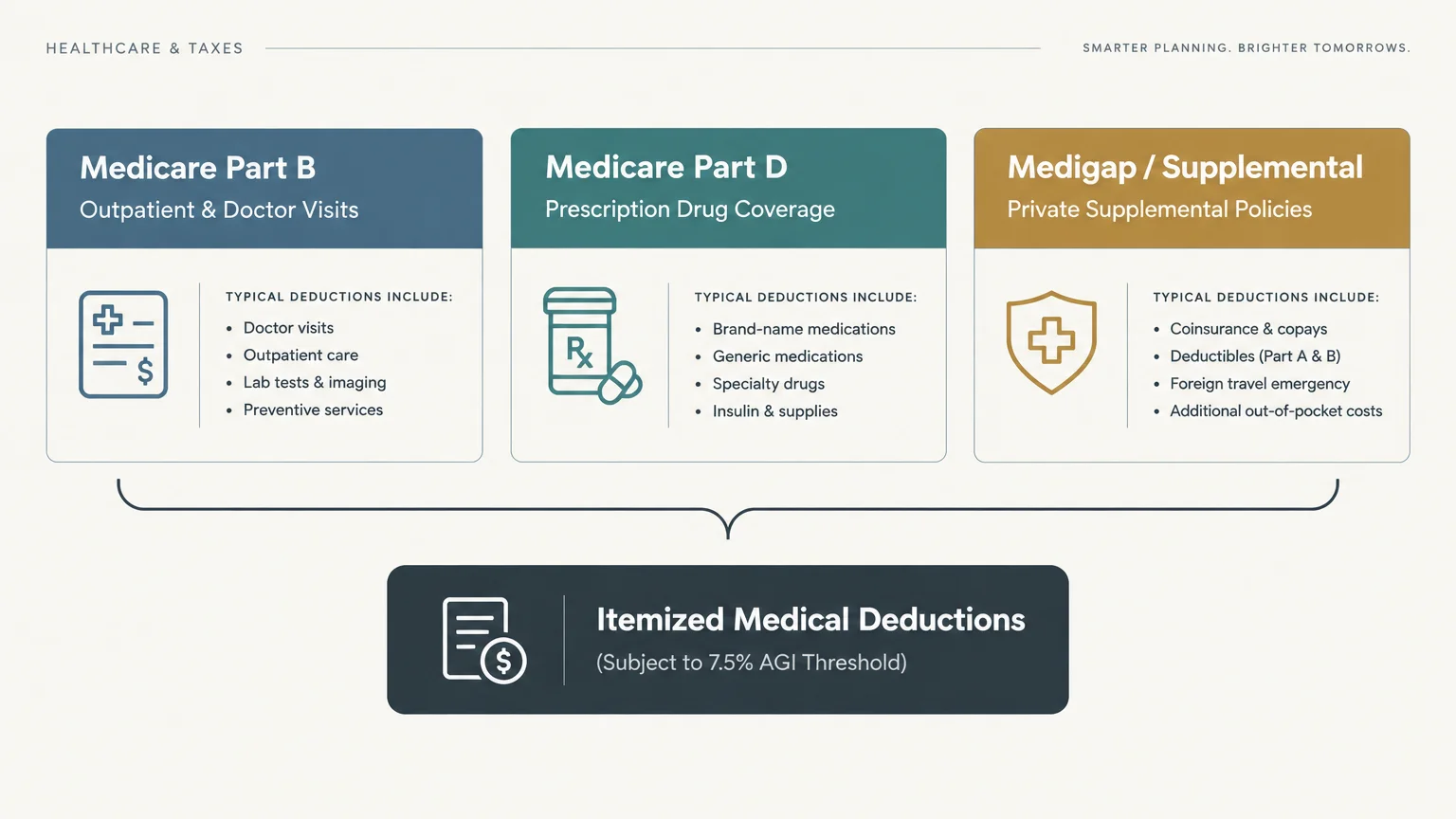
According to Medicare.gov, most beneficiaries pay monthly premiums for outpatient care and prescription drug coverage. You can include these payments when calculating your itemized medical expenses.
Eligible expenses include monthly premiums for Medicare Part B, Part C (Medicare Advantage), Part D prescription plans, and Medigap supplemental policies. If you pay a Part A premium, that qualifies too.
These premiums add up quickly over twelve months, especially if income-related adjustments increase your baseline rates. They provide a reliable baseline to help you exceed the 7.5% AGI medical deduction floor.
Retirees who perform freelance or 1099 consulting work have an even greater tax advantage. Under Internal Revenue Code Section 162(l), self-employed seniors can deduct their Medicare premiums above-the-line.
This above-the-line deduction lowers your AGI directly without requiring you to itemize on Schedule A. You can deduct your full Medicare premiums up to your net self-employment business earnings.
Even modest side consulting income allows you to take advantage of this lucrative carve-out. It effectively transforms your Medicare premiums into a dollar-for-dollar reduction of your business earnings.

5. Assisted Living and Skilled Nursing Facility Care
Long-term residential care costs place immense financial strain on families. Fortunately, the IRS provides extensive medical deductions for senior care that younger taxpayers rarely encounter.
According to IRS Publication 502, if you enter a nursing home primarily for medical care, your entire fee is tax-deductible. This deduction covers skilled nursing, medical services, lodging, and meals.
For assisted living communities, the tax deductibility depends on your physical and cognitive condition. To deduct these expenses, a licensed healthcare professional must certify you as chronically ill.
A chronic illness certification means you cannot perform at least two Activities of Daily Living (ADLs) for 90 days. Eligible ADLs include bathing, dressing, eating, toileting, transferring, and maintaining continence.
Older adults with severe cognitive impairments, such as dementia or Alzheimer’s, also qualify automatically. Research from Eldercare Locator highlights how families can identify certified care facilities that document these qualified expenses.
When certified, personal care and medical service costs become fully deductible medical expenses. Facility administrators often provide residents with an annual breakdown detailing the medical percentage of their total monthly rent.
Because annual assisted living costs often exceed $50,000, this write-off frequently wipes out a retiree’s taxable income. Make sure you retain a copy of the doctor’s care plan in your records.

6. Medically Necessary Home Modifications for Aging in Place
Most seniors prefer living safely in their homes rather than moving into institutional care. The IRS supports aging in place by treating specific home accessibility upgrades as fully deductible medical expenses.
Younger homeowners who remodel kitchens or bathrooms must treat those costs as non-deductible capital home improvements. In contrast, older adults who modify homes for medical limitations can deduct the full expense.
Qualified home accessibility improvements include constructing wheelchair ramps and widening interior or exterior doorways. Installing support grab bars in showers and lowering kitchen cabinets also qualify under federal tax guidelines.
You can also deduct the costs of adding stair lifts, modifying electrical fixtures, and grading pathways outside your home. These modifications must accommodate a physical condition affecting you, your spouse, or your dependent.
Under IRS rules, accessibility modifications intended to accommodate a disability do not require offsetting property value appraisals. The agency recognizes that these specific adjustments rarely increase the commercial market value of a private residence.
Be sure to obtain a written letter of medical necessity from your physician before beginning renovation work. Retain all invoices, contractor receipts, and canceled checks in your permanent tax files.
7. The Tax Credit for the Elderly or Disabled
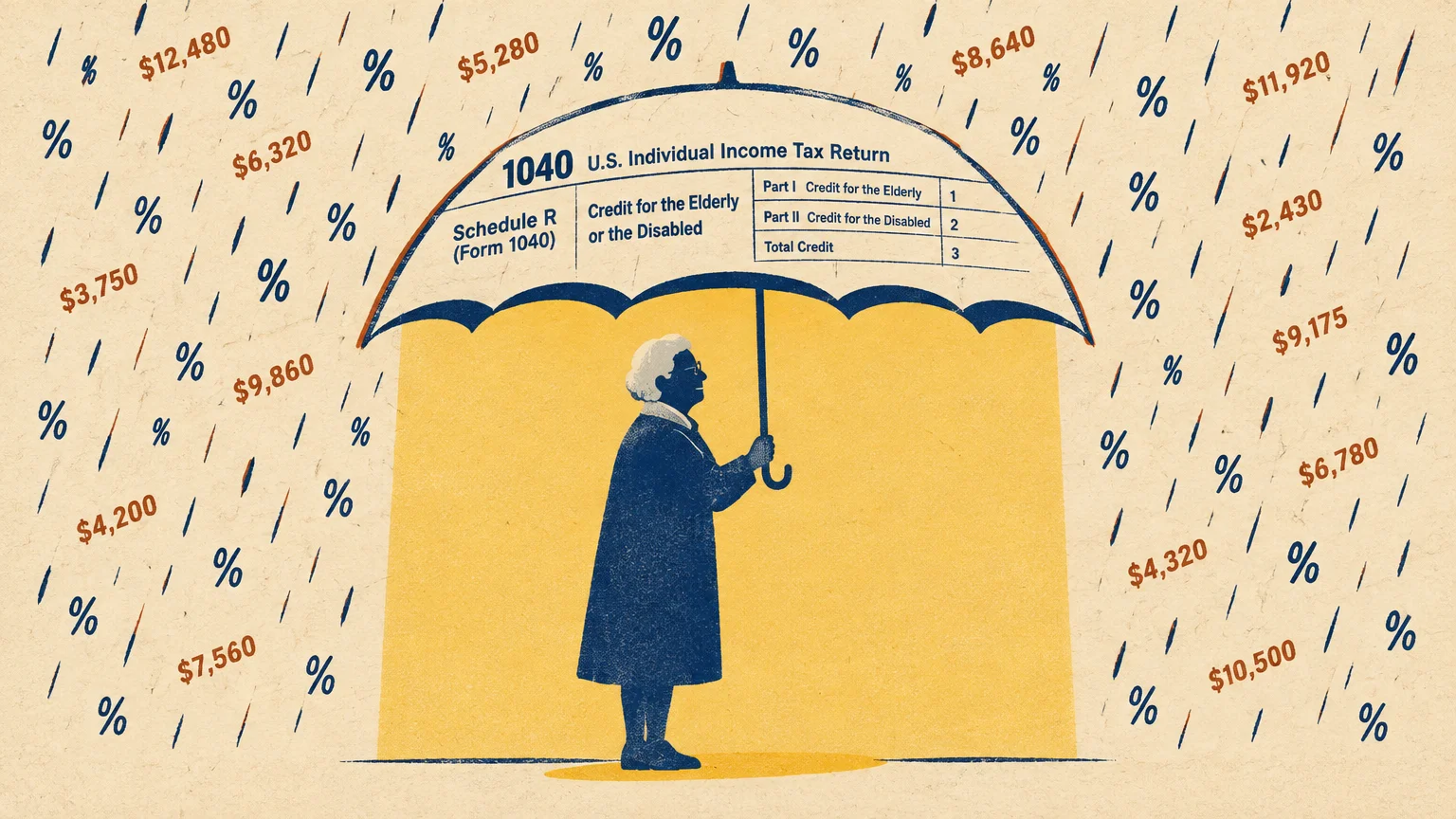
While deductions lower your taxable income, tax credits reduce your tax bill dollar-for-dollar. The Credit for the Elderly or the Disabled provides targeted relief strictly for low-to-moderate-income seniors.
You can claim this federal benefit on Schedule R if you are 65 or older. Filers under age 65 can only qualify if they are permanently and totally disabled.
The maximum credit reaches $750 for single filers and up to $1,125 for married couples filing jointly. This non-refundable credit directly offsets federal income tax liability that you would otherwise owe.
Because the credit aims to assist modest-income retirees, strict income limitations apply. As noted on Benefits.gov, the credit phases out for single filers with an AGI of $17,500 or more.
For married couples filing jointly, the credit phases out when total AGI reaches or exceeds $25,000. It also reduces if you receive substantial nontaxable Social Security or veterans’ pension benefits.
Many qualifying retirees overlook this credit because filing Schedule R requires manual calculations. Free tax assistance programs routinely help older filers capture this neglected benefit on their annual tax returns.

8. Higher Filing Thresholds That Protect Your Fixed Income
One of the most comforting senior tax breaks is the ability to avoid filing a tax return altogether. Retirees enjoy significantly higher gross income filing thresholds than younger working adults.
According to IRS Publication 501, mandatory filing triggers depend directly on your age and marital status. The higher standard deduction for seniors raises the bar on what counts as reportable taxable income.
For tax year 2024, a single filer under age 65 had to file a federal return at $14,600. A single filer aged 65 or older did not have to file until gross income reached $16,550.
For married couples where both spouses are 65 or older, the filing threshold reached $32,300 in 2024. Younger married couples were required to file once their income crossed $29,200.
Social Security benefits generally do not count toward this gross income threshold unless your combined income exceeds federal limits. This rule lets millions of low-income retirees live completely free of annual tax filings.
However, you should still file a return if federal income taxes were withheld from your pension distributions. Filing allows you to claim a complete refund of those withheld funds.

Common Tax Filing Pitfalls and Scams to Avoid
Navigating retirement tax deductions can be complex, and errors often trigger IRS review or penalty notices. Protecting your financial security requires vigilance against both innocent filing mistakes and predatory scams.
One frequent error involves double-counting charitable gifts transferred as Qualified Charitable Distributions. If you exclude an IRA distribution via a QCD, you cannot also claim it as an itemized charitable deduction.
Another common mistake is failing to separate personal care from room and board in assisted living facilities. Unless certified as chronically ill, you may only deduct nursing and therapy fees, not standard rent.
As noted by AARP, seniors often miss out on state-level property tax credits and pension exemptions. Always verify whether your state offers additional deductions on top of federal allowances.
Retirees must also stay alert for seasonal tax scams targeting older Americans. Fraudsters frequently impersonate IRS agents over the phone or via email, threatening arrest over fictitious unpaid taxes.
The Consumer Financial Protection Bureau (CFPB) warns consumers that legitimate tax agencies never demand immediate wire transfers, gift cards, or cryptocurrency payments. If you receive a suspicious call, hang up immediately.
Maintaining organized records throughout the year makes claiming your eligible deductions seamless and audit-proof. Consider this essential step-by-step checklist to keep your senior tax planning on track:
- Track all out-of-pocket medical expenses, including prescription co-pays, dental treatments, and Medicare premiums.
- Request written certification from your assisted living administrator detailing medical and personal care percentages.
- Instruct your IRA custodian to send Qualified Charitable Distributions directly to eligible charities before December 31.
- Obtain a physician’s letter of medical necessity prior to completing accessibility home renovations.
- Compare your total itemized deductions against the enhanced age-65 standard deduction to maximize your savings.
- Review your eligibility for the Credit for the Elderly or Disabled on Schedule R if your income is modest.
Keep physical copies of doctor statements, receipts, and 1099 distribution forms in a dedicated folder for seven years. Clean documentation gives you confidence and protects your retirement savings against unexpected tax disputes.
Frequently Asked Questions
Can I take the extra standard deduction if I turn 65 on January 1?
Yes, you can. Under IRS regulations, you are legally considered to have attained age 65 on the day before your actual birthday.
If you turn 65 on January 1, 2025, the IRS considers you 65 for the entire 2024 tax year. You can claim the higher deduction on that year’s return.
Are Medicare Part B premiums deducted automatically, and are they deductible?
Most retirees have Part B premiums withheld directly from their monthly Social Security benefit checks. While not taxable income, those withheld premiums remain eligible medical deductions on Schedule A.
Check Box 3 on your Form SSA-1099 to see the total Medicare premiums deducted from your benefits. You can add this figure to your other out-of-pocket healthcare expenses.
Can a younger spouse qualify for the extra standard deduction on a joint return?
No, the age-based additional standard deduction applies strictly on an individual basis. If you are 66 but your spouse is 62, only your portion receives the additional allowance.
On your joint return, you will receive the standard married deduction plus one age-based addition. Once your spouse reaches 65, you can claim the full double bonus.
What documentation do I need to deduct assisted living expenses?
You need a formal written plan of care signed by a licensed healthcare professional certifying your chronic illness. This document must state that you cannot perform at least two daily living activities independently.
You also need an itemized financial statement from the facility showing medical care charges versus basic lodging. Keep these records organized with your annual tax return files.
How does a Qualified Charitable Distribution affect my Medicare IRMAA surcharges?
A QCD reduces your Adjusted Gross Income because the distributed amount bypasses your tax return entirely. Because Medicare uses modified AGI to calculate Income-Related Monthly Adjustment Amounts (IRMAA), QCDs can prevent costly surcharges.
By donating through a QCD rather than a taxable IRA withdrawal, you keep your reported income below the IRMAA brackets. This smart strategy protects you against sharp Part B and Part D premium hikes.
For additional senior resources, visit
Social Security Administration (SSA), Consumer Financial Protection Bureau (CFPB), Administration for Community Living (ACL), Eldercare Locator and AARP.
Disclaimer: The information in this article is for educational purposes only and is not intended to be a substitute for professional financial, legal, or medical advice. Always consult with a qualified expert for advice tailored to your personal situation.









Leave a Reply