

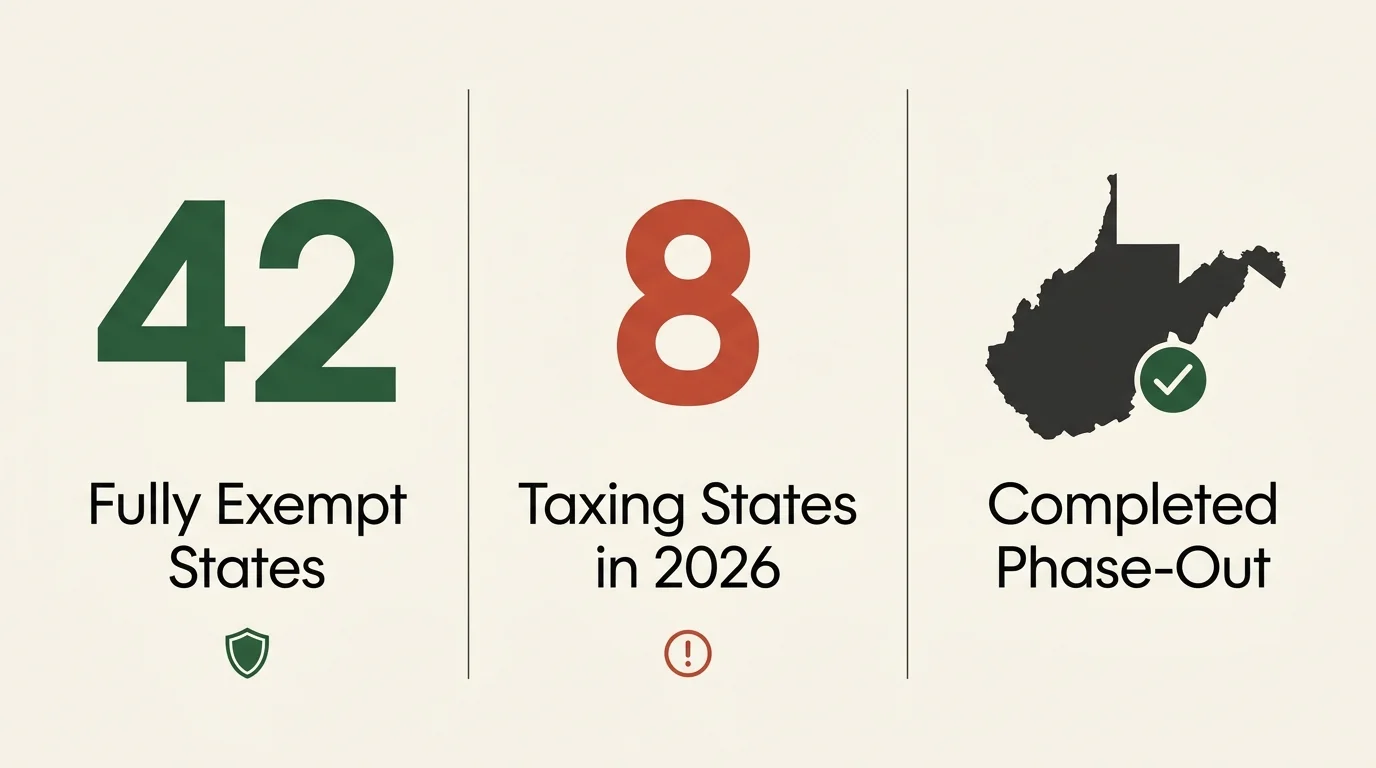
Many retirees assume that reaching retirement age means their Social Security benefits arrive completely tax-free; however, state income taxes can quietly drain hundreds or even thousands of dollars from your monthly budget. While federal taxes catch most people’s attention, local rules regarding state taxes on Social Security vary dramatically depending on where you live. For the 2026 tax year, only eight states continue to tax your hard-earned benefits, while West Virginia has officially completed its multi-year phase-out to join forty-two other states in offering full state exemptions. Understanding how your state handles retirement tax planning helps you keep more money in your pocket during your golden years.
Understanding the Basics of Social Security Taxation
Navigating taxes in retirement can feel overwhelming, especially when you expect your benefits to remain entirely yours. To understand how state taxes impact your monthly budget, you must first grasp how tax authorities view Social Security income. The government does not automatically exempt benefit payments from taxation; instead, specific income formulas dictate how much of your benefit remains subject to tax.
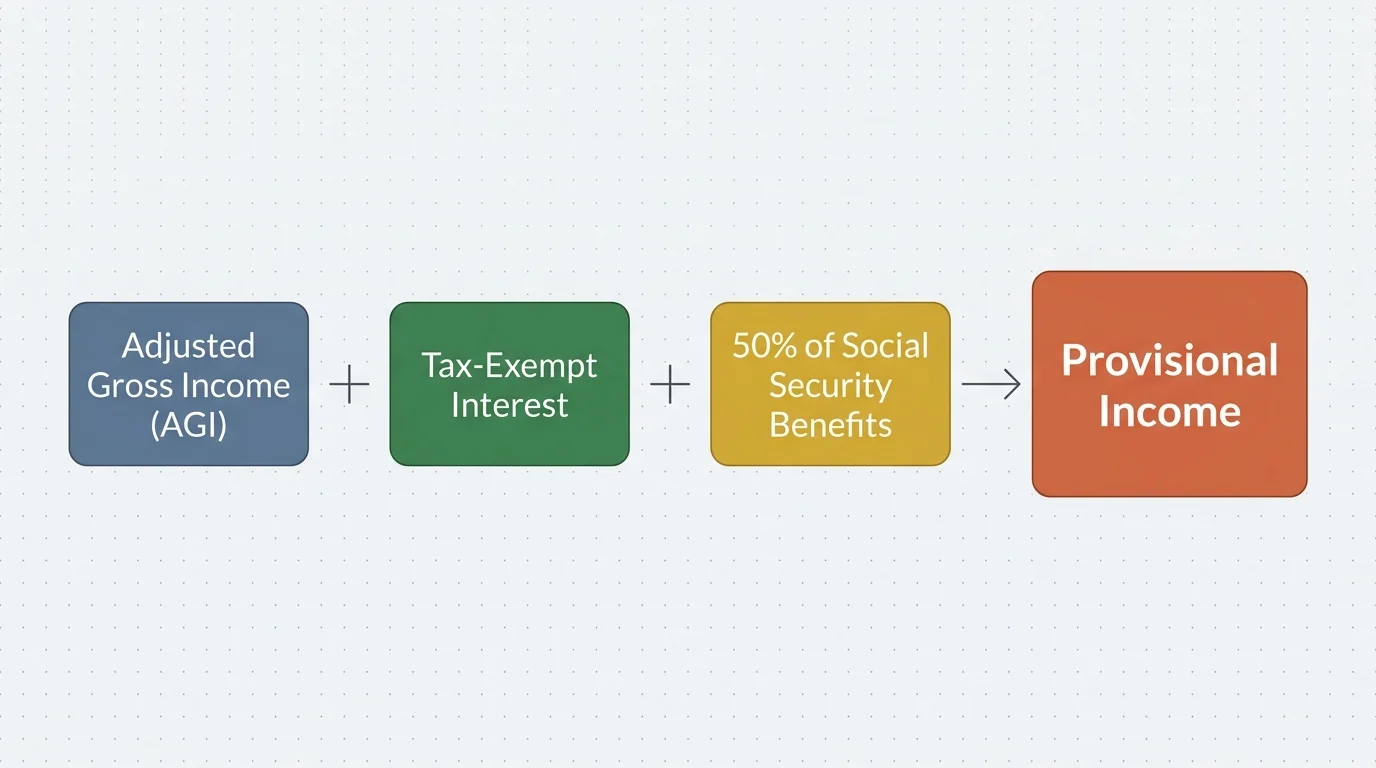
At the federal level, taxation depends on a figure known as provisional income or combined income. The IRS calculates this by adding your Adjusted Gross Income (AGI), any tax-exempt interest you earn, and exactly 50% of your total Social Security benefit for the year. According to the Social Security Administration (SSA), millions of beneficiaries pay income taxes on their benefits because these federal thresholds have remained static for decades.
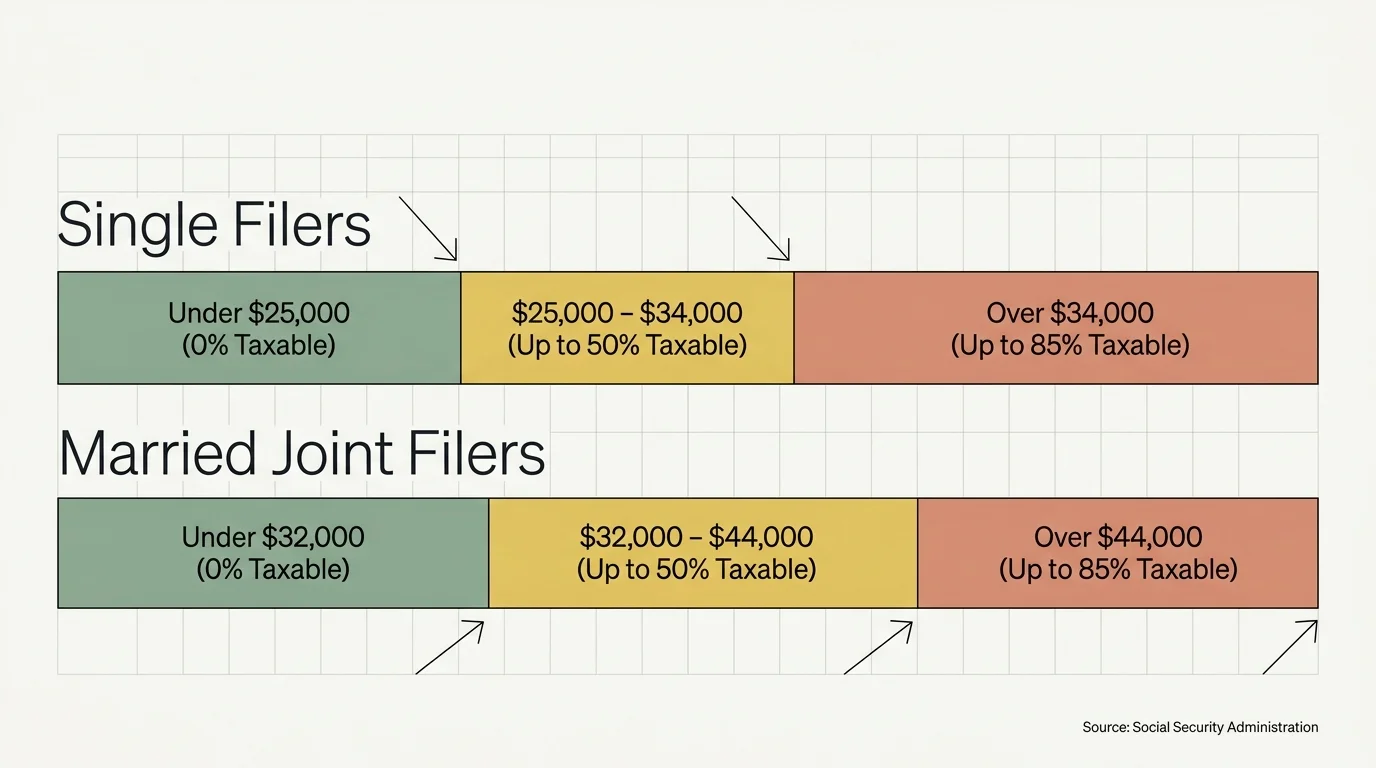
The federal brackets break down into two main tiers based on filing status:
- Single Filers: Pay income tax on up to 50% of benefits if provisional income falls between $25,000 and $34,000. Up to 85% of benefits become taxable if provisional income exceeds $34,000.
- Married Couples Filing Jointly: Pay income tax on up to 50% of benefits if combined provisional income falls between $32,000 and $44,000. Up to 85% becomes taxable if combined income exceeds $44,000.
Because federal law established these income limits in 1983 and 1993 without adjusting them for inflation, routine cost-of-living adjustments (COLAs) push more retirees into taxable territory every year. Once federal taxable income increases, state income calculations often follow suit unless your state provides explicit statutory protections.
The 8 States That Tax Social Security Benefits in 2026
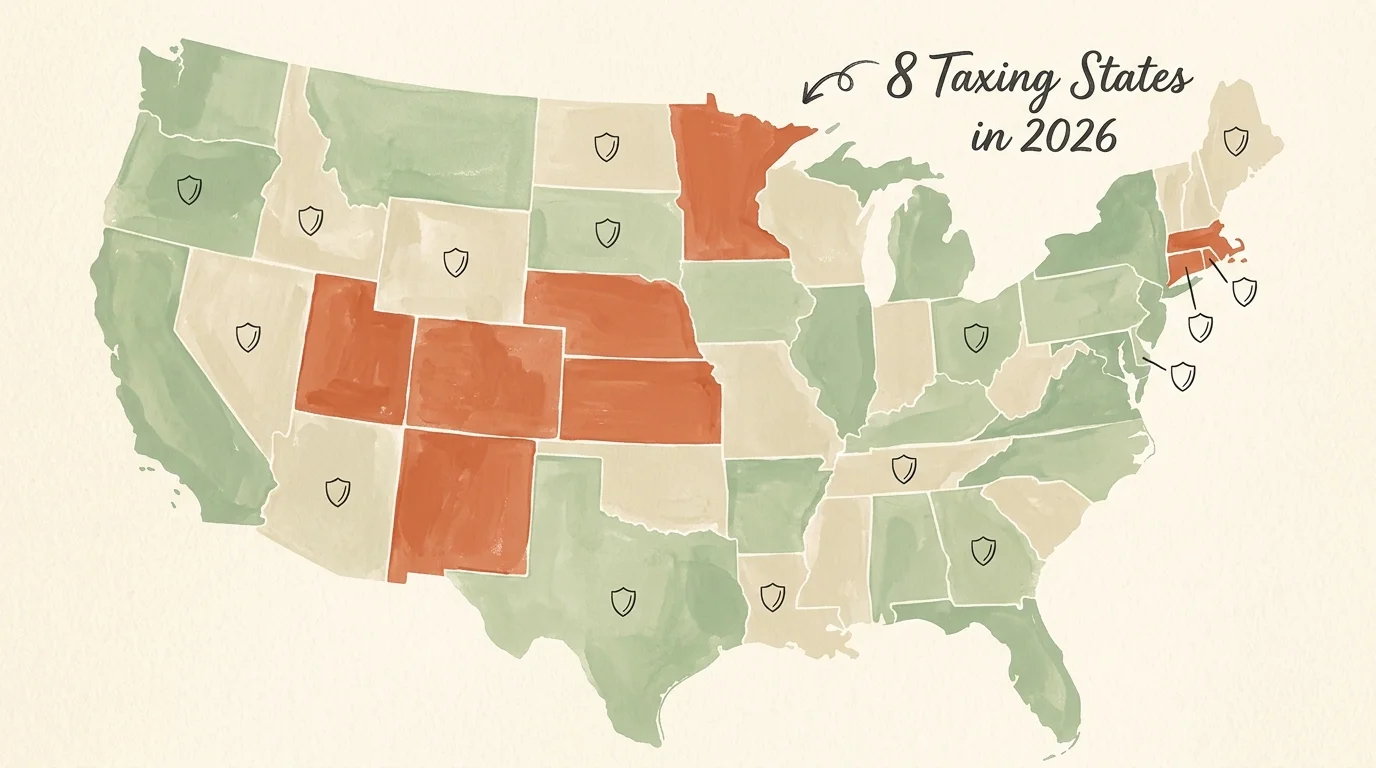
State laws evolve constantly, creating a shifting map for retirees. For the 2026 tax year, the vast majority of the country exempts Social Security payments entirely. West Virginia recently finalized its scheduled tax reform, completing its multi-year phase-out so that benefits become 100% exempt from state income tax starting in 2026. This brings the total number of states that tax Social Security benefits down to just eight.
If you live in one of the following eight states, local tax authorities may tax a portion of your Social Security check depending on your total income level and age:
- Colorado: Applies state tax rules, but offers significant age-based deduction allowances.
- Connecticut: Taxes benefits for higher-earning households while exempting low- to middle-income seniors.
- Minnesota: Uses state-specific subtractions that mirror or modify federal combined income rules.
- Montana: Taxes benefits using state calculation formulas with tiered deduction thresholds.
- New Mexico: Includes benefits in state taxable income while offering generous personal income exemptions.
- Rhode Island: Taxes benefits only for retirees whose overall income exceeds specified statutory caps.
- Utah: Applies a state income tax rate but offers a nonrefundable retirement tax credit to offset costs.
- Vermont: Taxes benefits for upper-income filers while providing full exemptions for lower income brackets.
Living in one of these eight states does not automatically guarantee you will pay a dime in state taxes on Social Security. Most of these jurisdictions build generous safeguards directly into their tax codes to protect average retirement budgets.
How State Exemptions and Income Thresholds Protect Your Money
Even within the eight states that collect Social Security tax by state rules, state legislators design exemptions so that most low- and moderate-income seniors pay nothing. Understanding your state’s exact income boundaries prevents unnecessary financial anxiety and allows you to structure withdrawals wisely.
For example, Colorado offers robust protection based on age. Taxpayers age 65 and older can fully deduct all Social Security benefits included in their federal taxable income when completing their Colorado state return. This rule essentially eliminates state Social Security taxes for older residents regardless of their income level.
Connecticut relies on explicit income limits rather than age alone. Single filers with an Adjusted Gross Income under $75,000 and married couples filing jointly with an AGI under $100,000 pay zero state income tax on their Social Security checks. If your income falls below these amounts, Connecticut grants a 100% exemption on those benefits.
The table below summarizes how key exemptive rules apply across several taxing states for the 2026 tax year:
| State | Primary Exemption Threshold / Rule | Who Qualifies for 0% State Tax on Benefits |
|---|---|---|
| Colorado | Full deduction for taxpayers age 65+ | All residents age 65 or older |
| Connecticut | AGI under $75,000 (Single) / $100,000 (Joint) | Single filers under $75k; Joint filers under $100k |
| Minnesota | State subtraction caps tied to income phase-outs | Lower- and middle-income retirees below state cap |
| Rhode Island | AGI thresholds based on Full Retirement Age | Seniors at FRA meeting state income limits |
| Vermont | AGI phase-outs beginning at designated brackets | Single filers under $50k; Joint filers under $65k (approx.) |
These exemptions demonstrate why examining local state tax codes remains an essential component of comprehensive retirement tax planning. Missing a state threshold by just a few hundred dollars could trigger unnecessary tax liabilities on your state return.
The Hidden Cost of Provisional Income and Combined Income
To avoid tax surprises, you must monitor how separate income streams interact with one another. Withdrawals from traditional IRAs, 401(k) plans, pensions, or part-time jobs add directly to your Adjusted Gross Income. When your AGI rises, your provisional income rises alongside it, potentially pushing your Social Security benefits into higher federal and state tax brackets.
Consider a practical example. Imagine you are a single retiree receiving $22,000 annually from Social Security. To cover home repairs, you withdraw $18,000 from a traditional IRA and collect $1,000 in interest from municipal bonds. State and federal tax rules calculate your provisional income as follows:
- Adjusted Gross Income (IRA withdrawal): $18,000
- Tax-Exempt Interest (Municipal bonds): $1,000
- 50% of Social Security Benefits ($22,000 ÷ 2): $11,000
- Total Provisional Income: $30,000
Because $30,000 exceeds the $25,000 federal provisional income threshold for single filers, up to 50% of your Social Security benefits become subject to federal income tax. That added taxable amount elevates your overall federal AGI, which then flows directly onto your state tax return. If you live in a state like Montana or Minnesota, this ripple effect can create an unexpected state tax bill.
Seniors should also take note of recent federal tax legislation. Under current provisions (including the One Big Beautiful Bill Act), taxpayers age 65 and older can claim an additional senior tax deduction of up to $6,000 through 2028. This senior bonus deduction begins phasing out for single filers with an AGI above $75,000 and joint filers above $150,000. Taking full advantage of this deduction helps offset taxable income on your federal return, providing indirect relief on your state income tax filing as well.

Common Retirement Tax Planning Mistakes to Avoid
Retirees often fall into predictable tax traps simply because retirement cash flow operates differently than pre-retirement salary income. Recognizing these mistakes early allows you to safeguard your fixed income.
One common mistake involves withdrawing large lump sums from traditional tax-deferred accounts without calculating the tax impact. Taking a $20,000 chunk out of a traditional IRA to buy a car might seem harmless, but that single transaction can artificially spike your AGI, causing your Social Security check to lose its tax-exempt status for that year.
Another widespread misconception surrounds municipal bond interest. While municipal bond interest avoids federal income tax, tax codes explicitly require you to add tax-exempt interest back into your provisional income formula when determining Social Security taxability. Assuming tax-exempt income is completely invisible during tax season can leave you exposed to unexpected liabilities.
A third error is failing to coordinate state and federal tax withholdings. If you discover that your benefits are taxable, failing to request voluntary tax withholding leaves you open to underpayment penalties. According to guidance from the Consumer Financial Protection Bureau (CFPB), maintaining clear oversight over your recurring financial obligations prevents unexpected tax bills from depleting your emergency savings.
Finally, many retirees assume moving to a state with no income tax automatically saves them money. Nine states—Alaska, Florida, Nevada, New Hampshire, South Dakota, Tennessee, Texas, Washington, and Wyoming—charge zero general individual income tax. However, these states often recoup revenue through higher sales taxes, elevated local property taxes, or special vehicle fees. Always evaluate your total cost of living rather than focusing solely on income tax rates.

Actionable Strategies to Reduce Taxes on Your Social Security Check
You can employ several practical, legal strategies to reduce taxes on Social Security benefits and preserve your monthly income. Managing your income sources with foresight allows you to stay below state and federal tax triggers.
Consider the following concrete steps to minimize your tax exposure:
- Execute Roth IRA Conversions Early: Converting traditional IRA funds into a Roth IRA before claiming Social Security creates a tax-free withdrawal bucket. Because qualified Roth distributions do not count toward AGI or provisional income, they generate cash flow without making your Social Security benefits taxable.
- Utilize Qualified Charitable Distributions (QCDs): If you are age 70½ or older, you can transfer up to $105,000 per year directly from a traditional IRA to an eligible charity. A QCD satisfies your Required Minimum Distribution (RMD) requirements without increasing your AGI or provisional income.
- Manage Withdrawal Sequences: Draw funds strategically across taxable brokerage accounts, tax-deferred IRAs, and tax-free Roth accounts. Balancing your withdrawals keeps your overall provisional income below critical threshold lines.
- Monitor State Income Cliffs: If you live in a state like Connecticut or Vermont with strict income phase-outs, keep your AGI just under the statutory exemption threshold. Delaying an optional taxable withdrawal until January can save thousands in state taxes for the current year.
- Submit Form W-4V for Voluntary Withholding: If you owe state or federal taxes on your benefits, complete IRS Form W-4V (Voluntary Withholding Request) and submit it to the Social Security Administration. Electing to withhold 7%, 8%, 10%, or 12% spreads your tax obligations evenly across the year.
According to educational insights from AARP, structured withdrawal planning remains one of the most effective tools seniors have to control income taxation and extend the lifespan of their retirement savings.
State-by-State Breakdown: Tax Treatment Across the Country
To help you see where your state stands, the following list outlines tax treatment rules across all 50 states and Washington, D.C., for the 2026 tax year. Understanding your local tax environment ensures you do not pay more than required.
Category 1: States with No Individual Income Tax (9 States)
These states do not assess any state income tax, meaning your Social Security benefits remain 100% tax-free at the state level: Alaska, Florida, Nevada, New Hampshire, South Dakota, Tennessee, Texas, Washington, and Wyoming.
Category 2: States with Income Tax That Exempt Social Security (33 States + Washington, D.C.)
These jurisdictions levy a state income tax on general earnings but explicitly exempt Social Security benefits from state taxation: Alabama, Arizona, Arkansas, California, Delaware, Georgia, Hawaii, Idaho, Illinois, Indiana, Iowa, Kansas, Kentucky, Louisiana, Maine, Maryland, Massachusetts, Michigan, Mississippi, Missouri, Nebraska, New Jersey, New York, North Carolina, North Dakota, Ohio, Oklahoma, Oregon, Pennsylvania, South Carolina, Virginia, West Virginia, and Wisconsin, along with Washington, D.C.
Category 3: States That May Tax Social Security Benefits (8 States)
These states levy income tax on benefits for specific higher-income filers, though most offer substantial income or age exemptions: Colorado, Connecticut, Minnesota, Montana, New Mexico, Rhode Island, Utah, and Vermont.
Frequently Asked Questions
How do I know if my state taxes my Social Security benefits?
Check your state department of revenue guidelines or review the list of taxing states provided in this article. Only eight states tax Social Security benefits in 2026: Colorado, Connecticut, Minnesota, Montana, New Mexico, Rhode Island, Utah, and Vermont. If you live in any of the other 42 states or Washington, D.C., your state charges zero income tax on your benefits.
Did West Virginia stop taxing Social Security benefits?
Yes. West Virginia passed tax legislation that gradually phased out state income taxes on Social Security payments. The phase-out reached 100% completion for the 2026 tax year, making Social Security benefits completely exempt from West Virginia state income tax moving forward.
How does the federal senior bonus tax deduction affect my state taxes?
The federal senior bonus tax deduction allows taxpayers age 65 and older to claim an additional deduction of up to $6,000 through 2028. Because many state tax returns calculate state taxable income starting from your federal Adjusted Gross Income or taxable income baseline, reducing your federal taxable income often reduces your state taxable income as well.
Can I have state income taxes withheld directly from my Social Security check?
The Social Security Administration allows voluntary federal tax withholding using Form W-4V; however, the SSA does not automatically withhold state income taxes for all states. Depending on where you live, you may need to make quarterly estimated tax payments directly to your state department of revenue or set up state withholding through private pension or IRA payouts.
Does municipal bond interest count when calculating taxes on Social Security?
Yes. Even though municipal bond interest is exempt from federal income tax, federal rules require you to include tax-exempt interest in your provisional income calculation. Higher provisional income can cause a larger portion of your Social Security benefits to become taxable at the federal level, which may subsequently increase your state tax obligation.
For additional senior resources, visit
Benefits.gov, National Institute on Aging (NIA), Centers for Disease Control and Prevention (CDC) and Medicare.gov.
Disclaimer: The information in this article is for educational purposes only and is not intended to be a substitute for professional financial, legal, or medical advice. Always consult with a qualified expert for advice tailored to your personal situation.









Leave a Reply