
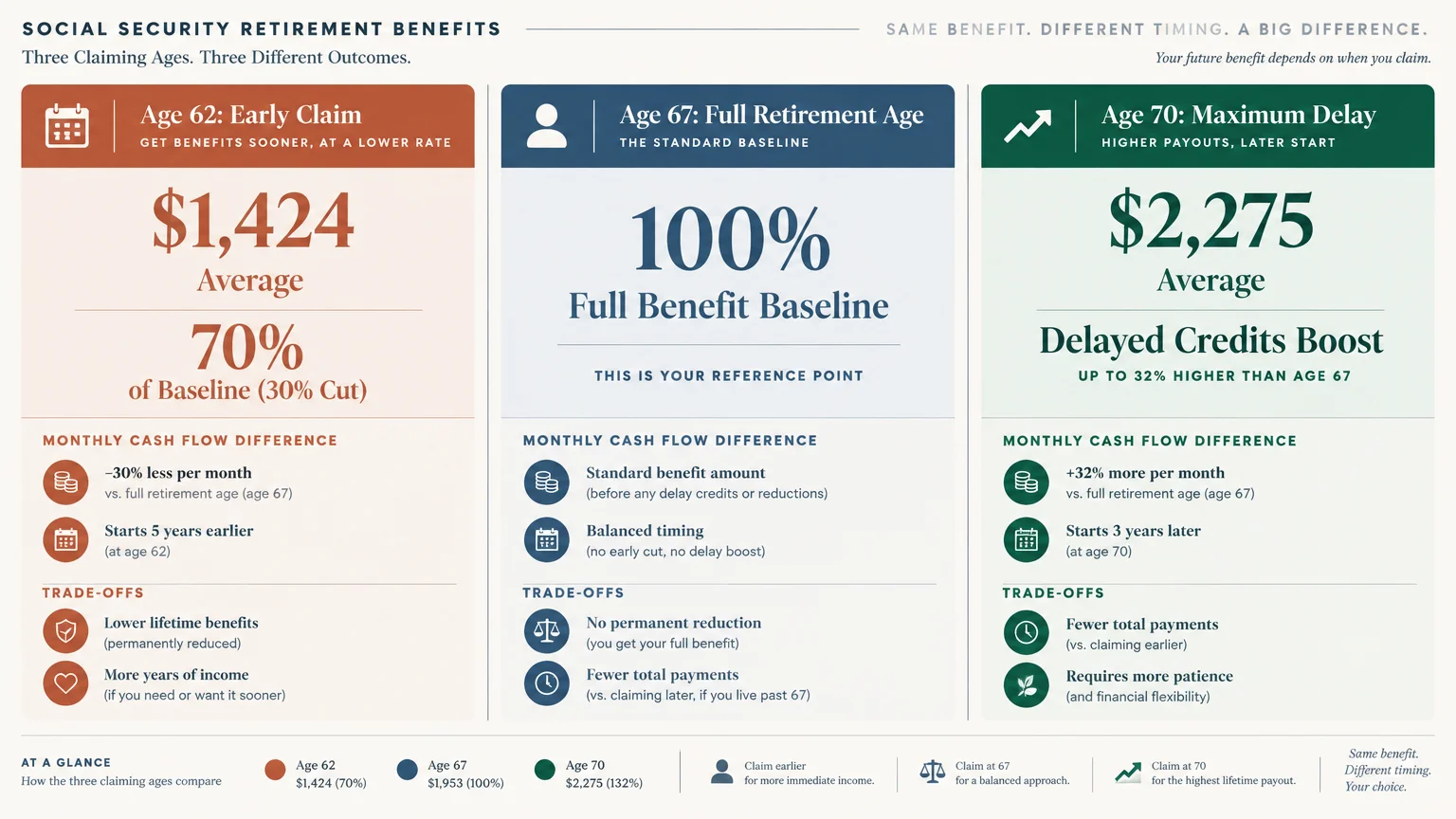
Comparing Benefits Across Claiming Ages
Evaluating how much Social Security pays requires comparing both monthly checks and lifetime payouts. The gap between age 62 and age 70 is substantial.
A retiree collecting $1,424 at 62 receives $851 less each month than someone collecting $2,275 at 70. Over a full calendar year, that difference equals more than $10,200.
| Claiming Age | Benefit Status | Average Monthly Check (2026) | Maximum Monthly Check (2026) | Percent of Full Benefit |
|---|---|---|---|---|
| Age 62 | Earliest Eligibility | $1,424 | $2,969 | 70% |
| Age 67 | Full Retirement Age | $2,016 | $4,152 – $4,207 | 100% |
| Age 70 | Maximum Delayed Credits | $2,275 (Overall) / $3,030+ (Delayed) | $5,181 – $5,251 | 124% |
The break-even age represents the moment where delayed filing produces more cumulative lifetime cash than claiming early. For most retirees, this cross-over occurs between ages 78 and 82.
If you live past age 80, waiting until 67 or 70 generates greater total lifetime income. If you face serious health concerns, claiming earlier often delivers greater total cash.

Working While Receiving Benefits: Earnings Test Rules
Many older adults continue working part-time or full-time after filing for retirement benefits. If you claim before Full Retirement Age, the government limits your earned income.
The Retirement Earnings Test applies strict thresholds until you reach age 67. In 2026, the baseline earnings limit sits at $24,480 per year.
If you earn more than $24,480, the agency withholds $1 in benefits for every $2 earned above the cap. These rules apply to wages and net self-employment earnings.
During the calendar year you reach 67, the restriction eases significantly. The agency deducts $1 for every $3 earned above $65,160 before your birthday month.
Once you reach your 67th birthday, the earnings test disappears entirely. You can earn an unlimited income without losing a single dollar of your monthly check.
Withheld money is not permanently forfeited. When you turn 67, the agency recalculates your monthly benefit upward to credit back the withheld amounts over time.









Leave a Reply