
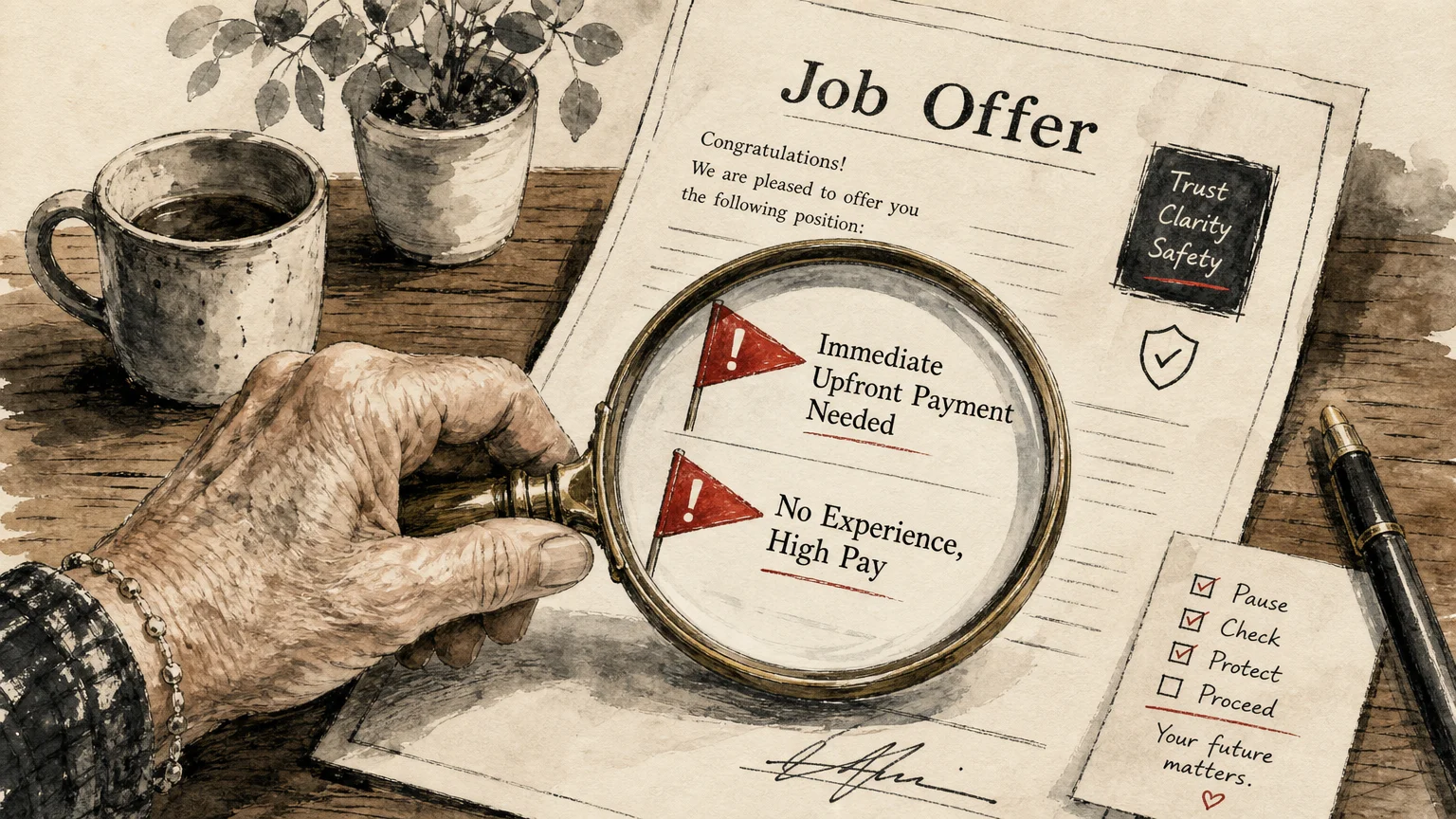
Red Flags and Job Scams to Avoid
Unfortunately, eager job seekers often attract fraudsters. Because older adults frequently look for part-time, flexible work, scammers specifically design fake job listings to steal money and identities.
As noted by experts at AARP, scammers often target older job seekers with fraudulent offers that require upfront payments or sensitive personal information. You should never have to pay your own money to secure a job. If a “hiring manager” asks you to purchase your own training materials, pay for a background check via gift cards, or shell out money for a starter kit, walk away immediately.
Another common trap is the check-cashing scam. In this scenario, a fake employer sends you a large check, asks you to deposit it, and instructs you to wire a portion of the funds to a “supplier” for your home office setup. A few days later, the original check bounces, and your bank holds you responsible for the wired money.
Always verify an employer’s credibility. Stick to well-known local businesses, established volunteer organizations, or reputable job boards. If an offer promises exorbitant pay for very little work—especially data entry or envelope-stuffing from home—it is almost certainly a scam.
Frequently Asked Questions
Will a part-time job affect my Medicare premiums?
It is possible, though it requires a significant jump in income. Medicare Part B and Part D premiums are based on your modified adjusted gross income (MAGI) from two years prior. If your part-time wages push your income above the threshold for the Income-Related Monthly Adjustment Amount (IRMAA), you will pay higher premiums. However, most modest, part-time wages do not trigger this surcharge unless you already have substantial income from pensions or investments.
How many hours should a retiree aim to work each week?
Most experts recommend starting slowly—around 10 to 15 hours a week. This provides enough structure to keep you socially engaged but leaves plenty of free time for travel, hobbies, and family. You can always increase your hours later if you find the work energizing and physically manageable.
Do I need to update my resume if I haven’t applied for a job in decades?
Yes, but keep it brief and relevant. Focus on the skills that apply directly to the part-time role you want. You do not need to list every job you have held since the 1970s. To prevent age bias, you can omit the graduation dates from your education section and only list your most recent 10 to 15 years of work history. Emphasize your reliability, communication skills, and willingness to learn.
What if I want to socialize but do not need the extra money?
If you are financially comfortable but crave community interaction, volunteering is an exceptional alternative. Hospitals, animal shelters, food banks, and national parks rely on dedicated senior volunteers. Volunteering provides the exact same social and mental health benefits as a paid job, often with even greater scheduling flexibility.
Are there work-from-home jobs that still offer social interaction?
Yes. If mobility or transportation is an issue, consider online tutoring or virtual customer service roles. While you are physically at home, you spend your shift talking with clients or students via video calls and phone lines. It provides meaningful daily conversation without the physical strain of commuting or standing.
For additional senior resources, visit
Benefits.gov,
National Institute on Aging (NIA),
Centers for Disease Control and Prevention (CDC) and
Medicare.gov.
Disclaimer: The information in this article is for educational purposes only and is not intended to be a substitute for professional financial, legal, or medical advice. Always consult with a qualified expert for advice tailored to your personal situation.









I am interested, although, I do have bad knees and back problem, that may limit, the extent of my physical activity.
However, I am not limiting myself. Even though, I am concentrating, currently, on ‘Work from home’ – Remote jobs search.
I am interested in taking a part time job.
I am looking for a remote position that allows me to work from home. I have a very bad back and can hardly walk. I can do customer service. I can work about 20 hours a week.
I am interested in a part time remote position if you can assist with this option.
I am interested, but don’t know who to contact. I am a retired veteran, but I also am a right foot amputee, since Febbruary 2025. I haven’t yet gotten my car modified by the VA. Right now, I am mostly housebound. I have worked almost 39 of my 43 years of working in the medical field. I am 69 and single, never married
I’m interested a part time job.
I’m RN, retired 12/01/2025.
Yes I am interested.
Im interested in 20 hours a week or part time hours .
looking for at home part time position, healthy/
I’m interested in part time clerical positions. 20 hours per week.
like to know about work from home
I need at home Radiology/Medical Transcription.
I also do part time Print/Commercial Modeling.
Thank you
yes I am interested in a part time job something like a event usher or a ticket taker at event or football game I would love to have something like this if you could help me I would be very thankful
I able to work for 25 hrs in Customer Service and Retail service i had knee pain but i able to manage the duties
Yes would like to work but I have bad knee pain problems but still I think can work in labor or clerical works close to my home.
Diddo.
Part time job please in Spokane Valley, WA. Need to keep my mind busy & something to look forward to. Remote or sit & stand option job would be ideal, since Im still gaining strength back after hip replacement & my low back makes long walking or static standing miserable. Thank You!
I am interested in a part time job in North Dallas area. Need something stimulating and interactive.
Love to qork still part time…
Very interested in any position with costco in woodinville (very close to home) either part time or full time. Worked for Boeing for 36 years as an industrial Engineer. I would appreciate a position with Costco in order to subsidize my personal and family needs. Thank you
Applied to Costco for a twenty hour wee but did not take it cause at CostCo you Re required to work 5 days a week,.which means I would be working 4 hours per day which hardly makes it worthwile. Seniors need to to picket their stores t demand a ,hangs in this polocy. Can you help?