The Dollars and Cents: What Claiming at 62, 67, or 70 Really Pays
Your claiming age remains the single most significant factor determining the size of your monthly payment. Even small timing adjustments can alter your lifetime income by tens of thousands of dollars.
Under long-standing statutory guidelines, your standard benefit age reached its final scheduled increase in November 2026. For anyone born in 1960 or later, your standard retirement age is now officially 67.
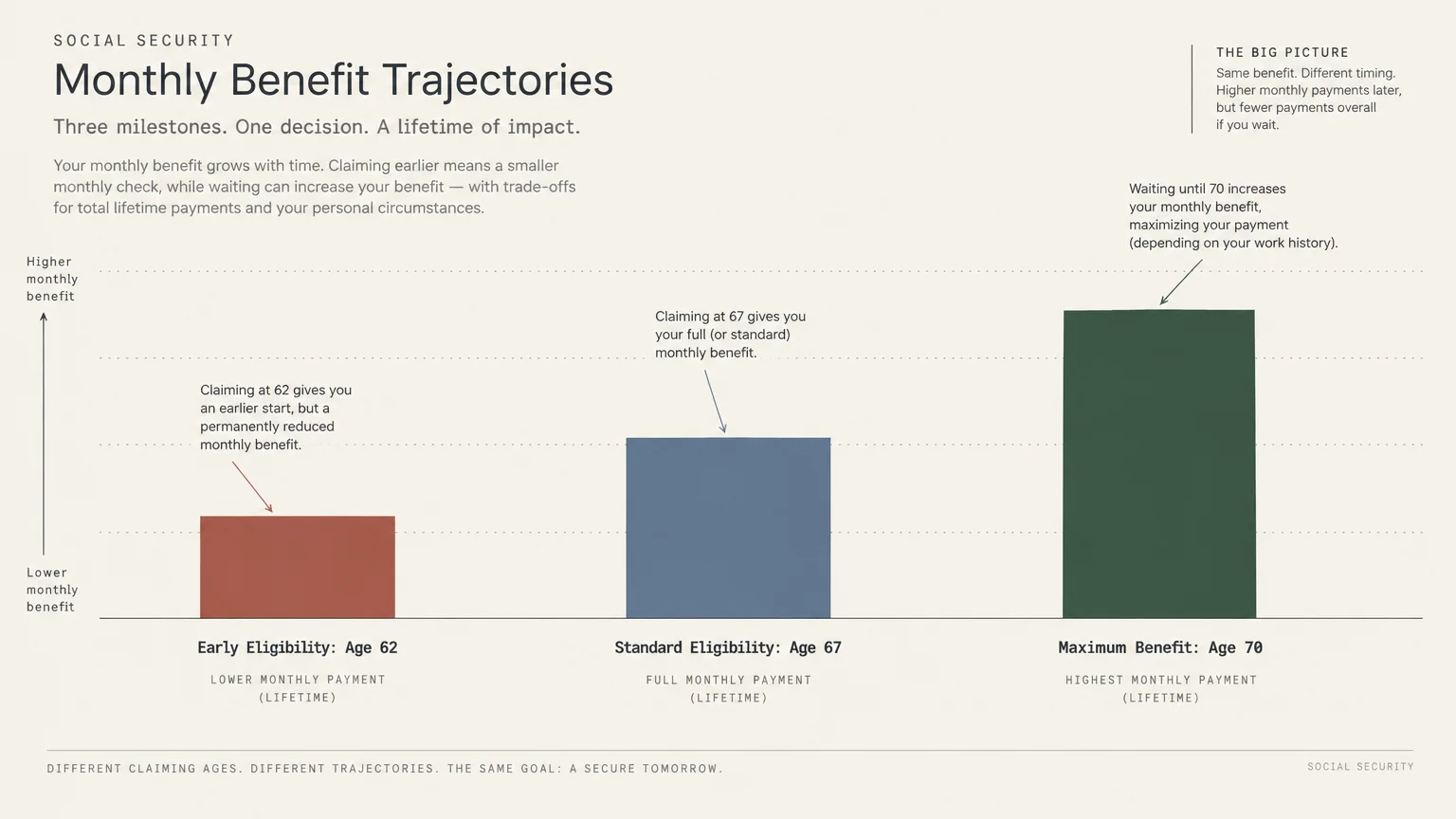
If you choose to claim your benefits at age 62, you accept a permanent reduction of up to 30%. This reduction remains attached to your monthly check for the rest of your life.
Despite this steep haircut, age 62 remains popular among older Americans. Approximately 23% of new claims occur at age 62, often because workers fail to realize how much income they sacrifice.
Waiting until age 67 ensures that you collect 100% of your primary insurance amount. This benchmark represents the full monthly entitlement you earned through your decades of payroll contributions.
Delaying your application beyond age 67 unlocks substantial rewards. According to the Social Security Administration (SSA), your benefit grows by 8% per year for every year you delay until age 70.
For individuals reaching standard retirement at 67, delaying until age 70 generates a permanent 24% boost. That higher baseline persists throughout your life and compounds with annual cost-of-living increases.
The financial differences between these milestones are striking when examining actual dollar limits. High earners who reach maximum eligibility in 2026 face vastly different payment caps based purely on timing.
A maximum earner claiming at age 62 in 2026 receives up to $2,969 per month. Waiting until standard benefit age pushes that ceiling to $4,152 per month.
Maximizing benefits by waiting until age 70 produces an impressive monthly cap of $5,181 in 2026. That creates an income difference of more than $2,200 every single month compared to early filing.
Inflation protection also plays a major role in your purchasing power over time. In October 2026, federal officials announced a 3.6% Cost-of-Living Adjustment for 2027.
This adjustment increases the average monthly retirement benefit by approximately $75 beginning in January 2027. When you secure a larger initial monthly benefit, percentage-based adjustments deliver substantially higher dollar increases.