

Rising real estate values across the United States have driven up property tax bills, forcing many older adults on fixed incomes to stretch their monthly budgets to the limit. Fortunately, all fifty states and the District of Columbia offer specialized programs designed to reduce, freeze, or postpone home taxes for older homeowners. Despite these broad safety nets, millions of eligible individuals pay far more than necessary simply because local governments rarely advertise available tax relief options. Securing your senior property tax relief can save you thousands of dollars each year, protect your home equity, and ensure your housing remains comfortable and affordable throughout your retirement years.
Understanding Senior Property Tax Relief and Why It Matters
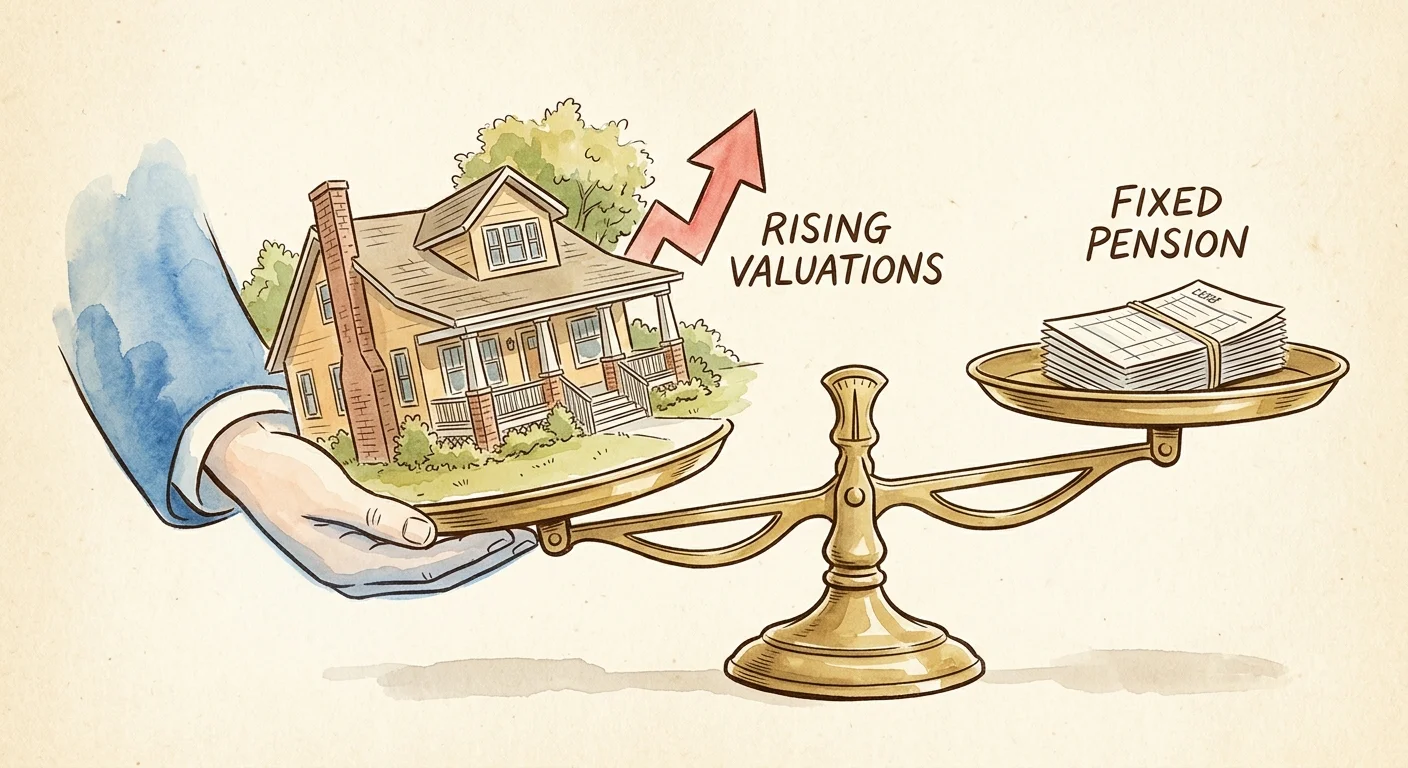
Staying in the home you love should bring peace of mind, not constant financial anxiety. Between 2020 and 2024, U.S. home values surged nearly 27% faster than inflation. While rising home values build overall wealth on paper, they create an immediate crisis for fixed-income retirees; local tax assessors calculate your annual property tax bill based on those inflated home valuations. When tax bills climb while your Social Security or pension payouts remain relatively flat, keeping up with basic living expenses becomes a daily struggle.
According to research published by the National Institutes of Health (NIH), every $100 annual increase in property taxes correlates with a 0.73 to 0.76 percentage point increase in two-year relocation rates for homeowners over age 50. This statistic highlights a harsh reality: rising tax burdens actively force older Americans out of their long-term family homes. You do not have to accept financial displacement as an inevitable part of aging. Senior property tax relief programs exist precisely to break this cycle, offering tax discounts, assessment limits, and flexible payment arrangements tailored to your financial situation.
Understanding these options allows you to regain control over your housing costs. Every state maintains specific statutory provisions created to assist mature homeowners, yet local tax offices rarely send direct reminders to eligible households. By taking proactive steps to claim these legal benefits, you can lower your annual expenses and safeguard your hard-earned financial independence.
The Four Main Types of Property Tax Relief Programs
State and county tax offices structure relief in several distinct ways. Depending on where you live, your age, and your total household income, you may qualify for one or more of these programs simultaneously. Understanding how each program functions helps you identify which options will deliver the largest savings to your budget.
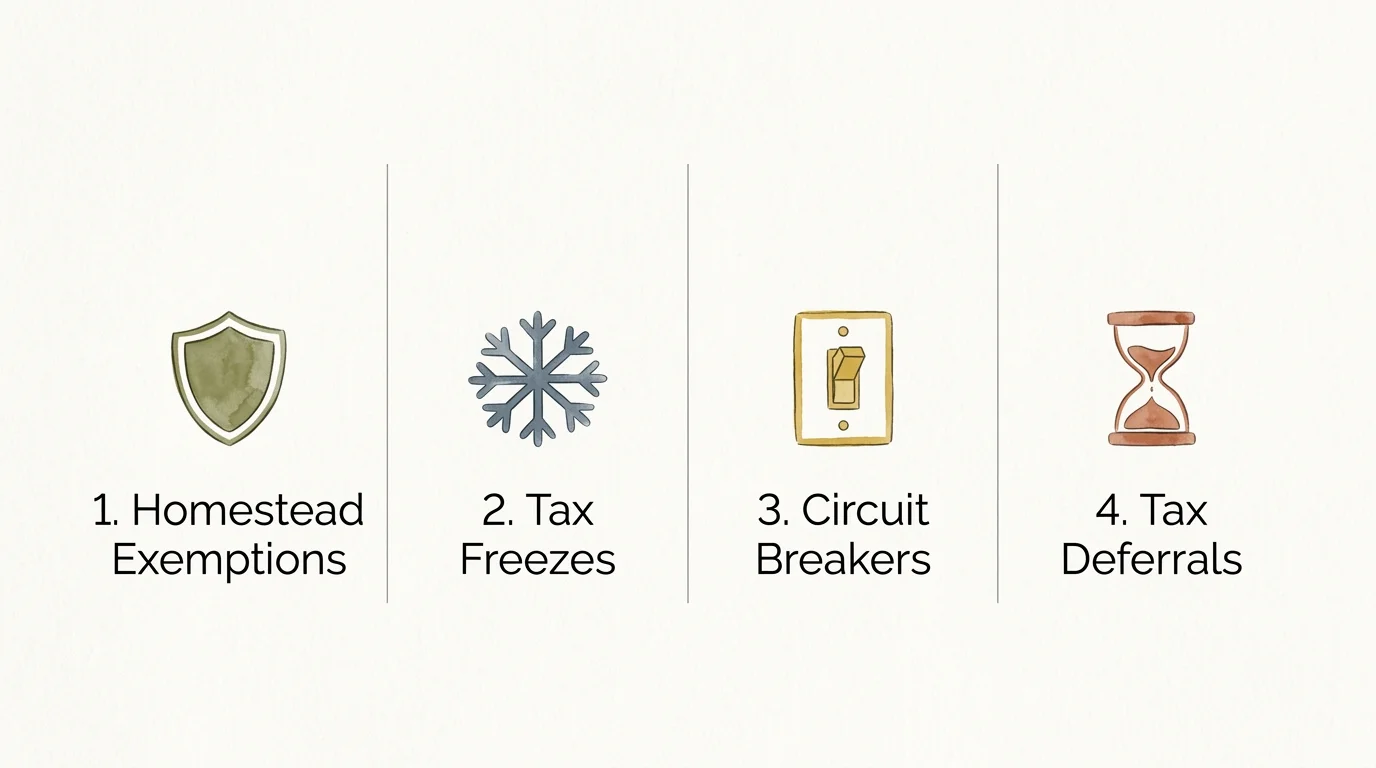
The four primary mechanisms for tax relief include homestead exemptions, property tax freezes, circuit breaker credits, and tax deferral programs. Each targets a different aspect of your tax bill—some reduce the assessed value of your home, others cap your total liability, and some allow you to postpone payments entirely.
| Program Type | Primary Mechanism | Estimated Participation | Typical Eligibility Criteria |
|---|---|---|---|
| Homestead Exemption | Reduces the taxable assessed value of your primary residence by a fixed dollar amount or percentage. | High (~90%) | Age threshold (usually 62 or 65+), primary residence ownership, legal residency status. |
| Property Tax Freeze | Locks in your home’s assessed value or total tax bill amount to prevent future rate increases. | Moderate (Varies by state) | Age 65+, primary homeownership, state-specific income caps in certain jurisdictions. |
| Circuit Breaker Credit | Provides a tax credit or rebate if property taxes exceed a designated percentage of household income. | Low (~40%) | Low-to-moderate household income limits, age or disability requirements, annual tax filing. |
| Property Tax Deferral | Postpones property tax payments until you sell the home or transfer the estate; low interest applies. | Very Low (<1%) | Age 62 to 65+, equity threshold in home, income limits, primary residence status. |
While standard homestead exemptions enjoy high awareness, specialized senior tax assistance programs like circuit breakers and deferrals remain underutilized. Reviewing all four categories ensures you leave no money on the table when filing your paperwork with county authorities.

Property Tax Deferrals: The High-Value Option Most Seniors Overlook
Of all the official property tax reduction tools available across the nation, property tax deferral programs hold the lowest participation rate—frequently enrolling less than 1% of eligible older homeowners. Many seniors avoid tax deferrals because they misunderstand how they operate. Misconceptions abound that the government will seize your property or force you out of your home. In reality, a property tax deferral operates much like a low-interest safety net designed to preserve your monthly cash flow.
When you enroll in a state or county deferral program, the local tax authority pays your annual property taxes on your behalf. In exchange, the state places a soft lien on your property. You retain complete ownership, deed title, and occupancy rights of your home for as long as you live there. The deferred tax amount—accumulated with simple, low-interest rates set by state law—is paid back only when you sell the property, transfer the title, or when your estate closes after your passing.
Consider how this option impacts your daily budget. If you receive $2,200 a month from Social Security and face an annual property tax bill of $4,800, that tax bill consumes nearly two full months of your total retirement income. By deferring that tax obligation, you immediately free up $400 every single month—cash that can cover vital expenses like prescription medications, healthcare co-pays, home repairs, or healthy groceries.
As noted by experts at the Consumer Financial Protection Bureau (CFPB), maintaining housing stability while managing debt requires carefully evaluating how low-interest government equity programs compare to high-cost alternatives like commercial loans or aggressive reverse mortgages. A state-backed property tax deferral generally offers far lower interest rates and zero upfront origination fees, making it an extraordinarily safe tool for staying comfortably in your residence.

Homestead Exemptions and Tax Freezes Explained
A senior property tax exemption directly shrinks the portion of your home’s value that local authorities can tax. Most states offer a baseline homestead exemption to all residents, but they frequently grant an expanded property tax exemption seniors can access once they reach age 62 or 65. For instance, if your county assesses your home at $250,000 and offers a $50,000 senior homestead exemption, you only pay taxes on $200,000 of assessed value. At a local tax rate of 2%, that single exemption puts $1,000 back in your pocket every year.
Property tax freeze programs work through a different, highly effective mechanism. Instead of discounting your current assessment, a tax freeze locks in your tax bill or home assessment value at its current level. Even if real estate values in your neighborhood skyrocket over the next decade, your frozen property tax amount remains unchanged for as long as you qualify.
Tax freeze programs prove exceptionally valuable in rapidly growing suburban or urban areas. When neighboring homes sell for record prices, local assessors raise area property valuations. A tax freeze acts as a legal shield; it prevents speculative housing markets from inflating your personal tax bill out of reach. Check with your city or county tax assessor to determine whether your jurisdiction offers a tax assessment cap, a tax dollar freeze, or both.
Circuit Breakers: Tailoring Relief to Your Income
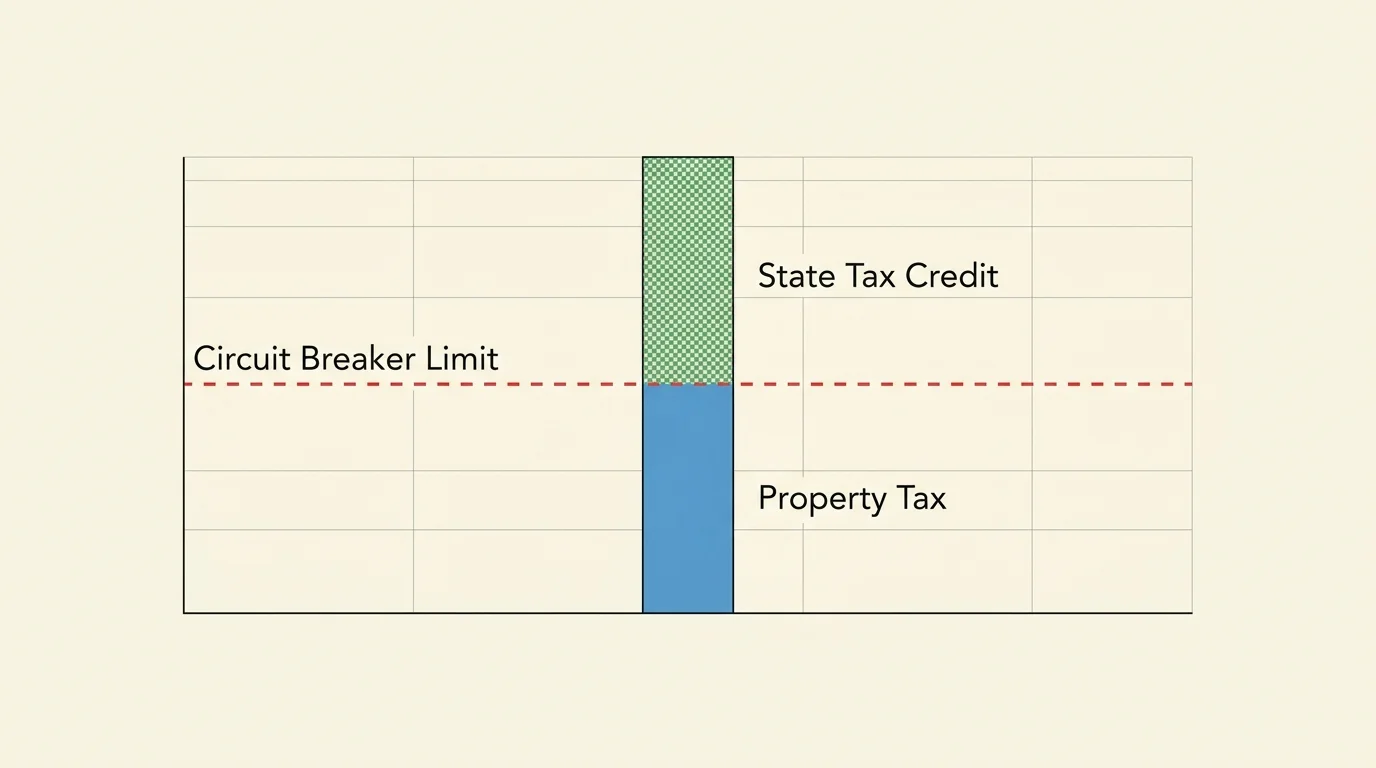
Property tax circuit breaker programs derive their name from electrical circuit breakers, which shut down power when an electrical surge threatens a home. Similarly, a tax circuit breaker kicks in to protect your finances when your property tax bill exceeds an affordable proportion of your household income. These programs acknowledge that an individual’s ability to pay property taxes depends on current cash flow, not theoretical property wealth.
Circuit breaker systems operate by establishing an income-to-tax ceiling—typically between 3% and 7% of your total gross annual income. If your property tax bill exceeds that set percentage, the state government issues a direct credit, property tax refund, or discount to cover the excess amount. For example, if a state caps tax burdens at 5% of income for a homeowner earning $28,000 annually, the maximum tax burden should be $1,400. If the actual tax bill reaches $3,400, the circuit breaker program provides a $2,000 credit to offset the difference.
Research published by AARP demonstrates that circuit breaker tax relief provides targeted assistance directly to lower- and middle-income retirees who are overburdened by escalating neighborhood property values. Despite these clear advantages, participation in circuit breaker initiatives hovers around 40% nationwide. Many seniors miss out simply because state regulations often require filing an annual property tax relief application or a state income tax return—even if your low overall income otherwise exempts you from mandatory tax filing.

Step-by-Step Guide: How to Apply and Secure Your Discounts
Securing your rightful savings requires taking structured, proactive steps. Because local tax offices rarely apply senior exemptions automatically, you must submit formal applications directly to your county assessor or municipal tax authority. Following a methodical process ensures you meet all state requirements and lock in your discounts without unnecessary delays.
- Gather Key Financial and Property Documents: Collect proof of age (such as a driver’s license or state ID card), property deed records, recent property tax statements, proof of primary residency (utility bills), and income documentation (W-2s, 1099s, Social Security benefit statements, or federal tax returns).
- Identify Your Local Tax Agency: Locate the municipal or county agency responsible for real estate assessments in your area. Search for your county’s Tax Assessor, Revenue Department, or Equalization Office online or in your local directory.
- Explore Broad Benefit Finder Tools: Review state-specific resource lists to confirm every discount program you qualify for. You can explore broad federal and state assistance categories on Benefits.gov to ensure you do not miss qualifying local relief.
- Seek Direct Navigational Support: If navigating government websites or completing tax forms presents technology or mobility challenges, reach out for community assistance. You can connect with trained local specialists through the Eldercare Locator to find free application help from local Area Agencies on Aging.
- Submit Applications Before State Deadlines: Complete and file your paperwork well before local cutoff dates. Most states enforce strict application windows that fall between January 1st and May 15th for the upcoming tax tax year.
- Establish an Annual Renewal Schedule: Many freeze and circuit breaker programs require annual re-certification of household income. Mark your calendar every January to confirm whether your tax exemption requires an updated form.
Taking time to complete these steps guarantees that your application moves smoothly through administrative channels, protecting your wallet from unnecessary assessment hikes.

Common Pitfalls, Deadlines, and Tax Scams to Avoid
Navigating senior property tax programs requires avoiding common administrative traps and bad actors who target older adults. The most frequent mistake homeowning seniors make is assuming that local tax offices apply senior exemptions automatically once a homeowner turns 62 or 65. Assessor databases do not track birth dates automatically; you must actively notify the office and submit proof of age to claim your benefit.
Another common pitfall involves missing strict annual filing deadlines. Unlike regular federal income tax deadlines, local property tax exemption windows vary widely across states and counties. Missing a deadline by even a single day can force you to pay full tax rates for an entire calendar year, with zero retroactivity in many jurisdictions. Always confirm your local filing deadline with your county assessor’s office directly.
Finally, stay vigilant against fraudulent schemes that target senior homeowners. Scammers frequently send official-looking mailers offering to file your senior homestead exemption or property tax freeze for a mandatory service fee ranging from $50 to $200. These private companies charge high fees for tasks you can easily complete yourself for free.
- Free Official Processing: Government agencies never charge application or filing fees to process senior tax assistance programs.
- Misleading Mailings: Ignore mailers that use intimidating logos or urgent warnings demanding payment to process home property tax relief.
- Reporting Fraud: If you suspect a deceptive solicitation, report the company to your State Attorney General or local consumer protection office.
By relying exclusively on official municipal websites, local government offices, and trusted non-profit aging organizations, you keep your personal data secure and keep your hard-earned money in your bank account.
Frequently Asked Questions
Does enrolling in a senior property tax relief program affect my Social Security or Medicare benefits?
No, enrolling in a property tax exemption, freeze, circuit breaker, or deferral program will not reduce your Social Security monthly benefits or impact your Medicare coverage. Property tax relief is classified as a local tax reduction or state credit, not earned income; therefore, it has zero impact on federal benefit eligibility calculations.
What happens to a deferred tax balance when I sell my home or pass away?
When you sell a home enrolled in a property tax deferral program, the total accumulated taxes and accrued interest are paid off directly from the proceeds of the sale at closing. If you pass away while owning the home, your heirs can choose to settle the deferred tax lien using estate assets, or pay off the balance by selling the property. You retain complete ownership rights throughout your life.
Can I apply for senior property tax relief if I still have an active mortgage on my home?
Yes, you can qualify for senior tax relief programs even if you carry an outstanding mortgage. Once your county assessor approves your tax exemption or freeze, your lowered property tax bill is sent to your mortgage servicer. The lender will adjust your monthly escrow payments accordingly, resulting in a lower overall monthly mortgage check.
What steps should I take if my local tax exemption application is denied?
If local authorities deny your application, review the official denial notice carefully to understand the specific reason cited. Common reasons include missing proof of income, incomplete paperwork, or unverified primary residency. You have a legal right to file a formal appeal with your county Board of Tax Equalization or Assessment Appeals within a specified timeframe, usually 30 to 60 days from notice receipt.
Do renters over age 65 qualify for any form of property tax relief?
Yes, several states offer property tax circuit breaker refunds directly to low-income senior renters. Because landlords pass property taxes down through monthly rental payments, state circuit breaker rules often treat a designated percentage of annual rent (typically 15% to 20%) as property tax, allowing eligible renters to receive a direct cash refund check or state tax credit.
For additional senior resources, visit
National Institutes of Health (NIH), Centers for Medicare & Medicaid Services (CMS), Social Security Administration (SSA) and Consumer Financial Protection Bureau (CFPB).
Disclaimer: The information in this article is for educational purposes only and is not intended to be a substitute for professional financial, legal, or medical advice. Always consult with a qualified expert for advice tailored to your personal situation.









Leave a Reply