

You worked hard to build a safe, comfortable retirement. Yet everyday habits can unknowingly expose your nest egg and independence to severe legal penalties.
Well-intentioned actions like sharing a prescription or helping grandchildren buy a car can violate strict federal and state regulations. These missteps often trigger devastating tax audits, loss of healthcare coverage, or civil liability.
Protecting your assets requires recognizing these common retirement legal pitfalls before an agency investigates. This guide breaks down nine hazardous habits and gives you actionable ways to stay compliant.

1. Gifting Cash and Property Generously to Family
Helping your children or grandchildren financially feels natural and rewarding. You might pay for college tuition, help with a mortgage down payment, or give generous holiday cash gifts.
However, generous asset transfers can devastate your future healthcare security. Many seniors conflate IRS gift tax exemptions with Medicaid eligibility regulations.
Under federal guidelines from the Centers for Medicare & Medicaid Services (CMS), Medicaid enforces a mandatory 60-month look-back period under 42 U.S.C. § 1396p.
Caseworkers scrutinize every financial transaction made during the five years preceding your long-term care application. Any asset transferred for less than fair market value triggers an immediate penalty period of Medicaid ineligibility.
Medicaid calculates this penalty by dividing your total gifted amount by your state’s average monthly nursing home cost. If you gifted $100,000 and nursing care costs $10,000 monthly, you must self-fund ten full months of care.
For tax years 2025 and 2026, the IRS allows annual gifts of $19,000 per recipient without filing a gift tax return. Married couples can combine exemptions to gift up to $38,000 per recipient.
Retirees often assume this IRS exemption shields their transfers from Medicaid penalties. Unfortunately, Medicaid rules do not recognize the annual IRS gift tax exclusion.
Even a modest wedding gift to a grandchild violates Medicaid look-back rules if you enter a nursing facility within five years.
| Feature | IRS Annual Gift Tax Rules | Medicaid Long-Term Care Rules |
|---|---|---|
| Annual Exemption (2025/2026) | $19,000 per recipient ($38,000 married) | $0 (No gift exclusion permitted) |
| Look-Back Window | Calendar tax year | 60 months (5 years) |
| Legal Consequence of Violation | Filing IRS Form 709 or estate tax credit reduction | Delayed nursing home benefit eligibility |
To avoid these legal pitfalls, consult an elder law attorney before transferring substantial funds. You can structure gifts through irrevocable trusts or make medical payments directly to healthcare providers.

2. Paying Household Helpers and Caregivers in Cash
Hiring an independent caregiver, housekeeper, or companion provides vital assistance as you age in place. Paying these workers in cash seems convenient and mutually beneficial.
However, paying domestic helpers under the table violates federal and state employment tax laws. The IRS classifies most in-home caregivers as statutory household employees rather than independent contractors.
You must withhold and pay Social Security and Medicare taxes once domestic worker wages exceed $2,800 in 2025 or $3,000 in 2026. This threshold applies per worker across the entire calendar year.
Furthermore, paying $1,000 or more to domestic staff in any single calendar quarter triggers Federal Unemployment Tax Act obligations. Failing to withhold these taxes can lead to civil fraud audits and substantial unpaid tax assessments.
Paying cash also creates severe personal injury liability. If an unregistered caregiver suffers an injury in your home, your standard homeowner policy often denies coverage for domestic workplace accidents.
The injured worker could sue you personally for medical expenses, lost wages, and disability damages. That lawsuit places your personal savings and home equity at direct risk.
If you need dependable in-home assistance, use the Eldercare Locator to connect with accredited, bonded home care agencies. These organizations handle all payroll taxes and workers’ compensation coverage.
If you hire privately, partner with a household payroll service. Always file IRS Schedule H with your annual Form 1040 tax return to maintain legal compliance.

3. Sharing or Swapping Prescription Medications
Prescription medications represent a major budget item for older Americans. When a spouse, family member, or neighbor experiences acute pain or insomnia, sharing medication feels like an act of kindness.
However, distributing prescription medications is a direct violation of the Controlled Substances Act under 21 U.S.C. § 841. Giving away even a single pill of a controlled substance constitutes a federal drug distribution felony.
Common medications like oxycodone, hydrocodone, alprazolam, and zolpidem are strictly scheduled drugs. Federal and state laws make no exceptions for family relationships or compassionate intentions.
Beyond criminal prosecution, medication sharing creates catastrophic civil liability. If a recipient suffers a fatal drug interaction or allergic reaction, you could face wrongful death lawsuits or manslaughter charges.
To keep yourself and your family safe, follow these strict medication handling rules:
- Store all controlled substances in a locked cabinet away from visitors and relatives.
- Never give your prescribed drugs to anyone, including your legally married spouse.
- Dispose of expired medications safely at authorized community drop-off locations or pharmacy kiosks.
- Consult your physician immediately if you experience adverse medication side effects.
Never treat prescription drugs as interchangeable household items. Protect your household by keeping every prescription strictly within the possession of the named patient.
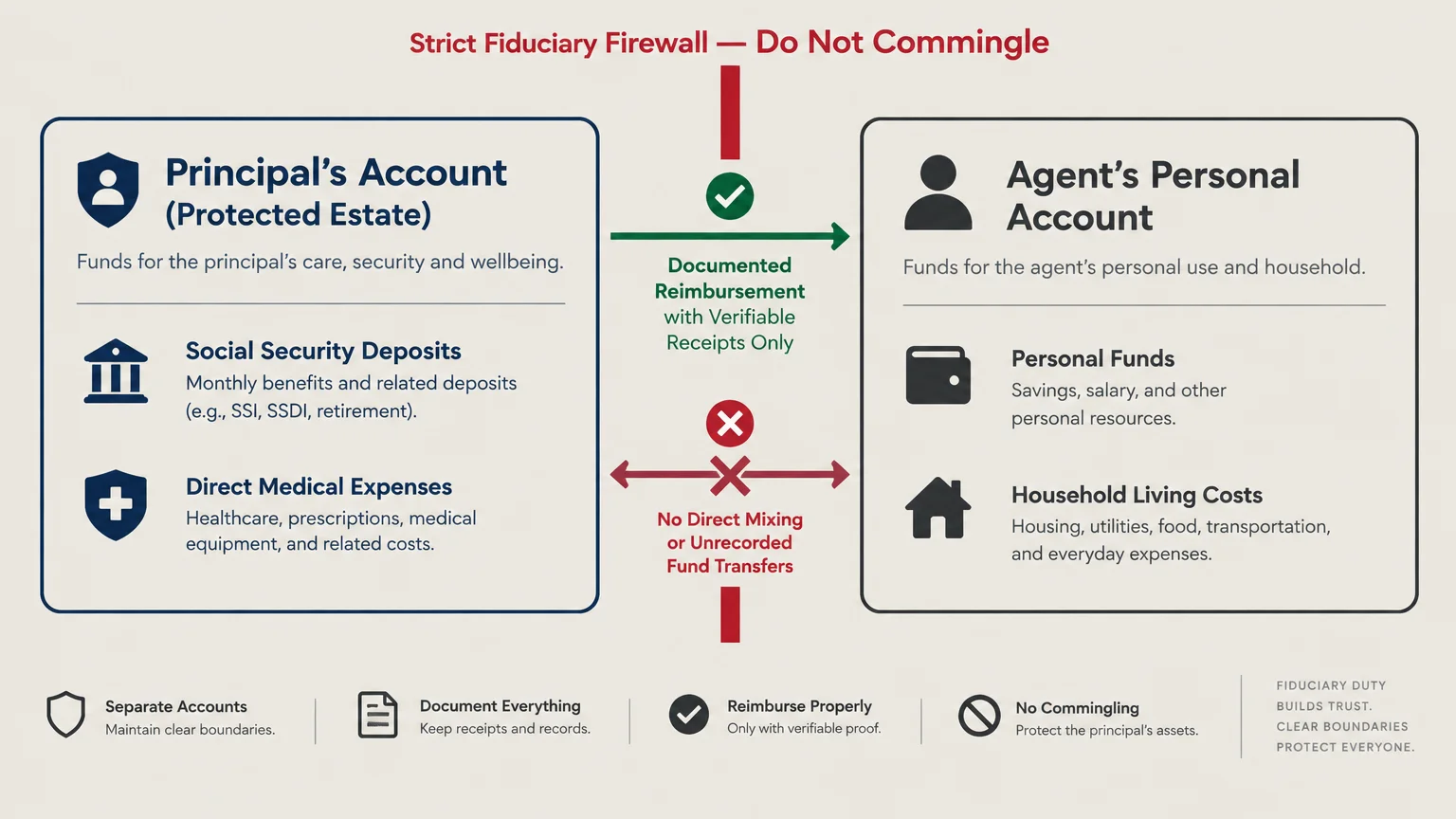
4. Commingling Finances as a Power of Attorney
Serving as an agent under a Power of Attorney (POA) for an aging parent or relative is a significant responsibility. Agents frequently combine bank accounts to make utility payments and medical bill management easier.
However, commingling your personal money with the principal’s funds breaches your legal fiduciary duty. State laws, including the Uniform Power of Attorney Act, require strict separation of all assets.
The Consumer Financial Protection Bureau (CFPB) warns that fiduciary agents must act solely in the best interest of the principal. Using a principal’s account for personal expenses constitutes illegal self-dealing.
Even if you plan to reimburse the account immediately, commingling can trigger state elder financial abuse investigations. Suspicious relatives can file civil lawsuits demanding formal accountings or damages.
You can face criminal charges, immediate removal as agent, and personal liability for all missing funds. Prosecutors treat unauthorized withdrawals as theft from an elderly adult.
Maintain separate accounts to protect your integrity and legal standing:
- Title accounts clearly as “[Principal Name] by [Your Name], Power of Attorney.”
- Never deposit personal checks into the principal’s account.
- Keep detailed digital receipts and bank records for every expenditure.
- Never write checks to yourself unless the legal document explicitly authorizes fiduciary compensation.
Meticulous recordkeeping proves your honesty and protects your family relationships. When doubts arise, consult a probate attorney before executing complex transactions.

5. Underreporting Early Social Security Side Earnings
Many seniors retire early and take part-time jobs or consulting gigs to supplement their fixed income. Doing so while collecting early Social Security benefits requires strict adherence to federal income rules.
If you claim Social Security before your Full Retirement Age (FRA), you must comply with the annual earnings test. Failing to report side income can trigger severe financial clawbacks and fraud audits.
The Social Security Administration (SSA) deducts $1 from your benefits for every $2 earned above the annual earnings limit if you are under FRA all year.
These earnings thresholds adjust upward annually for inflation:
- 2024 Earnings Limit: $22,320 per year
- 2025 Earnings Limit: $23,400 per year
- 2026 Earnings Limit: $24,480 per year
In the calendar year you reach your Full Retirement Age, the rule relaxes. The SSA deducts $1 for every $3 earned above a higher threshold until your birth month.
Unreported 1099 independent contractor earnings and cash tips still count as earned income. The IRS shares tax data directly with the Social Security Administration each tax season.
When the SSA discovers unreported earnings, they issue demand letters requiring immediate lump-sum repayment. If you cannot pay, the agency withholds your monthly benefit checks until the debt clears.
Track your earnings closely throughout the calendar year. Notify the Social Security Administration promptly if your earned income will exceed the annual limit.
6. Delaying Required Minimum Distributions
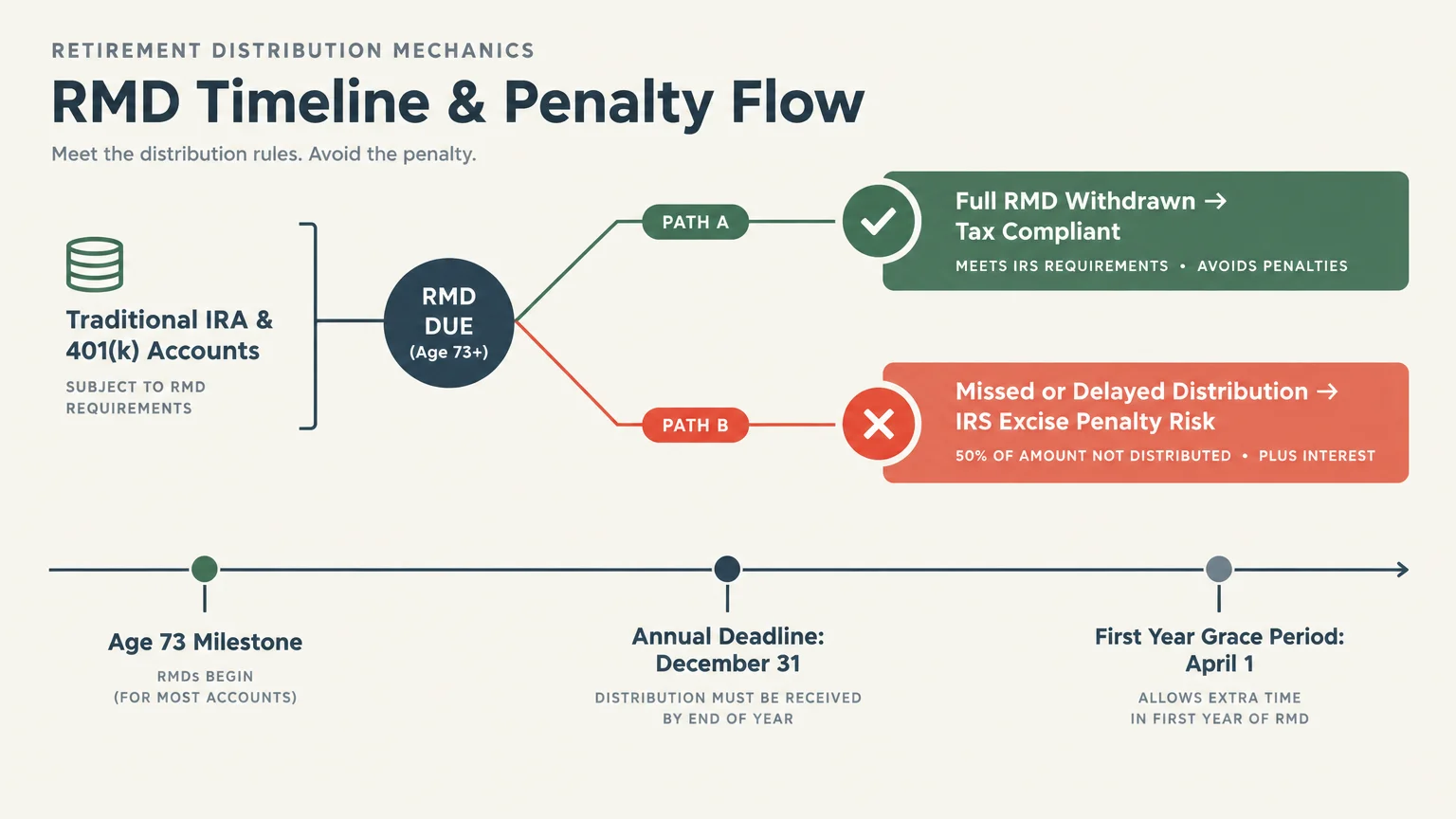
You might prefer to leave your traditional IRA and 401(k) savings untouched so they can grow tax-deferred. However, federal law mandates that you withdraw minimum sums once you reach a specific age.
The SECURE 2.0 Act of 2022 established age 73 as the mandatory starting age for Required Minimum Distributions (RMDs). That age rises to 75 in 2033 for people born in 1960 or later.
Missing your annual distribution deadline incurs severe IRS excise taxes. Congress recently lowered the excise tax penalty from 50% down to 25% of the undistributed amount.
If you correct the missed distribution and submit IRS Form 5329 within the two-year statutory correction window, the penalty drops to 10%. However, ignoring the issue leads to compounding interest and penalties.
For example, failing to take a $20,000 RMD can result in an immediate $5,000 tax penalty. That unnecessary penalty drains your hard-earned retirement savings without providing any financial return.
Take proactive measures to avoid missing required deadlines:
- Establish automated annual distributions with your plan custodian or brokerage firm.
- Complete your first distribution by April 1 of the year after turning 73.
- Satisfy all subsequent RMDs by December 31 each calendar year.
- Consider Qualified Charitable Distributions (QCDs) to satisfy RMD requirements tax-free if you do not need the income.
Consult your tax professional every autumn to calculate your exact withdrawal requirements. Staying organized prevents surprise penalty notices from the IRS.

7. Renting Out Living Space Without Local Compliance
With extra bedrooms available after children move away, renting living space seems like an easy way to earn supplemental income. Many retirees advertise rooms or vacation properties on popular digital platforms.
However, running an informal rental can violate local municipal zoning laws, building codes, and homeowners association (HOA) rules. Municipalities increasingly enforce strict licensing requirements and short-term rental bans.
Operating an unpermitted short-term rental exposes you to daily municipal fines that can reach thousands of dollars. Local code enforcement offices use automated software to scan listing platforms and penalize unregistered hosts.
Furthermore, standard homeowner policies exclude commercial lodging activities. If a paying guest suffers an injury or causes a fire, your insurer can deny the claim entirely.
Long-term tenants introduce tenant-rights laws into your personal home. In many states, a guest staying over 30 days acquires legal tenancy status.
If that tenant refuses to pay rent, you cannot simply change the locks or shut off utilities. Doing so is an illegal eviction that exposes you to civil lawsuits and statutory damages.
You must endure formal court eviction procedures, which often take months and cost thousands in legal fees. Always verify local housing regulations, draft formal leases, and carry commercial rental insurance.

8. Running Informal Online Sales and Craft Ventures
Retirement offers ample free time to pursue creative hobbies, such as woodworking, baking, or reselling vintage collectibles online. Selling your creations at flea markets or online marketplaces provides great satisfaction and extra pocket cash.
However, selling goods regularly without formal business registration and tax reporting can violate local, state, and federal laws. State tax agencies aggressively enforce sales tax collection on retail goods.
The IRS requires you to report all net business earnings, even from casual hobbies. Online payment platforms report gross transactions directly to the IRS using Form 1099-K.
Failing to declare online marketplace revenues on your tax return constitutes federal tax evasion. The IRS can assess back taxes, substantial civil penalties, and interest charges.
Selling homemade foods brings additional legal scrutiny under state cottage food statutes. Operating an uninspected kitchen or failing to include mandatory ingredient labels can trigger severe public health fines.
Before launching your home venture, take these fundamental legal steps:
- Register your business name with your county or state department of commerce.
- Obtain a state sales tax permit to collect and remit retail taxes correctly.
- Review local zoning rules to ensure your neighborhood allows home-based commercial activities.
- Carry general business liability insurance to protect personal assets from customer claims.
Treating your craft or resale hobby like a legitimate business keeps you in full compliance. Clear bookkeeping ensures that your creative passion remains an enjoyable, stress-free pursuit.

9. Signing Legal Documents for an Incapacitated Spouse
Couples often share everything during decades of marriage, from household finances to major life decisions. When a spouse faces illness, cognitive decline, or physical disability, you might naturally sign documents on their behalf.
However, marriage alone does not grant automatic legal authority to sign your spouse’s name. Signing another person’s signature on deeds, titles, or loan documents constitutes legal forgery.
Signing your spouse’s name on joint tax returns is also illegal without a formal IRS Form 2848 Power of Attorney on file. The IRS can reject filings, delay refunds, or initiate audits.
Financial institutions will freeze joint transactions if they detect unauthorized signatures. This freeze can trap funds right when you need them most for urgent medical care.
To avoid these devastating administrative delays, establish comprehensive legal protections before cognitive capacity declines:
- Draft durable financial and healthcare powers of attorney while both partners are legally competent.
- Designate secondary agents in case the primary caregiver spouse becomes incapacitated.
- Submit completed POA documents to banks, mortgage lenders, and financial institutions ahead of time.
- Petition a probate court for legal guardianship or conservatorship if capacity is lost before documents are executed.
Proactive legal planning removes uncertainty and protects both partners during medical crises. Consult a qualified estate planner to secure proper documentation today.
Frequently Asked Questions
Can the IRS penalize me for paying my grandchild’s college tuition?
No, paying tuition directly to an educational institution is fully exempt from federal gift taxes. However, transferring cash directly to your grandchild can count as a gift under IRS and Medicaid rules.
What should I do if I accidentally miss my annual RMD deadline?
Withdraw the required amount immediately from your retirement account. File IRS Form 5329 and attach a written statement requesting a penalty waiver due to reasonable cause.
Is it legal to pay my adult child for providing daily caregiving services?
Yes, but you must establish a formal written caregiver agreement before services begin. You must also pay fair market rates and report all caregiver wages for employment taxes.
How does Medicaid uncover financial gifts made years ago?
Medicaid caseworkers inspect five years of complete bank statements, real estate deeds, and tax filings. They use automated databases to identify unexplained asset transfers and cash withdrawals.
Will the Social Security Administration permanently reduce my benefits if I exceed the earnings cap?
No, the benefit reduction is temporary. Once you reach Full Retirement Age, the agency recalculates your monthly benefit upward to credit you for withheld payments.
For additional senior resources, visit
American Heart Association, Benefits.gov, National Institute on Aging (NIA) and Centers for Disease Control and Prevention (CDC).
Disclaimer: The information in this article is for educational purposes only and is not intended to be a substitute for professional financial, legal, or medical advice. Always consult with a qualified expert for advice tailored to your personal situation.









Leave a Reply