

Helpful Resources for Seniors
Helpful Resources for Seniors Navigate life's next chapter with confidence
  • Home
  • Lifestyle
  • Well-Being
  • Finance

How to Avoid Hidden Fees on Senior Bank Accounts

September 8, 2025 · Finance

Reading glasses on an open book next to an armchair where a person is relaxing in the warm light of an evening lamp.

Actionable Strategies and Money-Saving Tips

You don’t have to accept bank fees as a fact of life. With a few proactive steps, you can significantly reduce or even eliminate them entirely. These finance tips for retirees are practical and can be put into action today.

An older woman talking with a bank representative at a desk in a modern bank branch.
Asking about special accounts for seniors at the bank.

1. Specifically Ask for a “Senior Checking Account”

Many banks and credit unions offer special accounts designed for customers over a certain age, usually 60 or 65. These accounts often come with valuable perks, such as waived monthly maintenance fees, free standard checks, and sometimes even free cashier’s checks. However, banks don’t always automatically enroll you in one when you reach the qualifying age. You have to ask for it. Call or visit your local branch and say, “I’d like to know if you offer a senior checking account or if my current account can be converted to one.”
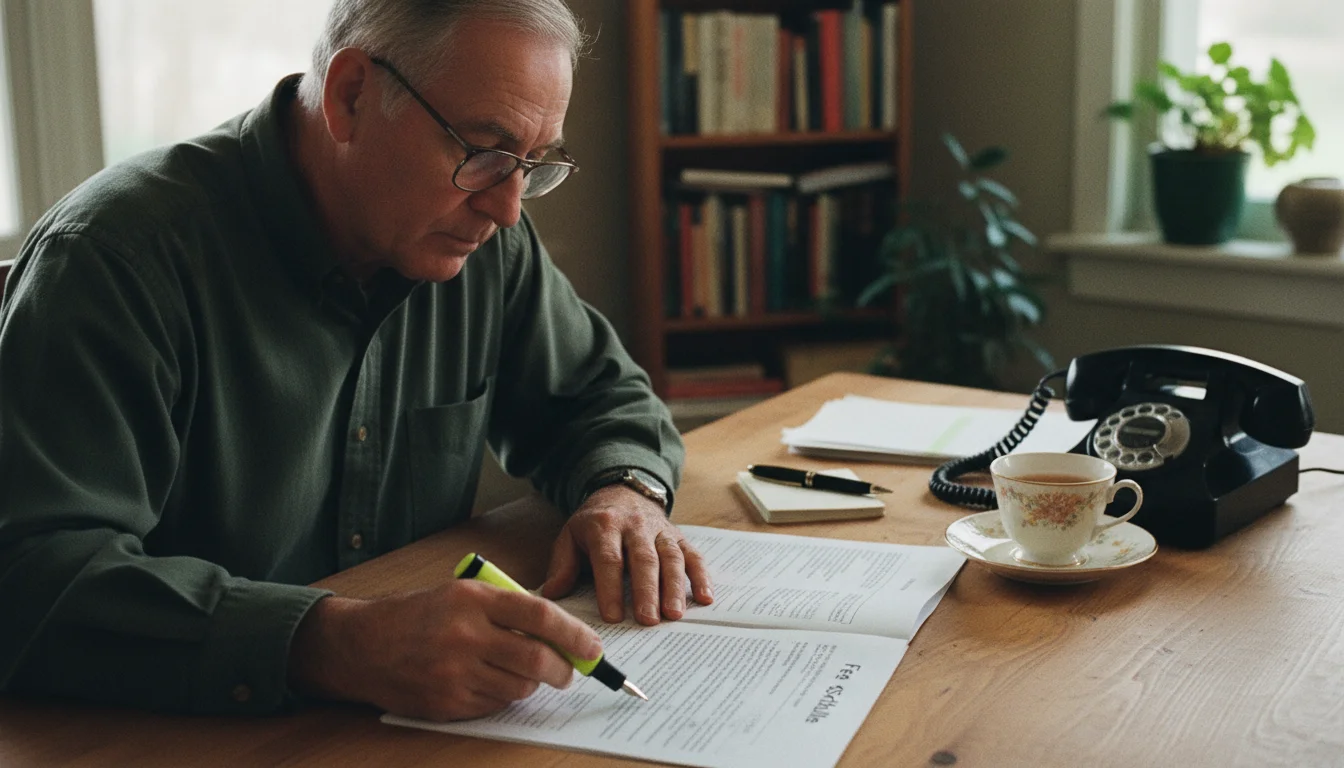
A senior man with glasses carefully highlights a 'Fee Schedule' document at his wooden desk.
Carefully scrutinizing the bank’s fee schedule for hidden details.

2. Get and Read Your Bank’s Fee Schedule

Every bank is required to have a document that lists every single potential fee they can charge you. It’s often called a “Fee Schedule” or “Account Terms and Conditions.” If you can’t find it online, call your bank and ask them to mail you a copy. It might seem like a boring document, but it’s your roadmap to avoiding charges. Look for the fees we discussed above and, most importantly, read the section that tells you how to get them waived.

An older couple at their kitchen table, intently reviewing an online bank statement on a tablet, with careful expressions.
Working together to keep an eye on their bank account balance.

3. Meet the Minimum Balance Requirement

One of the most common ways to avoid a monthly service fee is by maintaining a minimum balance. For example, a bank might waive its $12 monthly fee if you keep a minimum daily balance of $1,500 in your checking account. For some, this is easy. For others on a tight budget, it can be a challenge. If you choose this route, be vigilant. A single day below the threshold can trigger the fee. A good strategy is to keep a buffer of a few hundred dollars above the minimum, just in case of an unexpected expense.

A senior woman sits at a kitchen island, looking at a tablet screen displaying a generic banking app interface.
Staying on top of finances feels easy.

4. Set Up Direct Deposit

This is often the easiest way to get a free checking account. Banks want your primary business, and they reward customers who have their income deposited directly into their accounts. If you receive Social Security, a pension, or other retirement income, setting up direct deposit can often get that monthly fee waived, regardless of your balance. For official information on Social Security and Medicare, visit SSA.gov and Medicare.gov. Federal tax information is at the IRS.

Senior woman, mid-70s, in a cozy sunlit nook, calmly viewing her banking app on a tablet.
Checking bank statements online can be simple and convenient.

5. Go Paperless (If You’re Comfortable)

If you use a computer or smartphone and feel comfortable checking your statements online, opting out of paper statements is a quick way to save $2 to $5 a month. That’s $24 to $60 a year. Most banks make this very easy to do through their website or mobile app. If you still prefer a paper trail, you can often print the statements yourself from your online account at no charge.

An older woman with a kind smile receives cash from a grocery store cashier after a debit card transaction.
Getting cash back at the grocery store is a smart, fee-free way to grab money.

6. Be Strategic with Your Cash Withdrawals

Out-of-network ATM fees are completely avoidable. First, find out which ATMs are in your bank’s network—they are often listed on the bank’s website or app. Plan to only use those. An even better strategy is to get cash back when you’re paying with your debit card at the grocery store or pharmacy. It’s free and convenient. For example, if your bill is $23, you can ask for $40 cash back. Your account will be debited for $63, and you’ll walk away with your groceries and the cash you need, with no fee.

Senior man, late 60s, reviews online banking on laptop at kitchen table, focused on linked checking and savings accounts.
Keeping an eye on linked accounts can protect your finances.

7. Use Overdraft Protection Wisely

Overdraft fees are costly. The best defense is to keep a close eye on your account balance. As a backup, link your checking account to your savings account. This is called “overdraft protection.” If you overspend your checking account, the bank will automatically transfer money from your savings to cover the difference. There might be a small transfer fee (perhaps $10), but that is much better than a $35 overdraft penalty. Be careful not to confuse this with “overdraft coverage,” which is a high-interest loan the bank extends to you.

A senior woman listens attentively to a credit union employee at a counter in a bright, modern branch.
Getting personalized advice from a helpful credit union employee.

8. Explore Credit Unions and Online Banks

If your big national bank isn’t meeting your needs, don’t be afraid to look elsewhere. Credit unions are non-profit institutions owned by their members. Because they don’t have to generate profits for shareholders, they often offer accounts with no monthly fees, lower minimum balance requirements, and a more personal level of service. Similarly, online-only banks have very low overhead costs and pass those savings on to customers, often in the form of completely free checking and savings accounts with higher interest rates.

An older woman, mid-70s, sits at a kitchen table, calmly talking on a cordless phone with a notepad and pen nearby.
A calm phone call about bank fees can save you money.

9. Don’t Be Afraid to Call and Ask

If you get hit with a fee, especially for the first time, call your bank. Calmly explain the situation and ask if they would be willing to offer a one-time courtesy waiver. Banks value loyal, long-term customers and are often willing to waive a fee to keep you happy. You can also use this call to ask what you can do to avoid that fee in the future. A simple, polite phone call can save you $35 or more.



Pages: 1 2 3 4 5 6

Share this article

Facebook Twitter Pinterest LinkedIn Email

Leave a Reply Cancel reply

Your email address will not be published. Required fields are marked *

Search

Latest Posts

  • A senior couple smiles while sitting on a porch overlooking a canal, drinking coffee with a map on the table. States Where You Can Retire Without Paying State Taxes on Your Retirement Income
  • Senior man wearing glasses and a sweater sits at a wooden table reviewing paperwork beside a calculator and a coffee mug. Average Social Security Benefit for Men: How Does Your Payment Compare?
  • An older couple sits together at a wooden dining table reviewing paperwork, binders, and notes in a bright living room. 13 Things Every Retiree With a Pension Must Know About Taxes
  • A smiling senior couple sits at a wooden dining table reviewing bills, checks, a credit card, and paperwork together. 5 Regular Bills Retirees Can Prepay for Instant Savings
  • A family of three smiles while sitting on the wooden porch steps of their suburban home on a sunny day. 7 States With the Cheapest Home Insurance
  • An older woman and a young female volunteer laugh together while potting green herbs on a sunny wooden porch. 9 Senior Companion Programs Worth Exploring
  • An ink and watercolor illustration of a senior woman looking out a window with a peaceful expression, holding a warm mug. 7 Emergency Financial Assistance Programs for Seniors
  • An older woman reads a book comfortably on a sunlit porch wearing glasses, representing clear vision and independence. 8 Free Vision Care Programs for Low-Income Seniors
  • An older woman speaks with a compassionate female ombudsman in a sunlit apartment, showcasing supportive advocacy. 9 Local Ombudsman Programs Protecting Senior Rights
  • An older couple smiling in relief at their kitchen table, looking over organized paperwork and a pill organizer in soft morning light. 7 Prescription Assistance Programs Beyond Medicare

Newsletter

Get the latest posts delivered to your inbox.

Related Articles

Older woman in glasses calmly reviews financial documents at a dining table, a blurred family photo in the background.

How to Deal With Adult Children Who Want Your Money

How to Deal With Adult Children Who Want Your Money As you navigate your retirement…

Read More →
Understanding Social Security in 2025

Understanding Social Security in 2025: What’s Changed?

As we move through 2025, understanding the landscape of your retirement income is more important…

Read More →
A man sits at a table, reviewing bank statements highlighted in green, yellow, and red.

How I Went from Overspending to Saving $300 a Month in Retirement

If you had asked me two years ago how I was doing with my finances,…

Read More →
Internet, Social Security change

8 Key Social Security Changes Coming in 2025

Staying informed helps us plan confidently for tomorrow’s financial future. Let’s talk about all the…

Read More →
An older couple sitting at a sunlit kitchen table reviewing their paper Social Security statement together in the morning.

How State Taxes Can Quietly Eat Into Your Social Security Check

Discover how state taxes impact your Social Security benefits in 2026, which 8 states still…

Read More →
A senior is reviewing their monthly budget, spread across a table with categorized expenses and income sources clearly visible.

How to Budget on a Fixed Income Without Sacrifice

Navigating your finances in retirement can feel like a significant challenge. When your income is…

Read More →
A smiling senior couple sits at a wooden dining table reviewing bills, checks, a credit card, and paperwork together.

5 Regular Bills Retirees Can Prepay for Instant Savings

Learn how retirees can prepay regular household bills like insurance, taxes, and utilities to unlock…

Read More →
A senior citizen examines financial documents, such as a budget and investment statements, while sitting at a desk with a computer.

Understanding Inflation and What It Means for Your Nest Egg

You worked hard for decades, carefully saving and planning for a comfortable retirement. You built…

Read More →
A senior citizen is reviewing paperwork at their kitchen table with groceries and an EBT card nearby.

Getting the Most From SNAP and Other Assistance Programs

Navigating your finances during retirement can feel like a full-time job. On a fixed income,…

Read More →
Helpful Resources for Seniors Helpful Resources for Seniors

Navigate life's next chapter with confidence

Inedit Agency S.R.L.
Bucharest, Romania

contact@helpfulresourcesforseniors.com

Explore

  • Home
  • About Us
  • Editorial Policy
  • Privacy Policy
  • Terms and Conditions
  • Subscribe
  • Unsubscribe
  • Contact
  • Request to Know
  • Request to Delete
  • CA Private Policy

Categories

  • Finance
  • Lifestyle
  • Well-Being

© 2026 Helpful Resources for Seniors. All rights reserved.