

Transitioning into retirement shifts how you pay income taxes, often creating unexpected tax bills and IRS underpayment penalty triggers. If you owe more than $1,000 when filing your tax return, the IRS may assess a penalty for not paying enough tax throughout the year. Recognizing underpaid taxes penalty warning signs early helps you protect your retirement savings, avoid costly interest fees, and maintain financial peace of mind. By reviewing your current income withholding, quarterly estimated payments, and special retirement tax waivers, you can easily catch underpayment issues before tax season arrives and keep your hard-earned retirement money working directly for you.
1. Understanding Tax Underpayment in Retirement
The United States operates on a pay-as-you-go tax system. The Internal Revenue Service expects you to pay income tax continuously throughout the year as you receive income, rather than paying one lump sum during tax season. During your working years, employers handle this system automatically by withholding taxes from your paycheck. However, once you step into retirement, your income sources diversify into Social Security, pensions, traditional Individual Retirement Accounts (IRAs), 401(k) withdrawals, and brokerage investments; none of which automatically handle your taxes in the same seamless manner.
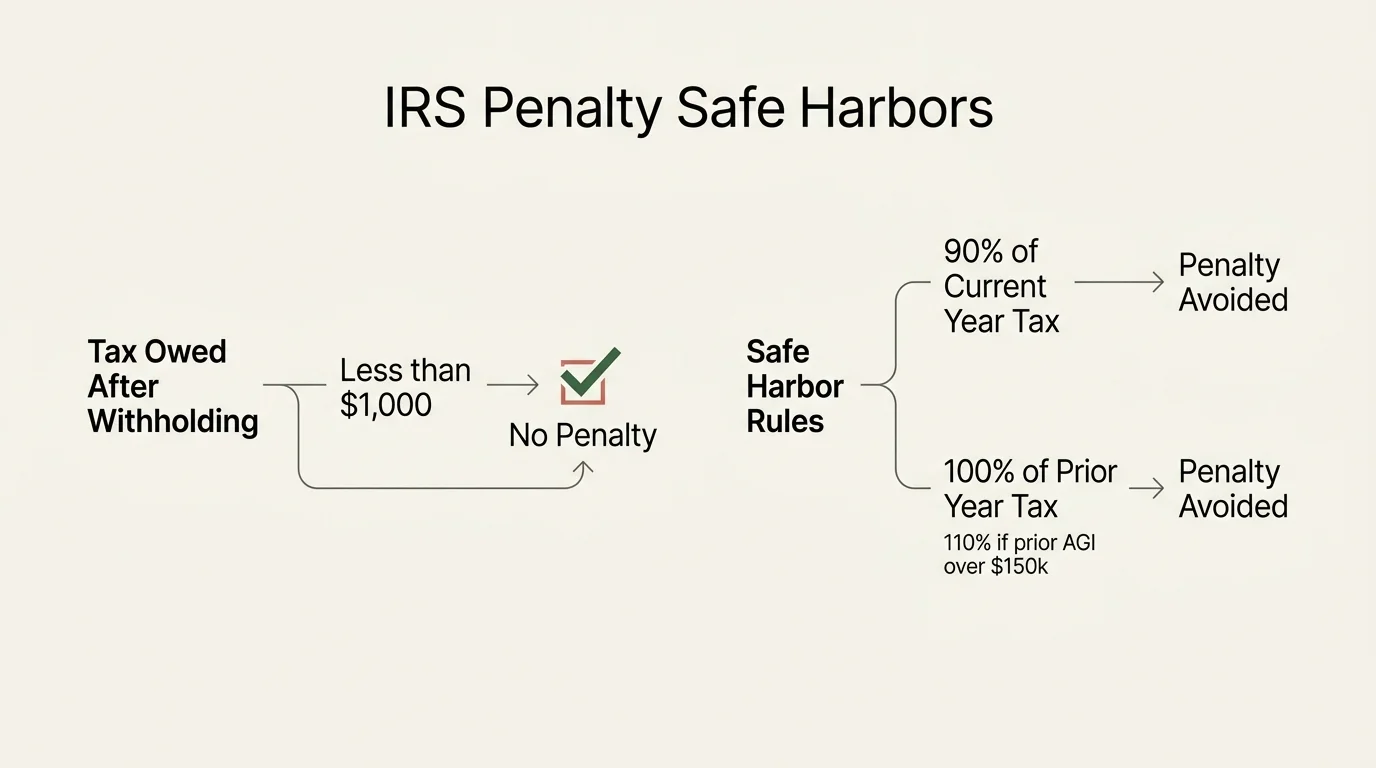
The IRS imposes an underpayment penalty when you fail to pay enough tax through withholding or quarterly estimated tax payments. To avoid this penalty, your total tax payments must meet specific legal standards known as Safe Harbor rules. You must understand two essential financial thresholds:
- The $1,000 Threshold: The IRS will not charge an underpayment penalty if the total tax you owe after subtracting withholdings and refundable credits is under $1,000.
- The Safe Harbor Rules: You can avoid a penalty regardless of your final balance if you pay at least 90% of your current year’s total tax liability, or 100% of your prior year’s tax liability (whichever amount is smaller).
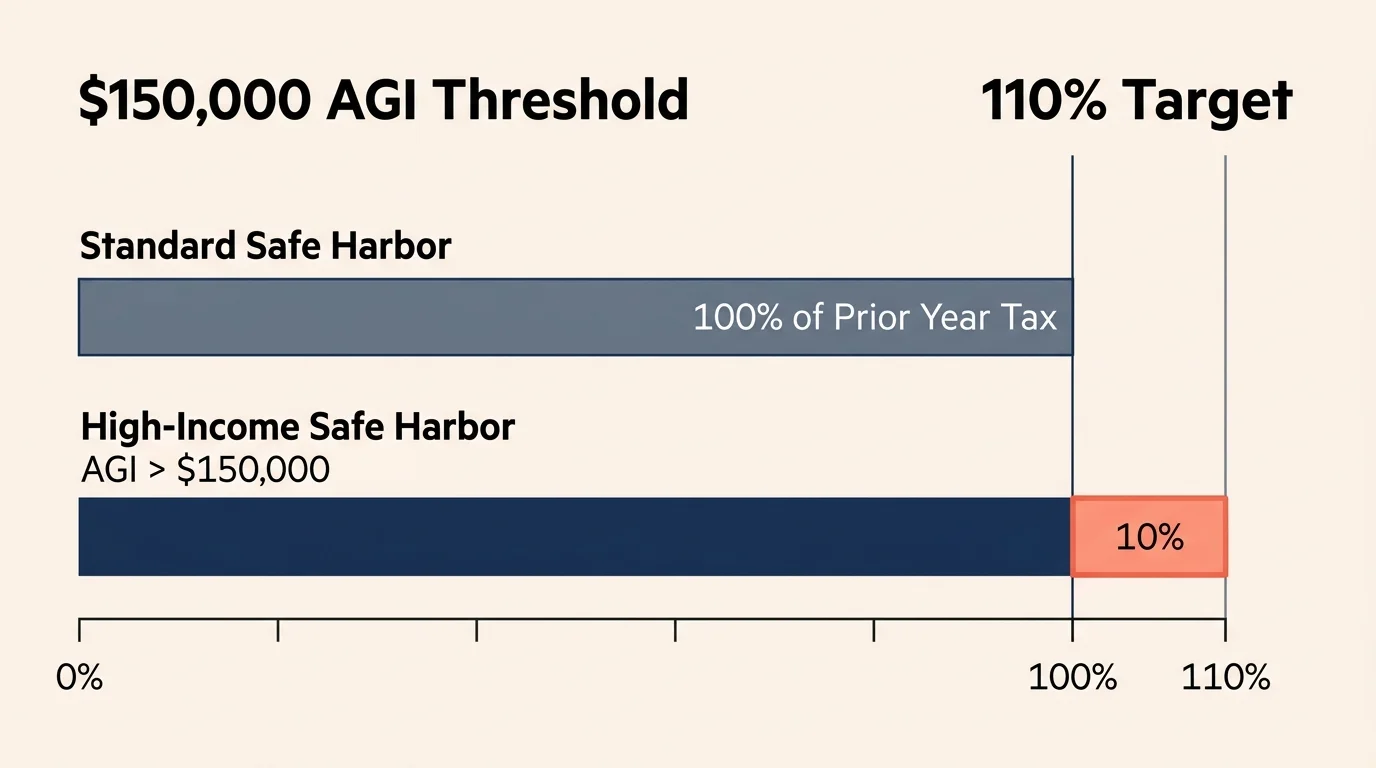
High-income retirees face a slightly stricter requirement. If your prior year’s Adjusted Gross Income (AGI) exceeded $150,000 (or $75,000 if you are married filing separately), your safe harbor threshold increases to 110% of your prior year’s tax liability. Failing to meet these specific targets exposes your retirement fund to unnecessary IRS penalty fees calculated using daily compounded interest rates.
| Safe Harbor Category | Requirement to Avoid Penalty | Who It Applies To |
|---|---|---|
| Current Year Threshold | Pay at least 90% of current year tax liability | All taxpayers |
| Standard Prior Year Threshold | Pay at least 100% of prior year tax liability | Taxpayers with prior year AGI of $150,000 or less |
| High-Income Prior Year Threshold | Pay at least 110% of prior year tax liability | Taxpayers with prior year AGI over $150,000 |
| Minimum Debt Threshold | Owe less than $1,000 at tax filing time | All taxpayers |
2. Sign 1: Your Retirement Income Streams Lack Automatic Tax Withholding
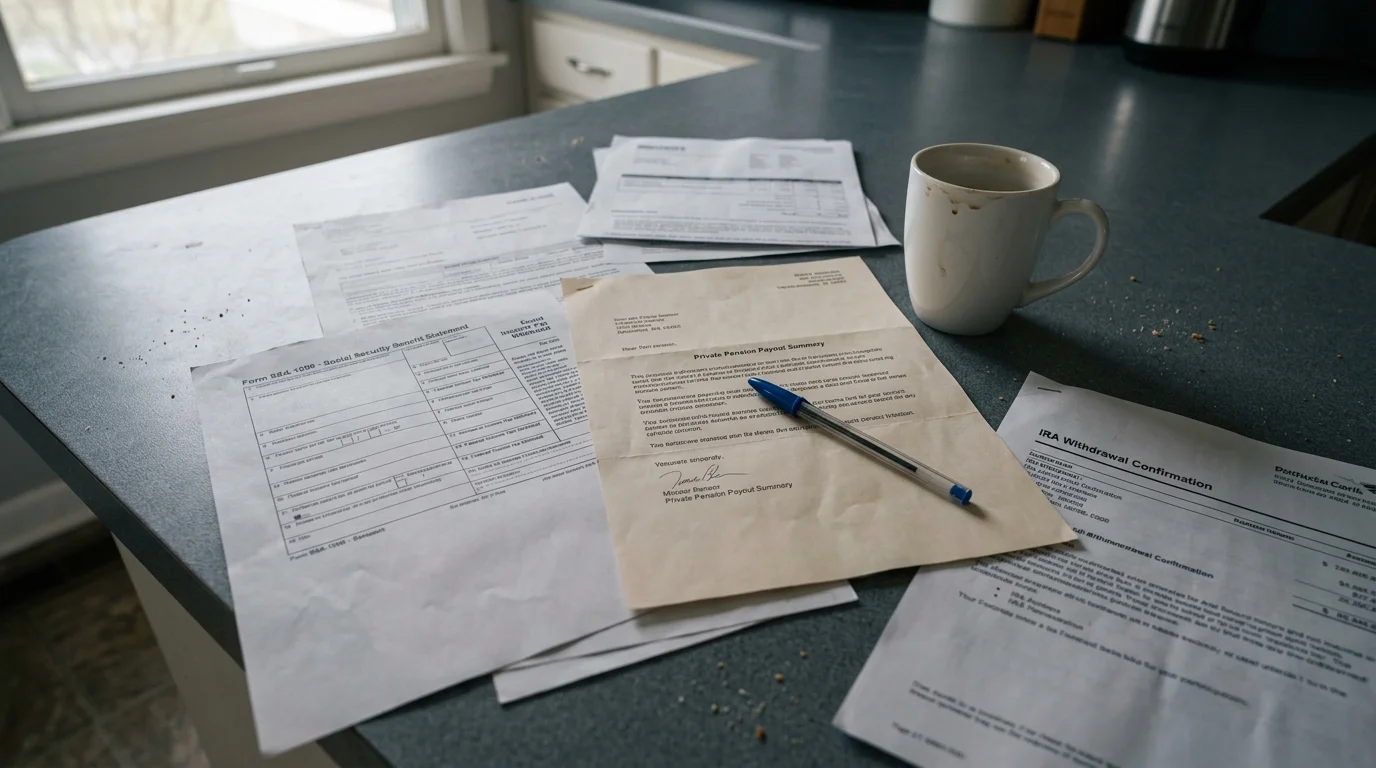
One of the primary signs of tax penalty risk occurs when you transition to retirement without actively requesting tax withholding on your new income streams. While employers automatically deduct taxes from traditional paychecks, government benefits and private pension providers do not withhold federal income tax unless you specifically instruct them to do so.
According to the Social Security Administration (SSA), up to 85% of your Social Security benefits may become taxable if your combined income exceeds specific threshold limits. However, the SSA does not automatically withhold federal taxes from your monthly benefit checks. If you collect Social Security while receiving a pension or drawing money from investments without setting up voluntary withholding, you create an immediate tax gap that can trigger underpaid taxes penalty warning signs.
To resolve this gap on Social Security income, you must submit IRS Form W-4V (Voluntary Withholding Request) to your local Social Security office. The IRS allows you to select specific flat withholding rates: 7%, 10%, 12%, or 22%. Choosing an appropriate withholding rate ensures that your taxes are paid gradually across all twelve months, safeguarding you against unexpected tax bills when filing season arrives.
3. Sign 2: You Realized Unexpected Capital Gains or Investment Surprises
Investment activities often generate taxable income without generating immediate cash flow to cover the associated tax bill. If you sold real estate, rebalanced a taxable investment portfolio, or received substantial mutual fund capital gain distributions late in the year, you may have unknowingly stepped into an IRS tax underpayment penalty trigger.
Retirees often experience capital gain surprises in three primary scenarios:
- Downsizing Your Home: Selling a primary residence or vacation home can yield significant capital gains. While primary residences offer gain exclusions ($250,000 for single filers, $500,000 for married couples), profits exceeding these limits are taxable immediately.
- Mutual Fund Capital Gain Distributions: Mutual funds often pass internal capital gains along to shareholders in December. Even if you automatically reinvest those gains back into the fund, the IRS considers them taxable income for that calendar year.
- Portfolio Rebalancing: Liquidating appreciated stocks or bonds to lower your risk profile triggers capital gains taxes in the quarter the trade settled.
If you realize a major capital gain during the calendar year, you cannot wait until April 15 of the following year to settle the tax bill. The IRS expects you to make an estimated tax payment in the tax quarter when the gain occurred. Ignoring mid-year capital gains is one of the most common signs you owe a tax underpayment penalty.

4. Sign 3: You Took RMDs at the 10% Default Withholding Rate
When you reach your required beginning age for Required Minimum Distributions (RMDs)—currently age 73 for most seniors—you must withdraw specified minimum balances from your tax-deferred IRAs and 401(k) accounts annually. Financial custodians automatically present you with tax withholding options when you request these distributions.
The IRS requires brokerage firms to apply a default federal income tax withholding rate of 10% on nonperiodic distributions and RMDs. You must complete IRS Form W-4R if you wish to adjust or waive this default amount. For many seniors, a 10% withholding rate falls far below their actual federal marginal tax bracket, which may easily sit at 12%, 22%, or 24% depending on total household retirement income.
Consider a practical example: If you withdraw an RMD of $50,000 and stick with the default 10% withholding, your custodian sends $5,000 to the IRS. However, if your overall income places you in the 22% tax bracket, your actual federal tax burden on that distribution is $11,000. That single transaction creates a $6,000 tax deficit. Unless you compensate for this difference through other withholdings or estimated quarterly payments, you face a direct risk of underpayment penalties.
5. Sign 4: You Missed Quarterly Estimated Tax Deadlines
If your retirement income lacks sufficient automated withholding, the IRS mandates that you submit quarterly estimated tax payments using Form 1040-ES. Missing these rigid calendar deadlines represents one of the clearest signs of tax penalty risk, even if you pay your total tax bill in full by the April deadline.
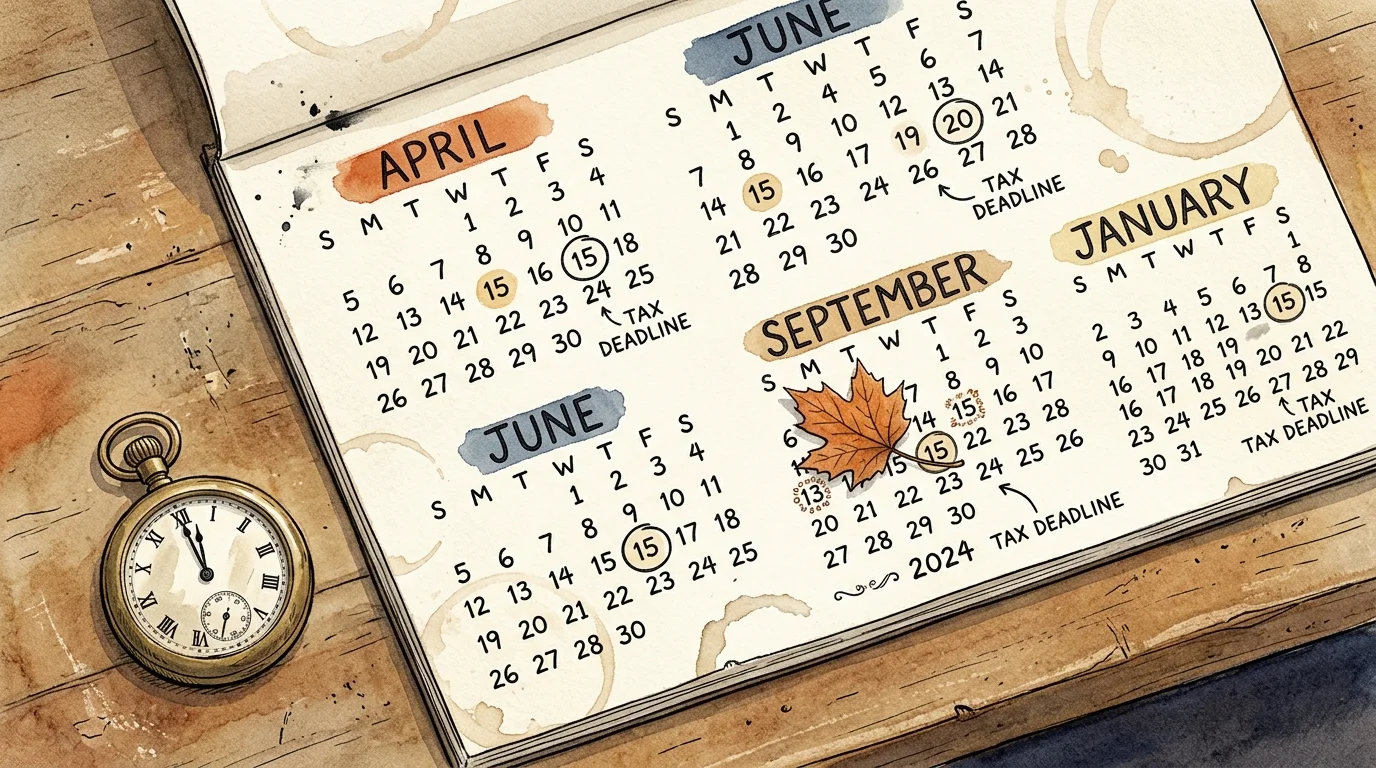
The IRS structures the tax year into four distinct payment quarters, each with its own strict due date:
- First Quarter (January 1 – March 31): Due April 15
- Second Quarter (April 1 – May 31): Due June 15
- Third Quarter (June 1 – August 31): Due September 15
- Fourth Quarter (September 1 – December 31): Due January 15 of the following year
A common misconception among retirees is that paying the full annual tax liability before April 15 satisfies all IRS obligations. However, because taxes are due as income is earned, underpaying in the first quarter creates an immediate penalty that accrues daily interest, even if you overpay in the fourth quarter. Federal underpayment interest rates are set quarterly; for individual taxpayers, these rates have ranged between 6% and 7%, compounded daily on unpaid balances. Timely quarterly payments are essential for avoiding tax underpayment penalties.
6. Sign 5: Your Prior Year AGI Exceeded $150,000 Without Increasing Withholding
A sudden rise in your prior year’s Adjusted Gross Income (AGI) can inadvertently render your current withholding strategy insufficient. If your prior year’s AGI was over $150,000 as a joint filing couple or $75,000 as a married individual filing separately, the basic 100% Safe Harbor rule no longer protects you.
To qualify for Safe Harbor protection under high-income rules, you must pay at least 110% of your prior year’s total tax bill through your current year payments. Retirees often miss this threshold when transitioning into higher income brackets due to one-time financial events, such as:
- Converting a traditional IRA into a Roth IRA (Roth conversions count as taxable income).
- Receiving a lump-sum payout from a deferred executive compensation plan or pension cash-out.
- Selling an investment property or a business asset.
If your AGI exceeded $150,000 in the previous tax year and you maintained the exact same withholding amounts without accounting for the 110% rule, you are at risk. Recalculating your tax strategy annually helps ensure your withholding matches your updated income status.

7. Sign 6: Life Changes Altered Your Filing Status or Standard Deduction
Major personal life events significantly impact your federal tax liability. A change in filing status or standard deduction rules often increases your taxable income overnight, leaving previously adequate tax withholding levels completely inadequate.
Research from the Consumer Financial Protection Bureau (CFPB) highlights how unexpected life changes in retirement can disrupt long-term financial plans. One of the most painful tax disruptions occurs when a spouse passes away. In the year following a spouse’s death, the surviving partner must shift filing status from Married Filing Jointly to Single. This transition—often referred to as the “widow’s penalty”—compresses tax brackets and significantly lowers the standard deduction while income streams like pension payouts or investment dividends often remain largely unchanged.
Additionally, losing eligible itemized deductions, such as declining medical expense deductions or hitting the federal cap on state and local tax (SALT) deductions, pushes more of your income into taxable territory. If you experienced a major life event or loss in the past year without adjusting your tax withholdings upward, you should review your tax liability immediately to prevent an underpayment penalty.
8. Sign 7: You Received an IRS Notice CP14 or Form 2210 Warning
The most unambiguous sign that you underpaid your taxes is direct notification from the IRS or your tax preparation software. When preparing your return, tax software automatically runs calculations on IRS Form 2210 (Underpayment of Estimated Tax by Individuals, Estates, and Trusts).
If your tax software generates Form 2210 or flags an underpayment penalty warning during tax filing, you have officially missed the Safe Harbor thresholds. The software will calculate a penalty fee based on how much you underpaid and how many days each payment was late.
If you fail to include the penalty payment with your filed tax return, the IRS will send an official notice in the mail—most commonly Notice CP14. IRS Notice CP14 serves as the initial official demand for unpaid taxes and assessed penalties. Receiving a Notice CP14 requires prompt attention; ignoring official IRS correspondence leads to additional late-payment interest charges and potential collection actions against your retirement funds.

9. How to Fix Underpayment and Qualify for IRS Waivers
If you discover that you have underpaid your taxes, you can take immediate action to minimize fees or request an official penalty waiver from the IRS. Older adults possess unique options under federal tax laws that can reduce or eliminate assessed penalties entirely.
According to tax guidance from AARP, many retirees needlessly pay underpayment penalties because they are unaware of specific IRS waiver provisions designed for newly retired individuals. Under IRS regulations, the IRS may waive the underpayment penalty if you meet all of the following criteria:
- You retired after reaching age 62, or became disabled, during the tax year in question or the preceding tax year.
- You had a reasonable cause for the underpayment rather than demonstrating willful neglect.
- You can show that the underpayment was caused by a major life transition, such as unexpected health challenges or adapting to complex retirement distribution rules.
To request this relief, file IRS Form 2210 along with your tax return, check the waiver box in Part II, and attach a detailed statement explaining your retirement timing and reasonable cause. Additionally, if your income fluctuated heavily throughout the year—such as receiving a large distribution in December—you can fill out the Annualized Income Installment Method on Form 2210. This method recalculates your tax obligations based on when you actually earned the money, often eliminating penalties assessed for earlier quarters.
To prevent future penalties, take these proactive correction steps immediately:
- Increase IRA Withholding: Tax withholding from retirement distributions is treated by the IRS as if it were paid evenly throughout the entire year, regardless of when the withdrawal occurs. Taking an extra IRA distribution in December with 100% designated for tax withholding can instantly cure underpayments from earlier quarters.
- File Form W-4V: Instruct the Social Security Administration to withhold 7%, 10%, 12%, or 22% from your monthly checks.
- Submit Form W-4R: Update your IRA and pension custodians to increase withholding above the default 10% level.
- Utilize Electronic Payments: Set up an online account with the IRS Electronic Federal Tax Payment System (EFTPS) to schedule precise, automated quarterly estimated payments.
Frequently Asked Questions
What is the minimum tax underpayment amount that triggers an IRS penalty?
The IRS does not charge an underpayment penalty if your total tax balance due is less than $1,000 after subtracting all withholdings and refundable credits. Additionally, you avoid penalties if your total payments equal at least 90% of your current year tax liability or 100% of your previous year tax liability (110% if your prior year AGI was over $150,000).
Can I get an IRS underpayment penalty waived if I recently retired?
Yes. The IRS offers a specific waiver exception under Form 2210 rules if you retired after reaching age 62 (or became disabled) during the current or preceding tax year. You must demonstrate that your underpayment occurred due to reasonable cause rather than deliberate neglect, such as adjusting to new income rules or coping with unexpected medical events.
How does withholding from IRA distributions differ from quarterly estimated payments?
Quarterly estimated tax payments must be submitted on specific quarterly deadlines to avoid penalties for that specific period. In contrast, taxes withheld from IRA distributions or pensions are treated by the IRS as if they were paid equally across all four quarters of the year, regardless of when the distribution actually took place. This makes late-year IRA withholding a powerful tool for fixing early-year underpayments.
What form do I use to withhold federal income tax from Social Security benefits?
You must complete IRS Form W-4V (Voluntary Withholding Request) and submit it directly to the Social Security Administration. You can choose to have 7%, 10%, 12%, or 22% of your monthly benefit checks withheld for federal income taxes.
What is the default tax withholding rate on Required Minimum Distributions (RMDs)?
The standard default federal tax withholding rate for RMDs and nonperiodic retirement plan distributions is 10%. Because many retirees fall into higher marginal tax brackets (such as 12%, 22%, or 24%), relying solely on the 10% default rate often results in tax underpayment. You can adjust this rate by filing Form W-4R with your financial account custodian.
For additional senior resources, visit
Benefits.gov,
National Institute on Aging (NIA),
Centers for Disease Control and Prevention (CDC) and
Medicare.gov.
Disclaimer: The information in this article is for educational purposes only and is not intended to be a substitute for professional financial, legal, or medical advice. Always consult with a qualified expert for advice tailored to your personal situation.









Leave a Reply